|
I love driving around Iowa. In the past few weeks, I’ve seen much of the western half of the state. The world desperately needs what we’re growing in Iowa. And the good news is we’ve got some beautiful crops growing on our Iowa farms. We’re making a strong hay crop and pastures are green in most parts of the state. Granted we have some pockets of severe weather damage, some replanted crops, and some serious drought issues in northwest Iowa. We had some challenges getting the crops planted. High Pathogenic Avian Influenza returned to Iowa with a vengeance this spring, however, summer weather has been helpful in stopping the spread. Right now, we have the potential to deliver a great bounty of crops and livestock products as demand for what we grow increases across local and global markets.
Ag leaders in our county offices are busy recording these crops. Please remember to get into your county office to do your crop reporting. Try to make an appointment to help our staff manage their schedules. Farmers have until July 15 to get that done.
When you stop in, you may see some new faces as we fill positions around the state. I appreciate that Secretary Vilsack and the Biden-Harris Administration have been working with us to staff up our county offices to deliver FSA programs and service to Iowa farmers.
I’m also looking forward to pulling county committees together for a day of training this summer. These elected agricultural leaders do important work in our counties hiring and managing our County Executive Directors and helping to implement our programs. I’m excited to get to spend a day with county committee members and to hear about what’s happening on their farms.
Every day, whether I’m working on our family’s farm or working at Iowa FSA, I’m reminded how blessed we are to be growing crops and raising livestock in this beautiful land between two great rivers. - Matt
The U.S. Department of Agriculture’s (USDA) Agricultural Marketing Service (AMS) today announced it has signed a cooperative agreement with Iowa under the Local Food Purchase Assistance Cooperative Agreement Program (LFPA). LFPA funding will enable the Iowa Department of Agriculture and Land Stewardship (IDALS) to purchase and distribute Iowa grown and produced food to underserved communities.
IDALS will utilize LFPA funding to create a sustainable program that increases access to local food and improves supply chain resiliency through partnerships with local underserved producers and underserved communities. It is expected that at least 300 farmers and ranchers will benefit from the program. IDALS will establish a tiered equitable purchasing standard. Focus will be placed on underserved producers, such as farmers of color, women farmers, refugee and immigrant farmers, LGBTQ farmers, and Veteran farmers.
The program will create 2,000 distribution sites with food banks, food hub distribution partners, and the Meskwaki Nation. Additionally, the Food Hub Managers Working group’s eight food hubs will purchase, aggregate, distribute and market products from local producers across the state of Iowa. In total, IDALS plans to purchase and distribute $1.8 million of locally grown foods to underserved communities.
The LFPA program is authorized by the American Rescue Plan to maintain and improve food and agricultural supply chain resiliency. Through this program, USDA will award up to $400 million through non-competitive cooperative agreements with state and tribal governments to support local, regional, and underserved producers through the purchase of food produced within the state or within 400 miles of delivery destination.
AMS looks forward to continuing to sign agreements under this innovative program that allows state and tribal governments to procure and distribute local and regional foods and beverages that are healthy, nutritious, and unique to their geographic area.
More information about the program is available on AMS’s Local Food Purchase Assistance Cooperative Agreement Program webpage.
Agricultural producers in Iowa who have not yet completed their crop acreage reports after planting should make an appointment with their U.S. Department of Agriculture (USDA) Farm Service Agency (FSA) service center before the July 15 deadline.
An acreage report documents a crop grown on a farm or ranch and its intended uses. Filing an accurate and timely acreage report for all crops and land uses, including failed acreage and prevented planted acreage, can prevent the loss of benefits.
How to File a Report
The following acreage reporting dates are applicable in Iowa:
July 15, 2022 All crops including perennial Forages
December 15, 2022 Fall-Seeded Small Grains
To file a crop acreage report, producers need to provide:
- Crop and crop type or variety.
- Intended use of the crop.
- Number of acres of the crop.
- Map with approximate boundaries for the crop.
- Planting date(s).
- Planting pattern, when applicable.
- Producer shares.
- Irrigation practice(s).
- Acreage prevented from planting, when applicable.
- Other information as required.
Acreage Reporting Details
The following exceptions apply to acreage reporting dates:
- If the crop has not been planted by the acreage reporting date, then the acreage must be reported no later than 15 calendar days after planting is completed.
- If a producer acquires additional acreage after the acreage reporting date, then the acreage must be reported no later than 30 calendar days after purchase or acquiring the lease. Appropriate documentation must be provided to the county office.
- If crops are covered by the Noninsured Crop Disaster Assistance Program, acreage reports should be submitted by the applicable state, county, or crop-specific reporting deadline or 15 calendar days before grazing or harvesting of the crop begins.
Producers should also report crop acreage they intended to plant, but due to natural disaster, were unable to because of a natural disaster.
Prevented planting acreage must be reported on form CCC-576, Notice of Loss, no later than 15 calendar days after the final planting date as established by FSA and USDA’s Risk Management Agency.
FSA offers continuous certification for perennial forage. This means after perennial forage is reported once and the producer elects continuous certification, the certification remains in effect until a change is made. Check with FSA at the local USDA Service Center for more information on continuous certification.
New Option to View, Print and Label Maps on Farmers.gov
Producers with an eAuth account linked to their USDA customer record can now access their FSA farm records, maps and common land units by logging into farmers.gov. A new feature will allow producers to export field boundaries as shapefiles and import and view other shapefiles, such as precision agriculture boundaries. This will allow producers to view, print and label their own maps for acreage reporting purposes.
Producers who have authority to act on behalf of another customer as a grantee via form FSA-211 Power of Attorney, Business Partner Signature Authority, along with other signature types, or as a member of a business can now access information in the farmers.gov portal.
Producers can learn how to use the farmers.gov Farm Records Mapping functionality with this fact sheet and these video tutorials.
More Information
Producers can make an appointment to report acres by contacting their local USDA Service Center.
Agriculture Secretary Tom Vilsack announced that the U.S. Department of Agriculture (USDA) plans to provide up to $200 million in assistance for specialty crop producers who incur eligible on-farm food safety program expenses to obtain or renew a food safety certification in calendar years 2022 or 2023. USDA’s new Food Safety Certification for Specialty Crops (FSCSC) program will help to offset costs for specialty crop producers to comply with regulatory requirements and market-driven food safety certification requirements, which is part of USDA’s broader effort to transform the food system to create a more level playing field for small and medium producers and a more balanced, equitable economy for everyone working in food and agriculture.
Specialty crop operations can apply for assistance for eligible expenses related to a 2022 food safety certificate issued on or after June 21, 2022, beginning June 27, 2022. USDA is delivering FSCSC to provide critical assistance for specialty crop operations, with an emphasis on equity in program delivery while building on lessons learned from the COVID-19 pandemic and supply chain disruptions. Vilsack made the announcement from Hollis, N.H., where he toured a local, family-owned farm and highlighted USDA’s efforts to help reduce costs for farmers and support local economies by providing significant funding to cut regulatory costs and increase market opportunities for farmers in New Hampshire and across the nation.
Program Details
FSCSC will assist specialty crop operations that incurred eligible on-farm food safety certification and related expenses related to obtaining or renewing a food safety certification in calendar years 2022 and 2023. For each year, FSCSC covers a percentage of the specialty crop operation’s cost of obtaining or renewing their certification, as well as a portion of their related expenses.
To be eligible for FSCSC, the applicant must be a specialty crop operation; meet the definition of a small business or very small business; and have paid eligible expenses related to the 2022 (issued on or after June 21, 2022) or 2023 certification.
Specialty crop operations may receive assistance for the following costs:
- Developing a food safety plan for first-time food safety certification.
- Maintaining or updating an existing food safety plan.
- Food safety certification.
- Certification upload fees.
- Microbiological testing for products, soil amendments and water.
- Training
FSCSC payments are calculated separately for each category of eligible costs. A higher payment rate has been set for socially disadvantaged, limited resource, beginning and veteran farmers and ranchers. Details about the payment rates and limitations can be found at farmers.gov/food-safety.
Applying for Assistance
The FSCSC application period for 2022 is June 27, 2022, through January 31, 2023, and the application period for 2023 will be announced at a later date. FSA will issue payments at the time of application approval for 2022 and after the application period ends for 2023. If calculated payments exceed the amount of available funding, payments will be prorated.
Interested specialty crop producers can apply by completing the FSA-888, Food Safety Certification for Specialty Crops Program (FSCSC) application. The application, along with other required documents, can be submitted to the FSA office at any USDA Service Center nationwide by mail, fax, hand delivery or via electronic means. Producers can visit farmers.gov/service-locator to find their local FSA office. Specialty crop producers can also call 877-508-8364 to speak directly with a USDA employee ready to assist.
Producers can visit farmers.gov/food-safety for additional program details, eligibility information and forms needed to apply.
Farmers and ranchers can use the Farm Loan Discovery Tool on farmers.gov to find information on USDA farm loans that may best fit their operations.
USDA’s Farm Service Agency (FSA) offers a variety of loan options to help farmers finance their operations. From buying land to financing the purchase of equipment, FSA loans can help.
USDA conducted field research in eight states, gathering input from farmers and FSA farm loan staff to better understand their needs and challenges.
How the Tool Works
Farmers who are looking for financing options to operate a farm or buy land can answer a few simple questions about what they are looking to fund and how much money they need to borrow. After submitting their answers, farmers will receive information on farm loans that best fit their specific needs. The loan application and additional resources also will be provided.
Farmers can download application quick guides that outline what to expect from preparing an application to receiving a loan decision. There are four guides that cover loans to individuals, entities, and youth, as well as information on microloans. The guides include general eligibility requirements and a list of required forms and documentation for each type of loan. These guides can help farmers prepare before their first USDA service center visit with a loan officer.
Farmers can access the Farm Loan Discovery Tool by visiting farmers.gov/fund and clicking the “Start” button. Follow the prompts and answer five simple questions to receive loan information that is applicable to your agricultural operation. The tool is built to run on any modern browser like Chrome, Edge, Firefox, or the Safari browser, and is fully functional on mobile devices. It does not work in Internet Explorer.
About Farmers.gov
In 2018, USDA unveiled farmers.gov, a dynamic, mobile-friendly public website combined with an authenticated portal where farmers will be able to apply for programs, process transactions, and manage accounts.
The Farm Loan Discovery Tool is one of many resources on farmers.gov to help connect farmers to information that can help their operations. Earlier this year, USDA launched the My Financial Information feature, which enables farmers to view their loan information, history, payments, and alerts by logging into the website.
USDA is building farmers.gov for farmers, by farmers. In addition to the interactive farm loan features, the site also offers a Disaster Assistance Discovery Tool. Farmers can visit farmers.gov/recover/disaster-assistance-tool#step-1 to find disaster assistance programs that can help their operation recover from natural disasters.
For more information, contact your local USDA Service Center or visit farmers.gov.
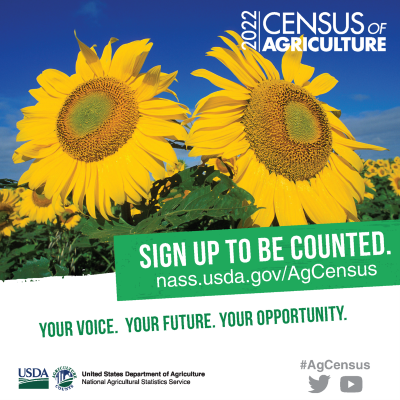
Sign up and be counted in the 2022 Ag Census! Agriculture producers who did not receive the 2017 Census of Agriculture and do not receive other USDA surveys or censuses have until June 30 to sign up to receive the 2022 Census of Agriculture at nass.usda.gov/AgCensus. This once-every-five-years data collection begins this November.
The Ag Census includes every American operation – large or small, urban or rural – from which $1,000 or more of agricultural products are produced and sold, or would normally be produced and sold, in the ag census year. This can include hobby farms with livestock, such as chickens or horses, or crops growing in the backyard or on a rooftop. The data inform policy and program decisions that directly impact producers, their operations, industries, and communities. A complete count, with every producer getting and taking the opportunity to be represented in these data, is vital.
On the NASS Ag Census webpage, producers can also access frequently asked questions, explore past and current Ag Census data, access tools to help spread the word about the upcoming Ag Census, learn about Ag Census special studies, and more.
Farm Service Agency (FSA) is committed to providing our farm loan borrowers the tools necessary to be successful. FSA staff will provide guidance and counsel from the loan application process through the borrower’s graduation to commercial credit. While it is FSA’s commitment to advise borrowers as they identify goals and evaluate progress, it is crucial for borrowers to communicate with their farm loan staff when changes occur. It is the borrower’s responsibility to alert FSA to any of the following:
- Any proposed or significant changes in the farming operation
- Any significant changes to family income or expenses
- The development of problem situations
- Any losses or proposed significant changes in security
If a farm loan borrower can’t make payments to suppliers, other creditors, or FSA on time, contact your farm loan staff immediately to discuss loan servicing options.
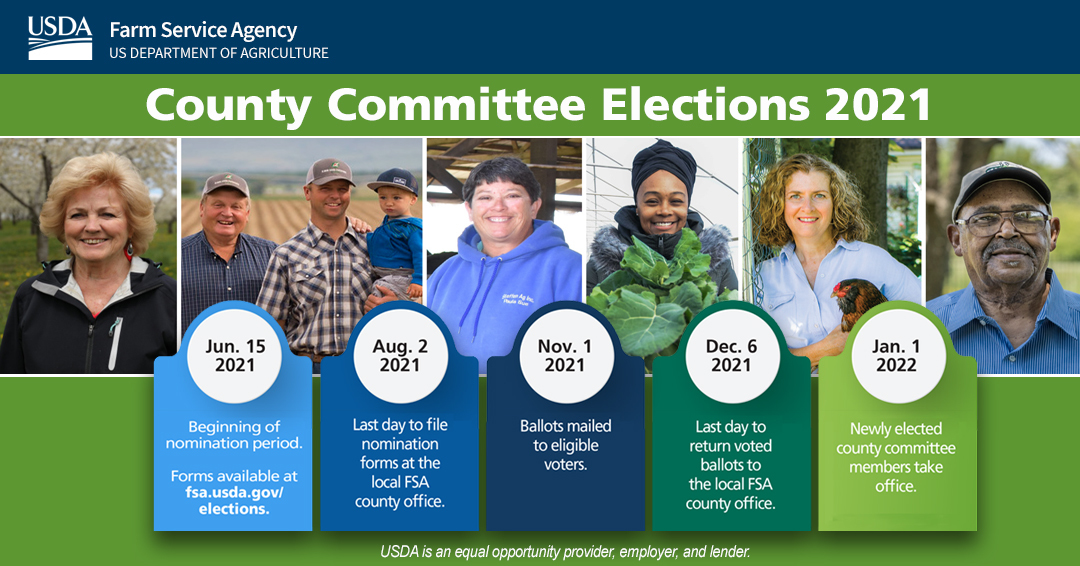 The U.S. Department of Agriculture (USDA) Farm Service Agency (FSA) is now accepting nominations for county committee members. Elections will occur in certain Local Administrative Areas (LAA) for members. LAAs are elective areas for FSA committees in a single county or multi-county jurisdiction. This may include LAAs that are focused on an urban or suburban area.
County committee members make important decisions about how Federal farm programs are administered locally. All nomination forms for the 2022 election must be postmarked or received in the local FSA office by Aug. 1, 2022.
Agricultural producers who participate or cooperate in a USDA program and reside in the LAA that is up for election this year, may be nominated for candidacy for the county committee. A cooperating producer is someone who has provided information about their farming or ranching operation to FSA, even if they have not applied or received program benefits. Individuals may nominate themselves or others and qualifying organizations may also nominate candidates. USDA encourages minority producers, women, and beginning farmers or ranchers to nominate, vote and hold office.
Nationwide, more than 7,700 dedicated members of the agricultural community serve on FSA county committees. The committees are made up of three to 11 members who serve three-year terms. Producers serving on FSA county committees play a critical role in the day-to-day operations of the agency. Committee members are vital to how FSA carries out disaster programs, as well as conservation, commodity and price support programs, county office employment and other agricultural issues.
More Information
Producers should contact their local FSA office today to register and find out how to get involved in their county’s election, including if their LAA is up for election this year. To be considered, a producer must be registered and sign an FSA-669A nomination form. Urban farmers should use an FSA-669-A-3 for urban county committees. The form and other information about FSA county committee elections are available at fsa.usda.gov/elections.
|
June 25, 2022
|
Practical Farmers of Iowa Field Day - Connecting Agriculture and Conservation - Radcliffe, IA. More Information
|
|
July 6, 2022
|
Iowa State University Extension and Outreach and Iowa Learning Farms
Soil Health & Grazing Field Days - Traer, IA. More information
|
|
July 18, 2022
|
Iowa Organic Association - Field Day - To Till or Not to Till? Building Soil Organically - Keota, IA. More information.
|
|
July 27, 2022
|
Iowa Learning Farms - Prairie Strips Field Day - Zwingle, IA. More information.
|
|