In This Issue:
Traffic is picking up at county Farm Service Agency offices across the state as folks park their planters and come in to work with us to complete their 2022 crop acreage certification. The deadline for certification of spring crop, perennial forage (pastures) and Conservation Reserve Program (CRP) acres is July 15. Please remember we also need to know of failed crops prior to disposition. If you have not yet communicated with your county FSA office on this subject, please do so immediately.
If you are a livestock producer who is trying to manage your herd through drought, excessive heat and other extreme weather conditions, please familiarize yourself with the Farm Service Agency programs that can assist you and then contact your county FSA office for additional information. Programs such as the Livestock Forage Disaster Program (LFP) and the Emergency Assistance for Livestock, Honeybees and Farm-raised Fish Program (ELAP) trigger with the U.S. Drought Monitor. The Livestock Indemnity Program (LIP) provides financial assistance for livestock lost above normal mortality rates due to extreme weather conditions. The Conservation Reserve Program emergency haying and grazing provisions can provide much-needed forage.
Was your operation impacted by natural disaster to crops in 2020 and/or 2021 to the point of receiving insurance indemnification? If so, you may be eligible for financial assistance through the Emergency Relief Program (ERP). Impacted producers already should have received a pre-filled application for this program from FSA, however producers still will need to work with their county FSA office to ensure all paperwork is complete to receive this assistance. The deadline to complete this process is July 22, 2022. Producers who did not receive a pre-filled application, but believe they may be eligible, should contact their county FSA office for more information. Read below for additional information.
It’s the start of the FSA County Committee election season, with nominations for local county committee representatives now being accepted through Aug. 1. County Committees play an important role in your local agriculture community because they are made up of farmers and ranchers, elected by farmers and ranchers. County Committees provide a local voice on FSA programming and county office operations. Want to learn more? Read below and then stop in and visit with your County Executive Director.
That’s all for June. Enjoy the longer days.
--John Berge
The U.S. Department of Agriculture (USDA) Farm Service Agency (FSA) encourages all farmers, ranchers and FSA program participants to take part in their County FSA Committee election nomination process.
FSA’s county committees are a critical component of FSA and allow grassroots input and local administration of federal farm programs. Committees are comprised of locally elected agricultural producers responsible for the fair and equitable administration of FSA farm programs in their counties. Committee members are accountable to the Secretary of Agriculture. The candidate nomination period is now open and runs through Aug. 1, 2022.
Each FSA County Office has a county committee comprised of three to 11 members, each from a local administrative area (LAA). Each member serves a three-year term. One-third of the seats on the committee is open for election each year.
To be eligible for nomination and hold office as a committee member or alternate, a person must fulfill each of the following requirements: (1) be a producer with an interest in farming or ranching operations, (2) participate or cooperate in any FSA program provided for by law, (3) be a U.S. citizen, (4) be of legal voting age, (5) meet the basic eligibility requirements, and (6) reside in the county or multi-county jurisdiction in which they will be serving.
County committees may have an appointed adviser to further represent the local interests of underserved farmers and ranchers. Underserved producers are beginning, women and other minority farmers and ranchers and landowners, and/or operators who have limited resources.
All nomination forms for the 2022 election must be postmarked or received in the local USDA service center by Aug. 1, 2022. For more information on FSA county committee elections and appointments, refer to the FSA fact sheet: Eligibility to Vote and Hold Office as a COC Member available online at: fsa.usda.gov/elections.
FSA recently mailed 303,000 pre-filled applications to producers across the nation for the Emergency Relief Program (ERP), a new program designed to help agricultural producers impacted by wildfires, droughts, hurricanes, winter storms, and other qualifying natural disasters experienced during calendar years 2020 and 2021.
This Phase 1 of ERP uses existing Federal Crop Insurance or Noninsured Crop Disaster Assistance Program (NAP) data as the basis for calculating initial payments.
To apply for ERP Phase 1, here’s what you need to do:
- Check Your Mailbox
The form being mailed to you includes eligibility requirements, outlines the application process, and provides estimated ERP payment calculations. Producers will receive a separate application form for each program year in which an eligible loss occurred. Receipt of a pre-filled application is not confirmation that a producer is eligible to receive an ERP phase one payment. This application takes about 0.176 hours (that’s less than 15 minutes) for producers to complete, compared to the former Wildfire and Hurricane Indemnity Program – Plus application which took several hours for producers to complete and even longer for FSA staff.
The deadline to return completed ERP applications to FSA is Friday, July 22, 2022. If you have NAP coverage, you will receive pre-filled ERP applications later this summer. Details on ERP Phase 2 will be forthcoming as well.
- Check Your Eligibility
ERP covers losses to crops, trees, bushes, and vines due to a qualifying natural disaster event in calendar years 2020 and 2021. Eligible crops include all crops for which crop insurance or NAP coverage was available, except for crops intended for grazing. Qualifying natural disaster events include wildfires, hurricanes, floods, derechos, excessive heat, winter storms, freeze (including a polar vortex), smoke exposure, excessive moisture, qualifying drought*, and related conditions.
*Lists of 2020 and 2021 drought counties eligible for ERP are available online.
- Check Required Forms on File with FSA
Producers must have the following forms on file with FSA:
- Form AD-2047, Customer Data Worksheet.
- Form CCC-902, Farm Operating Plan for an individual or legal entity.
- Form CCC-901, Member Information for Legal Entities(if applicable).
- Form FSA-510, Request for an Exception to the $125,000 Payment Limitation for Certain Programs(if applicable).
- A highly erodible land conservation (sometimes referred to as HELC) and wetland conservation certification (Form AD-1026 Highly Erodible Land Conservation (HELC) and Wetland Conservation (WC) Certification) for the ERP producer and applicable affiliates.
If you have previously participated in FSA programs, you will likely have these required forms on file. However, if you’re uncertain or want to confirm the status of your forms, contact your local FSA county office.
- Check Historically Underserved Status with FSA, If Applicable
The ERP payment percentage for historically underserved producers, including beginning, limited resource, socially disadvantaged, and veteran farmers, and ranchers will be increased by 15% of the calculated ERP payment.
To qualify for the higher payment percentage, eligible producers must have Form CCC-860, Socially Disadvantaged, Limited Resource, Beginning and Veteran Farmer or Rancher Certification on file with FSA.
- Check Your Future Insurance Coverage
All producers who receive ERP phase one payments are statutorily required to purchase crop insurance, or NAP coverage where crop insurance is not available, for the next two available crop years, as determined by the Secretary.
Coverage requirements will be determined from the date a producer receives an ERP payment and may vary depending on the timing and availability of crop insurance or NAP for a producer’s particular crops. The final crop year to purchase crop insurance or NAP coverage to meet the second year of coverage for this requirement is the 2026 crop year.
- Check Your Bank
Once the completed ERP application for payment is submitted to and signed by FSA, producers who have direct deposit should look for payment within three business days.
More Information
We have additional resources, including:
In addition to ERP, FSA is also implementing the first phase of the new Emergency Livestock Relief Program. FSA has made more than $588 million in payments nationally to impacted livestock producers.
Producers with farmers.gov accounts can now access farm records and maps online, the latest self-service feature added to the U.S. Department of Agriculture (USDA) website.
You can quickly and easily access your land information in real time by desktop computer, tablet or phone. Capabilities include:
- View, print and export detailed farm records such as cropland, base acres, yields, CRP acres, land ownership details, and much more;
- View, print and export farm/tract maps that can be provided to lenders, chemical or fertilizer providers, and FSA for reporting acreage and crop insurance agents; and
- Export common land unit (field) boundaries as ESRI shapefiles.
The ability to access these records on demand without a visit to the service center saves you time and money. In addition, Farmers.gov also now includes the option for accessibility to include farmers and ranchers who are members of an entity, as well as people with a power of attorney form (FSA-211) on file with FSA.
Other online features also are available, such as the ability to view, upload, download and e-sign conservation documents or view farm loan and interest information (producers only).
To access your information, you will need a USDA eAuth account to login to farmers.gov. After obtaining an eAuth account, producers should visit farmers.gov and sign into the site’s authenticated portal via the Sign In/Sign Up link at the top right of the website. Google Chrome, Mozilla Firefox or Microsoft Edge are the recommended browsers to access the feature.
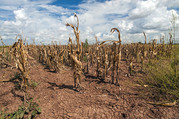
This is likely no surprise to you, but drought persists across the western U.S. and is intensifying in some areas. No geographic area is immune to the potential of drought at any given time. The U.S. Drought Monitor provides a weekly drought assessment, and it plays an important role in USDA programs that help farmers and ranchers recover from drought.
Fact #1 - Numerous agencies use the Drought Monitor to inform drought-related decisions.
The map identifies areas of drought and labels them by intensity on a weekly basis. It categorizes the entire country as being in one of six levels of drought. The first two, None and Abnormally Dry (D0), are not considered to be drought. The next four describe increasing levels of drought: Moderate (D1), Severe (D2), Extreme (D3) and Exceptional (D4).
While many entities consult the Drought Monitor for drought information, drought declarations are made by federal, state and local agencies that may or may not use the Drought Monitor to inform their decisions. Some of the ways USDA uses it to determine a producer’s eligibility for certain drought assistance programs, like the Livestock Forage Disaster Program and Emergency Haying or Grazing on Conservation Reserve Program acres and to “fast-track” Secretarial drought disaster designations.
Fact #2 - U.S. Drought Monitor is made with more than precipitation data.
When you think about drought, you probably think about water, or the lack of it. Precipitation plays a major role in the creation of the Drought Monitor, but the map’s author considers numerous indicators, including drought impacts and local insight from over 450 expert observers around the country. Authors use several dozen indicators to assess drought, including precipitation, streamflow, reservoir levels, temperature and evaporative demand, soil moisture and vegetation health. Because the drought monitor depicts both short and long‐term drought conditions, the authors must look at data for multiple timeframes. The final map produced each week represents a summary of the story being told by all the pieces of data. To help tell that story, authors don’t just look at data. They converse over the course of the map-making week with experts across the country and draw information about drought impacts from media reports and private citizens.
Fact #3 - A real person, using real data, updates the map.
Each week’s map author, not a computer, processes and analyzes data to update the drought monitor. The map authors are trained climatologists or meteorologists from the National Drought Mitigation Center at the University of Nebraska-Lincoln (the academic partner and website host of the Drought Monitor), the National Oceanic and Atmospheric Administration and USDA. The author’s job is to do what a computer can’t – use their expertise to reconcile the sometimes-conflicting stories told by each stream of data into a single assessment.
Fact #4 - The Drought Monitor provides a current snapshot, not a forecast.
The Drought Monitor is a “snapshot” of conditions observed during the most recent week and builds off the previous week’s map. The map is released on Thursdays and depicts conditions based on data for the week that ended the preceding Tuesday. Rain that falls on the Wednesday just before the USDM’s release won’t be reflected until the next map is published. This provides a consistent, week‐to‐week product and gives the author a window to assess the data and come up with a final map.
Fact #5 – Your input can be part of the drought-monitoring process.
State climatologists and other trained observers in the drought monitoring network relay on-the-ground information from numerous sources to the US Drought monitor author each week. That can include information that you contribute.
The Drought Monitor serves as a trigger for multiple forms of federal disaster relief for agricultural producers, and sometimes producers contact the author to suggest that drought conditions in their area are worse than what the latest drought monitor shows. When the author gets a call like that, it prompts them to look closely at all available data for that area, to see whether measurements of precipitation, temperature, soil moisture and other indicators corroborate producer-submitted reports. This is the process that authors follow whether they receive one report or one hundred reports, although reports from more points may help state officials and others know where to look for impacts.
There are multiple ways to contribute your observations:
-
Talk to your state climatologist - Find the current list at the American Association of State Climatologists website.
-
Email - Emails sent to droughtmonitor@unl.edu inform the USDM authors.
-
Become a CoCoRaHS observer - Submit drought reports along with daily precipitation observations to the Community Collaborative Rain, Hail & Snow Network.
-
Submit Condition Monitoring Observer Reports (CMOR) - go.unl.edu/CMOR.
For more information, read our Ask the Expert blog with a NDMC climatologist or visit farmers.gov/protection-recovery.
|
The Livestock Indemnity Program (LIP) provides financial benefits to producers who suffer livestock losses above normal mortality due to adverse weather, which can include extreme heat, tornadoes, hail and lightning.
Livestock producers who have experienced weather-related livestock losses are reminded that reporting and documenting those losses is an important part of the LIP application process. Producers must report losses within 30 days of when those livestock losses become apparent. A phone call to the county FSA office can serve as official notice of loss.
Adequate documentation must be provided that proves the death or injury of eligible livestock occurred as a direct result of an eligible loss condition in the calendar year for which benefits are being requested. Documentation also must provide sufficient data that identifies the quantity and the livestock kind/type and weight range. Documents providing acceptable evidence may include, but are not limited to, any or a combination of the following:
- contemporaneous producer records existing at the time of event - pictures with a date
- rendering truck receipts or certificates
- veterinary records
- records assembled for tax purposes
- private insurance documents
- bank or other loan documents
- brand inspection records
Livestock owners or contract growers who suffered livestock losses will file a notice of loss and an application for payment at the USDA Service Center responsible for the physical location county where the livestock deaths or injuries occurred. While livestock owners and contract growers must file the notice of loss by 30 calendar days of when the loss is first apparent to the participant, producers have until March 1, 2023, to file the application for payment and provide the supporting documentation.
CRP contract holders are encouraged to transition their Conservation Reserve Program (CRP) acres to beginning, veteran or socially disadvantaged farmers or ranchers through the Transition Incentives Program (TIP). TIP provides annual rental payments to the landowner or operator for up to two additional years after the CRP contract expires.
CRP contract holders no longer need to be a retired or retiring owner or operator to transition their land. TIP participants must agree to sell, have a contract to sell, or agree to lease long term (at least five years) land enrolled in an expiring CRP contract to a beginning, veteran, or socially disadvantaged farmer or rancher who is not a family member.
Beginning, veteran or social disadvantaged farmers and ranchers and CRP participants may enroll in TIP beginning two years before the expiration date of the CRP contract. The TIP application must be submitted prior to completing the lease or sale of the affected lands. New landowners or renters that return the land to production must use sustainable grazing or farming methods.
For more information, contact your county FSA office.
Farm Service Agency’s (FSA) Farm Storage Facility Loan (FSFL) program provides low-interest financing to help you build or upgrade storage facilities and to purchase portable (new or used) structures, equipment and storage and handling trucks.
Eligible commodities include corn, grain sorghum, rice, soybeans, oats, peanuts, wheat, barley, minor oilseeds harvested as whole grain, pulse crops (lentils, chickpeas and dry peas), hay, honey, renewable biomass, fruits, nuts and vegetables for cold storage facilities, floriculture, hops, maple sap, rye, milk, cheese, butter, yogurt, meat and poultry (unprocessed), eggs, and aquaculture (excluding systems that maintain live animals through uptake and discharge of water).
Qualified facilities include grain bins, hay barns and cold storage facilities for eligible commodities. Drying and handling and storage equipment is also eligible, including storage and handling trucks. Eligible facilities and equipment may be new or used, permanently affixed or portable.
Loans exceeding $100,000 require additional security.
You do not need to demonstrate the lack of commercial credit availability to apply. The loans are designed to assist a diverse range of farming operations, including small and mid-sized businesses, new farmers, operations supplying local food and farmers markets, non-traditional farm products, and underserved producers.
For more information, contact the farm loan team at your USDA Service Center.
Farm Service Agency (FSA) is committed to providing our farm loan borrowers the tools necessary to be successful. FSA staff will provide guidance and counsel from the loan application process through the borrower’s graduation to commercial credit. While it is FSA’s commitment to advise borrowers as they identify goals and evaluate progress, it is crucial for borrowers to communicate with their farm loan staff when changes occur. It is the borrower’s responsibility to alert FSA to any of the following:
- Any proposed or significant changes in the farming operation
- Any significant changes to family income or expenses
- The development of problem situations
- Any losses or proposed significant changes in security
If a farm loan borrower can’t make payments to suppliers, other creditors, or FSA on time, contact your farm loan staff immediately to discuss loan servicing options.
OPERATING/OWNERSHIP
Farm Operating: 3.625%
Microloan Operating: 3.625%
Farm Ownership: 3.75%
Farm Ownership - Joint Financing: 2.5%
Farm Ownership - Down Payment: 1.5%
Emergency - Actual Loss: 3.750%
FARM STORAGE FACILITY LOAN
3-year term: 2.875%
5-year term: 2.875%
7-year term: 3%
10-year term: 2.875%
12-year term: 3%
MARKETING ASSISTANCE
Commodity Loan: 3%
The U.S. Department of Agriculture's Natural Resources Conservation Service (NRCS) has funding available for Nebraska's farmers and ranchers to develop Conservation Planning Activities. These plans are developed by NRCS certified Technical Service Providers (TSP) or other third-party service provides to help identify and find solutions for specific natural resource concerns on a farm or ranch operation. Technical service provides for NRCS can carry out planning, design, implementation, and monitoring tasks for NRCS conservation program purposes.
Applications for this year's funding are currently being accepted at local NRCS offices through July 6.
With a certified conservation planning activity, producers can not only have assistance in identifying resource concerns, but they can then apply for financial assistance to implement conservation practices needed to address these concerns. Eligible producers may apply at their local NRCS office at any time, but to be considered for this year’s funding, applications need to be submitted by July 6. If an application is approved for funding, payments are made directly to program participants after development and certification of a conservation planning activity. For more information, contact your local NRCS field office.
|
The Conservation Practice Adoption Motivations Survey is now underway. This survey is a joint project between USDA’s National Agricultural Statistics Service (NASS) and Natural Resources Conservation Service (NRCS) aimed at assessing the adoption rates of different conservation practices. Survey data will be used to guide the implementation of NRCS programs in the future. The data collection period runs from May 30 to August 19.
There are four different conservation categories which are surveyed: crop practices, grazing practices, confined livestock practices, and forestry practices. Each category will have a questionnaire that has been designed to gather information specific to the practices involved in each category.
NASS is sending questionnaires for crop practices and confined livestock practices in 2022. Questionnaires for grazing practices and forestry practices will be sent in 2024.
If you received a survey, please respond securely online at agcounts.usda.gov, using the 12-digit survey code mailed with the survey. Producers responding online will now use NASS’s new Respondent Portal. On the portal, producers can complete their surveys, access data visualizations and reports of interest, link to other USDA agencies, get a local weather update and more. Completed questionnaires may also be mailed back in the prepaid envelope provided.
Results from both versions of the survey will be available Sept. 15, 2022, at nass.usda.gov and in NASS’s Quick Stats database at quickstats.nass.usda.gov.
Learn more.
June 30, 2022 – NRCS deadline to apply for State Wildfire Assistance Initiative
July 4, 2022 – USDA Service Centers closed for federal holiday
July 15, 2022 – FSA deadline to report all spring-seeded crops, perennial forage and Conservation Reserve Program acreage
July 22, 2022 – FSA deadline for producers to complete paperwork for the Emergency Relief Program
Aug. 1, 2022 – FSA deadline for producers to request a farm transfer or a farm reconstitution
Aug. 1, 2022 – Deadline to return candidate nominations to USDA Service Center for FSA County Committee Election
Aug. 5, 2022 – FSA deadline for contract offers for CLEAR30 CRP special water quality initiative
Oct. 31, 2022 – FSA deadline for applications to the Organic Certification Cost Share Program and the Organic and Transitional Education Certification Program
***Please note any above NAP calendar reference may not be inclusive for all NAP-covered crops; NAP participants should contact their County FSA Office to confirm important program deadlines.
|