Today, June 15, 2022 marks the opening of the nomination period for the 2022 County Committee (COC) elections that runs through August 1. County Committees oversee FSA programs for farmers and ranchers in their communities. Committee members are farmers, ranchers and landowners elected by local producers. The 2018 Farm Bill directed USDA to form urban county committees and Minnesota is fortunate to have an Urban COC serving Minneapolis and Saint Paul. The urban county committee works to encourage and promote urban, indoor, and other emerging agricultural production practices. Urban committee members are nominated and elected to serve by local urban producers in the same jurisdiction.
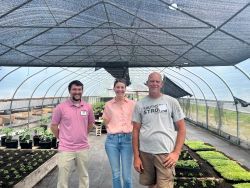
Last week I had the opportunity to attend a field day hosted by the Twin Cities Metro Growers Network at Bullthistle Gardens in Minneapolis. David Gray of Bullthistle Gardens is a member of our Urban Committee, and it was a great opportunity to learn about the operation’s work feeding the community and supporting urban agriculture. It was also encouraging to connect with the many organizations supporting agriculture in the state.
Whether in an urban or rural community, COC members are a vital link in the effective administration of USDA programs and are responsible for carrying out programs in full accordance with the regulations, national and state policies, procedures, and instructions. The contributions of our many committee members in Minnesota is greatly appreciated. If you are interested in serving or know someone that would be, I strongly encourage you to contact your local FSA office to learn more about FSA county committees or visit fsa.usda.gov/elections. I hope that many of you find the time to talk to local FSA staff about the opportunity to serve on your committee while completing your annual acreage reporting by the July 15 deadline.
For many in the state, spring planting has been impacted by severe weather conditions, including excessive moisture and flooding. Please refer to the article in the newsletter below on acreage reporting requirements for farms impacted by prevented planting and failed acres.
Lastly, the first phase of the Emergency Relief Program is currently being implemented. FSA has mailed pre-filled applications directly to agricultural producers. This new program is designed to help agricultural producers impacted by qualifying natural disasters experienced during calendar years 2020 and 2021. The article below provides additional details and a checklist of items for producers participating in ERP.
Respectfully,
Whitney Place, State Executive Director
|
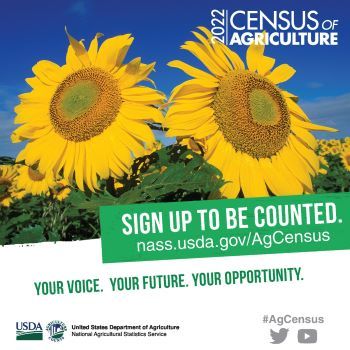
Your voice. Your future. Your opportunity.
Sign up and be counted in the 2022 Ag Census! Agriculture producers who did not receive the 2017 Census of Agriculture and do not receive other USDA surveys or censuses have until June 30 to sign up to receive the 2022 Census of Agriculture at nass.usda.gov/AgCensus. This once-every-five-years data collection begins this November.
The Ag Census includes every American operation – large or small, urban or rural – from which $1,000 or more of agricultural products are produced and sold, or would normally be produced and sold, in the ag census year. This can include hobby farms with livestock, such as chickens or horses, or crops growing in the backyard or on a rooftop. The data inform policy and program decisions that directly impact producers, their operations, industries, and communities. A complete count, with every producer getting and taking the opportunity to be represented in these data, is vital.
On the NASS Ag Census webpage, producers can also access frequently asked questions, explore past and current Ag Census data, access tools to help spread the word about the upcoming Ag Census, learn about Ag Census special studies, and more.
|
USDA Farm Service Agency (FSA) reminds you to report prevented planting and failed acres in order to establish or retain FSA program eligibility for some programs.
You should report crop acreage you intended to plant, but due to natural disaster, were prevented from planting. Prevented planting acreage must be reported on form CCC-576, Notice of Loss, no later than 15 calendar days after the final planting date as established by FSA and Risk Management Agency (RMA).
If you’re unable to report the prevented planting acreage within the 15 calendar days following the final planting date, a late-filed report can be submitted. Late-filed reports will only be accepted if FSA conducts a farm visit to assess the eligible disaster condition that prevented the crop from being planted. A measurement service fee will be charged.
Additionally, if you have failed acres, you should also use form CCC-576, Notice of Loss, to report failed acres.
For hand-harvested crops and certain perishables, you must notify FSA of damage or loss through the administrative County Office within 72 hours of the date of damage or loss first becomes apparent. This notification can be provided by filing a CCC-576, email, fax or phone. If you notify the County Office by any method other than by filing the CCC-576, you are still required to file a CCC-576, Notice of Loss, within the required 15 calendar days.
For losses on crops covered by the Non-Insured Crop Disaster Assistance Program (NAP), you must file a Notice of Loss within 15 days of the occurrence of the disaster or when losses become apparent. You must timely file a Notice of Loss for failed acres on all crops including grasses.
For more information, contact your local County USDA Service Center or visit fsa.usda.gov
FSA recently began mailing 303,000 pre-filled applications for the Emergency Relief Program (ERP), a new program designed to help agricultural producers impacted by wildfires, droughts, hurricanes, winter storms, and other qualifying natural disasters experienced during calendar years 2020 and 2021.
The past few years have been tough to say the least. As producers have dealt with the continued impacts of the COVID-19 pandemic, they have also struggled to recover from more frequent, more intense natural disasters. I am grateful that Congress passed, and President Biden signed into law the Extending Government Funding and Delivering Emergency Assistance Act (P.L. 117-43), which includes $10 billion in critical emergency relief.
After extensive stakeholder outreach, including with producers and groups that have not always been included in USDA programs, our team began work developing a responsive, easier-to-access program that could be rolled out in phases. We’re now rolling out the first phase of ERP, which uses existing Federal Crop Insurance or Noninsured Crop Disaster Assistance Program (NAP) data as the basis for calculating initial payments.
By leveraging existing data, we will be able to deliver approximately $6 billion in assistance on a faster timeline; at the same time, my team and I are committed to ensuring that producers who do not have existing data on file with USDA are captured in the second phase of ERP, which will be explicitly focused on filling gaps in previously implemented emergency assistance.
To apply for ERP Phase 1, here’s what you need to do:
- Check Your Mailbox
The form being mailed to you includes eligibility requirements, outlines the application process, and provides estimated ERP payment calculations. Producers will receive a separate application form for each program year in which an eligible loss occurred. Receipt of a pre-filled application is not confirmation that a producer is eligible to receive an ERP phase one payment. This application takes about 0.176 hours (that’s less than 15 minutes) for producers to complete, compared to the former Wildfire and Hurricane Indemnity Program – Plus application which took several hours for producers to complete and even longer for FSA staff.
The deadline to return completed ERP applications to FSA is Friday, July 22, 2022. If you have NAP coverage, you will receive pre-filled ERP applications later this summer. Details on ERP Phase 2 will be forthcoming as well.
- Check Your Eligibility
ERP covers losses to crops, trees, bushes, and vines due to a qualifying natural disaster event in calendar years 2020 and 2021. Eligible crops include all crops for which crop insurance or NAP coverage was available, except for crops intended for grazing. Qualifying natural disaster events include wildfires, hurricanes, floods, derechos, excessive heat, winter storms, freeze (including a polar vortex), smoke exposure, excessive moisture, qualifying drought*, and related conditions.
*Lists of 2020 and 2021 drought counties eligible for ERP are available online.
- Check Required Forms on File with FSA
Producers must have the following forms on file with FSA:
- Form AD-2047, Customer Data Worksheet.
- Form CCC-902, Farm Operating Plan for an individual or legal entity.
- Form CCC-901, Member Information for Legal Entities(if applicable).
- Form FSA-510, Request for an Exception to the $125,000 Payment Limitation for Certain Programs(if applicable).
- A highly erodible land conservation (sometimes referred to as HELC) and wetland conservation certification (Form AD-1026 Highly Erodible Land Conservation (HELC) and Wetland Conservation (WC) Certification) for the ERP producer and applicable affiliates.
If you have previously participated in FSA programs, you will likely have these required forms on file. However, if you’re uncertain or want to confirm the status of your forms, contact your local FSA county office.
- Check Historically Underserved Status with FSA, If Applicable
The ERP payment percentage for historically underserved producers, including beginning, limited resource, socially disadvantaged, and veteran farmers, and ranchers will be increased by 15% of the calculated ERP payment.
To qualify for the higher payment percentage, eligible producers must have the following form on file with FSA:
- Form CCC-860, Socially Disadvantaged, Limited Resource, Beginning and Veteran Farmer or Rancher Certification.
- Check Your Future Insurance Coverage
All producers who receive ERP phase one payments are statutorily required to purchase crop insurance, or NAP coverage where crop insurance is not available, for the next two available crop years, as determined by the Secretary.
Coverage requirements will be determined from the date a producer receives an ERP payment and may vary depending on the timing and availability of crop insurance or NAP for a producer’s particular crops. The final crop year to purchase crop insurance or NAP coverage to meet the second year of coverage for this requirement is the 2026 crop year.
- Check Your bank
Once the completed ERP application for payment is submitted to and signed by FSA, producers who have direct deposit should look for payment within three business days.
More Information
We have additional resources, including:
In addition to ERP, FSA is also implementing the first phase of the new Emergency Livestock Relief Program. At this time, FSA has made more than $588 million in payments to impacted livestock producers.
Bottom line, we take your feedback seriously, and we wanted to deliver this relief as soon as possible. We learned from previous relief programs, and we’re excited to be getting this to you as swiftly as we can.
The USDA Farm Service Agency’s (FSA) Direct Farm Ownership loans can help farmers and ranchers become owner-operators of family farms, improve and expand current operations, increase agricultural productivity, and assist with land tenure to save farmland for future generations.
There are three types of Direct Farm Ownership Loans: regular, down payment and joint financing. FSA also offers a Direct Farm Ownership Microloan option for smaller financial needs up to $50,000.
Joint financing allows FSA to provide more farmers and ranchers with access to capital. FSA lends up to 50 percent of the total amount financed. A commercial lender, a State program or the seller of the property being purchased, provides the balance of loan funds, with or without an FSA guarantee. The maximum loan amount for a joint financing loan is $600,000, and the repayment period for the loan is up to 40 years.
The operation must be an eligible farm enterprise. Farm Ownership loan funds cannot be used to finance nonfarm enterprises and all applicants must be able to meet general eligibility requirements. Loan applicants are also required to have participated in the business operations of a farm or ranch for at least three years out of the 10 years prior to the date the application is submitted. The applicant must show documentation that their participation in the business operation of the farm or ranch was not solely as a laborer.
For more information about farm loans, contact your USDA Service Center or visit fsa.usda.gov.
The Farm Service Agency (FSA) is accepting offers for specific conservation practices under the Conservation Reserve Program (CRP) Continuous Signup.
In exchange for a yearly rental payment, farmers enrolled in the program agree to remove environmentally sensitive land from agricultural production and to plant species that will improve environmental health and quality. The program’s long-term goal is to re-establish valuable land cover to improve water quality, prevent soil erosion, and reduce loss of wildlife habitat. Contracts for land enrolled in CRP are 10-15 years in length.
Under continuous CRP signup, environmentally sensitive land devoted to certain conservation practices can be enrolled in CRP at any time. Offers for continuous enrollment are not subject to competitive bidding during specific periods. Instead they are automatically accepted provided the land and producer meet certain eligibility requirements and the enrollment levels do not exceed the statutory cap.
For more information, including a list of acceptable practices, contact your USDA Service Center at visit fsa.usda.gov/crp.
|
For the 2022 crop year, NAP forage producers with the intended use of grazing who elect to use independent assessments or other approved alternative loss percentage methods to establish their loss are no longer required to file a CCC-576 Notice of Loss with FSA. However, a CCC-576 Application for Payment form must be submitted to FSA no later than 60 calendar days after the coverage period ends. If an independent assessment is used to determine the loss, producers have 180 days to file an application for payment.
Producers that elect to have the grazing loss determined using similar mechanically harvested units still must timely file a CCC-576 Notice of Loss within 15 days of the disaster event or damage to the crop first becomes apparent or within 15 days of harvest.
The National Environmental Policy Act (NEPA) requires Federal agencies to consider all potential environmental impacts for federally funded projects before the project is approved.
For all Farm Service Agency (FSA) programs, an environmental review must be completed before actions are approved, such as site preparation or ground disturbance. These programs include, but are not limited to, the Emergency Conservation Program (ECP), Farm Storage Facility Loan (FSFL) program and farm loans. If project implementation begins before FSA has completed an environmental review, the request will be denied. Although there are exceptions regarding the Stafford Act and emergencies, it’s important to wait until you receive written approval of your project proposal before starting any actions.
Applications cannot be approved until FSA has copies of all permits and plans. Contact your local FSA office early in your planning process to determine what level of environmental review is required for your program application so that it can be completed timely.
Farm Service Agency (FSA) loans require applicants to have a satisfactory credit history. A credit report is requested for all FSA direct farm loan applicants. These reports are reviewed to verify outstanding debts, see if bills are paid timely and to determine the impact on cash flow.
Information on your credit report is strictly confidential and is used only as an aid in conducting FSA business.
Our farm loan staff will discuss options with you if you have an unfavorable credit report and will provide a copy of your report. If you dispute the accuracy of the information on the credit report, it is up to you to contact the issuing credit report company to resolve any errors or inaccuracies.
There are multiple ways to remedy an unfavorable credit score:
- Make sure to pay bills on time
- Setting up automatic payments or automated reminders can be an effective way to remember payment due dates.
- Pay down existing debt
- Keep your credit card balances low
- Avoid suddenly opening or closing existing credit accounts
FSA’s farm loan staff will guide you through the process, which may require you to reapply for a loan after improving or correcting your credit report.
For more information on FSA farm loan programs, contact your County USDA Service Center or visit fsa.usda.gov.

ELAP provides emergency assistance to eligible livestock, honeybee, and farm-raised fish producers who have losses due to disease, adverse weather or other conditions, such as blizzards and wildfires, not covered by other agricultural disaster assistance programs.
Eligible losses include:
-
Livestock - grazing losses not covered under the Livestock Forage Disaster Program (LFP), loss of purchased feed and/or mechanically harvested feed due to an eligible adverse weather event, additional cost of transporting water because of an eligible drought and additional cost associated with gathering livestock to treat for cattle tick fever.
-
Honeybee - loss of purchased feed due to an eligible adverse weather event, cost of additional feed purchased above normal quantities due to an eligible adverse weather condition, colony losses in excess of normal mortality due to an eligible weather event or loss condition, including CCD, and hive losses due to eligible adverse weather.
-
Farm-Raised Fish - death losses in excess of normal mortality and/or loss of purchased feed due to an eligible adverse weather event.
If you’ve suffered eligible livestock, honeybee, or farm-raised fish losses during calendar year 2022, you must file:
- A notice of loss within 30 calendar days after the loss is apparent (15 days for honeybee losses)
- An application for payment by Jan. 30, 2023
|
|