Reminders from the CED

Please take a moment to review the following reminders:
Employment Opportunity - Please see the article below for a Program Technician position currently open in the Haskell County FSA Office. The position closes June 21, 2022.
Emergency Conservation Program (ECP) - ECP applications will be accepted to address fence damages from recent wildfires in Stonewall County. ECP signup will begin for Stonewall County on Monday, June 13, 2022, and end on Friday, July 15, 2022.
2022 Acreage Reporting Deadline - July 15, 2022 is the deadline to timely certify acreage for Spring seeded crops in Haskell and Stonewall Counties including Beans, Corn, Cotton, CRP, Grain Sorghum, Guar, Peanuts, Sesame, Sudan/Hay Grazer, and Sunflowers. This is also the deadline to report crops reported as grass, cover only, green manure, left standing, or sod. Please report your crops as soon as possible after planting.
Emergency Relief Program (ERP) – If you received an ERP application by mail, the deadline to submit the application to the county office is July 22. 2022.
2022 County Committee Nominations – The Haskell and Stonewall County FSA Offices will begin accepting nominations beginning June 15th for the 2022 COC Election.
Haskell County will be seeking nominations from Local Administrative Area 3 (LAA-3) which is the Eastern part of the county that lies east of a boundary line which begins at the Northern county line on HWY 277N, then South on HWY 277 to Haskell and then East on HWY 380 for approximately 1 mile and then right on FM 600 and to the Southern county line. LAA-3 includes areas of Haskell, Mattson, Paint Creek, and Weinert
Stonewall County will be seeking nominations from Local Administrative Area 3 (LAA-3) which is the area East and Southeast of Aspermont that is East of Hwy 1263 and South of the Salt Fork of the Brazos River and East of Hwy 83. This includes the Old Glory area.
2022 Livestock Forage Disaster Program - Haskell and Stonewall Counties are continuing to accept applications for the 2022 LFP Program. The forage types eligible are native and improved grass for grazing, and wheat for grazing. For livestock producers who suffered grazing losses and owned livestock during the 60 days prior to the trigger dates for wheat and/or grass, the deadline to apply is January 31, 2023. All applicable leases must be submitted by this deadline as well.
Shawn Ferguson, CED
Haskell/Stonewall County FSA
|

The Haskell/Stonewall County Farm Service Agency (FSA) office in Haskell TX is hiring a full time, permanent Program Technician. The deadline to apply is June 21, 2022.
Duties include general office activities supporting FSA Farm Programs administered at the field level. Successful applicants must be reliable, have a professional attitude and enjoy working with the public. Salary $33,221 - $58,158
Applications must be completed through USAJOBs no later than close of business June 21, 2022. This specific application can be accessed at https://www.usajobs.gov/job/658836700.
Contact Shawn Ferguson at 940-864-2617 x2 if you have specific questions regarding this position. USDA is an equal opportunity provider, employer and lender.
|
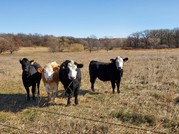
If you’ve suffered above normal expenses for hauling feed or water to livestock or hauling livestock to forage/grazing acres due to the impacts of drought, you may be eligible for financial assistance through the Emergency Assistance for Livestock, Honey Bees, and Farm-Raised Fish Program (ELAP).
For eligible producers in qualifying counties, ELAP provides financial assistance for:
- the transportation of water to livestock;
- the above normal cost of mileage for transporting feed to livestock,
- the above normal cost of transporting livestock to forage/grazing acres.*
*Hauling livestock one-way, one haul per animal reimbursement and no payment for “empty miles.”
Eligible livestock include cattle, buffalo, goats and sheep, among others, that are maintained for commercial use and located in a county where the qualifying drought conditions occur. A county must have had D2 severe drought intensity on the U.S. Drought Monitor for eight consecutive weeks during the normal grazing period, or D3 or D4 drought intensity at any time during the normal grazing period. Producers must have risk in both eligible livestock and eligible grazing land in an eligible county to qualify for ELAP assistance.
WATER TRANSPORTATION
For ELAP water transportation assistance, a producer must be transporting water to eligible livestock on eligible grazing land where the producer had adequate livestock watering systems or facilities in place before the drought occurred and where they do not normally require the transportation of water. Payments are for costs associated with personal labor, equipment, hired labor, equipment, and/or contracted water transportation fees. Cost of the water itself is not covered. The ELAP payment formula uses a national average price per gallon.
ABOVE NORMAL COSTS OF TRANSPORTING FEED
ELAP provides financial assistance to livestock producers who incur above normal expenses for transporting feed to livestock during drought. The payment formula excludes the first 25 miles and any mileage over 1,000 miles. The reimbursement rate is 60% of the costs above what would normally have been incurred during the same time period in a normal (non-drought) year.
ABOVE NORMAL COSTS OF TRANSPORTING LIVESTOCK TO FORAGE/GRAZING ACRES
ELAP provides financial assistance to livestock producers who are hauling livestock to a new location for feed resources due to insufficient feed and/or grazing in drought-impacted areas. Assistance for Livestock transportation is retroactive to 2021 and available for 2022 and subsequent years. For those interested in this provision for 2021, the deadline to apply for assistance is June 30, 2022. Please contact your county FSA office for additional details.
For calendar year 2022 forward, producers must submit a notice of loss to your local FSA office within 30 calendar days of when the loss is apparent; producers should contact their county FSA office as soon as the loss of water resources or feed resources are known. For ELAP eligibility, documentation of expenses is critical. Producers should maintain records and receipts associated with the costs of transporting water to eligible livestock, the costs of transporting feed to eligible livestock, and the costs of transporting eligible livestock to forage/grazing acres.
ELAP also offers assistance to producers impacted by wildfire. Contact your county FSA office for more information on ELAP resources for wildfire losses. In addition, beekeepers also can benefit from ELAP provisions and should contact their county FSA office within 15 calendar days of when a loss occurs or from when the loss is apparent. For more information regarding ELAP, contact your Haskell County USDA Service Center at 940-864-2617 or Stonewall County USDA Service Center at 940-989-3546 or visit fsa.usda.gov/disaster.
|
Submitted by NRCS - Our lives are dependent on healthy soil. Healthy soil gives us clean air and water, bountiful crops and forests, productive grazing lands, diverse wildlife and beautiful landscapes. It’s the reason why USDA’s Natural Resources Conservation Service experts are in your community and across the nation.
Soil is composed of air, water, organic matter and minerals. A community of organisms – functioning as a soil food web – lives all or parts of their lives in soil. More individual organisms are in a teaspoon of soil than there are people on earth. Increasing soil organic matter typically improves soil health, since organic matter improves several critical functions of soil.
To improve the health of their soil, more and more farmers and ranchers are keeping soil covered, reducing disturbance activities such as tilling, keeping plants growing throughout the year, and diversifying the crops they’re planting in a rotation. Taking these steps allow farmers and ranchers to help reduce erosion while increasing the soil’s ability to provide nutrients and water to the plant at critical times during the growing season.
When producers focus on improving soil health, they often have larger harvests, lower input costs, optimized nutrient use, and improved crop resilience during drought years like last year. In heavy rainfall years, healthy soil holds more water, reducing runoff that helps avert flooding downstream.
And because healthy soil allows for greater water infiltration and less erosion, nutrients and pesticides stay on the farm where they benefit crops, and are far less likely to be carried off the farm into streams and lakes where they can cause harm.
NRCS helps farmers install conservation practices such as cover crops to maintain and improve soil health – all of which can lead to productive, profitable and sustainable farming and ranching operations for generations to come.
For more information, contact your Stonewall County USDA Service Center at 940-989-3546 ext 3 or visit nrcs.usda.gov.
|
USDA Service Center
Haskell County FSA
607 N 1st E, Ste B
Haskell, TX 79521
Phone: (940) 864-2617 |
|
Stonewall County FSA
635 S Broadway
Aspermont, TX 79502
(940) 989-3546 |
Fax: (844) 496-7965
FSA Farm Program Contacts
|
Shawn Ferguson, CED shawn.ferguson@usda.gov
|
Terri Klose, Chief PT
terri.klose@usda.gov |
|
Misti Davis, PT
misti.davis@usda.gov
|
Randall Frierson, PT randall.frierson@usda.gov
|
|
Rodney Tsoodle, PT rodney.tsoodle@usda.gov
|
Susie McLellan
scarlett.mclellan@usda.gov
|
|
Haskell County FSA Committee
Joe Wheatley, Chairperson
Ross Short, Vice-Chairperson
Steven Lehrmann, Member
Mollie Moeller, Advisor
Next Meeting: July 13 ,2022
|
Stonewall County FSA Committee
Jay Beakley, Chairperson
Cindy Jouett, Vice-Chairperson
Flyn Simmons, Member
Next Meeting: July 11, 2022
|
|
FSA Farm Loan Contacts
|
|
|
Brand Cude, FLM
brand.cude@usda.gov
|
Louisa Landry, PT
louisa.landry@usda.gov |
|
Natural Resources Conservation Service
|
|
|
Cody Mathis
NRCS District Conservationist - Haskell
(940) 864-2617 ext. 4
cody.mathis@usda.gov
|
Kegan Crouch
NRCS District Conservationist - Stonewall
(940) 989-3546 ext. 3
kegan.crouch@usda.gov
|
|