|
|
Vermont FSA Newsletter - June 9, 2022
|
|
|
In This Issue:
|
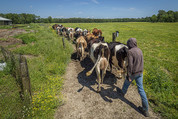
June is Dairy Month and dairy, as we all know, is Vermont’s leading agricultural product. Even though our farm numbers have declined dramatically in the nearly 50 years that I’ve lived in Vermont, there were nearly 5,000 dairy farms in 1974 and now there are about 562, Vermont produces as much or even more milk. Also, what the milk is utilized for has changed too, from a lot of fluid to far more processed products, cheese, yoghurt, ice cream etc. Dairy will continue to change, and it is hard to predict exactly how, but will probably stay a leading economic driver in the agricultural field. Vermont is well known as a good place to grow grass and forage; just what cows need to eat.
Our FSA offices will be assisting the Vermont Agency of Agriculture, Food and Markets to process the state legislated reimbursement to dairy farmers for their premium payment to the Dairy Margin Coverage program. The process has not been fully worked out yet, but we are both in agreement to make the process as straight forward as possible.
For me one of the important issues of my time with Vermont FSA will be to try and see what we can do to make sure our programs are reaching all the potential clients who might benefit, particularly new farmers, previously disadvantaged or less able to access land. I believe this to be a growing segment of Vermont’s farming population. Often these farmers are also not attracted to the traditional Vermont dairy farming because of the large investment of time and money to manage that type of operation. Smaller farmers can also benefit from the growing interest in a more diverse product availability expressed by consumers, although that can often come with a need for more intense marketing expertise.
I am learning a lot in my job and have a lot more to learn. I am also interested in making our programs easier to access, easier to administer and more effective for our farmers when we do. This approach cannot be done in Vermont alone so it will mean a coordinated effort to figure out what is and isn’t working well and then informing Washington DC and supply suggested solutions. No doubt a long process.
It has been nice to see the days getting longer though hard to believe that in about two weeks they will start to shorten again. It looks as though farming has gotten off to a good start this year in most of the state. As I write it is pouring with rain, much needed in Addison County where I live, though I know there are other parts of the state that are quite wet.
|
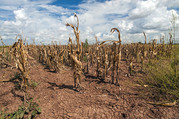
FSA recently began mailing 303,000 pre-filled applications for the Emergency Relief Program (ERP), a new program designed to help agricultural producers impacted by wildfires, droughts, hurricanes, winter storms, and other qualifying natural disasters experienced during calendar years 2020 and 2021.
The past few years have been tough to say the least. As producers have dealt with the continued impacts of the COVID-19 pandemic, they have also struggled to recover from more frequent, more intense natural disasters. I am grateful that Congress passed, and President Biden signed into law the Extending Government Funding and Delivering Emergency Assistance Act (P.L. 117-43), which includes $10 billion in critical emergency relief.
After extensive stakeholder outreach, including with producers and groups that have not always been included in USDA programs, our team began work developing a responsive, easier-to-access program that could be rolled out in phases. We’re now rolling out the first phase of ERP, which uses existing Federal Crop Insurance or Noninsured Crop Disaster Assistance Program (NAP) data as the basis for calculating initial payments.
By leveraging existing data, we will be able to deliver approximately $6 billion in assistance on a faster timeline; at the same time, my team and I are committed to ensuring that producers who do not have existing data on file with USDA are captured in the second phase of ERP, which will be explicitly focused on filling gaps in previously implemented emergency assistance.
To apply for ERP Phase 1, here’s what you need to do:
- Check Your Mailbox
The form being mailed to you includes eligibility requirements, outlines the application process, and provides estimated ERP payment calculations. Producers will receive a separate application form for each program year in which an eligible loss occurred. Receipt of a pre-filled application is not confirmation that a producer is eligible to receive an ERP phase one payment. This application takes about 0.176 hours (that’s less than 15 minutes) for producers to complete, compared to the former Wildfire and Hurricane Indemnity Program – Plus application which took several hours for producers to complete and even longer for FSA staff.
The deadline to return completed ERP applications to FSA is Friday, July 22, 2022. If you have NAP coverage, you will receive pre-filled ERP applications later this summer. Details on ERP Phase 2 will be forthcoming as well.
- Check Your Eligibility
ERP covers losses to crops, trees, bushes, and vines due to a qualifying natural disaster event in calendar years 2020 and 2021. Eligible crops include all crops for which crop insurance or NAP coverage was available, except for crops intended for grazing. Qualifying natural disaster events include wildfires, hurricanes, floods, derechos, excessive heat, winter storms, freeze (including a polar vortex), smoke exposure, excessive moisture, qualifying drought*, and related conditions.
*Lists of 2020 and 2021 drought counties eligible for ERP are available online.
- Check Required Forms on File with FSA
Producers must have the following forms on file with FSA:
- Form AD-2047, Customer Data Worksheet.
- Form CCC-902, Farm Operating Plan for an individual or legal entity.
- Form CCC-901, Member Information for Legal Entities(if applicable).
- Form FSA-510, Request for an Exception to the $125,000 Payment Limitation for Certain Programs(if applicable).
- A highly erodible land conservation (sometimes referred to as HELC) and wetland conservation certification (Form AD-1026 Highly Erodible Land Conservation (HELC) and Wetland Conservation (WC) Certification) for the ERP producer and applicable affiliates.
If you have previously participated in FSA programs, you will likely have these required forms on file. However, if you’re uncertain or want to confirm the status of your forms, contact your local FSA county office.
- Check Historically Underserved Status with FSA, If Applicable
The ERP payment percentage for historically underserved producers, including beginning, limited resource, socially disadvantaged, and veteran farmers, and ranchers will be increased by 15% of the calculated ERP payment.
To qualify for the higher payment percentage, eligible producers must have the following form on file with FSA:
- Form CCC-860, Socially Disadvantaged, Limited Resource, Beginning and Veteran Farmer or Rancher Certification.
- Check Your Future Insurance Coverage
All producers who receive ERP phase one payments are statutorily required to purchase crop insurance, or NAP coverage where crop insurance is not available, for the next two available crop years, as determined by the Secretary.
Coverage requirements will be determined from the date a producer receives an ERP payment and may vary depending on the timing and availability of crop insurance or NAP for a producer’s particular crops. The final crop year to purchase crop insurance or NAP coverage to meet the second year of coverage for this requirement is the 2026 crop year.
- Check Your bank
Once the completed ERP application for payment is submitted to and signed by FSA, producers who have direct deposit should look for payment within three business days.
More Information
We have additional resources, including:
In addition to ERP, FSA is also implementing the first phase of the new Emergency Livestock Relief Program. At this time, FSA has made more than $588 million in payments to impacted livestock producers.
Bottom line, we take your feedback seriously, and we wanted to deliver this relief as soon as possible. We learned from previous relief programs, and we’re excited to be getting this to you as swiftly as we can.
|

USDA Service Centers across the country, are hearing from people who are interested in more space and working the land and we want to let you know we can help. Are you new to farming because of the pandemic? USDA can help you get started in farming – on everything from helping you register your farm to getting financial assistance and advice.
Get Started with USDA
First, you want to make sure your farm is registered. If you purchased land, it might already be established with USDA’s Farm Service Agency (FSA) with a farm number on file. If not, FSA can help you register your farm.
To obtain a farm number, you’ll bring an official tax ID (Social Security number or an employer ID) and a property deed. If you do not own the land, bring a lease agreement to your FSA representative to show you have control of the property. If your operation is incorporated or an entity, you may also need to provide proof that you have signature authority and the legal ability to enter into contracts with USDA.
Access to Capital
USDA can provide access to capital through its farm loans, which is a great resource when producers aren’t able to get a loan from a traditional lender. Loans can help with purchasing land or equipment or with operating costs, and FSA even offers microloans, which are especially popular among producers with smaller farms. For more information, check out our Farm Loan Discovery Tool.
Conservation Practices
We can help you make conservation improvements to your farm, which are good for your bottom line and your operation. We’ll help you develop a conservation plan and apply for financial assistance that’ll cover the bulk of the costs for implementing. To learn more about some of the conservation practices that we help producers with, check out our Conservation at Work Video Series.
If you purchase land, and you don’t want to farm all of it, you can look at either a conservation easement or managing for native shrubs and grasses through either the Agricultural Conservation Easement Program (ACEP) or Conservation Reserve Program (CRP). Easements are long-term, while a CRP contract is 10-15 years. These are good options for land that is not optimal for production or sensitive lands like wetlands and grasslands.
Additional Resources
Depending on your farm, you may want to look at crop insurance. The USDA’s Risk Management Agency provides crop insurance to help you manage risks on your farm. There are many types of insurance products available for a wide variety of production practices, including organic and sustainable agriculture.
Your local communities also have great resources for farmers including conservation districts, Rural Development, cooperative extensions, and different farming groups. To get started with USDA, contact your local USDA service center.
|

On your own land, you’ve probably seen evidence that climate change is happening – things like extreme weather events or changes in growing seasons over the years. America’s rural communities are on the frontlines of climate change, and now is the time for agriculture, forestry, and rural communities to act.
There are various ways to help mitigate the effects of climate change on your land and improve your bottom line at the same time. One very effective way is by planting cover crops.
Cover crops offer agricultural producers a natural and inexpensive climate solution through their ability to capture atmospheric carbon dioxide (CO2) into soils. But cover crops don’t just remove CO2 from the atmosphere, they also help make your soil healthier and your crops more resilient to a changing climate.
Healthy soil has better water infiltration and water holding capacity and is less susceptible to erosion from wind and water.
Cover crops also trap excess nitrogen – keeping it from leaching into groundwater or running off into surface water – releasing it later to feed growing crops. This saves you money on inputs like water and fertilizer and makes your crops more able to survive in harsh conditions.
USDA’s Cover Crop Support
During the past year, USDA has made a number of strides to encourage use of cover crops. Earlier this month, USDA’s Natural Resources Conservation Service (NRCS) formed a new partnership with Farmers For Soil Health. We also launched a new Cover Crop Initiative in 11 states through the Environmental Quality Incentives Program (EQIP), targeted $38 million to help producers mitigate climate change through adoption of cover crops.
In fiscal 2021, NRCS provided technical and financial assistance to help producers plant 2.3 million acres of cover crops through EQIP.
We’ve also recognized the importance of supporting cover crops through crop insurance. USDA’s Risk Management Agency (RMA) recently provided $59.5 million in premium support for producers who planted cover crops on 12.2 million acres through the new Pandemic Cover Crop Program. Additionally, RMA recently updated policy to allow producers with crop insurance to hay, graze or chop cover crops at any time and still receive 100% of the prevented planting payment. This policy change supports use of cover crops, which can help producers build resilience to drought. Visit RMA’s Conservation webpage to learn more.
Working together, we can lead the way through climate-smart solutions that will improve the profitability and resilience of producers and foresters, open new market opportunities, and build wealth that stays in rural communities. Our support for cover crops are part of a much broader effort at USDA to address climate change. To learn more, read USDA’s January 18, 2022 news release.
Cover crops are not only good for rural communities, but also for urban areas. Late last year, the NRCS National Plant Materials Center planted cover crops in the urban garden in front of USDA’s Washington, D.C. Headquarters. See how cover crops are also great for the urban farmer or backyard gardener.
To learn more, visit farmers.gov/conserve/soil-health, watch our Conservation at Work video on cover crops, or contact your local USDA Service Center.
|
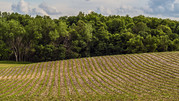
Agricultural producers who have not yet completed their crop acreage reports after spring planting should make an appointment with their local Farm Service Agency (FSA) office before the applicable deadline.
An acreage report documents a crop grown on a farm or ranch and its intended uses. Filing an accurate and timely acreage report for all crops and land uses, including failed acreage and prevented planted acreage, can prevent the loss of benefits.
How to File a Report
The acreage reporting deadline for Vermont spring planting is July 15th.
Service Center staff continue to work with agricultural producers via phone, email, and other digital tools. Because of the pandemic, some USDA Service Centers are open to limited visitors. Contact your county FSA office to set up an in-person or phone appointment.
To file a crop acreage report, you will need to provide:
- Crop and crop type or variety.
- Intended use of the crop.
- Number of acres of the crop.
- Map with approximate boundaries for the crop.
- Planting date(s).
- Planting pattern, when applicable.
- Producer shares.
- Irrigation practice(s).
- Acreage prevented from planting, when applicable.
- Other information as required.
Acreage Reporting Details
The following exceptions apply to acreage reporting dates:
- If the crop has not been planted by the acreage reporting date, then the acreage must be reported no later than 15 calendar days after planting is completed.
- If a producer acquires additional acreage after the acreage reporting date, then the acreage must be reported no later than 30 calendar days after purchase or acquiring the lease. Appropriate documentation must be provided to the county office.
Producers should also report crop acreage they intended to plant, but due to natural disaster, were unable to plant. Prevented planting acreage must be reported on form CCC-576, Notice of Loss, no later than 15 calendar days after the final planting date as established by FSA and USDA’s Risk Management Agency.
Noninsured Crop Disaster Assistance Program (NAP) policy holders should note that the acreage reporting date for NAP-covered crops is the earlier of the dates listed above or 15 calendar days before grazing or harvesting of the crop begins.
More Information
For questions, please contact your local FSA county office.
|

Agricultural producers and handlers who are certified organic, along with producers and handlers who are transitioning to organic production, can now apply for the U.S. Department of Agriculture’s (USDA) Organic and Transitional Education Certification Program (OTECP) and Organic Certification Cost Share Program (OCCSP), which help producers and handlers cover the cost of organic certification, along with other related expenses. Applications for OTECP and OCCSP are both due October 31, 2022.
OTECP covers:
- Certification costs for organic producers and handlers (25% up to $250 per category).
- Eligible expenses for transitional producers, including fees for pre-certification inspections and development of an organic system plan (75% up to $750).
- Registration fees for educational events (75% up to $200).
- Soil testing (75% up to $100).
Meanwhile, OCCSP covers 50% or up to $500 per category of certification costs in 2022.
This cost share for certification is available for each of these categories: crops, wild crops, livestock, processing/handling and State organic program fees.
Producers can receive cost share through both OTECP and OCCSP. Both OTECP and OCCSP cover costs incurred from October 1, 2021, to September 30, 2022. Producers have until October 31, 2022 to file applications, and FSA will make payments as applications are received.
To apply, producers and handlers should contact the Farm Service Agency (FSA) at their local USDA Service Center. As part of completing the OCCSP applications, producers and handlers will need to provide documentation of their organic certification and eligible expenses. Organic producers and handlers may also apply for OCCSP through participating State agencies.
Additional details can be found on the OTECP and OCCSP webpages.
|
This planting season let’s highlight the innovation and leadership demonstrated by conservation-minded farmers in our #Plant2022 campaign. We’ll share your photos and stories on social media, blogs, and a nationwide storymap.
Learn more (https://go.usa.gov/xuTqj)
|
|
|
Vermont Farm Service Agency
356 Mountain View Drive, Suite 104
Colchester, VT 05446
John Roberts, State Executive Director
john.roberts2@usda.gov
Phone: 802-658-2803
Fax: 855-794-3676
|
Addison County Office
Tina Williams, Acting County Executive Dir.
802-771-3027
tina.williams2@usda.gov
Rebecca Davis, Farm Loan Manager
603-223-6003
rebecca.davis2@usda.gov
|
Franklin/Grand Isle County Office
Laurie Locke, County Executive Director
802-528-4162
laurie.locke@usda.gov
Ryan Howrigan, District Director
802-528-4160
ryan.howrigan@usda.gov
|
|
Caledonia/Essex County Office
Patricia Matte, County Executive Director
802-424-3146
patricia.matte@usda.gov
|
Rutland/Bennington County Office
Tina Williams, County Executive Director
802-775-8034, ext. 111
tina.williams2@usda.gov
|
|
Chittenden/Washington County Office
Lawrence Parker, County Executive Director
802-288-8155, ext. 102
lawrence.parker@usda.gov
|
Windsor/Orange County Offices
Christine Lary, County Executive Director
802-295-7942, ext. 3168
christine.lary@usda.gov
|
|
Lamoille/Orleans County Offices
Heather Mateja, County Executive Director
Orleans: 802-334-6090, ext. 7016
Lamoille: 802-888-4935, ext. 3002 (Tues.)
heather.mateja@usda.gov
Angela Goodridge, Farm Loan Manager
802-334-6090, ext. 7003
angela.goodridge@usda.gov
|
Windham County Office
Christine Lary, County Executive Director
802-254-9766, ext. 3032 christine.lary@usda.gov
|
|
|