Welcome to the 2nd Edition of our partner newsletter, "News and Views, NRCS Partners in Conservation."
As we continue to experience the positive results of our efforts to reduce the impacts of the COVID-19 virus, I believe it is important to recognize that no matter the obstacles, all of us continued to press forward. Site visits, meetings, and normal forms of evaluation and communication had to be altered. However, we as federal, state, and community partners never faltered, always placing priority on conservation.
The dedication and resiliency displayed during the pandemic will yield positive results in the years to come. I believe it is important to reflect and recognize that our perseverance, regardless of the challenges, reaffirms conservation never stops. Also, I believe that our adaptation provided us with alternate ways to accomplish various tasks necessary to fulfill our mission.
I want to take a moment to congratulate everyone, including our federal, state, and community partners for their commitment and a job well done!
Respectfully,
Jon Bourdon
NRCS-WV State Conservationist
|
USDA’s Grant Program to Boost Urban Agriculture in Wheeling, West Virginia
By NRCS-WV Public Affairs Specialist, Becky Haddix. Photo Credit: Becky Haddix and GrowOV website.
Pictured l-r: Vincent DeGeorge, GrowOV’s Director of Special Projects and Strategic Initiatives; Danny Swan, GrowOV’s Executive Director; Katie Fitzsimmons, NRCS Northern Panhandle District Conservationist
Grow Ohio Valley (GrowOV), a nonprofit organization that focuses on working with urban farms to build a local food system, has been awarded a grant through USDA’s Office of Urban Agriculture and Innovative Production. (UAIP).
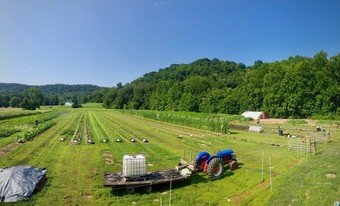
GrowOV’s Executive Director, Danny Swan, sought out the USDA grant knowing that it was a good fit for their operation. GrowOV’s 30-acre farm, coined, “Big Wheeling Agrarian Center (BWAC),” serves as an Ohio County, WV farming operation as well as a training ground for beginning farmers in the area. (Pictured: The Big Wheeling Agrarian Center).
The (UAIP) Competitive Grants Program supports a wide range of activities through two grant types: planning projects and implementation projects. Across the country, $4.75 million was awarded for 10 Planning Projects and 11 Implementation Projects, including an Implementation Project for GrowOV in Wheeling. Projects may target areas of food access, education, business and start-up costs for new farmers, and development of policies related to zoning and other needs of urban production.
|
The UAIP Competitive Grants Program was created to better focus on the needs of urban farmers who are a valuable part of the community. They work among diverse populations to expand access to nutritious foods, foster community engagement, provide jobs, educate communities about farming, and expand green spaces. The NRCS leads the USDA-wide effort with help from other agencies including the FSA and the Agricultural Marketing Service.
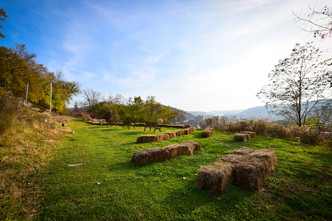
“The big picture for us is to set up a training/incubation farm on the Big Wheeling Creek,” said Swan. “A big part of this place is to capture that loss of generational skills; to create a system of mentorship for those who have not grown up on farms with grandpa, grandma, dad, and mom teaching them how to frame up a farm. We’re teaching the practical hands-on skills that have been lost.” (pictured: Edible Mountain Park)
BWAC will be a place where first generation farmers have the support and resources needed to develop skills in agriculture. The grant will help the farm get over the initial hill of building infrastructure and paying the farmers while they get the farm fully up and running. The grant, which injects about $250,000 into the farm, will fund things like barns, tractors, and high tunnels.
|
“This will get us ready to be a fully-fledged incubator farm,” said Swan. “We also have this AmeriCorps program, a way to bring in apprentices and interns who can learn farming and contribute to this emerging local food system.”
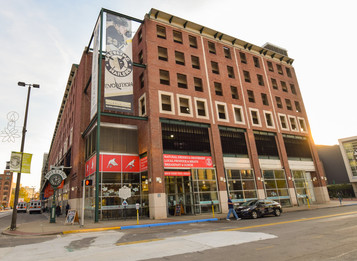
The BWAC directly serves trainees in three ways: it provides land access and diverse agricultural training to aspiring farmers; it provides business guidance to farm entrepreneurs; and it provides equipment and assistance for existing local farmers. “We want to get our young farmers incubated and get their products to market. Help them build a brand, a business plan, and help young people learn what NRCS and the local conservation districts and conservation partners can provide.” said Swan. (pictured above: GrowOV's Public Market ).
Swan explains that with the USDA funding, along with assistance from some local foundations, they were able to start the whole initiative without going into debt so they can turn back more money to the people of the community. “Sometimes people just need an obstacle cleared out of the way in order to help themselves.”
“Danny and his team at Grow Ohio Valley have a lot of ambition,” said NRCS Northern Panhandle District Conservationist, Katie Fitzsimmons. “They have a passion for what they are doing for the Wheeling community, and they are proactive in seeking avenues for funding and have done a great deal of things on their own or through grants. We have worked with them in installing a high tunnel, a water well, and there are plans for installing an irrigation system.”
|
More About Grow Ohio Valley:
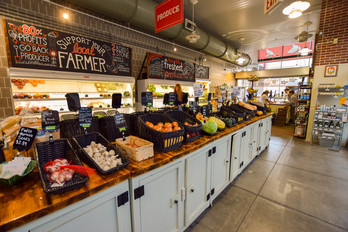
“GrowOV has recently launched a five-year strategic plan,” said Swan. “To me the biggest outcome of the strategic plan was to stop thinking of GrowOV in terms of the programs and activities that we do but more in terms of what impact we have.” The five-year consists of two parts: economic development, and public health. (pictured: GrowOV Food Market).
The economic development side will help business succeed, provide more jobs, more resources, especially in the food sector including agriculture. The economic development side goes from seed all the way to end user. Some of GrowOV projects include a public market where farmers can sell their product. The Wheeling Food Hub (WFH) is another project which is a shared community kitchen that provides formal processing infrastructure for producers. GrowOV has the right people on hand to help with food science, labeling, and FDA clearances, the whole gamut.
“Here in Wheeling, West Virginia, we have small business and small farms. We produce a phenomenal product that deserves to be on our grocery store shelves,” said Swan. Vincent DeGeorge, Director of Special Projects and Strategic Initiatives at GrowOV, manages the WFH project.
|
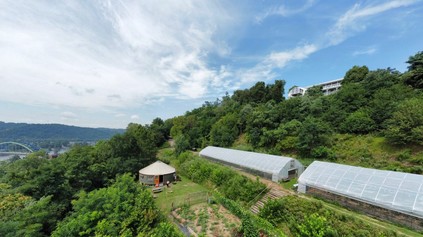
Swan envisions how GrowOV as a non-profit can use itself as a tool for the community where they can take the risk, make that capitol expense, use the non-profit status to find grants, and put the infrastructure in place. “All these little pieces and services are part of the dream at the WFH— efficient, cost effective, and a facility that helps removes obstacles so your dream can be realized.” (pictured: Edible Mountain Park)
The public health side involves things like school gardens, youth centers, food literacy, garden education, and food dessert resources. Their vision is to bring partners together into one coalition to focus on youth wellness. They named this coalition Edible Mountain, which is approximately a two-acre area in downtown Wheeling where they can integrate urban agriculture with youth programing.
|
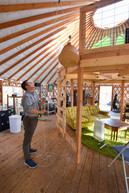
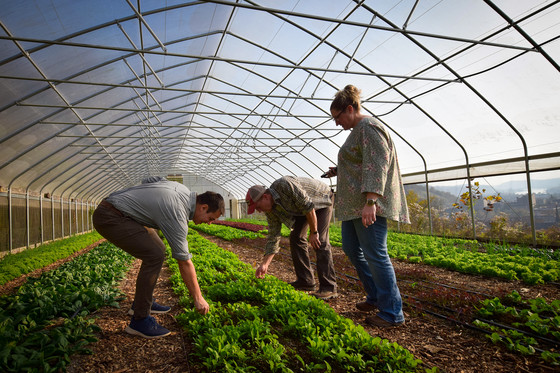
At Edible Mountain Park there are two high tunnels used as training venues and food production for the public market. “We are right downtown,” said Swan. “We have an urban farm but we have all the country features, things you would have on a farm.” Swan says there are kids here all the time and most of the plants are planted by kids. “We are skill building and teaching kids hard core farming,” said Swan. “We are happy about that outcome. Accidental successes are more powerful than the ones you plan.” (Pictured: Inside Edible Mountain Park's Learning Center)
|
NRCS Awards On-Farm Trials to WVU's Research Corporation through the CIG Program
Submitted by Dr. Ember Morrissey, Assistant Professor of Environmental Microbiology, WVU Davis College– Division of Plant and Soil Sciences, West Virginia University
 On-Farm Conservation Innovation Trials (On-Farm Trials) support more widespread adoption of innovative approaches, practices, and systems on working lands. On-Farm Trials (OFT), part of the agency’s Conservation Innovation Grant (CIG) program, feature collaboration between NRCS and partners to implement on-the-ground conservation activities and then evaluate their impact. Up to $25 million annually is available for OFTs. Funding goes directly to partners, which in turn provide technical assistance (TA) and incentive payments to producers.
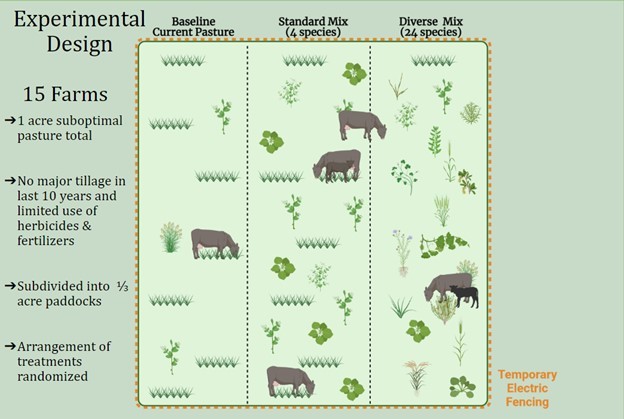
One of the OFT projects recently funded by NRCS is WVU’s Research Corporation – Diversifying Appalachia’s Pastures to Improve Soil Health. The objective of this soil health demonstration trial is to evaluate, simplify, and promote pasture diversification through reseeding as an innovative conservation strategy. To achieve this objective, our team will perform demonstration trials on the farms of fifteen pasture-based cattle producers across West Virginia. "We identified willing producers across a diverse range of climatic conditions, soil characteristics, and topographic regions," said Dr. Ember Morrissey, Assistant Professor of Environmental Microbiology, WVU Davis College's Division of Plant and Soil Sciences. Click here for a list of farms.
The on-farm trials will compare our proposed conservation practice of reseeding pasture with a highly diverse mixture (24 species) to unaltered pasture and conventional reseeding (with a commercially available mixture of 4 species). We will begin by renovating and seeding the trial's pastures this spring. The environmental benefits of the practice will be evaluated by monitoring the recommended soil health indicators, performing infield soil health assessments, and assigning pasture conditioning scores every year until at least 2025. The economic evaluation will include quantifying the economic costs (e.g. labor, seeds) and benefits (e.g. enhanced pasture productivity, increased soil carbon storage) of pasture diversification. Evaluation of the social impacts will leverage surveys and interviews to document the perceived benefits and challenges of the conservation practice throughout the on-farm trial.
This project aims to demonstrate that reseeding to increase pasture diversity provides a wide variety of environmental and economic benefits, hopefully facilitating the adoption of this innovative conservation practice. Click here for additional details on the project.
West Virginia Communities receive funding for Flood Protection and Rural Water Supply Projects through Infrastructure Investment and Jobs Act
Submitted by Andy Deichert, NRCS State Conservation Engineer and Donny Dodd, NRCS Water Resources Planning Specialist.
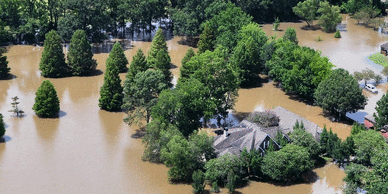
Several communities in West Virginia have received funding for flood protection and water supply infrastructure projects as part of the Bipartisan Infrastructure Law, also known as the Infrastructure Investment and Jobs Act (IIJA). These projects will help communities protect lives, property, and the watershed as a result of climate change and extreme weather events.
Watershed Rehabilitation projects in West Virginia focus on repairing existing infrastructure. The following projects were funded for planning phase work.
- North & South Mill Creek Site 3 (Grant Co.)
- North & South Mill Creek Site 4 (Grant Co.)
- Pocatalico Site 28 (Jackson Co.)
- Brush Creek Site 12 (Mercer Co.)
- Bonds Creek Site 1 (Ritchie Co.)
- Big Ditch Site 1 (Webster Co.)
Meanwhile, Watershed and Flood Prevention Operations projects in West Virginia focus on new infrastructure. The following projects were funded for preliminary investigation and feasibility reporting (PIFR). The PIFRs provide initial information and assist in determining if the project should advance to the planning phase.
- Daves Fork-Christian Fork Watershed (Mercer Co.)
- Harmon Creek Watershed (Brooke Co.)
- Marlin Run Watershed (Pocahontas Co.)
- Mill Creek Watershed (Jackson Co.)
- New Creek Watershed (Grant/Mineral Cos.)
- Patterson Creek Watershed (Grant/Mineral Cos.)
- Polk Creek Watershed (Lewis Co.)
- Salem Fork Watershed (Harrison Co.)
- Saltlick Creek Watershed (Braxton Co.)
- Sleepy Creek Watershed (Berkeley/Morgan Co.)
- South Fork River Watershed (Hardy/Pendleton Cos.)
- Town of Rainelle (Meadow River Watershed, Greenbrier Co.)
- Upper Buffalo Creek Watershed (Marion Co.)
- Upper Deckers Creek Watershed (Preston Co.)
- Upper Grave Creek Watershed (Marshall Co.)
- Warm Springs Run Watershed (Morgan Co.)
- Wolf Creek Watershed (Fayette Co.)
Click here for Infrastructure Investment and Jobs Act News Release
|
Pond Removal and Ecosystem Remediation Project — Raleigh County
Submitted by: Donny Dodd, NRCS Water Resources Planning Specialist; Katy McBride, NRCS Soil Conservationist; Joseph Wickline, NRCS Civil Engineer. Photo Credit: Joseph Wickline.
WWHS Ecosystem Remediation Finished Project
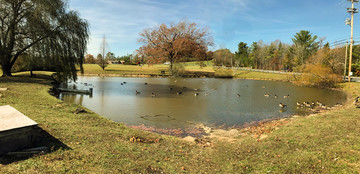
In the fall of 2019, NRCS was contacted about a possible ecosystem remediation project at Woodrow Wilson High School (WWHS) in Raleigh County. Local NRCS staff organized a meeting with the Woodrow Wilson High School Principal, Raleigh County Board of Education (RCBOE) and the Piney Creek Watershed Association (PCWA) to discuss resource concerns regarding the pond located in front of the school. The recommended remediation and goal were to drain the pond, establish hydric plants, and create conservation education opportunities for WWHS students.
The NRCS Beckley Area/Field office staff on the project were NRCS Civil Engineer, Joseph Wickline; NRCS Soil Conservationist and Acting District Conservationist, Katy McBride; NRCS Civil Engineer, Leslie Sears; NRCS Civil Engineering Technician, Rocky Wickline; and NRCS Pathways Engineer, Nikki Borglin. Cooperating partners and organizations on the project included the PCWA, RCBOE, WVDEP, WVDNR, and the Beckley Sanitary Board. Other partners and cooperating agencies included WVCA, WWHS faculty and students, the New River Master Gardeners, WVU Tech greenhouse, the Beckley Fire Department and AmeriCorps USFWS volunteers.
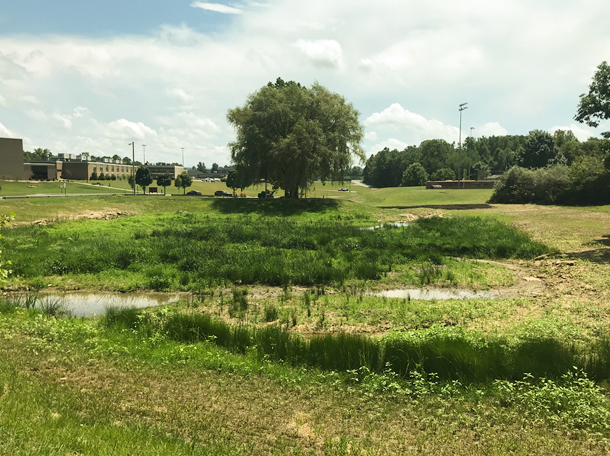
The construction was completed by ALLCON out of Beaver, West Virginia. Funding was funneled to PCWA through a US EPA Clean Water Act Section-319 grant. Pictured above: The pond before construction.
Project Design Specifics
- Drain pond, remove dam, and install a water control feature to convert the pond into an occasionally flooded wetland. Seed wetland with West Virginia wetland specific seed mix.
- Connect the wetland to a downstream outlet with a new channel feature and remove old principal spillway pipes.
- Restore drainage downstream of pond to a more “natural” condition by adjusting alignment to add meandering channel. Restore above ground channel from the parking lot to the wood line by regrading a formal channel.
- Use natural stream restoration structures and techniques to assist in realignment and use for potential educational opportunities.
- Construct pollinator habitat gardens in multiple locations surrounding the project area.
After much planning, revisions, approvals, permitting, and COVID delays, the wetland and stream enhancement portion of construction was completed in July 2021.
|
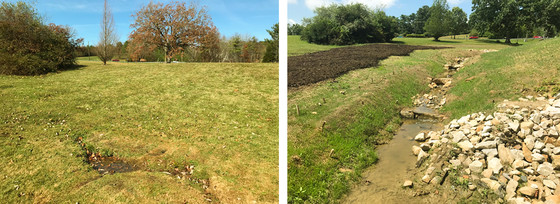 |
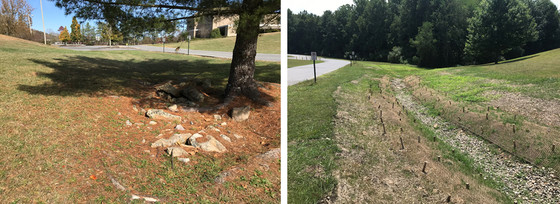
Pictured on left: Before=Dam; Pictured on right: After= Channel with Step Pools and Pollinator Garden
Additional Contributions
A Beckley Area Foundation Grant provided the materials for a butterfly garden, interpretive educational signage, and a walking bridge. The walking bridge was built and installed in the fall of 2021 by the Academy of Careers and Technology (ACT), a vocational school located next to WWHS. The Girl Scouts will be planting trees throughout the project area.
Pictured on left: Before – Looking Upstream; Pictured on right: After – Looking Downstream at end of Project
A Conservation Technical Assistance (CTA) Project in Capitol District, Kanawha County.
Submitted by: Dawn Lemle, Urban Ag and Soil Conservationist, Cross Lanes FO; Photo Credit: Dawn Lemle and Joe Cook.
Ken Ellis Memorial Park - after photo
This last summer I was invited to participate in SummerFest 2021 at Ken Ellis Memorial Park located at Campbell’s Creek, Kanawha County. As an NRCS Soil Conservationist for Capitol’s Conservation District, my goal that day was to help a growing interest in building a community garden and educate the public about soil health, gardens, and conservation. Joyce Jones, and her son KD, were working hard to drum up some interest in building a community garden on the property. Their goal was to help people learn more about how to grow their own food.
Little did we know that a chance meeting that day with the park’s Chairman of the Board, Joe Cook, would turn into a project supported by partnerships across the area. As the conversation turned from community gardens to drainage problems with standing water at the park, I knew that we could help the park in a different way.
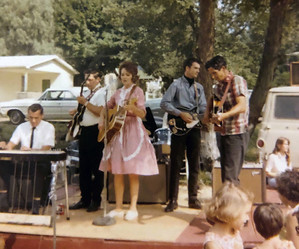
The Ken Ellis Memorial Park was established in 1967 and has been a staple to the community, offering a fun place for family and community alike to gather and create life-long memories. As I spoke with Joe about the park and the project, I quickly realized the rich history of the park and the potential it still holds. He spoke fondly of times he spent at the park as a child, watching his mother sing from the stage and his family gathering with other families. (pictured at left: Joe Cook's mother, Mary Ann Cook, performing at the park to raise funds for a stage).
|
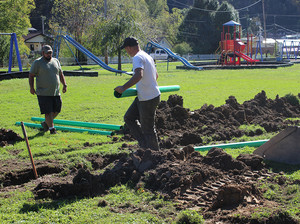
The standing water at the park would often be in front of the stage, making it a problem over the years. It would make a muddy mess when people would gather, which is not ideal. The Park is funded primarily by community support, donations, and grants. There was just not enough funding to address this issue properly without additional help.
After meeting, Joe was able to contact the local NRCS District Conservationist, Julie Stutler. Together, we were able to work on improving the drainage at the park site. NRCS was quickly able to have an engineer onsite to inspect the park, draw up a plan, and help get things started. NRCS Civil Engineering Technician, Rodney Sites, and the South Area engineering staff provided the design assistance.
|
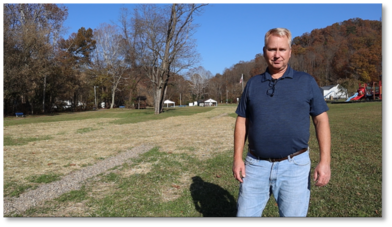
With a newly drawn engineering plan in hand, the next step would be finding the funding for the project and someone to complete it. With approval from the property owner, Amherst Coal Company, they would be able to move forward. Fortunately, in the parks favor, they were quickly able to secure a grant through TC Energy, and Dirtwork Solutions, LLC would be able to complete the work. Things rapidly turned from a casual conversation to a completed project! (pictured above: Park Chairman of the Board, Joe Cook).
|
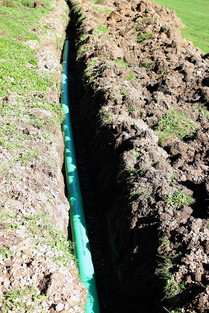
There is much more to be done on site and Joe hopes to be able to complete a few more new projects for park improvement. He has had the park surveyed by the National Parks and Recreation Services out of Morgantown, through a WVU grad project. The students were able to give the park some tips for future growth and purpose. We’re looking forward to helping them with future projects as well.
As we continue our work together, you’ll be hearing more about how all of our partnerships worked together to complete this project and many others just like it. We’re proud to serve in partnership with our local NRCS personnel and join with local businesses to meet the needs of our conservation efforts across the district. Chairman Hudson often says, “many hands, make the work light.” We all happen to agree!
|
Riparian Reforestation Efforts on Private Lands in the Cheat River Watershed
Submitted by: Madison Ball, Friends of the Cheat Restoration Program Manager. Photo Credit: Madison Ball.
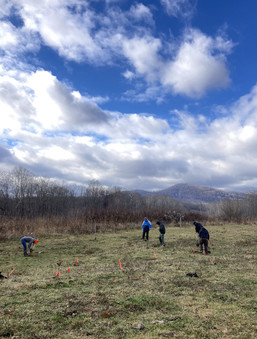
In Fall of 2019, Friends of the Cheat (FOC) entered into a cooperative agreement with NRCS to identify open riparian areas within the Upper Cheat, Lower Cheat, and Big Sandy Creek watersheds of the Cheat River.
The early stages of the project consisted of FOC mapping open riparian areas using ArcGIS software, then conducting on-the-ground reconnaissance to assess if sites would be viable for planting efforts.
FOC then created a scoring system for each subwatershed based on a multitude of variables, including pollutant impairment status, percent of public ownership from state or federal lands, number of tier-three trout stream miles, proximity to abandoned mine lands, and other factors.
|
Subwatersheds considered otherwise healthy, based on the factors above and/or that had partial protection from mixed public land ownership, were identified as priority subwatersheds for riparian reforestation. These subwatersheds include: Clover Run, Horseshoe Run, Saltlick Creek, Buffalo Creek, Minear Run, Licking Creek, and the Cheat River from Parsons to Rowlesburg.
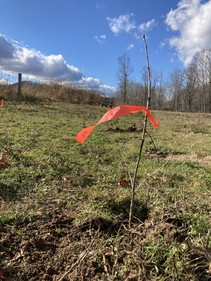
In 2020, with help from NRCS staff, FOC created a landowner mailer, which was sent to all addresses within the priority area described above. Since 2021, FOC has completed five plantings with private landowners on the Cheat River and tributaries to Clover Run. Only native species well adapted to each specific site are used in the plantings. Plans are shared with District Conservationists who provide guidance on the project. The work is completed with a mixture of FOC staff and local volunteers.
In order to boost outreach, FOC also ran a local ad in the Parsons Advocate newspaper, which led to several new landowner contacts. FOC has eight plantings scheduled for this spring across the priority area.
The project will continue until 2024 and FOC will continue to look to partner with interested landowners, who can be directed to Madison Ball, FOC Restoration Program Manager at madison@cheat.org if interested!
|
2022 Appalachian Grazing Conference
Submitted by WVCA Communication Specialist, Davin White. Photos by Davin White and NRCS Public Affairs Specialist, Becky Haddix.
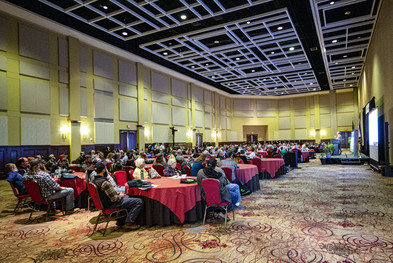
The 2022 Appalachian Grazing Conference returned to Morgantown for an in-person event for the first time since 2019, with high-density grazing expert Greg Judy delivering two keynote sessions on March 11 and March 12. The second keynote session was sponsored by USDA-NRCS.
The many partners involved with the 2022 Appalachian Grazing Conference were happy to host this year’s event in person, which had been in doubt even in early 2022.
Planning committee members were very pleased that more than 250 people registered and attended this year’s conference, not including speakers and about 65 FFA students.
|
This year, the Appalachian Grazing Conference celebrated its 10th event. The first conference was held in 2003 at Pipestem State Park in Mercer County and featured speakers that included Bob Evans, Jim Gerrish and Joel Salatin.
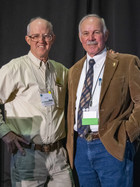
Judy, of Green Pastures Farm, was just one of the many great speakers this year. The AGC also was fortunate to have a wealth of knowledge from forage, soil and water resource experts from West Virginia University, as well, who spoke during the event.
Pictures on left: Greg Judy and Dr. Paul Lewis, Assistant Director of Outreach and Community Affairs for WVU Davis College,
Professor Emeritus of Animal & Nutritional Sciences, AGC planning committee member.
|
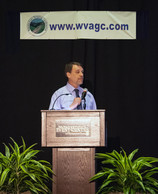
NRCS State Conservationist Jon Bourdon (pictured on right) spoke on Saturday, and grazing land specialist JB Harrold from Pennsylvania and J.B. Daniel, a forage and grassland agronomist from Farmville, Va., were two program speakers from NRCS who also presented at the conference.
|
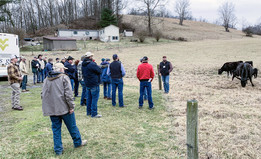
The three-day conference was boosted by a Thursday afternoon farm tour in southern Harrison County, at the farms of Richard Law and Quill Ward. (pictured on left).
|
The planning committee members for the Appalachian Grazing Conference are: the West Virginia Association of Conservation Districts; the West Virginia Conservation Agency; the WVU Cooperative Extension Service; the WVU Davis College of Agriculture, Natural Resources, and Design; the USDA-Natural Resources Conservation Service (West Virginia and Pennsylvania); the Pennsylvania Department of Agriculture; the State Conservation Commission, and the West Virginia Department of Agriculture.
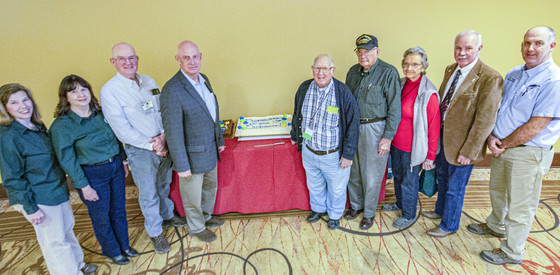 Pictured l-r: Regional Nutrient Management Program Coordinator for the PA Department of Agriculture, State Conservation Commission, Laurel Rush; NRCS Soil Conservationist, Barbara Greenleaf; WVU Extension Specialist, Ag and Natural Resources, Ed Rayburn, PhD; WV Department of Ag Commissioner, Kent Leonhart; WVACD Tygarts Valley District Supervisor, Joe Gumm; WVACD West Fork District Supervisor, Jim Foster, Earlene Foster; Assistant Director of Outreach and Community Affairs for WVU Davis College, Professor Emeritus of Animal & Nutritional Sciences, Paul Lewis; WVDA Deputy Commissioner, Joe Hatton.
Increased Demand for Contractors to Complete Conservation Forestry Jobs on West Virginia Private Lands
Submitted by Jane Capozzelli, Avian Partner Biologist, NRCS/WVDNR; Photo by Kyle Aldinger.
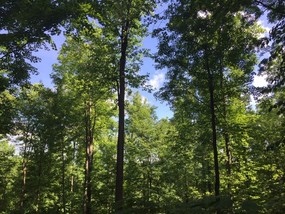
West Virginia landowners are looking to hire loggers or contractors for conservation forestry work. The demand is generated through several NRCS programs that provide technical and financial assistance for landowners who want to manage their forests.
Landowners who participate in NRCS programs are encouraged to hire independent forestry contractors to help implement certain conservation practices. With financial assistance from NRCS, landowner’s out-of-pocket costs are lowered and thus they are often able to hire independent contractors. (pictured: Conservation thinning with chainsaw. The objective was to create bird habitat, specifically for cerulean warblers).
Please share with your local loggers and contractors. Interested persons should contact their local NRCS Field Office to connect with landowners in their area. For more information about NRCS forestry assistance, contact Kyle Aldinger, Forestry Point of Contact at NRCS; Christopher Evans, NRCS Forester in northern West Virginia; or Carl Gower, NRCS Forester in southern West Virginia. Click here for contact information.
|
Announcements
-
John Perdue has been appointed FSA State Executive Director for West Virginia John Perdue arrives at USDA after a long career in public service. Perdue began his career with the West Virginia Department of Agriculture as a pesticide inspector. In 1989, he became the Executive Assistant to former West Virginia Governor Gaston Caperton and served as a member of his executive staff for eight years. In 1996, Mr. Perdue was elected as the 24th State Treasurer of West Virginia and served in that role for six terms. As State Treasurer, Mr. Perdue established SMART 529, a college savings plan designed to help West Virginians pay for college. By the time he left office, SMART 529 had amassed over three billion dollars, with more than 150,000 West Virginians vested in the program. John is a graduate of West Virginia University where he received a Bachelor of Science in Agriculture.
-
Ryan Thorn has been appointed Rural Development State Director for West Virginia Prior to joining USDA, Ryan Thorn served more than five years as Economic Development Manager for the Office of U.S. Senator Joe Manchin III. In this role, he worked with local, state, and federal stakeholders to attract new and expand existing businesses, strengthen public infrastructure, develop a skilled and ready workforce, and create economically diverse and resilient communities across the state. Thorn is a board member of the Southern West Virginia Community and Technical College Foundation. He holds a master’s degree from West Virginia University and a bachelor’s degree from West Virginia Wesleyan College.
-
Cerulean Warbler Habitat in West Virginia Map – A statewide map plus a map for each conservation district has been created. Click here for the West Virginia Cerulean Warbler Habitat Map. This map was created from data in The Second Atlas of Breeding Birds in West Virginia, completed by the West Virginia Division of Natural Resources in 2021, which provided data estimating the density of Cerulean Warblers in the landscape. The warbler density data was overlaid with local landmarks including cities, towns, rivers, and roads to orient in the Conservation Districts. The purpose of this map is to aid in determining whether a property may be a good fit for a Cerulean Warbler forestland enhancement project or when to refer a landowner to a Partner Avian Biologist. For more information contact Jane Capozzelli, Avian Partner Biologist, NRCS/WVDNR, jane.capozzelli@usda.gov
Environmental Defense Fund
USDA WV Farm Service Agency
WV Association of Conservation Districts
WV Department of Agriculture
WV Poultry Association
USDA Rural Development
US Environmental Protection Agency
WV Department of Health and Human Resources
WV National Guard
WV Rivers Coalition
WV Rural Water Association
WV University
WVU Potomac State University
WVU Potomac State University
WV Agricultural Land Protection Authority
WV Land Trust
US Fish and Wildlife Service
WVU Wildlife & Fisheries Resources
WV Division of Forestry
WVU Extension
USDA Forest Service
WV Association of RC&D Councils
WV Farm Bureau
WV Farmland Protection
WV Conservation Agency
American Bird Conservancy
The National Wild Turkey Federation
The Nature Conservancy
Trout Unlimited
WV Division of Natural Resources
WV Dept. of Environmental Protection
WV State University
Risk Management Agency
WVU College of Law
Send your submissions to rebecca.haddix@usda.gov
|