
|
|
Lonoke/Pulaski - March 31, 2022
|
|
|
|
Farm Service Agency | Natural Resources Conservation Service | Risk Management Agency
|
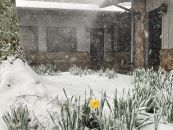
From the image on the right, you may think I visited a USDA Service Center in Michigan; however, that is not the case. This picture was taken when I left the Lonoke office on the evening of March 11. The daffodil sure does look lonely, and cold. Since then, only one more daffodil has bloomed; they may not be a big fan of snow and ice.
For some of you the busyness of spring has already started with livestock being born and the work associated with cool season fruit and vegetable production. And, I imagine others are chomping at the bit to get to the fields. I have always been amazed that, with the passage of a 7 day period in spring, a farmer/rancher/beekeeper/etc. would go from being caught up on work to 3 weeks behind, which is how I define the busyness of spring.
By the way, did any of you notice the hidden icon in the last newsletter? It was a question mark in a square. Well, it was not exactly hidden and I still don't know what happened. I guess I experienced a "technical difficulty" and hopefully it was a one time occurrence.
Enough rambling, time for business...
Below is an article about the current CRP Grassland and Continuous signups. If you are interested or think you are interested, call Lucy. She has the information needed for you to determine if CRP will help you meet your goals.
In order to get relevant and current information out to producers, FSA will be conducting webinars again this year. See the list for upcoming topics and dates.
Till next time,
Paul
Important Dates
|
Grassland CRP Signup Opens
|
April 4, 2022
|
|
Spot Market Hog Pandemic Program (SMHPP) Deadline
|
April 29, 2022
|
|
Grassland CRP Signup Deadline
|
May 13, 2022
|
|
Final date to Report 2022 Spring Seeded & All Other Crops
|
July 15, 2022
|
|
Continuous CRP Signup
|
Ongoing
|
|
|
|
|
FINAL DATES for PREVENTED PLANTED ACREAGE
|
|
|
Corn
|
May 10, 2022
|
|
Grain Sorghum
|
May 30, 2022
|
|
Rice
|
June 9, 2022
|
|
Upland Cotton
|
June 9, 2022
|
|
Soybeans Not Following Another Crop (NFAC)
|
June 30, 2022
|
|
Soybeans Following Another Crop (FAC)
|
July 10, 2022
|
|
|
|
|
RECURRING ITEMS
|
|
|
FAILED ACRES should be reported using form CCC-576, Notice of Loss. This must be filed, and a field visit made by FSA before disposition of the crop to be considered eligible for history. For losses on crops covered by the Non-Insured Crop Disaster Assistance Program (NAP), producers must file a Notice of Loss within 15 days of the occurrence of the disaster or when losses become apparent. Producers must timely file a Notice of Loss for failed acres on all crops including grasses. Please call the office an make an appointment to file failed acres.
|
15 Days of the occurrence of the disaster
|
|
Final date to inform FSA of crop losses
|
Before Crop Disposition
|
|
Sign-up continues for Disaster Assistance Programs: Livestock Indemnity Program (LIP), Emergency Assistance for Livestock, Honeybees, and Farm-Raised Fish Program (ELAP). Submit notice of loss within 15 calendar days of when the loss is apparent.
|
Continuing
|
|
Agricultural producers and landowners can sign up soon for the Conservation Reserve Program (CRP), a cornerstone conservation program offered by the U.S. Department of Agriculture (USDA) and a key tool in the Biden-Harris Administration effort to address climate change and achieve other natural resource benefits. The Grassland CRP signup will run from April 4 to May 13 and the Continuous CRP signup is ongoing.
Producers and landowners enrolled 4.6 million acres into CRP signups in 2021, including 2.5 million acres in the largest Grassland CRP signup in history. There are currently 22.1 million acres enrolled, and FSA is aiming to reach the 25.5-million-acre cap statutorily set for fiscal year 2022.
Grassland CRP is a working lands program, helping landowners and operators protect grassland, including rangeland and pastureland and certain other lands, while maintaining the areas as working grazing lands. Protecting grasslands contributes positively to the economy of many regions, provides biodiversity of plant and animal populations and provides important carbon sequestration benefits to deliver lasting climate outcomes.
Climate Benefits
Last year, FSA enacted a Climate-Smart Practice Incentive for CRP General and Continuous signups, to better target CRP on addressing climate change. This incentive aims to increase carbon sequestration and reduce greenhouse gas emissions. CRP’s climate-smart practices include establishment of trees and permanent grasses, development of wildlife habitat and wetland restoration. The Climate-Smart Practice Incentive is annual, and the amount is based on the benefits of each practice type.
Additionally, in order to better target the program toward climate outcomes, USDA invested $10 million last year in the CRP Monitoring, Assessment and Evaluation (MAE) program to measure and monitor the soil carbon and climate resilience impacts of conservation practices over the life of new CRP contracts. This will enable the agency to further refine the program and practices to provide producers tools for increased climate resilience.
More Information on CRP
Landowners and producers interested in CRP should contact their local USDA Service Center to learn more or to apply for the Grassland CRP before the May 13 deadline. Additionally, fact sheets and other resources are available at fsa.usda.gov/crp.
Signed into law in 1985, CRP is one of the largest voluntary private-lands conservation programs in the United States. It was originally intended to primarily control soil erosion and potentially stabilize commodity prices by taking marginal lands out of production. The program has evolved over the years, providing many conservation and economic benefits.
|
Tuesday, April 19th 10:00 - 11:00 a.m. - Safety Net and Disaster Programs The meeting will provide an overview of the safety net and disaster programs available through FSA. Click here to join the virtual meeting or for audio only call 1-202-650-0123 and enter this code, 130769479#
Tuesday, May 17th 10:00 11:00 a.m. – Youth Loan Programs Please join us for a presentation on the youth loan programs available through FSA. Click here to join the virtual meeting or for audio only call 1-202-650-0123 and enter this code, 826513715#
Thursday, May 26th 10:00-11:00 – Youth Loan Program Also updates on Arkansas Agriculture from Wes Ward, Secretary, Arkansas Dept. of Agriculture. Click here to join the virtual meeting or for AUDIO ONLY CALL - 202-650-0123 and enter this code: 307 597 909#
|
|
|
|
Lonoke/Pulaski County USDA Service Center
Lonoke Service Center
1300 N Center St, Lonoke, AR 72086
Pulaski County NRCS
Arvest Bank Building, 4004McCain Blvd, Ste 201, North Little Rock, AR 72116
|
Lonoke/Pulaski County FSA
County Executive Director
Paul Casey
501-676-5116 X 2
paul.casey@usda.gov
|
Lonoke County NRCS
District Conservationist
Robert Smith
501-676-5116 X 3
robert.smith@usda.gov
|
|
FSA Farm Loan Manager
Tammy Jones
tammy.jones@usda.gov
FSA Farm Loan Officer
Jessica Willis
jessica.willis@usda.gov
|
Pulaski County NRCS
District Conservationist
Kennard Williams
501-758-2544 x 3
kennard.williams@usda.gov
|
FSA Program Technicians
Samantha Davis
Lucy Fitts
Darrell Park
Paul Wolf
|
FSA County Committee Meeting:
COC meetings are held on the third Wednesday of the month at 1:00 p.m. on an as needed basis.
|
|
County Committee Members
Chad Webb - Chair
Scott Mitchell - Vice Chair
Gary Bredlow
Dewayne Burns
Nolan McCoy
Debra Moreland
|
If you need to request an accommodation (e.g., an interpreter, translator, seating arrangements, etc.) or materials in an alternative format (e.g., Braille, large print, audiotape – captioning, etc.), please contact Paul Casey at 501-676-5116 ext. 2.
|
|
|







