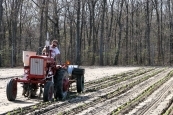
The Noninsured Crop Disaster Assistance Program (NAP) provides financial assistance to you for crops that aren’t eligible for crop insurance to protect against lower yields or crops unable to be planted due to natural disasters including freeze, hail, excessive moisture, excessive wind or hurricanes, flood, excessive heat and qualifying drought (includes native grass for grazing), among others.
In order to participate, you must obtain NAP coverage for the crop year by the applicable deadline using form CCC-471 “Application for Coverage” and pay the service fee. Application closing dates vary by crop. Producers are also required to submit an acceptable crop acreage report. Additionally, NAP participants must provide:
- The quantity of all harvested production of the crop in which the producer held an interest during the crop year
- The disposition of the harvested crop, such as whether it is marketable, unmarketable, salvaged or used differently than intended
- Acceptable crop production records (when requested by FSA)
Producers who fail to report acreage and production information for NAP-covered crops could see reduced or zero NAP assistance. These reports are used to calculate the approved yield.
If your NAP-covered crops are affected by a natural disaster, notify your FSA office by completing Part B of form CCC-576 “Notice of Loss and Application for Payment.” This must be completed within 15 calendar days of the occurrence of the disaster or when losses become apparent or 15 days of the final harvest date. For hand-harvested crops and certain perishable crops, you must notify FSA within 72 hours of when a loss becomes apparent.
To receive benefits, you must also complete Parts D, E, F and G of the CCC-576 “Notice of Loss and Application for Payment” within 60 days of the last day of coverage for the crop year for any NAP covered crops. The CCC-576 requires acceptable appraisal information. Producers must provide evidence of production and note whether the crop was marketable, unmarketable, salvaged or used differently than intended.
Eligible crops must be commercially produced agricultural commodities for which crop insurance is not available, including perennial grass forage and grazing crops, fruits, vegetables, mushrooms, floriculture, ornamental nursery, aquaculture, turf grass, ginseng, honey, syrup, bioenergy, and industrial crops.
For more information on NAP, contact the Hackettstown USDA Service Center at (908) 852-2576 or visit fsa.usda.gov/nap.
|
Agriculture Secretary Tom Vilsack selected 12 members to serve on the USDA’s inaugural Secretary’s Advisory Committee for Urban Agriculture to provide input on policy development and to help identify barriers to urban agriculture as USDA works to promote urban farming and the economic opportunities it provides in cities across the country.
The new Secretary’s Advisory Committee is part of USDA’s efforts to support urban agriculture, creating a network for feedback. Urban agriculture plays an important role in producing fresh, healthy food in areas where grocery stores are scarce, and also provides jobs and beautifies neighborhoods.
The Committee is made up of agricultural producers, and representatives from the areas of higher education or extension programs, non-profits, business and economic development, supply chains and financing.
Members include:
-
Jerry Ann Hebron, Mich., Urban Producer
-
Bobby Wilson, Ga., Urban Producer
-
Viraj Puri, N.Y., Innovative Producer
-
Kaben Smallwood, Okla., Innovative Producer
-
Sally Brown, Wash., Higher Education
-
John Erwin, Md., Higher Education
-
Carl Wallace, Ohio, Non-Profit Representative
-
John Lebeaux, Mass., Business and Economic Development Representative
-
Zachari Curtis, D.C., Supply Chain Experience
-
Allison Paap, Calif., Financing Entity Representative
-
Tara Chadwick, Fla., Related Experience
-
Angela Mason, Ill., Related Experience
USDA and the Office of Urban Agriculture and Innovative Production peer reviewed more than 300 nominees, and Vilsack made the final selections. Selections ensured geographic, racial and gender diversity and a broad range of agricultural experience. The new members will serve terms of one to three years. More information is available at farmers.gov/urban and the new Federal Advisory Committee for Urban Agriculture website at www.usda.gov/partnerships/advisory-committee-urban-ag-innovative-production.
USDA has extended the comment period deadline contained in the proposed rule for the Apple Crop Provisions through April 15, 2022. USDA’s Risk Management Agency (RMA) originally announced the publication of a proposed rule in the Federal Register to amend the Apple Crop Provisions in December 2021. The proposed changes are based on stakeholder feedback and recommended changes from a contracted study on the apple crop insurance program. Following feedback from the proposed rule, RMA will publish a final rule that is expected to be effective for the 2024 crop year.
RMA is proposing to make changes to the apple crop insurance program that:
- Enable producers to elect different coverage levels and percent of price elections by type, which allows producers to manage individual coverage and price risk more effectively.
- Allow producers’ premiums to be reduced in response to orchard management practices, such as removing or grafting trees, that typically occur after the acreage reporting date and decrease an orchard’s productivity.
- Allow producers to insure at a higher price for apples sold predominantly to direct markets or premium processing markets.
- Exclude apples sold for the slicer market from being considered “fresh apple production.”
- Introduce a fresh fruit factor to account for the reduced market value of production insured under the Quality Option sold for a grade other than U.S. Fancy.
Interested parties can submit comments via the Federal Register.
Crop insurance is sold and delivered solely through private crop insurance agents. A list of crop insurance agents is available at all USDA Service Centers and online at the RMA Agent Locator. Learn more about crop insurance and the modern farm safety net at rma.usda.gov.
The Farm Service Agency (FSA) assists beginning farmers to finance agricultural enterprises. Under these designated farm loan programs, FSA can provide financing to eligible applicants through either direct or guaranteed loans. FSA defines a beginning farmer as a person who:
- Has operated a farm for not more than 10 years
- Will materially and substantially participate in the operation of the farm
- Agrees to participate in a loan assessment, borrower training and financial management program sponsored by FSA
- Does not own a farm in excess of 30 percent of the county’s average size farm.
For more information contact, contact your Hackettstown USDA Service Center at (908) 852-2576or visit fsa.usda.gov.
|