
Agriculture Secretary Tom Vilsack announced on February 7 that the U.S. Department of Agriculture is delivering on its promise to expand markets by investing $1 billion in partnerships to support America’s climate-smart farmers, ranchers and forest landowners. The new Partnerships for Climate-Smart Commodities opportunity will finance pilot projects that create market opportunities for U.S. agricultural and forestry products that use climate-smart practices and include innovative, cost-effective ways to measure and verify greenhouse gas benefits. USDA is now accepting project applications for fiscal year 2022.
For the purposes of this funding opportunity, a climate-smart commodity is defined as an agricultural commodity that is produced using agricultural (farming, ranching or forestry) practices that reduce greenhouse gas emissions or sequester carbon.
Funding will be provided to partners through the USDA’s Commodity Credit Corporation for pilot projects to provide incentives to producers and landowners to:
- implement climate-smart production practices, activities, and systems on working lands,
- measure/quantify, monitor and verify the carbon and greenhouse gas (GHG) benefits associated with those practices, and
- develop markets and promote the resulting climate-smart commodities.
Funding will be provided in two funding pools, and applicants must submit their applications via Grants.gov by 11:59 p.m. Eastern Time on:
- April 8, 2022, for the first funding pool (proposals from $5 million to $100 million), and
- May 27, 2022, for the second funding pool (proposals from $250,000 to $4,999,999).
A wide range of organizations may apply, but the primary applicant must be an entity, not an individual.
USDA is committed to equity in program delivery and is specifically seeking proposals from entities serving all types of producers, including small or historically underserved producers.
Visit usda.gov for additional information including Partnerships for Climate-Smart Commodities and resources to support your application.
Secretary Tom Vilsack announced on February 7 that the U.S. Department of Agriculture is delivering on its promise to expand markets by investing $1 billion in partnerships to support America’s climate-smart farmers, ranchers and forest landowners. The new Partnerships for Climate-Smart Commodities opportunity will finance pilot projects that create market opportunities for U.S. agricultural and forestry products that use climate-smart practices and include innovative, cost-effective ways to measure and verify greenhouse gas benefits. USDA is now accepting project applications for fiscal year 2022.
For the purposes of this funding opportunity, a climate-smart commodity is defined as an agricultural commodity that is produced using agricultural (farming, ranching or forestry) practices that reduce greenhouse gas emissions or sequester carbon.
Funding will be provided to partners through the USDA’s Commodity Credit Corporation for pilot projects to provide incentives to producers and landowners to:
- implement climate-smart production practices, activities, and systems on working lands,
- measure/quantify, monitor and verify the carbon and greenhouse gas (GHG) benefits associated with those practices, and
- develop markets and promote the resulting climate-smart commodities.
Funding will be provided in two funding pools, and applicants must submit their applications via Grants.gov by 11:59 p.m. Eastern Time on:
- April 8, 2022, for the first funding pool (proposals from $5 million to $100 million), and
- May 27, 2022, for the second funding pool (proposals from $250,000 to $4,999,999).
A wide range of organizations may apply, but the primary applicant must be an entity, not an individual.
USDA is committed to equity in program delivery and is specifically seeking proposals from entities serving all types of producers, including small or historically underserved producers.
Visit usda.gov for additional information including Partnerships for Climate-Smart Commodities and resources to support your application.
|
Does your operation include specialty crops? Whether you grow fruits, vegetables, tree nuts, dried fruits, horticulture, or nursery crops - USDA is here for you.
Over the past year, USDA has stepped up our support of specialty crop producers and local and regional food systems. USDA believes specialty crop producers are integral to the food system of the future, and we are working to improve available options for specialty crop producers as well as ensure equity in program delivery.
What’s New?
The Risk Management Agency (RMA) rolled out a new insurance option for small-scale producers who sell locally, which is named Micro Farm. This new insurance coverage option simplifies record keeping and covers post-production costs, such as washing and value-added products. It is available now, and you can learn more from an Approved Insurance Provider or your RMA specialty crop liaison.
In addition to Micro Farm, RMA rolled out other new insurance options in the past year, including: California Citrus Trees, Florida Citrus, Production and Revenue History option for Florida strawberries, and Hurricane Insurance Protection-Wind Index (HIP-WI). These new options either fill gaps in coverage or offer advantages over other policies. Since 2020, producers weathered several major hurricanes. The new HIP-WI played a crucial role in recovery with more than $250 million in indemnities paid so far with most payments issued in a matter of weeks following a hurricane.
Interest in growing and insuring specialty crops has grown significantly with $1 billion in liabilities for 1990 to $22 billion in liabilities for 2021. (For more details, check out reports on our Specialty Crops webpage.)
The Farm Service Agency (FSA) also offered pandemic assistance for organic producers. The new Organic and Transitional Education and Certification Program (OTECP) provided assistance to help cover loss of markets, increased costs, labor shortages and expenses related to obtaining or renewing their organic certification.
What’s Improved?
In the past year, RMA made improvements to existing policies -- including Whole-Farm Revenue Protection, a key insurance option for specialty crop producers. Beginning in the 2021 crop year, direct market producers could report two or more commodities using a new combined direct marketing code.
This reduced a tremendous burden for diversified producers and allowed them to receive a premium rate discount for diversification. For 2022, RMA increased coverage for organic and aquaculture producers and enabled organic producers to report certified organic acreage as long as the request for certification had been made by the reporting date, which provides additional flexibility to producers.
Want to Learn More?
These new and improved options for specialty crop producers are but a few of USDA’s strides over the past year to build a fairer, more transparent food system rooted in local and regional production. To learn more, please read USDA’s January 19, 2022, news release.
For crop insurance, visit RMA’s Specialty Crops webpage or contact your specialty crop liaison.
Also, if there is not a standard offer for the crop you would like insured, you may still be able to get a written agreement for coverage. RMA Regional Offices review these requests to help provide coverage. These requests also provide Regional Offices the opportunity to review the possible expansion of the policy to your county.
Lastly, you can read our Specialty Crops webpage on farmers.gov and question-and-answer with two specialty crop liaisons, Adrienne Steinacher and Matt Wilkin.
|
Agricultural producers and landowners can sign up soon for the Conservation Reserve Program (CRP), a cornerstone conservation program offered by the U.S. Department of Agriculture (USDA) and a key tool in the Biden-Harris Administration effort to address climate change and achieve other natural resource benefits. The General CRP signup will run from Jan. 31 to March 11, and the Grassland CRP signup will run from April 4 to May 13.
Producers and landowners enrolled 4.6 million acres into CRP signups in 2021, including 2.5 million acres in the largest Grassland CRP signup in history. There are currently 22.1 million acres enrolled, and FSA is aiming to reach the 25.5-million-acre cap statutorily set for fiscal year 2022.
CRP Signups
General CRP helps producers and landowners establish long-term, resource-conserving plant species, such as approved grasses or trees, to control soil erosion, improve water quality and enhance wildlife habitat on cropland.
Meanwhile, Grassland CRP is a working lands program, helping landowners and operators protect grassland, including rangeland and pastureland and certain other lands, while maintaining the areas as working grazing lands. Protecting grasslands contributes positively to the economy of many regions, provides biodiversity of plant and animal populations and provides important carbon sequestration benefits to deliver lasting climate outcomes.
Alongside these programs, producers and landowners can enroll acres in Continuous CRP under the ongoing sign up, which includes projects available through the Conservation Reserve Enhancement Program (CREP) and State Acres for Wildlife Enhancement (SAFE).
Climate Benefits
Last year, FSA enacted a Climate-Smart Practice Incentive for CRP General and Continuous signups, to better target CRP on addressing climate change. This incentive aims to increase carbon sequestration and reduce greenhouse gas emissions. CRP’s climate-smart practices include establishment of trees and permanent grasses, development of wildlife habitat and wetland restoration. The Climate-Smart Practice Incentive is annual, and the amount is based on the benefits of each practice type.
Additionally, in order to better target the program toward climate outcomes, USDA invested $10 million last year in the CRP Monitoring, Assessment and Evaluation (MAE) program to measure and monitor the soil carbon and climate resilience impacts of conservation practices over the life of new CRP contracts. This will enable the agency to further refine the program and practices to provide producers tools for increased climate resilience.
More Information on CRP
Landowners and producers interested in CRP should contact their local USDA Service Center to learn more or to apply for the program -- for General CRP before the March 11 deadline, and for Grassland CRP before the May 13 deadline. Service Center staff continue to work with agricultural producers via phone, email, and other digital tools. Due to the pandemic, some USDA Service Centers are open to limited visitors. Additionally, fact sheets and other resources are available at fsa.usda.gov/crp.
Signed into law in 1985, CRP is one of the largest voluntary private-lands conservation programs in the United States. It was originally intended to primarily control soil erosion and potentially stabilize commodity prices by taking marginal lands out of production. The program has evolved over the years, providing many conservation and economic benefits.
On your own land, you’ve probably seen evidence that climate change is happening – things like extreme weather events or changes in growing seasons over the years. America’s rural communities are on the frontlines of climate change, and now is the time for agriculture, forestry, and rural communities to act.
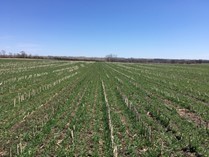
There are various ways to help mitigate the effects of climate change on your land and improve your bottom line at the same time. One very effective way is by planting cover crops.
Cover crops offer agricultural producers a natural and inexpensive climate solution through their ability to capture atmospheric carbon dioxide (CO2) into soils. But cover crops don’t just remove CO2 from the atmosphere, they also help make your soil healthier and your crops more resilient to a changing climate.
Healthy soil has better water infiltration and water holding capacity and is less susceptible to erosion from wind and water.
Cover crops also trap excess nitrogen – keeping it from leaching into groundwater or running off into surface water – releasing it later to feed growing crops. This saves you money on inputs like water and fertilizer and makes your crops more able to survive in harsh conditions.
USDA’s Cover Crop Support
During the past year, USDA has made a number of strides to encourage use of cover crops. Earlier this month, USDA’s Natural Resources Conservation Service (NRCS) formed a new partnership with Farmers For Soil Health. We also launched a new Cover Crop Initiative in 11 states through the Environmental Quality Incentives Program (EQIP), targeted $38 million to help producers mitigate climate change through adoption of cover crops.
In fiscal 2021, NRCS provided technical and financial assistance to help producers plant 2.3 million acres of cover crops through EQIP.
We’ve also recognized the importance of supporting cover crops through crop insurance. USDA’s Risk Management Agency (RMA) recently provided $59.5 million in premium support for producers who planted cover crops on 12.2 million acres through the new Pandemic Cover Crop Program. Additionally, RMA recently updated policy to allow producers with crop insurance to hay, graze or chop cover crops at any time and still receive 100% of the prevented planting payment. This policy change supports use of cover crops, which can help producers build resilience to drought. Visit RMA’s Conservation webpage to learn more.
Working together, we can lead the way through climate-smart solutions that will improve the profitability and resilience of producers and foresters, open new market opportunities, and build wealth that stays in rural communities. Our support for cover crops are part of a much broader effort at USDA to address climate change. To learn more, read USDA’s January 18, 2022 news release.
Cover crops are not only good for rural communities, but also for urban areas. Late last year, the NRCS National Plant Materials Center planted cover crops in the urban garden in front of USDA’s Washington, D.C. Headquarters. See how cover crops are also great for the urban farmer or backyard gardener.
To learn more, visit farmers.gov/conserve/soil-health, watch our Conservation at Work video on cover crops, or contact your local USDA Service Center.
Farm loan borrowers who have pledged real estate as security for their Farm Service Agency (FSA) direct or guaranteed loans are responsible for maintaining loan collateral. Borrowers must obtain prior consent or approval from FSA or the guaranteed lender for any transaction that affects real estate security. These transactions include, but are not limited to:
- Leases of any kind
- Easements of any kind
- Subordinations
- Partial releases
- Sale
Failure to meet or follow the requirements in the loan agreement, promissory note, and other security instruments could lead to nonmonetary default which could jeopardize your current and future loans.
It is critical that borrowers keep an open line of communication with their FSA loan staff or guaranteed lender when it comes to changes in their operation. For more information on borrower responsibilities, read Your FSA Farm Loan Compass.
The USDA Farm Service Agency’s (FSA) Direct Farm Ownership loans can help farmers and ranchers become owner-operators of family farms, improve and expand current operations, increase agricultural productivity, and assist with land tenure to save farmland for future generations.
There are three types of Direct Farm Ownership Loans: regular, down payment and joint financing. FSA also offers a Direct Farm Ownership Microloan option for smaller financial needs up to $50,000.
Joint financing allows FSA to provide more farmers and ranchers with access to capital. FSA lends up to 50 percent of the total amount financed. A commercial lender, a State program or the seller of the property being purchased, provides the balance of loan funds, with or without an FSA guarantee. The maximum loan amount for a joint financing loan is $600,000, and the repayment period for the loan is up to 40 years.
The operation must be an eligible farm enterprise. Farm Ownership loan funds cannot be used to finance nonfarm enterprises and all applicants must be able to meet general eligibility requirements. Loan applicants are also required to have participated in the business operations of a farm or ranch for at least three years out of the 10 years prior to the date the application is submitted. The applicant must show documentation that their participation in the business operation of the farm or ranch was not solely as a laborer.
For more information about farm loans, contact your local County USDA Service Center or visit fsa.usda.gov.
|

|
Selected Interest Rates for
March 2022
|
|
90-Day Treasury Bill 0.125%
|
|
|
Farm Operating Loans — Direct 2.375%
|
|
|
Farm Ownership Loans — Direct 3.00%
|
|
|
Farm Ownership Loans — Direct Down Payment,
Beginning Farmer or Rancher 1.50%
|
|
|
Emergency Loans 3.375%
|
|
|
Farm Storage Facility Loans
(7 years) 1.875%
|
|
| |
|
| |
|
|
|