
|
|
Vermont FSA Newsletter - March 24, 2022
|
|
|
In This Issue:
|

I am writing my first contribution to our FSA Newsletter as the new State Executive Director. It is with a strong sense of commitment to Vermont’s farmers and to the hardworking staff of FSA that I do this job. I hope as time passes to become fully cognizant with the full range of programs that we offer and help to keep you informed. At this time though, because of an impending sign up deadline on March 25th, I want to urge all dairy farmers to sign up for the Dairy Margin Coverage Program (DMC). DMC continues to offer protection to dairy producers when the difference between the all-milk price and the average feed price (the margin) falls below a certain dollar amount selected by the producer. The mailbox price for each hundredweight of milk dairy farmers produce has fluctuated wildly, certainly over the last decade or so. Although the predictions are for a fairly robust milk price for this year it really is the costs that you need to track carefully. The pandemic has caused some additional stresses on cost of production, falling demand and supply issues has already had an impact on the cost of fuel, amongst other things. In the last three weeks everything has been thrown into turmoil by the unjust invasion of Ukraine by Russia. The resulting disruption of the valuable commodities, for example wheat and sunflowers, from Ukraine and the economic sanctions on Russia, effecting fuel and fertilizer in particular, is likely to drive feed costs up. A benefit for Vermont dairy farmers is that the Governor and Legislature have agreed to reimburse the Tier 1 level of premium to our dairy farmers, this is important. I urge you all to sign up and protect yourselves to some degree from the potential uncertainty ahead.
|
John D. E. Roberts
|
|
State Executive Director
|
|

The Orleans County Farm Service Agency (FSA) is accepting applications to fill two permanent Program Technician positions. All candidates must be U.S. Citizens, high school graduates or the equivalent. The individual selected will be responsible for carrying out general office activities, and technical functions pertaining to FSA administered programs. Applicants should possess excellent human relations skills as well as strong clerical and computer skills. A general knowledge of agricultural practices would also be beneficial. The selected applicant must undergo a background investigation. The full vacancy announcement can be obtained via USAJOBS at https://www.usajobs.gov/job/641823500 by accessing vacancy announcement number FSACO-11420719-22-VT-RW. The closing date for this announcement is 3/28/22. For additional information, please contact Lana Walden, Administrative Officer at (802) 658-2803.
|
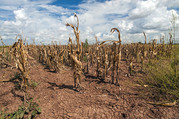
This is likely no surprise to you, but drought persists across the western U.S. and is intensifying in some areas. No geographic area is immune to the potential of drought at any given time. The U.S. Drought Monitor provides a weekly drought assessment, and it plays an important role in USDA programs that help farmers and ranchers recover from drought.
Fact #1 - Numerous agencies use the Drought Monitor to inform drought-related decisions.
The map identifies areas of drought and labels them by intensity on a weekly basis. It categorizes the entire country as being in one of six levels of drought. The first two, None and Abnormally Dry (D0), are not considered to be drought. The next four describe increasing levels of drought: Moderate (D1), Severe (D2), Extreme (D3) and Exceptional (D4).
While many entities consult the Drought Monitor for drought information, drought declarations are made by federal, state and local agencies that may or may not use the Drought Monitor to inform their decisions. Some of the ways USDA uses it to determine a producer’s eligibility for certain drought assistance programs, like the Livestock Forage Disaster Program and Emergency Haying or Grazing on Conservation Reserve Program acres and to “fast-track” Secretarial drought disaster designations.
Fact #2 - U.S. Drought Monitor is made with more than precipitation data.
When you think about drought, you probably think about water, or the lack of it. Precipitation plays a major role in the creation of the Drought Monitor, but the map’s author considers numerous indicators, including drought impacts and local insight from over 450 expert observers around the country. Authors use several dozen indicators to assess drought, including precipitation, streamflow, reservoir levels, temperature and evaporative demand, soil moisture and vegetation health. Because the drought monitor depicts both short and long‐term drought conditions, the authors must look at data for multiple timeframes. The final map produced each week represents a summary of the story being told by all the pieces of data. To help tell that story, authors don’t just look at data. They converse over the course of the map-making week with experts across the country and draw information about drought impacts from media reports and private citizens.
Fact #3 - A real person, using real data, updates the map.
Each week’s map author, not a computer, processes and analyzes data to update the drought monitor. The map authors are trained climatologists or meteorologists from the National Drought Mitigation Center at the University of Nebraska-Lincoln (the academic partner and website host of the Drought Monitor), the National Oceanic and Atmospheric Administration and USDA. The author’s job is to do what a computer can’t – use their expertise to reconcile the sometimes-conflicting stories told by each stream of data into a single assessment.
Fact #4 - The Drought Monitor provides a current snapshot, not a forecast.
The Drought Monitor is a “snapshot” of conditions observed during the most recent week and builds off the previous week’s map. The map is released on Thursdays and depicts conditions based on data for the week that ended the preceding Tuesday. Rain that falls on the Wednesday just before the USDM’s release won’t be reflected until the next map is published. This provides a consistent, week‐to‐week product and gives the author a window to assess the data and come up with a final map.
Fact #5 – Your input can be part of the drought-monitoring process.
State climatologists and other trained observers in the drought monitoring network relay on-the-ground information from numerous sources to the US Drought monitor author each week. That can include information that you contribute.
The Drought Monitor serves as a trigger for multiple forms of federal disaster relief for agricultural producers, and sometimes producers contact the author to suggest that drought conditions in their area are worse than what the latest drought monitor shows. When the author gets a call like that, it prompts them to look closely at all available data for that area, to see whether measurements of precipitation, temperature, soil moisture and other indicators corroborate producer-submitted reports. This is the process that authors follow whether they receive one report or one hundred reports, although reports from more points may help state officials and others know where to look for impacts.
There are multiple ways to contribute your observations:
-
Talk to your state climatologist - Find the current list at the American Association of State Climatologists website.
-
Email - Emails sent to droughtmonitor@unl.edu inform the USDM authors.
-
Become a CoCoRaHS observer - Submit drought reports along with daily precipitation observations to the Community Collaborative Rain, Hail & Snow Network.
-
Submit Condition Monitoring Observer Reports (CMOR) - go.unl.edu/CMOR.
For more information, read our Ask the Expert blog with a NDMC climatologist or visit farmers.gov/protection-recovery.
|
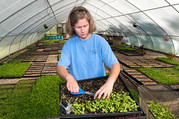
In this Ask the Expert, Jack Carlile, Farm Loan Manager for the USDA Farm Service Agency (FSA), answers questions about farm operating loans and when producers should apply in order to secure funds for the current crop year.
As the Farm Loan Manager for the Cherokee County Service Center, Jack is responsible for managing the loan making and loan servicing activities for five counties in northeast Oklahoma. His office provides services for over 650 farm loan customers. Jack was raised on a cross bred cow/calf operation that his grandparents started. Over the years, each generation has added to the operation by purchasing additional pasture. The operation also grows and bales their own hay. Jack’s agriculture background and degree in agriculture economics from Oklahoma State University help him better understand the financing needs of his producers.
Who can apply for FSA Farm Loans?
Anyone can apply for FSA’s loan programs. Applications will be considered on basic eligibility requirements. To apply for a loan, you must meet the following general eligibility requirements including:
- Be a U.S. citizen or qualified alien.
- Operator of a family farm or ranch.
- Have a satisfactory credit history.
- Unable to obtain credit elsewhere at reasonable rates and terms to meet actual needs.
- Not be delinquent on any federal debts.
What can I purchase with operating loans?
Farm Operating Loans are traditionally used for purchasing capital items such as farm machinery, equipment, or livestock. Loan funds can also be used to help pay typical operating expenses for farming and ranching operations. For example, a rancher may use an operating loan to purchase forage for his cattle to feed them through the winter or a row crop producer may use an operating loan for paying for inputs like seed or fertilizer.
What is the maximum loan amount and terms?
The maximum loan amount for a Direct Farm Operating Loan is $400,000. Direct loans are made and serviced by FSA.
Producers can also apply for Guaranteed Operating Loans that are made by your commercial lender, and guaranteed against loss by FSA. The maximum loan amount for a Guaranteed Farm Operating Loan is $1,825,000. Loan terms for operating loans range from one to seven years.
How do I apply?
If you’re interested in applying for a farm loan, you can pick up an application by visiting your local FSA office. Visit farmers.gov to find the USDA Service Center nearest you.
When applying for a loan, you will need a business plan, which must include:
- Your mission, vision, and goals for your farm or ranch.
- Your current assets and liabilities.
- Marketing Plan (what your operation will produce and where you will market and sell your products.)
- Whether the amount of income your operation generates will be enough to pay your business and family living expenses.
When should I apply for an operating loan?
I would recommend beginning the application process a few months in advance of needing the funds to allow time for the request to be processed, and for any necessary security checks and searches to be completed. That allows time for the funds to be available for your use when most needed.
Where can I find more information?
To learn more about FSA loans visit farmers.gov/loans or fsa.usda.gov/farmloans. Fact sheets and application packages are also available at your USDA Service Center. To learn more about other types of FSA loans or to find the right loan for your operation, use the Farm Loan Discovery Tool by visiting farmers.gov/loans/farm-loan-discovery-tool.
|
On January 27, 2021, the Biden-Harris Administration suspended all debt collections, foreclosures, and other adverse actions for borrowers of direct farm loans and Farm Storage Facility Loans (FSFL) through USDA’s Farm Service Agency (FSA) because of the national public health emergency caused by the Coronavirus pandemic.
It has been determined that the January 2021 suspension included a waiver of the Debt Collection Improvement Act (DCIA) noncompliance for issuing new Marketing Assistance Loans (MAL), Loan Deficiency Payments (LDP) or FSFL to borrowers who are in delinquent status with FSFL or farm loans.
Under normal circumstances, DCIA specifies that a person cannot obtain Federal financial assistance in the form of loans (other than disaster loans), loan insurance, or guarantees if that person has delinquent Federal non-tax debt. MAL, LDP, and FSFL programs administered by FSA are currently subject to these statutory constraints.
FSA county offices will review MALs, LDPs, and FSFLs that were previously denied on or after January 27, 2021, because of DCIA noncompliance. Offices will notify applicants of the waiver provisions and the opportunity to obtain a loan. All applicable eligibility requirements remain in place with the exception of DCIA waiver.
Reach out to your local FSA office for more information. To find your local office, visit farmers.gov/service-locator.
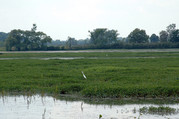
The National Environmental Policy Act (NEPA) requires Federal agencies to consider all potential environmental impacts for federally funded projects before the project is approved.
For all Farm Service Agency (FSA) programs, an environmental review must be completed before actions are approved, such as site preparation or ground disturbance. These programs include, but are not limited to, the Emergency Conservation Program (ECP), Farm Storage Facility Loan (FSFL) program and farm loans. If project implementation begins before FSA has completed an environmental review, the request will be denied. Although there are exceptions regarding the Stafford Act and emergencies, it’s important to wait until you receive written approval of your project proposal before starting any actions.
Applications cannot be approved until FSA has copies of all permits and plans. Contact your local FSA office early in your planning process to determine what level of environmental review is required for your program application so that it can be completed timely.
|
|
|
|
Vermont Farm Service Agency
356 Mountain View Drive, Suite 104
Colchester, VT 05446
John Roberts, State Executive Director
John.Roberts@usda.gov
Phone: 802-658-2803
Fax: 855-794-3676
|
Addison County Office
Tina Williams, Acting County Executive Dir.
802-771-3027
tina.williams2@usda.gov
David Girard, Jr., Farm Loan Manager
802-771-3031
david.girard@usda.gov
|
Franklin/Grand Isle County Office
Laurie Locke, County Executive Director
802-528-4162
laurie.locke@usda.gov
Ryan Howrigan, District Director
802-528-4160
ryan.howrigan@usda.gov
|
|
Caledonia/Essex County Office
Patricia Matte, County Executive Director
802-424-3146
patricia.matte@usda.gov
|
Rutland/Bennington County Office
Tina Williams, County Executive Director
802-775-8034, ext. 111
tina.williams2@usda.gov
|
|
Chittenden/Washington County Office
Lawrence Parker, County Executive Director
802-288-8155, ext. 102
lawrence.parker@usda.gov
|
Windsor/Orange County Offices
Christine Lary, County Executive Director
802-295-7942, ext. 3168
chris.lary@usda.gov
|
|
Lamoille/Orleans County Offices
Heather Mateja, County Executive Director
Orleans: 802-334-6090, ext. 7016
Lamoille: 802-888-4935, ext. 3002 (Tues.)
heather.mateja@usda.gov
Angela Goodridge, Farm Loan Manager
802-334-6090, ext. 7003
angela.goodridge@usda.gov
|
Windham County Office
Christine Lary, County Executive Director
802-254-9766, ext. 3032 chris.lary@usda.gov
|
|
|
|
| |
|
|
|






