Call Today About 2022 Crop Year Eligibility
Agricultural producers who have not yet enrolled in the Agriculture Risk Coverage (ARC) or Price Loss Coverage (PLC) programs for the 2022 crop year have until March 15, 2022, to sign a contract. The U.S. Department of Agriculture (USDA) offers these two safety net programs to provide vital income support to farmers experiencing substantial declines in crop prices or revenues.
Producers can elect coverage and enroll in ARC-County or PLC, which are both crop-by-crop, or ARC-Individual, which is for the entire farm. Although election changes for 2022 are optional, producers must enroll through a signed contract each year. Also, if a producer has a multi-year contract on the farm and makes an election change for 2022, it will be necessary to sign a new contract.
If an election is not submitted by the March 15, 2022, deadline, the election remains the same as the 2021 election for crops on the farm. Farm owners cannot enroll in either program unless they have a share interest in the crop.
Producers have completed 976,249 contracts to date, representing 54% of the more than 1.8 million expected contracts.
Producers who do not complete enrollment by the deadline will not be enrolled in ARC or PLC for the 2022 crop year and will not receive a payment if triggered.
Producers are eligible to enroll farms with base acres for the following commodities: barley, canola, large and small chickpeas, corn, crambe, flaxseed, grain sorghum, lentils, mustard seed, oats, peanuts, dry peas, rapeseed, long grain rice, medium and short grain rice, safflower seed, seed cotton, sesame, soybeans, sunflower seed, and wheat.
In partnership with USDA, two web-based decision tools are available to assist producers in making informed, educated decisions using crop data specific to their respective farming operations:
-
Gardner-farmdoc Payment Calculator, a tool available through the University of Illinois allows producers to estimate payments for farms and counties for ARC-CO and PLC.
-
ARC and PLC Decision Tool, a tool available through Texas A&M that allows producers to estimate payments and yield updates and expected payments for 2022.
Crop Insurance Considerations and Decision Deadline
ARC and PLC are part of a broader safety net provided by USDA, which also includes crop insurance and marketing assistance loans.
Producers are reminded that ARC and PLC elections and enrollments can impact eligibility for some crop insurance products.
Producers on farms with a PLC election have the option of purchasing Supplemental Coverage Option (SCO) through their Approved Insurance Provider; however, producers on farms where ARC is the election are ineligible for SCO on their planted acres for that crop on that farm.
Unlike SCO, the Enhanced Coverage Option (ECO) is unaffected by an ARC election. Producers may add ECO regardless of the farm program election.
Producers should contact their crop insurance agent to make certain that the election and enrollment made at FSA follows their intention to participate in STAX or SCO coverage. Producers have until March 15, 2022, to make the appropriate changes or cancel their ARC or PLC contract.
In addition to the March 15 deadline for ARC and PLC, other important deadlines include:
For more information on ARC and PLC, producers can visit the ARC and PLC webpage or contact their local USDA Service Center. In those service centers where COVID cases exceed safety levels, staff continue to work with agricultural producers via phone, email and other digital tools. Producers with level 2 eauthentication access can electronically sign contracts or may make arrangements to drop off signed contracts at the FSA county office. Because of the pandemic, some USDA Service Centers are open to limited visitors.
File acreage report by March 15, 2022 to receive the benefit.
Agricultural producers who have coverage under most crop insurance policies are eligible for a premium benefit from the U.S. Department of Agriculture (USDA) if they planted cover crops during the 2022 crop year. To receive the benefit from this year’s Pandemic Cover Crop Program (PCCP), producers must report cover crop acreage by March 15, 2022.
PCCP, offered by USDA’s Risk Management Agency (RMA), helps farmers maintain their cover crop systems, despite the financial challenges posed by the pandemic and is part of USDA’s Pandemic Assistance for Producers initiative, a bundle of programs to bring financial assistance to farmers, ranchers and producers who felt the impact of COVID-19 market disruptions.
PCCP provides premium support to producers who insured their crop with most insurance policies and planted a qualifying cover crop during the 2022 crop year. The premium support is $5 per acre, but no more than the full premium amount owed.
< USDA's Pandemic Cover Crop Program >
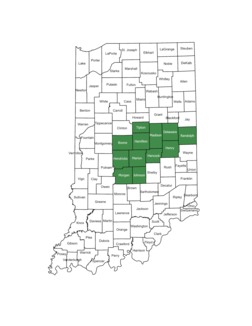
Attention Cover Crop Producers in Boone, Delaware, Hamilton, Hancock, Hendricks, Henry, Johnson, Madison, Marion, Morgan Randolph & Tipton counties!
This program is in addition to USDA's Pandemic Cover Crop Program.
The Indiana State Department of Ag (ISDA) will provide a cover crop premium discount program in collaboration with TNC and USDA-RMA. ISDA is re-opening the application for this program to compliment the federal Pandemic Cover Crop Program (PCCP).
As an overview, the program was previously offered in six counties, Delaware, Hamilton, Henry, Madison, Randolph, and Tipton. The program area has now been expanded to cover Boone, Hancock, Hendricks, Johnson, Marion and Morgan counties. The grower must farm within these counties to be eligible. The grower will receive a $5/acre cover crop insurance premium discount. This program was designed with first time cover crop adopters in mind, but it is not a requirement to enroll in the program.
Applications are accepted on a first come, first serve basis and will be verified by our team along with RMA. The acres the grower enrolls must also not be a part of any federal cost-share program (excluding PCCP), and must follow all program rules and guidance (found on website).
Interested participants can find the application for enrollment on our main website which is https://www.in.gov/isda/divisions/soil-conservation/cover-crop-premium-discount-program/.
The deadline to enroll is March 15th, 2022.
|

FSA encourages you to examine available USDA crop risk protection options, including federal crop insurance and Noninsured Crop Disaster Assistance Program (NAP) coverage, before the applicable crop sales deadline.
Federal crop insurance covers crop losses from natural adversities such as drought, hail and excessive moisture. NAP covers losses from natural disasters on crops for which no permanent federal crop insurance program is available. You can determine if crops are eligible for federal crop insurance or NAP by visiting the RMA website.
NAP offers higher levels of coverage, from 50 to 65 percent of expected production in 5 percent increments, at 100 percent of the average market price. Producers of organics and crops marketed directly to consumers also may exercise the “buy-up” option to obtain NAP coverage of 100 percent of the average market price at the coverage levels of between 50 and 65 percent of expected production. Buy-up levels of NAP coverage are available if the producer can show at least one year of previously successfully growing the crop for which coverage is being requested. NAP basic coverage is available at 55 percent of the average market price for crop losses that exceed 50 percent of expected production.
For all coverage levels, the NAP service fee is the lesser of $325 per crop or $825 per producer per county, not to exceed a total of $1,950 for a producer with farming interests in multiple counties.
Beginning, underserved, veterans and limited resource farmers are now eligible for free catastrophic level coverage.
In Indiana, March 15th is the NAP Sales Closing Date for annual spring/summer planted crops not limited to: beans, beets, broccoli, brussel sprouts, cabbage, canola, cantaloupes, carrots, cauliflower, corn, cucumbers, eggplant, garlic, greens, herbs, honeydew, lettuce, oats, okra, onions, peas, peppers, potatoes, pumpkins, radishes, sorghum, squash, tomatillos, tomatoes, and watermelon.
Federal crop insurance coverage is sold and delivered solely through private insurance agents. Agent lists are available at all USDA Service Centers or at USDA’s online Agent Locator. You can use the USDA Cost Estimator to predict insurance premium costs.
|
 Packers and Stockyards Violations
Farmers, ranchers, and other producers and growers now have a one-stop shop to help ensure they are treated fairly. The new farmerfairness.gov portal developed jointly by the U.S. Department of Agriculture (USDA) and Department of Justice (DOJ) allows you to report potential violations of livestock and poultry antitrust laws, including the Packers and Stockyards Act. Read More
Funding Opportunity Opens to Pilot New Revenue Streams for America’s Climate-Smart Farmers, Ranchers and Forest Landowners
Agriculture Secretary Tom Vilsack announced on February 7 that the U.S. Department of Agriculture is delivering on its promise to expand markets by investing $1 billion in partnerships to support America’s climate-smart farmers, ranchers and forest landowners. The new Partnerships for Climate-Smart Commodities opportunity will finance pilot projects that create market opportunities for U.S. agricultural and forestry products that use climate-smart practices and include innovative, cost-effective ways to measure and verify greenhouse gas benefits. USDA is now accepting project applications for fiscal year 2022.
For the purposes of this funding opportunity, a climate-smart commodity is defined as an agricultural commodity that is produced using agricultural (farming, ranching or forestry) practices that reduce greenhouse gas emissions or sequester carbon.
Funding will be provided to partners through the USDA’s Commodity Credit Corporation for pilot projects to provide incentives to producers and landowners to:
- implement climate-smart production practices, activities, and systems on working lands,
- measure/quantify, monitor and verify the carbon and greenhouse gas (GHG) benefits associated with those practices, and
- develop markets and promote the resulting climate-smart commodities.
Funding will be provided in two funding pools, and applicants must submit their applications via Grants.gov by 11:59 p.m. Eastern Time on:
- April 8, 2022, for the first funding pool (proposals from $5 million to $100 million), and
- May 27, 2022, for the second funding pool (proposals from $250,000 to $4,999,999).
A wide range of organizations may apply, but the primary applicant must be an entity, not an individual.
USDA is committed to equity in program delivery and is specifically seeking proposals from entities serving all types of producers, including small or historically underserved producers.
Visit usda.gov for additional information including Partnerships for Climate-Smart Commodities and resources to support your application.
The Indiana State Department of Agriculture (ISDA), is seeking project proposals from Indiana’s specialty crop sector for funding from the U.S. Department of Agriculture's (USDA) Specialty Crop Block Grant Program. Eligible projects must enhance the competitiveness of specialty crops in Indiana, defined as fruits, vegetables, tree nuts, horticulture and nursery crops.
The USDA Specialty Crop Block Grant Program offers federal funding annually to the state departments of agriculture to support their specialty crop industries. Indiana’s allocation is $486,095.35.
ISDA created and distributed a funding priority survey in early 2022 for specialty crop funding; respondents included stakeholders across the specialty crop industry. Based on the survey suggested projects included enhancing food safety, pest and disease control, developing organic and sustainable production practices, and developing local and regional food systems. When the application opens please refer to the notice of funding opportunity for a full list of suggested projects.
Applications are due by 11:59 p.m. ET on March 8, 2022. Proposals must be submitted online through the Indiana State Department of Agriculture’s Grants Management System. ISDA will host a SCBGP webinar for interested applicants on February 22, 2022. Registration information is available on ISDA’s Funding Opportunities website.
For more information and the solicitation click here. For a full list of eligible specialty crops please click here.
|