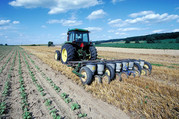
Agricultural producers and landowners can sign up soon for the Conservation Reserve Program (CRP), a cornerstone conservation program offered by the U.S. Department of Agriculture (USDA) and a key tool in the Biden-Harris Administration effort to address climate change and achieve other natural resource benefits. The General CRP signup will run from Jan. 31 to March 11, and the Grassland CRP signup will run from April 4 to May 13.
Producers and landowners enrolled 4.6 million acres into CRP signups in 2021, including 2.5 million acres in the largest Grassland CRP signup in history. There are currently 22.1 million acres enrolled, and FSA is aiming to reach the 25.5-million-acre cap statutorily set for fiscal year 2022.
CRP Signups
General CRP helps producers and landowners establish long-term, resource-conserving plant species, such as approved grasses or trees, to control soil erosion, improve water quality and enhance wildlife habitat on cropland.
Meanwhile, Grassland CRP is a working lands program, helping landowners and operators protect grassland, including rangeland and pastureland and certain other lands, while maintaining the areas as working grazing lands. Protecting grasslands contributes positively to the economy of many regions, provides biodiversity of plant and animal populations and provides important carbon sequestration benefits to deliver lasting climate outcomes.
Alongside these programs, producers and landowners can enroll acres in Continuous CRP under the ongoing sign up, which includes projects available through the Conservation Reserve Enhancement Program (CREP) and State Acres for Wildlife Enhancement (SAFE).
Climate Benefits
Last year, FSA enacted a Climate-Smart Practice Incentive for CRP General and Continuous signups, to better target CRP on addressing climate change. This incentive aims to increase carbon sequestration and reduce greenhouse gas emissions. CRP’s climate-smart practices include establishment of trees and permanent grasses, development of wildlife habitat and wetland restoration. The Climate-Smart Practice Incentive is annual, and the amount is based on the benefits of each practice type.
Additionally, in order to better target the program toward climate outcomes, USDA invested $10 million last year in the CRP Monitoring, Assessment and Evaluation (MAE) program to measure and monitor the soil carbon and climate resilience impacts of conservation practices over the life of new CRP contracts. This will enable the agency to further refine the program and practices to provide producers tools for increased climate resilience.
More Information on CRP
Landowners and producers interested in CRP should contact their local USDA Service Center to learn more or to apply for the program -- for General CRP before the March 11 deadline, and for Grassland CRP before the May 13 deadline. Continuous CRP signup types are ongoing throughout the year. Service Center staff continue to work with agricultural producers via phone, email, and other digital tools. Due to the pandemic, some USDA Service Centers are open to limited visitors. Additionally, fact sheets and other resources are available at fsa.usda.gov/crp.
Signed into law in 1985, CRP is one of the largest voluntary private-lands conservation programs in the United States. It was originally intended to primarily control soil erosion and potentially stabilize commodity prices by taking marginal lands out of production. The program has evolved over the years, providing many conservation and economic benefits.
|

On January 27, 2021, the Biden-Harris Administration suspended all debt collections, foreclosures, and other adverse actions for borrowers of direct farm loans and Farm Storage Facility Loans (FSFL) through USDA’s Farm Service Agency (FSA) because of the national public health emergency caused by the Coronavirus pandemic.
It has been determined that the January 2021 suspension included a waiver of the Debt Collection Improvement Act (DCIA) noncompliance for issuing new Marketing Assistance Loans (MAL), Loan Deficiency Payments (LDP) or FSFL to borrowers who are in delinquent status with FSFL or farm loans.
Under normal circumstances, DCIA specifies that a person cannot obtain Federal financial assistance in the form of loans (other than disaster loans), loan insurance, or guarantees if that person has delinquent Federal non-tax debt. MAL, LDP, and FSFL programs administered by FSA are currently subject to these statutory constraints.
FSA county offices will review MALs, LDPs, and FSFLs that were previously denied on or after January 27, 2021, because of DCIA noncompliance. Offices will notify applicants of the waiver provisions and the opportunity to obtain a loan. All applicable eligibility requirements remain in place with the exception of DCIA waiver.
Reach out to your local FSA office for more information. To find your local office, visit farmers.gov/service-locator.
|
Feb. 4 is the deadline for agricultural producers who are certified organic, or transitioning to organic, to apply for the Organic and Transitional Education and Certification Program (OTECP). Signup for OTECP, administered by USDA’s Farm Service Agency (FSA), began Nov. 8.
Certified operations and transitional operations may apply for OTECP for eligible expenses paid during the 2020 and 2021 fiscal years during this signup period. Signup for the 2022 fiscal year will be announced at a later date.
For each year, OTECP covers 25% of a certified operation’s eligible certification expenses, up to $250 per certification category (crop, livestock, wild crop, handling and State Organic Program fee). This includes application fees, inspection fees, USDA organic certification costs, state organic program fees and more.
Crop and livestock operations transitioning to organic production may be eligible for 75% of a transitional operation’s eligible expenses, up to $750, for each year. This includes fees charged by a certifying agent or consultant for pre-certification inspections and development of an organic system plan.
For both certified operations and transitional operations, OTECP covers 75% of the registration fees, up to $200, per year, for educational events that include content related to organic production and handling in order to assist operations in increasing their knowledge of production and marketing practices that can improve their operations, increase resilience and expand available marketing opportunities. Additionally, both certified and transitional operations may be eligible for 75% of the expense of soil testing required under the National Organic Program (NOP) to document micronutrient deficiency, not to exceed $100 per year.
Producers apply through their local FSA office and can also obtain one-on-one support with applications by calling 877-508-8364. The program application and additional information can be found at farmers.gov/otecp.
Additional Organic Support
OTECP builds upon USDA’s Organic Certification Cost Share Program (OCCSP) which provides cost share assistance of 50%, up to a maximum of $500 per scope, to producers and handlers of agricultural products who are obtaining or renewing their certification under the NOP. Although the application period for OCCSP ended Nov. 1, 2021, FSA will consider late-filed applications for those operations who still wish to apply.
Meanwhile, USDA’s Risk Management Agency (RMA) recently made improvements to Whole-Farm Revenue Protection to make it more flexible and accessible to organic producers.
To learn more about USDA’s broader assistance for organic producers, visit usda.gov/organic.
|
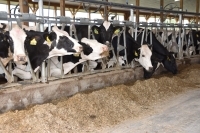
As part of the Biden-Harris Administration’s ongoing efforts to support dairy farmers and rural communities, today the U.S. Department of Agriculture (USDA) opened signup for the Dairy Margin Coverage (DMC) program and expanded the program to allow dairy producers to better protect their operations by enrolling supplemental production. This signup period – which runs from Dec. 13, 2021 to Feb. 18, 2022 – enables producers to get coverage through this important safety-net program for another year as well as get additional assistance through the new Supplemental DMC. |
|
 |
Supplemental DMC will provide $580 million to better help small- and mid-sized dairy operations that have increased production over the years but were not able to enroll the additional production. Now, they will be able to retroactively receive payments for that supplemental production. Additionally, USDA’s Farm Service Agency (FSA) updated how feed costs are calculated, which will make the program more reflective of actual dairy producer expenses.
Supplemental DMC Enrollment
Eligible dairy operations with less than 5 million pounds of established production history may enroll supplemental pounds based upon a formula using 2019 actual milk marketing's, which will result in additional payments. Producers will be required to provide FSA with their 2019 Milk Marketing Statement.
Supplemental DMC coverage is applicable to calendar years 2021, 2022 and 2023. Participating dairy operations with supplemental production may receive retroactive supplemental payments for 2021 in addition to payments based on their established production history.
Supplemental DMC will require a revision to a producer’s 2021 DMC contract and must occur before enrollment in DMC for the 2022 program year. Producers will be able to revise 2021 DMC contracts and then apply for 2022 DMC by contacting their local USDA Service Center.
DMC 2022 Enrollment
After making any revisions to 2021 DMC contracts for Supplemental DMC, producers can sign up for 2022 coverage. DMC provides eligible dairy producers with risk management coverage that pays producers when the difference between the price of milk and the cost of feed falls below a certain level. So far in 2021, DMC payments have triggered for January through October for more than $1.0 billion.
For DMC enrollment, producers must certify with FSA that the operation is commercially marketing milk, sign all required forms and pay the $100 administrative fee. The fee is waived for farmers who are considered limited resource, beginning, socially disadvantaged, or a military veteran. To determine the appropriate level of DMC coverage for a specific dairy operation, producers can use the online dairy decision tool.
Updates to Feed Costs
USDA is also changing the DMC feed cost formula to better reflect the actual cost dairy farmers pay for high-quality alfalfa hay. FSA will calculate payments using 100% premium alfalfa hay rather than 50%. The amended feed cost formula will make DMC payments more reflective of actual dairy producer expenses.
Additional Dairy Assistance
Today’s announcement is part of a broader package to help the dairy industry respond to the pandemic and other challenges. USDA is also amending Dairy Indemnity Payment Program (DIPP) regulations to add provisions for the indemnification of cows that are likely to be not marketable for longer durations, as a result, for example, of per- and polyfluoroalkyl substances. FSA also worked closely with USDA's Natural Resources Conservation Service to target assistance through the Environmental Quality Incentives Program) and other conservation programs to help producers safely dispose of and address resource concerns created by affected cows. Other recent dairy announcements include $350 million through the Pandemic Market Volatility Assistance Program and $400 million for the Dairy Donation Program.
Additional details on these changes to DMC and DIPP can be found in a rule that will be published soon in the Federal Register. This rule also included information on the new Oriental Fruit Fly Program as well as changes to FSA conservation programs. A copy of the rule is available here.
More Information
To learn more or to participate in DMC or DIPP, producers should contact their local USDA Service Center. Service Center staff continue to work with agricultural producers via phone, email and other digital tools. Because of the pandemic, some are open to limited visitors. Producers should contact their Service Center to set up an in-person or phone appointment. Additionally, more information related to USDA’s response and relief for producers can be found at farmers.gov/coronavirus.
If you received a payment under the Wildfires and Hurricanes Indemnity Program+ (WHIP+) or the Quality Loss Adjustment Program (QLA) for crop production and/or quality losses occurring in 2018, 2019, or 2020 crop years, you are required to meet linkage requirements by obtaining federal crop insurance or Non-Insured Crop Disaster Assistance Program (NAP) coverage at the 60/100 level, or higher, for both the 2022 and 2023 crop years. |
|
 |
When applying for WHIP+ or QLA, form FSA-895 (Crop Insurance and/or NAP Coverage Agreement) was submitted acknowledging the requirement to obtain federal crop insurance, if available, or NAP coverage if federal crop insurance is not available. The coverage requirement is applicable to the physical location county of the crop that received WHIP+ and/or QLA benefits.
Producers should not delay contacting their federal crop insurance agent or local county FSA Office to inquire about coverage options, as failure to obtain the applicable coverage by the sales/application closing date will result in the required refund of WHIP+ benefits received on the applicable crop, plus interest. You can determine if crops are eligible for federal crop insurance or NAP by visiting the RMA website.
For more information, contact your County USDA Service Center or visit fsa.usda.gov.
The Noninsured Crop Disaster Assistance Program (NAP) provides financial assistance to you for crops that aren’t eligible for crop insurance to protect against lower yields or crops unable to be planted due to natural disasters including freeze, hail, excessive moisture, excessive wind or hurricanes, flood, excessive heat and qualifying drought (includes native grass for grazing), among others.
In order to participate, you must obtain NAP coverage for the crop year by the applicable deadline using form CCC-471 “Application for Coverage” and pay the service fee. Application closing dates vary by crop. Producers are also required to submit an acceptable crop acreage report. Additionally, NAP participants must provide:
- The quantity of all harvested production of the crop in which the producer held an interest during the crop year
- The disposition of the harvested crop, such as whether it is marketable, unmarketable, salvaged or used differently than intended
- Acceptable crop production records (when requested by FSA)
Producers who fail to report acreage and production information for NAP-covered crops could see reduced or zero NAP assistance. These reports are used to calculate the approved yield.
If your NAP-covered crops are affected by a natural disaster, notify your FSA office by completing Part B of form CCC-576 “Notice of Loss and Application for Payment.” This must be completed within 15 calendar days of the occurrence of the disaster or when losses become apparent or 15 days of the final harvest date. For hand-harvested crops and certain perishable crops, you must notify FSA within 72 hours of when a loss becomes apparent.
To receive benefits, you must also complete Parts D, E, F and G of the CCC-576 “Notice of Loss and Application for Payment” within 60 days of the last day of coverage for the crop year for any NAP covered crops. The CCC-576 requires acceptable appraisal information. Producers must provide evidence of production and note whether the crop was marketable, unmarketable, salvaged or used differently than intended.
Eligible crops must be commercially produced agricultural commodities for which crop insurance is not available, including perennial grass forage and grazing crops, fruits, vegetables, mushrooms, floriculture, ornamental nursery, aquaculture, turf grass, ginseng, honey, syrup, bioenergy, and industrial crops.
For more information on NAP, contact your County USDA Service Center or visit fsa.usda.gov/nap.
|