In This Issue:
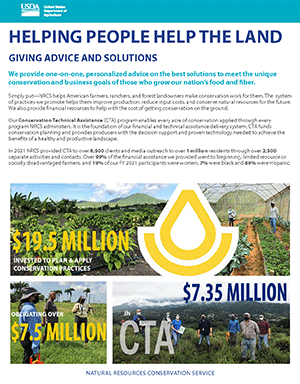
In 2021, USDA’s Natural Resources Conservation Service (NRCS) continued our proud tradition of working in partnership with farmers, ranchers, and forest landowners in Puerto Rico and the U.S. Virgin Islands (USVI), investing over $19.5 million to plan and apply conservation practices.
“Our data shows that we and our partners brought a healthier resource base and were able to impact farmers and communities by bringing more-efficient customer service and investing in targeted conservation initiatives in 2021,” said Luis Cruz-Arroyo, NRCS State Conservationist for the Caribbean Area (Puerto Rico and the USVI).
NRCS and our partners helped farmers invest in their operations through 307 new Environmental Quality Incentives Program (EQIP) contracts worth over $7.9 million. This work resulted in conservation plans for over 18,600 acres of farmland. And over $5 million was invested to apply conservation practices on 17,367 acres in the Caribbean Area through existing contracts.
We applied water quality improvement practices on over 12,000 acres; grazing land conservation practices on 8,364 acres; cropland conservation to improve soil health and quality on 3,765 acres; and improved irrigation efficiency on 1,358 acres; and delivered over 17,950 trees for wildlife habitat improvement.
A summary of our accomplishments can be found in our newly-released NRCS Caribbean Area 2021 Annual Accomplishments Summary or on our website at www.pr.nrcs.usda.gov.
^ back to top
|
NRCS offers new opportunities for climate-smart agriculture in 2022. Updates include nationwide availability of the Environmental Quality Incentives Program (EQIP) Conservation Incentive Contracts option. Conservation Incentive Contracts address priority resource concerns, including sequestering carbon and improving soil health in target areas. Through these contracts, NRCS works with farmers to improve the quality and condition of natural resources on their land using management practices like irrigation water management, drainage water management, feed management and residue and tillage management to target resource concerns such as degraded soil and water quality, available water and soil erosion.
EQIP Conservation Incentive Contracts (CIC) last five years and offer farmers annual incentive payments to apply management practices. CIC also offers conservation evaluation and monitoring activities to help manage, maintain and improve priority natural resource concerns within local target areas and build on existing conservation efforts.
NRCS accepts applications for conservation programs year-round, however farmers and landowners should apply for EQIP Conservation Incentive Contracts by March 11, 2022,to be considered for this year’s funding. To apply, contact your local NRCS office.
^ back to top
USDA Natural Resources Conservation Service (NRCS) is investing $50 million in 118 partnerships – including 4 targeting Puerto Rico & the U.S. Virgin Islands – to expand access to conservation assistance for climate-smart agriculture and forestry. The Equity Conservation Cooperative Agreements will fund two-year projects to expand the delivery of conservation assistance to farmers who are new to farming, low income, socially disadvantaged or military veterans. Projects will support USDA’s broader effort to address climate change and equitable access to programs. Learn more...
^ back to top
|
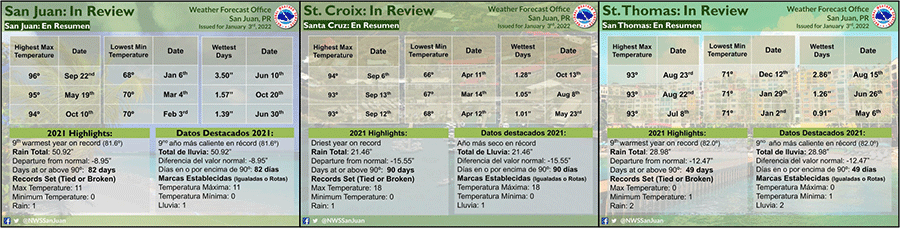 On January 3rd, the National Weather Service in San Juan released its annual summary of weather statistics for official climate sites in Puerto Rico and the U.S. Virgin Islands. As many suspected, a number of records were broken or tied last year (see info graphic below). Most remarkable, 2021 was the third driest year on record in St. Croix. Maximum temperature records were set 18 times in St. Croix and 11 times in San Juan.
The U.S. Drought Monitor status report for Puerto Rico and the USVI, released Dec. 17, described 2021 overall as a dry and hot year, “Drought conditions continue to worsen across most of Puerto Rico and all of the USVI without significant relief expected until the start of the wet season in April. Currently, Puerto Rico is experiencing abnormally dry (D0) to moderate drought (D1) conditions. Drought conditions vary in the USVI with moderate drought (D1) in St. John, severe drought (D2) in St. Thomas, and extreme drought (D3) conditions on St. Croix.”
2021 Perspective: San Juan’s annual rainfall for 2021 (~48.5”) was nearly 9 inches below normal and the annual average temperature (81.7°F) made 2021 the 10th warmest year on record dating back to 1899. In St. Thomas, 2021 was the ninth driest year in 50 years of data measured at Cyril E. King Airport. Annual rainfall (~28.2”) was almost 12 inches below normal and the average temperature (82.1°F) was 0.6°F above the 30-year normal. In St. Croix, 2021 was the third driest year on record in 58 years of recorded data at Henry Rohlsen Airport. The annual rainfall (~21.2”) was over 14 inches below normal and like St. Thomas, the average temperature (81.6°F) was 0.6°F above the 30-year normal. December saw five days with temperatures at or above 90°F in the first two weeks of the month!
Current Impacts: There have been reports of suffering vegetation and signs of soil cracking across southern Puerto Rico. Fuel moisture in the area has been below normal, resulting in an elevated risk of fire weather. In the USVI, sporadic and intermittent rainfall territory-wide is not recharging ponds and collection containers as it evaporates quickly due to hot temperatures and high winds. Soil moisture has been impacted by persistent wind and vegetation is showing signs of distress. Due to the below-normal rainfall that is expected through at least February 2022, as well as the observed conditions, drought throughout the islands is expected to persist and/or expand into March.
Although little can be done to control rainfall and storm events, technical experts at NRCS can help producers in Puerto Rico and the USVI apply science-based conservation solutions to build resilience in their operations and mitigate against the impacts of drought. Conservation practices like conservation covers, crop residue management, irrigation water management, rotational grazing, silvopasture, water harvesting catchments and more can help farmers combat drought and improve climate resilience. Contact your local USDA Service Center for more information.
^ back to top
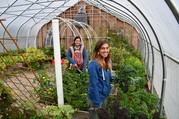
Are you new to farming because of the pandemic? USDA can help you get started in farming – on everything from helping you register your farm to getting financial assistance and technical advice.
Get Started with USDA: First make sure your farm is registered with USDA. If you bought or leased land, it might already be recorded with USDA’s Farm Service Agency (FSA) with a farm number on file. If not, FSA can help you register your farm. To get a farm number, bring an official tax ID (Social Security number or an employer ID) and a property deed. If you do not own the land, bring a lease agreement to FSA to show you have control of the land. If your operation is a business or entity, you will also need to provide proof that you have signature authority and the legal ability to enter into contracts with USDA.
Access to Capital: USDA can provide access to capital through farm loans, a great resource when producers aren’t able to get a loan from a traditional lender. Loans can help to buy land or equipment or with operating costs, and FSA even offers microloans, which are especially popular with small farmers. For more information, check out our Farm Loan Discovery Tool.
Conservation Practices: We can help you make conserve resources on your farm to improve your bottom line and your farm’s resiliency to storms, drought and climate change. We’ll help you develop a conservation plan and apply for financial assistance help install conservation practices. To learn more about our conservation assistance, visit www.pr.nrcs.usda.gov or check out our Conservation at Work Video Series. To get started with USDA, contact your local USDA Service Center.
^ back to top
|

Are you a military veteran interested in farming? USDA offers resources to help you:
-
Fund Your Operation: USDA’s Farm Service Agency offers a variety of funding opportunities to help farmers finance their businesses. Certain funds are targeted for veterans and beginning farmers and ranchers.
-
Conserve Natural Resources: USDA’s Natural Resources Conservation Service offers conservation programs and expert one-on-one technical assistance to strengthen agricultural operations now and into the future. Veterans may be eligible for a cost share of up to 90 percent and advance payments of up to 50 percent to cover certain conservation practices.
-
Manage Risks: USDA is here to help you prepare for and recover from the unexpected. Veterans who are beginning farmers may be eligible for reduced premiums, application fee waivers, increased insurance coverage, and other incentives for multiple USDA programs that support risk management.
USDA wants to ensure that veterans transitioning to agriculture have the resources needed to succeed. While USDA offices are currently closed to visitors because of the pandemic, Service Center staff continue to work with agricultural producers via phone, email, and other digital tools. To conduct business, please contact your local USDA Service Center. Additionally, more information related to USDA’s response and relief for producers can be found at farmers.gov/coronavirus. If you’re a new farmer, you can also reach out to your state Beginning Farmer and Rancher Coordinator.
^ back to top
|
At USDA, we are committed to helping farmers complete loan applications, environmental reviews, and other paperwork free of charge. One-on-one support is available at more than 2,300 USDA Service Centers nationwide. USDA’s Farm Service Agency and Natural Resources Conservation Service staff are usually co-located at these Service Centers and can help guide farmers to the best USDA assistance based on their unique goals, whether it is loans, conservation programs, or insurance.
Service Center staff can guide farmers through the process of preparing and submitting required paperwork on their own, with no need to hire a paid preparer. Language translation service is available in all USDA Service Centers, so one-on-one assistance with a Service Center employee can be translated in real time for farmers requiring it. And while some program and loan applications do have an administrative fee for filing, there is never a charge for preparation services provided by USDA staff.
Farmers who work with the USDA Service Center can:
- Establish their farm by registering for a farm number, which is required for USDA programs and assistance.
- Learn how to meet conservation compliance provisions.
- Verify eligibility for USDA programs.
- Discuss their business and conservation goals.
- Create a conservation plan.
- Fill out and file loan and program applications.
We are committed to delivering USDA programs and services to America’s farmers and ranchers while taking safety measures in response to COVID-19. We encourage you to check the status of your local USDA Service Center and make an appointment to discuss your business needs.
^ back to top
USDA Rural Development granted $38.5 million to nine projects in Puerto Rico to improve critical rural infrastructure last month. The funding will help expand access to high-speed internet, clean water and reliable electricity in people’s homes and businesses across rural areas in Puerto Rico.
“The investments we’re announcing today will drive the creation of good-paying union jobs and grow the economy sustainably and equitably so that everyone gets ahead for decades to come,” said USDA Secretary Tom Vilsack.
The grants will help fund the following projects:
-
Lajas municipality: $17.3 million for landfill work to close two cells and build three new cells. The debris from Hurricane María in 2017 nearly filled the landfill and damaged the cells. This investment will extend the life of the landfill that serves Guánica, Lajas, Sabana Grande and San Germán municipalities.
-
Puerto Rico Aqueduct and Sewer Authority (PRASA): $20.9 million for two projects to repair/build waste and water plants, and repair/replace pump stations, wells and properties damaged by Hurricane María.
-
Comunidad Asomante in Las Piedras - $181,000.
-
Corporación de Servicios de Acueductos Anones Maya (COSAAM) in Naranjito - $21,000.
-
Asociación de Residentes y Acueductos Barrio Real in Patillas - $25,000.
-
Barrio Quemados 1 Sector Ortiz Inc. in San Lorenzo - $25,000.
-
Comunidad Las Cruces Incorporado in Naranjito - $24,000.
-
Aqueductos Garzas Juncos Inc. in Adjuntas - $20,000.
USDA is investing $5.2 billion in 359 projects nationwide under seven programs to help people in rural areas access high-speed internet, clean water and dependable electric power. Read more...
^ back to top
2021 NRCS retirees (left to right) Freddie Rivera, Zulma García, Evelyn Rivera and Lydia Collazo (not pictured, Luis González).
NRCS bids congratulations and a fond farewell to Corozal District Conservationist Freddie Rivera, Mayagüez District Conservationist Zulma García, Utuado Soil Conservation Technician Evelyn Rivera, and IT Specialist Luis Gonzalez who retired Dec. 31. We also bid much-delayed congratulations and a fond farewell to Engineer Lydia Collazo, who retired July 29. We wish our retirees all the best for this new chapter in their lives!
^ back to top
|