In This Issue:
The Hawaii State and Pacific Basin U.S. Department of Agriculture (USDA) Farm Service Agency (FSA) announced the results of the recent county committee elections.
Roy Wall III will serve in Hawaii County representing LAA 2.
Raymond Maki Jr will serve in Kauai County representing LAA 3.
Colleen Lopes will serve in Maui County representing LAA 1.
Ernest Wusstig will serve in Guam County representing LAA 1.
Eugene Ogo will serve in CNMI representing LAA 1, Rota.
"County Committee members are a critical component of the day-to-day operations of FSA,” said Shirley Nakamura, Acting State Executive Director. "They help deliver programs at the county level and work to serve the needs of local producers. All recently elected county committee members will take office in January 2022 and will be joining the existing committee.”
Every FSA office is served by a county committee made up of local farmers, ranchers and foresters who are elected by local producers.
County committee members impact the administration of FSA within a community by applying their knowledge and judgment to help FSA make important decisions on its commodity support programs, conservation programs, indemnity and disaster programs, emergency programs and eligibility.
County committee members provide a service to local producers through their decision making and ensure the fair and equitable administration of FSA farm programs in their counties. They are accountable to the Secretary of Agriculture. Members conduct hearings and reviews as requested by the state committee, ensure that underserved farmers, ranchers and foresters are fairly represented, make recommendations to the state committee on existing programs, monitor changes in farm programs and inform farmers of the purpose and provisions of FSA programs. They also assist with outreach and inform underserved producers such as beginning farmers, ranchers and foresters about FSA opportunities.
For more information, visit the FSA website at fsa.usda.gov/elections or contact the your local County FSA office.

USDA’s Natural Resources Conservation Service will invest $225 million this year through the Regional Conservation Partnership Program (RCPP). RCPP is a partner-driven program that leverages collective resources to find solutions to address natural resource challenges on agricultural land. This year’s funding announcements include opportunities for projects that address climate change, benefit historically underserved producers and support urban agriculture. Read more in the press release.
|
At USDA, we are committed to helping farmers and ranchers complete loan and program applications, environmental reviews, and other paperwork free of charge. One-on-one support is available at more than 2,300 USDA Service Centers nationwide. USDA’s Farm Service Agency and Natural Resources Conservation Service staff are usually co-located at these Service Centers and can help guide farmers and ranchers to the best USDA assistance based on their unique goals, whether it is loans, conservation programs, or insurance.
Service Center staff can guide farmers and ranchers through the process of preparing and submitting required paperwork on their own, with no need to hire a paid preparer. Language translation service is available in all USDA Service Centers, so one-on-one assistance with a Service Center employee can be translated in real time for farmers requiring it. And while some program and loan applications do have an administrative fee for filing, there is never a charge for preparation services provided by USDA staff.
Farmers who work with the USDA Service Center can:
- Establish their farm by registering for a farm number, which is required for USDA programs and assistance.
- Learn how to meet conservation compliance provisions.
- Verify eligibility for USDA programs.
- Discuss their business and conservation goals.
- Create a conservation plan.
- Fill out and file loan and program applications.
We are committed to delivering USDA programs and services to America’s farmers and ranchers while taking safety measures in response to COVID-19. We encourage you to check the status of your local USDA Service Center and make an appointment to discuss your business needs.
The U.S. Department of Agriculture (USDA) has extended the deadline for agricultural producers who are certified organic, or transitioning to organic, to apply for the Organic and Transitional Education and Certification Program (OTECP). This program provides pandemic assistance to cover certification and education expenses. The deadline to apply for 2020 and 2021 eligible expenses is now Feb. 4, 2022, rather than the original deadline of Jan. 7, 2022.
Signup for OTECP, administered by USDA’s Farm Service Agency (FSA), began Nov. 8.
Certified operations and transitional operations may apply for OTECP for eligible expenses paid during the 2020, 2021 and 2022 fiscal years. Signup for the 2022 fiscal year will be announced at a later date.
For each year, OTECP covers 25% of a certified operation’s eligible certification expenses, up to $250 per certification category (crop, livestock, wild crop, handling and State Organic Program fee). This includes application fees, inspection fees, USDA organic certification costs, state organic program fees and more.
Crop and livestock operations transitioning to organic production may be eligible for 75% of a transitional operation’s eligible expenses, up to $750, for each year. This includes fees charged by a certifying agent or consultant for pre-certification inspections and development of an organic system plan.
For both certified operations and transitional operations, OTECP covers 75% of the registration fees, up to $200, per year, for educational events that include content related to organic production and handling in order to assist operations in increasing their knowledge of production and marketing practices that can improve their operations, increase resilience and expand available marketing opportunities. Additionally, both certified and transitional operations may be eligible for 75% of the expense of soil testing required under the National Organic Program (NOP) to document micronutrient deficiency, not to exceed $100 per year.
Producers apply through their local FSA office and can also obtain one-on-one support with applications by calling 877-508-8364. The program application and additional information can be found at farmers.gov/otecp.
Additional Organic Support
OTECP builds upon USDA’s Organic Certification Cost Share Program (OCCSP) which provides cost share assistance of 50%, up to a maximum of $500 per scope, to producers and handlers of agricultural products who are obtaining or renewing their certification under the NOP. Although the application period for OCCSP ended Nov. 1, 2021, FSA will consider late-filed applications for those operations who still wish to apply.
Meanwhile, USDA’s Risk Management Agency (RMA) recently made improvements to Whole-Farm Revenue Protection to make it more flexible and accessible to organic producers.
To learn more about USDA’s broader assistance for organic producers, visit usda.gov/organic.
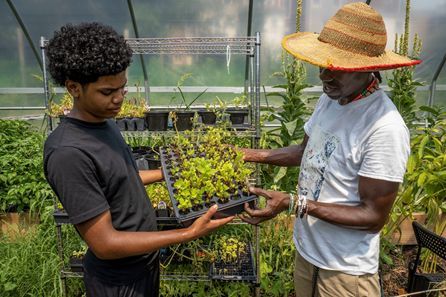
The U.S. Department of Agriculture (USDA) is investing up to $2 million in cooperative agreements this year for risk management education and training programs that support historically underserved producers, small-scale farmers, and conservation practices. USDA’s Risk Management Agency (RMA) is investing in organizations, such as nonprofit organizations, universities, and county cooperative extension offices, to develop training and education tools to help producers learn how to effectively manage long-term risks and challenges.
RMA also unveiled a new Conservation webpage, which talks about the many ways in which the USDA supports conservation through crop insurance.
RMA works with partners to assist producers, especially historically underserved, farmers and ranchers, in effectively managing long-term risks and challenges. RMA re-established its support of risk management education in 2021, investing nearly $1 million in nine risk management education projects. From 2002 to 2018, RMA provided annual funding for risk management education projects, supporting more than $126 million worth of projects in historically underserved communities.
How Organizations Can Apply
A broad range of risk management training activities are eligible for funding consideration, including training on Federal crop insurance options, record keeping, financial management, non-insurance-based risk management tools, and natural disaster preparedness among others. Partners can also train farmers at all levels on risk management options that help secure local food systems.
This selection process is competitive, and RMA will prioritize projects focused on underserved, organic, and specialty crop producers. Additionally, organizations providing training related to climate change, wildfire response, local foods, and urban ag will also be given stronger consideration.
Interested organizations must apply by 5:59 pm Eastern Time on March 11 through the Results Verification System at rvs.umn.edu.
|
January 30, 2022 - Deadline to sign up for 2021 Livestock Forage Disaster Program
February 3, 2022 - Deadline to apply for Pandemic Support for Certified Organic and Transitioning Operations
|








