|
Insert Table of Contents here if sending three or more articles, then delete this content block.
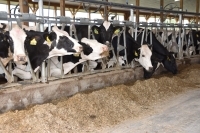
As part of the Biden-Harris Administration’s ongoing efforts to support dairy farmers and rural communities, today the U.S. Department of Agriculture (USDA) opened signup for the Dairy Margin Coverage (DMC) program and expanded the program to allow dairy producers to better protect their operations by enrolling supplemental production. This signup period – which runs from Dec. 13, 2021 to Feb. 18, 2022 – enables producers to get coverage through this important safety-net program for another year as well as get additional assistance through the new Supplemental DMC.
Supplemental DMC will provide $580 million to better help small- and mid-sized dairy operations that have increased production over the years but were not able to enroll the additional production. Now, they will be able to retroactively receive payments for that supplemental production. Additionally, USDA’s Farm Service Agency (FSA) updated how feed costs are calculated, which will make the program more reflective of actual dairy producer expenses.
Supplemental DMC Enrollment
Eligible dairy operations with less than 5 million pounds of established production history may enroll supplemental pounds based upon a formula using 2019 actual milk marketings, which will result in additional payments. Producers will be required to provide FSA with their 2019 Milk Marketing Statement.
Supplemental DMC coverage is applicable to calendar years 2021, 2022 and 2023. Participating dairy operations with supplemental production may receive retroactive supplemental payments for 2021 in addition to payments based on their established production history.
Supplemental DMC will require a revision to a producer’s 2021 DMC contract and must occur before enrollment in DMC for the 2022 program year. Producers will be able to revise 2021 DMC contracts and then apply for 2022 DMC by contacting their local USDA Service Center.
DMC 2022 Enrollment
After making any revisions to 2021 DMC contracts for Supplemental DMC, producers can sign up for 2022 coverage. DMC provides eligible dairy producers with risk management coverage that pays producers when the difference between the price of milk and the cost of feed falls below a certain level. So far in 2021, DMC payments have triggered for January through October for more than $1.0 billion.
For DMC enrollment, producers must certify with FSA that the operation is commercially marketing milk, sign all required forms and pay the $100 administrative fee. The fee is waived for farmers who are considered limited resource, beginning, socially disadvantaged, or a military veteran. To determine the appropriate level of DMC coverage for a specific dairy operation, producers can use the online dairy decision tool.
Updates to Feed Costs
USDA is also changing the DMC feed cost formula to better reflect the actual cost dairy farmers pay for high-quality alfalfa hay. FSA will calculate payments using 100% premium alfalfa hay rather than 50%. The amended feed cost formula will make DMC payments more reflective of actual dairy producer expenses.
Additional Dairy Assistance
Today’s announcement is part of a broader package to help the dairy industry respond to the pandemic and other challenges. USDA is also amending Dairy Indemnity Payment Program (DIPP) regulations to add provisions for the indemnification of cows that are likely to be not marketable for longer durations, as a result, for example, of per- and polyfluoroalkyl substances. FSA also worked closely with USDA's Natural Resources Conservation Service to target assistance through the Environmental Quality Incentives Program) and other conservation programs to help producers safely dispose of and address resource concerns created by affected cows. Other recent dairy announcements include $350 million through the Pandemic Market Volatility Assistance Program and $400 million for the Dairy Donation Program.
Additional details on these changes to DMC and DIPP can be found in a rule that will be published soon in the Federal Register. This rule also included information on the new Oriental Fruit Fly Program as well as changes to FSA conservation programs. A copy of the rule is available here.
More Information
To learn more or to participate in DMC or DIPP, producers should contact their local USDA Service Center. Service Center staff continue to work with agricultural producers via phone, email and other digital tools. Because of the pandemic, some are open to limited visitors. Producers should contact their Service Center to set up an in-person or phone appointment. Additionally, more information related to USDA’s response and relief for producers can be found at farmers.gov/coronavirus.
|
Howard County U.S. Department of Agriculture (USDA) Farm Service Agency (FSA) announced that County Committee elections are over and the ballots have been counted.
Joyce Swestka of Cresco was elected to represent local administrative area (LAA) #3.
Mark Murphy of Cresco will serve as the first alternate.
County committee members are a critical component of the day-to-day operations of FSA. They help deliver programs at the county level and work to serve the needs of local producers. All recently elected county committee members will take office in January 2022 and will be joining the existing committee. Every FSA office is required to have a county committee, which are made up of local farmers, ranchers and foresters elected by local producers.
County committee members impact the administration of FSA within a community by applying their knowledge and judgment to help FSA make important decisions on commodity support programs, conservation programs, indemnity and disaster programs, emergency programs and eligibility.
County committee members serve local producers through their decision making and help shape the culture of a local FSA office. They also ensure the fair and equitable administration of FSA farm programs in their counties and are accountable to the Secretary of Agriculture. Members conduct hearings and reviews as requested by the state committee, ensure underserved farmers, ranchers and foresters are fairly represented, make recommendations to the state committee on existing programs, monitor changes in farm programs and inform farmers of the purpose and provisions of FSA programs. They also assist with outreach and inform underserved producers, such as beginning farmers, ranchers and foresters, about FSA opportunities.
For more information, visit the FSA website at fsa.usda.gov/elections or contact the Howard County FSA office at 563-547-2841.
Agricultural producers in Howard County who lost property due to recent natural disasters are eligible for physical loss loans from the U.S. Department of Agriculture (USDA). USDA’s Farm Service Agency (FSA) offers these loans for losses caused by high winds, lightning, and tornadoes that occurred Dec. 15 & 16, 2021.
FSA is offering these low-interest emergency loans to producers with a qualifying loss. Approval is limited to applicants who suffered severe physical losses only, including the loss of buildings and livestock. The deadline for producers in designated primary and contiguous counties to apply for loans for physical losses is September 7, 2022.
Physical loss loans can help producers repair or replace damaged or destroyed physical property essential to the success of the agricultural operation, including livestock losses. Examples of property commonly affected include essential farm buildings, fixtures to real estate, equipment, livestock, perennial crops, fruit and nut bearing trees, and harvested or stored crops and hay.
Please contact FSA for more information on loan eligibility and the application process. FSA office information is available at http://offices.usda.gov. Additional FSA disaster assistance program information is available at disaster.fsa.usda.gov.

|
The Howard USDA Farm Service Agency (FSA) Office located in Cresco, Iowa, is accepting applications to fill a permanent Program Technician position starting Tuesday, January 18th.
The individual selected will be responsible for carrying out general office activities and technical functions pertaining to all FSA administered programs. Regular work schedule from 8:00 am to 4:30 pm, Monday through Friday.
Applicants should possess excellent customer service skills as well as strong clerical, math and computer data entry skills. A general knowledge of agricultural practices would also be beneficial. This position has a starting salary range of $32,283 up to $58,158/ per year including full health and retirement benefits under the federal employee program. The individual selected will be required to pass a background investigation and fingerprint check.
The full vacancy announcement with mandatory application requirements can be obtained online at www.usajobs.gov by searching in the keywords vacancy announcement number FSACO-11355139-22-IA-KR.
This vacancy has an opening date of January 18th, 2022, and a closing date of January 31st, 2022.
There is an essay section requirement entitled; Knowledge, Skills and Abilities (KSA). Applications that do not include KSA’s will not be considered.
Applicants should apply at all pay grades. The job announcement is for multiple locations, please ensure you choose Cresco in Howard County. Questions regarding this position can be directed to Ron Pethoud at 641-394-5929 or by email at ronald.pethoud@usda.gov. All applications must be submitted online by January 31, 2022.
Benefits:
- 401(k)
- 401(k) matching
- Dental insurance
- Employee assistance program
- Flexible schedule
- Flexible spending account
- Health insurance
- Health savings account
- Life insurance
- Paid time off
- Paid sick leave
- Parental leave
- Vision insurance
- 11 paid holidays
|
|
|