|
The Drew County Service Center is open to limited visitors, by appointment only. We continue to work with agricultural producers via phone, email, and other digital tools. Contact us at 870-224-7319 to make an in-person or phone appointment. We will be closed on Monday, January 17 in observance of Martin Luther King Day.
FSA Dates & Deadlines:
Final date to inform FSA of crop losses - Before Crop Disposition
January 17 - Service Center Closed
February 28 - NAP deadline for Fruits & Vegetables
NRCS Dates & Deadlines:
January 21 - Conservation Stewardship Program (CSP) Applications Due (see article below)
If you’ve been to farmers.gov before, things may look a little different from the last time you were here. We’ve made some changes, to improve how you find information so that you can find what you need even more easily and efficiently.
The big, green navigation bar near the top of every page – it’s different now. It opens up, to show descriptions and subtopics, making it quicker and easier to figure out what’s where and reduce guessing. Why? Two reasons: First, farmers.gov has grown a lot over the years and the old navigation wasn’t designed for the load. Second, because you asked for it. We analyzed your comments through the “Feedback” button on the site and tested our new designs and information organization with real farmers and ranchers through surveys and live testing sessions.
Along with the new website navigation, we restructured how our pages and topics are grouped and organized to help you easily access the information you need. We also relabeled some of our existing pages using more direct language. This means that pages or information you’ve used before may have different labels or be in new places.
Important changes:
- The old Fund page is now called Loans. The Loans page has information and resources about USDA loans, including the Farm Loan Programs.
- The Recover page is now Protection and Recovery. This page has information to help you prepare and recover from natural disasters, and to mitigate risk for your operation.
- The Conserve page is now Conservation. This page hasn’t changed much and still has information on how to implement conservation practices, improve and preserve natural resources, and address conservation concerns.
- The Manage page is now Working With Us. This page connects you with resources that tell you how USDA can help you start, expand, enhance, or improve your agricultural operation.
- The Connect page has been replaced with Your Business, a guide to USDA resources that cater to your specific operation. Information that was on the Connect page has been moved to the Contact Us page and the Get Involved page.
We are always updating farmers.gov based on your feedback and to stay up-to-date with important USDA announcements. We’ve recently created some new webpages, and updated some existing ones, to better equip you with the vital information you need. There are even more new pages coming soon, so stay tuned!
For farmers.gov, we don’t guess what farmers and ranchers want from a website. We start by asking, then test our designs with volunteers who are also farmers and ranchers.
There’s a feedback button on every page of farmers.gov. Based on your feedback, we looked for ways to make our site easier to use and to build the information that you’re looking for. Live user testing sessions provide data, such as this heatmap, showing where testers tended to click during an exercise.
You helped us create the new navigation design, the new information organization, and told us how to speak using your words, and not legalese.
Check out farmers.gov today!
|
The Agricultural Risk Protection Act of 2000 requires Farm Service Agency (FSA), and Risk Management Agency (RMA) to work together, to improve program compliance and integrity of the Federal Crop Insurance Program.
- FSA will be assisting RMA and insurance providers in monitoring crop conditions throughout the growing season
- FSA will refer all suspected cases of fraud, waste, and abuse in the Federal Crop Insurance Program to RMA
- Producers may report suspected cases of fraud, waste, and abuse to their local FSA County Office, RMA or the Office of Inspector General (OIG)
- FSA will assist RMA with auditing claims

The U.S. Department of Agriculture (USDA) announced a higher loan limit will be available for borrowers seeking a guaranteed farm loan starting Oct. 1, 2021, from $1.776 million to $1.825 million.
FSA farm loans offer access to funding for a wide range of producer needs, from securing land to financing the purchase of equipment. Guaranteed loans are financed and serviced by commercial lenders. FSA provides up to a 95% guarantee against possible financial loss of principal and interest. Guaranteed loans can be used for both farm ownership and operating purposes.
In fiscal year 2021, FSA saw continued strong demand for guaranteed loans. FSA obligated more than $3.4 billion in guaranteed farm ownership and operating loans. This includes nearly $1.2 billion for beginning farmers. The number of guaranteed borrowers has grown by 10% to more than 38,750 farmers and ranchers over the last decade. FSA expects the increasing demand for farm loans to continue into fiscal year 2022.
Disaster Set-Aside Extension
USDA has additional support available to producers given the recent outbreaks of the COVID-19 Delta variant and has extended the availability of COVID-19 Disaster Set-Aside (DSA) for installments due through Jan. 31, 2022. In addition, FSA will permit a second DSA for COVID-19 and a second DSA for natural disasters for those who had an initial COVID-19 DSA. Requests for a COVID-19 DSA or a second DSA must be received no later than May 1, 2022.
Last year, FSA broadened the use of the DSA. Normally used in the wake of natural disasters, the DSA can now allow farmers with USDA farm loans who are affected by COVID-19 and determined to be eligible, to have their next payment set aside. The set-aside payment’s due date is moved to the final maturity date of the loan or extended up to twelve months in the case of an annual operating loan. Any principal set-aside will continue to accrue interest until it is repaid. This will improve the borrower’s cashflow in the current production cycle.
More Information
Producers can explore available options on all FSA loan options at fsa.usda.gov or by contacting their local USDA Service Center. Service Center staff continue to work with agricultural producers via phone, email, and other digital tools. Because of the pandemic, some USDA Service Centers are open to limited visitors. Contact your Service Center to set up an in-person or phone appointment. Additionally, more information related to USDA’s response and relief for producers can be found at farmers.gov/coronavirus.
|
The Agricultural Foreign Investment Disclosure Act (AFIDA) requires all foreign owners of U.S. agricultural land to report their holdings to the Secretary of Agriculture. Foreign persons who have purchased or sold agricultural land in the county are required to report the transaction to FSA within 90 days of the closing. Failure to submit the AFIDA form could result in civil penalties of up to 25 percent of the fair market value of the property. County government offices, realtors, attorneys and others involved in real estate transactions are reminded to notify foreign investors of these reporting requirements. The data gained from these disclosures is used in the preparation of periodic reports to the President and Congress concerning the effect of such holdings upon family farms and rural communities. Click here for more information on AFIDA.
Using the correct signature when doing business with FSA can save time and prevent a delay in program benefits.
The following are FSA signature guidelines:
- A married woman must sign her given name: Mrs. Mary Doe, not Mrs. John Doe
- For a minor, FSA requires the minor's signature and one from the minor’s parent
Note, by signing a document with a minor, the parent is liable for actions of the minor and may be liable for refunds, liquidated damages, etc.
When signing on one’s behalf the signature must agree with the name typed or printed on the form or be a variation that does not cause the name and signature to be in disagreement. Example - John W. Smith is on the form. The signature may be John W. Smith or J.W. Smith or J. Smith. Or Mary J. Smith may be signed as Mrs. Mary Joe Smith, M.J. Smith, Mary Smith, etc.
FAXED signatures will be accepted for certain forms and other documents provided the acceptable program forms are approved for FAXED signatures. Producers are responsible for the successful transmission and receipt of FAXED information.
Examples of documents not approved for FAXED signatures include:
- Promissory note
- Assignment of payment
- Joint payment authorization
- Acknowledgement of commodity certificate purchase
Spouses may sign documents on behalf of each other for FSA and CCC programs in which either has an interest, unless written notification denying a spouse this authority has been provided to the county office.
Spouses cannot sign on behalf of each other as an authorized signatory for partnerships, joint ventures, corporations or other similar entities. Likewise, a spouse cannot sign a document on behalf of the other in order to affirm the eligibility of oneself.
Any member of a general partnership can sign on behalf of the general partnership and bind all members unless the Articles of Partnership are more restrictive. Spouses may sign on behalf of each other’s individual interest in a partnership, unless notification denying a spouse that authority is provided to the county office. Acceptable signatures for general partnerships, joint ventures, corporations, estates, and trusts must consist of an indicator “by” or “for” the individual’s name, individual’s name and capacity, or individual’s name, capacity, and name of entity.
For additional clarification on proper signatures contact your local FSA office.
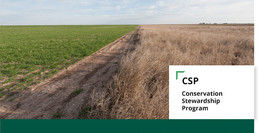
Farmers and landowners have until Jan. 21, 2022, to apply for funding consideration during the 2022 Conservation Stewardship Program (CSP) Classic enrollment period. Producers in portions of Chicot and Desha counties will also have the opportunity to apply for CSP in the MRBI-Canal 43 project area.
CSP offers additional opportunities to expand on existing conservation efforts by offering conservation practices, enhancements, bundles, and other conservation activities.
“CSP continues to be a very effective tool for private landowners working to achieve their conservation and management goals,” said Mike Sullivan, Arkansas NRCS state conservationist.
While applications are accepted throughout the year, interested producers should submit applications to their local NRCS office by Jan. 21, 2022, to ensure their applications are considered for 2022 CSP Classic funding.
CSP is offered in Arkansas through continuous sign-ups. The program provides many benefits including increased crop yields, decreased inputs, wildlife habitat improvements and increased resilience to weather extremes. CSP is for working lands including cropland, pastureland, rangeland, nonindustrial private forest land and agricultural land under the jurisdiction of a tribe.
For additional information about CSP, contact your local USDA Service Center https://offices.sc.egov.usda.gov/locator/app.
While USDA offices are currently closed to walk-in visitors because of the pandemic, service center staff continue to work with agricultural producers by appointment and via phone, email, and other digital tools. To conduct business, please contact your local USDA Service Center. Additionally, more information related to USDA’s response and relief for producers can be found at farmers.gov/coronavirus.
|
Persons with disabilities who require accommodations to attend or participate in this meeting should contact Christa Kimbrell at 870-224-7319
or Federal Relay Service at 1-800-877-8339.
|