
The U.S. Department of Agriculture (USDA) announced a new program to assist hog producers who sold hogs through a negotiated sale during the period in which these producers faced the greatest reduction in market prices due to the COVID-19 pandemic. The Spot Market Hog Pandemic Program (SMHPP) is part of USDA’s Pandemic Assistance for Producers initiative and addresses gaps in previous assistance for hog producers. USDA’s Farm Service Agency (FSA) will accept applications Dec. 15, 2021 through Feb. 25, 2022.
SMHPP provides assistance to hog producers who sold hogs through a negotiated sale from April 16, 2020 through Sept. 1, 2020. Negotiated sale, or negotiated formula sale, means a sale of hogs by a producer to a packer under which the base price for the hogs is determined by seller-buyer interaction and agreement on a delivery day. USDA is offering SMHPP as packer production was reduced due to the COVID-19 pandemic due to employee illness and supply chain issues, resulting in fewer negotiated hogs being procured and subsequent lower market prices.
The Department has set aside up to $50 million in pandemic assistance funds through the Coronavirus Aid, Relief and Economic Security (CARES) Act for SMHPP.
SMHPP Program Details
Eligible hogs include hogs sold through a negotiated sale by producers between April 16, 2020, and Sept. 1, 2020. To be eligible, the producer must be a person or legal entity who has ownership in the hogs and whose production facilities are located in the United States, including U.S. territories. Contract producers, federal, state and local governments, including public schools and packers are not eligible for SMHPP.
SMHPP payments will be calculated by multiplying the number of head of eligible hogs, not to exceed 10,000 head, by the payment rate of $54 per head. FSA will issue payments to eligible hog producers as applications are received and approved.
Applying for Assistance
Eligible hog producers can apply for SMHPP starting Dec. 15, 2021, by completing the FSA-940, Spot Market Hog Pandemic Program application. Additional documentation may be required. Visit farmers.gov/smhpp for a copy of the Notice of Funds Availability, information on applicant eligibility and more information on how to apply.
Applications can be submitted to the FSA office at any USDA Service Center nationwide by mail, fax, hand delivery or via electronic means. To find your local FSA office, visit farmers.gov/service-locator. Hog producers can also call 877-508-8364 to speak directly with a USDA employee ready to offer assistance.
|
USDA opened signup for the Dairy Margin Coverage (DMC) Program and expanded the program to allow dairy producers to better protect their operations by enrolling supplemental production. This signup period – which runs from Dec. 13, 2021 to Feb. 18, 2022 – enables producers to get coverage through this important safety-net program for another year as well as get additional assistance through the new Supplemental DMC. To determine the appropriate level of DMC coverage for a specific dairy operation, producers can use the online dairy decision tool.
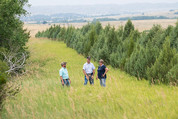
The U.S. Department of Agriculture (USDA) is leveraging its authorities under the Conservation Reserve Enhancement Program (CREP) to bring in new types of partners and ultimately expand opportunities in voluntary conservation for the Nation’s agricultural producers and private landowners. In direct response to feedback from state agencies, Tribes, non-profits and other groups, USDA has updated CREP’s rule regarding matching fund requirements, and invested in additional staff to work directly with partners for streamlined, partner-driven conservation efforts.
CREP is part of the Conservation Reserve Program (CRP) and enables USDA’s Commodity Credit Corporation (CCC), through Farm Service Agency (FSA), and partners to co-invest in partner-led projects. CREP also plays an important role in USDA’s broader climate change strategy, bringing together producers, landowners and partners for climate-smart land management.
Matching Funds
A Dec. 6, 2019, rule required that 50% of matching funds from partners be in the form of direct payments, which made it more difficult for diverse types of groups to participate as partners in CREP. With this rule change, partners can now provide their negotiated level of matching funds in the form of cash, in-kind contributions, or technical assistance. This change allows for greater flexibility and opportunity for additional partners to participate in the program.
This change was enacted through a Dec. 13, 2021 rule in the Federal Register.
The rule also updated policy to now provide a full annual rental rate to producers who are impacted by state, Tribal or local laws, ordinances and regulations that require a resource conserving or environmental protection measure. The previous rule reduced the rental payment made to producers who were covered by such laws.
Additional Capacity to Support Partners and Producers
In order to implement these changes, FSA has hired three new CREP staff members, using a regional approach to work closely with potential and existing partners and expand program availability. The team members include:
-
Evelyn Whitesides, focusing on Alabama, Connecticut, Delaware, Florida, Georgia, Kentucky Maine, Maryland, Massachusetts, Mississippi, New Hampshire, New Jersey, New York, North Carolina, Ohio, Pennsylvania, Rhode Island, South Carolina, Tennessee, Vermont, Virginia, West Virginia and Caribbean Region (Puerto Rico and Virgin Islands).
-
Kim Martin, focusing on Arkansas, Illinois, Indiana, Iowa, Kansas, Louisiana, Michigan, Minnesota, Missouri, Nebraska, North Dakota, Oklahoma, South Dakota, Texas and Wisconsin.
-
Patrick Lewis, focusing on Alaska, Arizona, California, Colorado, Hawaii, Idaho, Montana, Nevada, New Mexico, Oregon, Pacific Basin, Utah, Washington and Wyoming.
These investments in CREP staffing build on other recent outreach and education efforts by FSA, including a $4.7 million investment announced this year to establish partnerships with organizations to provide outreach and technical assistance to historically underserved farmers and ranchers on a variety of CCC and FSA programs, including conservation programs.
Currently, all CREP partners are States; however, FSA is strongly encouraging Tribes and non-governmental organizations to consider partnerships. This program is a great vehicle for their conservation-focused efforts.
About CREP
Currently, CREP has 34 projects in 26 states. In total, more than 860,000 acres are enrolled in CREP.
Eligible partners include States, Tribal groups, and non-governmental organizations. Potential partners interested in CREP should contact their FSA State Office or one of the new CREP team members listed above.
More Information
Earlier this year, FSA rolled out a number of improvements to CRP, which included a larger emphasis on climate-smart agriculture through a new Climate-Smart Practice Incentive for CRP general and continuous signups. Learn more in our “What’s New with CRP” fact sheet. These updates to CREP build on FSA’s larger effort to improve all components of CRP.
To learn about CREP and other CRP opportunities, producers and landowners should contact their local USDA Service Center.
|

The U.S. Department of Agriculture (USDA) has extended the deadline for agricultural producers who are certified organic, or transitioning to organic, to apply for the Organic and Transitional Education and Certification Program (OTECP). This program provides pandemic assistance to cover certification and education expenses. The deadline to apply for 2020 and 2021 eligible expenses is now Feb. 4, 2022, rather than the original deadline of Jan. 7, 2022.
Signup for OTECP, administered by USDA’s Farm Service Agency (FSA), began Nov. 8.
Certified operations and transitional operations may apply for OTECP for eligible expenses paid during the 2020, 2021 and 2022 fiscal years. Signup for the 2022 fiscal year will be announced at a later date.
For each year, OTECP covers 25% of a certified operation’s eligible certification expenses, up to $250 per certification category (crop, livestock, wild crop, handling and State Organic Program fee). This includes application fees, inspection fees, USDA organic certification costs, state organic program fees and more.
Crop and livestock operations transitioning to organic production may be eligible for 75% of a transitional operation’s eligible expenses, up to $750, for each year. This includes fees charged by a certifying agent or consultant for pre-certification inspections and development of an organic system plan.
For both certified operations and transitional operations, OTECP covers 75% of the registration fees, up to $200, per year, for educational events that include content related to organic production and handling in order to assist operations in increasing their knowledge of production and marketing practices that can improve their operations, increase resilience and expand available marketing opportunities. Additionally, both certified and transitional operations may be eligible for 75% of the expense of soil testing required under the National Organic Program (NOP) to document micronutrient deficiency, not to exceed $100 per year.
Producers apply through their local FSA office and can also obtain one-on-one support with applications by calling 877-508-8364. The program application and additional information can be found at farmers.gov/otecp.
Additional Organic Support
OTECP builds upon USDA’s Organic Certification Cost Share Program (OCCSP) which provides cost share assistance of 50%, up to a maximum of $500 per scope, to producers and handlers of agricultural products who are obtaining or renewing their certification under the NOP. Although the application period for OCCSP ended Nov. 1, 2021, FSA will consider late-filed applications for those operations who still wish to apply.
Meanwhile, USDA’s Risk Management Agency (RMA) recently made improvements to Whole-Farm Revenue Protection to make it more flexible and accessible to organic producers.
To learn more about USDA’s broader assistance for organic producers, visit usda.gov/organic.
|

The Farm Service Agency (FSA) has several loan programs to help you start or continue an agriculture production. Farm ownership and operating loans are available.
While all qualified producers are eligible to apply for these loan programs, FSA has provided priority funding for members of targeted underserved applicants.
A targeted underserved applicant is one of a group whose members have been subjected to racial, ethnic or gender prejudice because of his or her identity as members of the group without regard to his or her individual qualities.
For purposes of this program, targeted underserved groups are women, African Americans, American Indians, Alaskan Natives, Hispanics, Asian Americans and Pacific Islanders.
FSA loans are only available to applicants who meet all the eligibility requirements and are unable to obtain the needed credit elsewhere.
|

Farmers and ranchers can use the Farm Loan Discovery Tool on farmers.gov to find information on USDA farm loans that may best fit their operations.
USDA’s Farm Service Agency (FSA) offers a variety of loan options to help farmers finance their operations. From buying land to financing the purchase of equipment, FSA loans can help.
USDA conducted field research in eight states, gathering input from farmers and FSA farm loan staff to better understand their needs and challenges.
How the Tool Works
Farmers who are looking for financing options to operate a farm or buy land can answer a few simple questions about what they are looking to fund and how much money they need to borrow. After submitting their answers, farmers will receive information on farm loans that best fit their specific needs. The loan application and additional resources also will be provided.
Farmers can download application quick guides that outline what to expect from preparing an application to receiving a loan decision. There are four guides that cover loans to individuals, entities, and youth, as well as information on microloans. The guides include general eligibility requirements and a list of required forms and documentation for each type of loan. These guides can help farmers prepare before their first USDA service center visit with a loan officer.
Farmers can access the Farm Loan Discovery Tool by visiting farmers.gov/fund and clicking the “Start” button. Follow the prompts and answer five simple questions to receive loan information that is applicable to your agricultural operation. The tool is built to run on any modern browser like Chrome, Edge, Firefox, or the Safari browser, and is fully functional on mobile devices. It does not work in Internet Explorer.
|
|