Sac County FSA Updates

View as a webpage / Share

US Department of Agriculture

December 2021 Bulletin

Important Dates

December 24, 2021 Christmas Day Observance; Office Closed
December 31, 2021 New Years Day Observance; Office Closed
January 17, 2022 Martin Luther King Jr. Day; Office Closed
January 31, 2022 Livestock Forage Program Deadline
February 21, 2022 President's Day; Office Closed
February 25, 2022 Spot Market Hog Pandemic Program Application Deadline


Storm Damage

Storm Damage

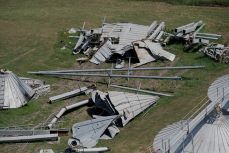
Anyone affected by last night’s (December 15) storm that has substantial damage to farmstead buildings and livestock facilities or livestock death loss should contact their local USDA Farm Service Agency and report their weather damage.

Producers that lost livestock beyond normal mortality due to extreme weather events are eligible for USDA compensation through the Livestock Indemnity Program (LIP).

Producers that have storm debris scattered across their cropland and farmsteads that requires a substantial economic effort to clean up, requiring Federal assistance, may be eligible for cost share assistance through the Emergency Conservation Program (ECP).


USDA Provides Additional Pandemic Assistance to Hog Producers

Spot Market Hog Pandemic Program

The U.S. Department of Agriculture (USDA) announced a new program to assist hog producers who sold hogs through a negotiated sale during the period in which these producers faced the greatest reduction in market prices due to the COVID-19 pandemic. The Spot Market Hog Pandemic Program (SMHPP) is part of USDA’s Pandemic Assistance for Producers initiative and addresses gaps in previous assistance for hog producers. USDA’s Farm Service Agency (FSA) will accept applications Dec. 15, 2021 through Feb. 25, 2022.

SMHPP provides assistance to hog producers who sold hogs through a negotiated sale from April 16, 2020 through Sept. 1, 2020. Negotiated sale, or negotiated formula sale, means a sale of hogs by a producer to a packer under which the base price for the hogs is determined by seller-buyer interaction and agreement on a delivery day. USDA is offering SMHPP as packer production was reduced due to the COVID-19 pandemic due to employee illness and supply chain issues, resulting in fewer negotiated hogs being procured and subsequent lower market prices.

The Department has set aside up to $50 million in pandemic assistance funds through the Coronavirus Aid, Relief and Economic Security (CARES) Act for SMHPP.

SMHPP Program Details 
Eligible hogs include hogs sold through a negotiated sale by producers between April 16, 2020, and Sept. 1, 2020. To be eligible, the producer must be a person or legal entity who has ownership in the hogs and whose production facilities are located in the United States, including U.S. territories. Contract producers, federal, state and local governments, including public schools and packers are not eligible for SMHPP. 

SMHPP payments will be calculated by multiplying the number of head of eligible hogs, not to exceed 10,000 head, by the payment rate of $54 per head. FSA will issue payments to eligible hog producers as applications are received and approved.

Applying for Assistance 
Eligible hog producers can apply for SMHPP starting Dec. 15, 2021, by completing the FSA-940, Spot Market Hog Pandemic Program application. Additional documentation may be required. Visit farmers.gov/smhpp for a copy of the Notice of Funds Availability, information on applicant eligibility and more information on how to apply. 

Applications can be submitted to the FSA office at any USDA Service Center nationwide by mail, fax, hand delivery or via electronic means. To find your local FSA office, visit farmers.gov/service-locator. Hog producers can also call 877-508-8364 to speak directly with a USDA employee ready to offer assistance.


USDA Builds Pandemic Support for Certified Organic and Transitioning Operations

USDA Organic

The U.S. Department of Agriculture (USDA) will provide pandemic assistance to cover certification and education expenses to agricultural producers who are certified organic or transitioning to organic. USDA will make $20 million available through the new Organic and Transitional Education and Certification Program (OTECP) as part of USDA’s broader Pandemic Assistance for Producers initiative, which provides new, broader and more equitable opportunities for farmers, ranchers and producers.    

During the COVID-19 pandemic, certified organic and transitional operations faced challenges due to loss of markets, and increased costs and labor shortages, in addition to costs related to obtaining or renewing their organic certification, which producers and handlers of conventionally grown commodities do not incur. Transitional operations also faced the financial challenge of implementing practices required to obtain organic certification without being able to obtain the premium prices normally received for certified organic commodities.     

 Eligible Expenses  

OTECP funding is provided through the Coronavirus Aid, Relief, and Economic Security Act (CARES Act). Certified operations and transitional operations may apply for OTECP for eligible expenses paid during the 2020, 2021 and 2022 fiscal years. For each year, OTECP covers 25% of a certified operation’s eligible certification expenses, up to $250 per certification category (crop, livestock, wild crop, handling and State Organic Program fee). This includes application fees, inspection fees, USDA organic certification costs, state organic program fees and more.    

Crop and livestock operations transitioning to organic production may be eligible for 75% of a transitional operation’s eligible expenses, up to $750, for each year. This includes fees charged by a certifying agent or consultant for pre-certification inspections and development of an organic system plan.    

For both certified operations and transitional operations, OTECP covers 75% of the registration fees, up to $200, per year, for educational events that include content related to organic production and handling in order to assist operations in increasing their knowledge of production and marketing practices that can improve their operations, increase resilience and expand available marketing opportunities. Additionally, both certified and transitional operations may be eligible for 75% of the expense of soil testing required under the National Organic Program (NOP) to document micronutrient deficiency, not to exceed $100 per year.  

Applying for Assistance    

Signup for 2020 and 2021 OTECP will be Nov. 8, 2021, through Jan. 7, 2022. Producers apply through their local Farm Service Agency (FSA) office and can also obtain one-on-one support with applications by calling 877-508-8364. Visit farmers.gov/otecp to learn more.     

Additional Organic Support    

OTECP builds upon USDA’s Organic Certification Cost Share Program (OCCSP) which provides cost share assistance of 50%, up to a maximum of $500 per scope, to producers and handlers of agricultural products who are obtaining or renewing their certification under the NOP. This year’s application period for OCCSP ended Nov. 1, 2021.  

Additionally, USDA’s Risk Management Agency announced improvements to the Whole-Farm Revenue Program including increasing expansion limits for organic producers to the higher of $500,000 or 35%. Previously, small and medium size organic operations were held to the same 35% limit to expansion as conventional practice producers. Also, producers can now report acreage as certified organic, or as acreage in transition to organic, when the producer has requested an organic certification by the acreage reporting date.    

To learn more about USDA’s assistance for organic producers, visit usda.gov/organic.   

As USDA looks for long-term solutions to build back a better food system, the Department is committed to delivery of financial assistance to farmers, ranchers and agricultural producers and businesses who have been impacted by COVID-19 market disruptions. Since USDA rolled out the Pandemic Assistance for Producers initiative in March, the Department has provided support to America’s farmers and ranchers including: 


USDA Service Center

406 Morningside Drive
Sac City, IA 50583

Phone: 712-662-7159
Fax: 855-218-8666

Farm Service Agency
Executive Director

John Landgraf, CED
712-662-7159
John.Landgraf@usda.gov

Natural Resources Conservation Service District Conservationist

Michaela Hawks
712-662-7773
Michaela.Hawks@usda.gov