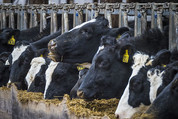
The U.S. Department of Agriculture will begin issuing additional payments next week for dairy producers who enrolled in 2020 and 2021 coverage through the Dairy Margin Coverage (DMC). USDA’s Farm Service Agency (FSA) updated the feed cost calculation by using 100% premium alfalfa hay rather than 50% premium hay in determining the monthly margin, which means an additional $4,956,000 for dairy producers in Vermont. Payments will be retroactive to Jan. 1, 2020. Dairy operations with 2020 and 2021 contracts will be paid automatically for the applicable months.
In addition to updating the feed cost, USDA announced other dairy-related updates, including the start of the 2022 DMC signup as well as the new Supplemental DMC. Both will run from Dec. 13, 2021 to Feb. 18, 2022. DMC is an important safety-net program. So far in 2021, DMC payments have triggered for January through October for more than $1.0 billion.
More Information
To learn more or to participate in DMC, producers should contact their local USDA Service Center. To determine the appropriate level of DMC coverage for a specific dairy operation, producers can also use the online dairy decision tool. Service Center staff continue to work with agricultural producers via phone, email and other digital tools. Because of the pandemic, some USDA Service Centers are open to limited visitors. Producers should contact their Service Center to set up an in-person or phone appointment. Additionally, more information related to USDA’s response and relief for producers can be found at farmers.gov/coronavirus.
|

The U.S. Department of Agriculture (USDA) is in the process of issuing $1.8 billion in payments to agricultural producers who enrolled in the Agriculture Risk Coverage (ARC) and Price Loss Coverage (PLC) programs for the 2020 crop year. These payments provide critical support to help mitigate fluctuations in either revenue or prices for certain crops. These two USDA safety-net programs help producers of certain crops build back better after facing the impacts of COVID-19 and other challenges.
In addition, USDA’s Farm Service Agency (FSA) is encouraging producers to contact their local USDA Service Centers to make or change elections and to enroll for 2022 ARC or PLC, providing future protections against market fluctuations. The election and enrollment period opened on Oct. 18, 2021 and runs through March 15, 2022.
2020 Payments and Contracts
ARC and PLC payments for a given crop year are paid out the following fall to allow actual county yields and the Market Year Average prices to be finalized. This month, FSA processed payments to producers enrolled in 2020 ARC-County (ARC-CO), ARC-Individual (ARC-IC) and PLC for covered commodities that triggered for the crop year.
For ARC-CO, view the 2020 ARC-CO Benchmark Yields and Revenues online database for payment rates applicable to their county and each covered commodity.
For PLC, payments have triggered for barley, canola, chickpeas (large and small), dry peas, flaxseed, lentils, peanuts, seed cotton and wheat. More information on rice payments will be announced later this fall and in early 2022.
For ARC-IC, producers should contact their local FSA office for additional information pertaining to 2020 payment information, which relies on producer-specific yields for the crop and farm to determine benchmark yields and actual year yields when calculating revenues.
By the Numbers
More than 1.7 million contracts were signed in 2019. In 2020, producers signed nearly 1.8 million ARC or PLC contracts, and 251 million out of 273 million base acres were enrolled in the programs. In 2021, signed contracts surpassed 1.8 million.
Since the ARC and PLC were authorized by the 2014 Farm Bill and reauthorized by the 2018 Farm Bill, these safety-net programs have paid out more than $32.5 billion to producers of covered commodities.
2022 Elections and Enrollment
Producers can elect coverage and enroll in ARC-CO or PLC, which are both crop-by-crop, or ARC-IC, which is for the entire farm. Although election changes for 2022 are optional, producers must enroll through a signed contract each year. Also, if a producer has a multi-year contract on the farm and makes an election change for 2022, it will be necessary to sign a new contract.
If an election is not submitted by the deadline of March 15, 2022, the election remains the same as the 2021 election for crops on the farm. Farm owners cannot enroll in either program unless they have a share interest in the farm.
Covered commodities include barley, canola, large and small chickpeas, corn, crambe, flaxseed, grain sorghum, lentils, mustard seed, oats, peanuts, dry peas, rapeseed, long grain rice, medium and short grain rice, safflower seed, seed cotton, sesame, soybeans, sunflower seed, and wheat.
Web-Based Decision Tools
In partnership with USDA, the University of Illinois and Texas A&M University offer web-based decision tools to assist producers in making informed, educated decisions using crop data specific to their respective farming operations. Tools include:
-
Gardner-farmdoc Payment Calculator, a tool available through the University of Illinois allows producers to estimate payments for farms and counties for ARC-CO and PLC.
-
ARC and PLC Decision Tool, a tool available through Texas A&M tallows producers to estimate payments and yield updates and expected payments for 2022.
Crop Insurance Considerations
ARC and PLC are part of a broader safety net provided by USDA, which also includes crop insurance and marketing assistance loans.
Producers are reminded that ARC and PLC elections and enrollments can impact eligibility for some crop insurance products.
Producers on farms with a PLC election have the option of purchasing Supplemental Coverage Option (SCO) through their Approved Insurance Provider; however, producers on farms where ARC is the election are ineligible for SCO on their planted acres for that crop on that farm.
Unlike SCO, the Enhanced Coverage Option (ECO) is unaffected by an ARC election. Producers may add ECO regardless of the farm program election.
Upland cotton farmers who choose to enroll seed cotton base acres in ARC or PLC are ineligible for the stacked income protection plan (STAX) on their planted cotton acres for that farm.
More Information
For more information on ARC and PLC, visit the ARC and PLC webpage or contact your local USDA Service Center.
|
The U.S. Department of Agriculture (USDA) will provide pandemic assistance to cover certification and education expenses to agricultural producers who are certified organic or transitioning to organic. USDA will make $20 million available through the new Organic and Transitional Education and Certification Program (OTECP) as part of USDA’s broader Pandemic Assistance for Producers initiative, which provides new, broader and more equitable opportunities for farmers, ranchers and producers.
During the COVID-19 pandemic, certified organic and transitional operations faced challenges due to loss of markets, and increased costs and labor shortages, in addition to costs related to obtaining or renewing their organic certification, which producers and handlers of conventionally grown commodities do not incur. Transitional operations also faced the financial challenge of implementing practices required to obtain organic certification without being able to obtain the premium prices normally received for certified organic commodities.
Eligible Expenses
OTECP funding is provided through the Coronavirus Aid, Relief, and Economic Security Act (CARES Act). Certified operations and transitional operations may apply for OTECP for eligible expenses paid during the 2020, 2021 and 2022 fiscal years. For each year, OTECP covers 25% of a certified operation’s eligible certification expenses, up to $250 per certification category (crop, livestock, wild crop, handling and State Organic Program fee). This includes application fees, inspection fees, USDA organic certification costs, state organic program fees and more.
Crop and livestock operations transitioning to organic production may be eligible for 75% of a transitional operation’s eligible expenses, up to $750, for each year. This includes fees charged by a certifying agent or consultant for pre-certification inspections and development of an organic system plan.
For both certified operations and transitional operations, OTECP covers 75% of the registration fees, up to $200, per year, for educational events that include content related to organic production and handling in order to assist operations in increasing their knowledge of production and marketing practices that can improve their operations, increase resilience and expand available marketing opportunities. Additionally, both certified and transitional operations may be eligible for 75% of the expense of soil testing required under the National Organic Program (NOP) to document micronutrient deficiency, not to exceed $100 per year.
Applying for Assistance
Signup for 2020 and 2021 OTECP will be Nov. 8, 2021, through Jan. 7, 2022. Producers apply through their local Farm Service Agency (FSA) office and can also obtain one-on-one support with applications by calling 877-508-8364. Visit farmers.gov/otecp to learn more.
Additional Organic Support
OTECP builds upon USDA’s Organic Certification Cost Share Program (OCCSP) which provides cost share assistance of 50%, up to a maximum of $500 per scope, to producers and handlers of agricultural products who are obtaining or renewing their certification under the NOP. This year’s application period for OCCSP ended Nov. 1, 2021.
Additionally, USDA’s Risk Management Agency announced improvements to the Whole-Farm Revenue Program including increasing expansion limits for organic producers to the higher of $500,000 or 35%. Previously, small and medium size organic operations were held to the same 35% limit to expansion as conventional practice producers. Also, producers can now report acreage as certified organic, or as acreage in transition to organic, when the producer has requested an organic certification by the acreage reporting date.
To learn more about USDA’s assistance for organic producers, visit usda.gov/organic.
|
USDA has issued approximately $270 million in payments to contract producers of eligible livestock and poultry who applied for Pandemic Assistance. Earlier this year, USDA’s Farm Service Agency (FSA) identified gaps in assistance including in the initial proposal to assist contract growers. In August, USDA released the improved program for contract producers to fill these gaps, providing support as part of USDA’s broader Pandemic Assistance for Producers initiative.
The Consolidated Appropriations Act, 2021, provided funding for payments to contract producers of eligible livestock and poultry for revenue losses from Jan. 1, 2020, through Dec. 27, 2020. Contract producers of broilers, pullets, chicken eggs, turkeys, hogs and pigs, ducks, geese, pheasants and quail were eligible for assistance, along with eligible breeding stock and eggs of all eligible poultry types produced under contract. Signup ran from Aug. 24, 2021, through Oct. 12, 2021.
In total, the Coronavirus Food Assistance Program 2 (CFAP 2), of which assistance for contract producers is part, provided more than $18.8 billion to producers whose operations were impacted by the coronavirus pandemic. CFAP 2 had a fourfold increase in participation by historically underserved producers since the program reopened in April 2021. This highlights USDA’s commitment to increase outreach, education and technical assistance to historically underserved farmers and ranchers, including by investing $4.7 million to assist in targeted outreach for FSA programs.
The U.S. Department of Agriculture issued final pandemic assistance payments to timber harvesters and timber hauling businesses through the Pandemic Assistance for Timber Harvesters and Haulers (PATHH) program. In total, $200 million will be provided to loggers and log trucking businesses who experienced a gross revenue loss of at least 10% during the period of Jan. 1 through Dec. 1, 2020, compared to the period of Jan. 1 through Dec. 1, 2019. This support is part of USDA’s broader Pandemic Assistance for Producers initiative.
Eligible PATHH applicants must have derived at least 50 percent of total gross revenue from timber harvesting and/or timber hauling. Specifically, eligible activities included cutting timber, transporting timber and/or the processing of wood on-site on the forest land, such as chipping, grinding, converting to biochar or cutting to smaller lengths.
The Consolidated Appropriations Act, 2021, authorized up to $200 million for PATHH. FSA issued initial payments up to $2,000 as applications were approved. Now that signup has ended and FSA has evaluated remaining funds, FSA has started to issue second payments to those applicants whose calculated payment amount was over $2,000.
Based on the number of actual PATHH applications filed, FSA will be required to lower the payment limitation for PATHH from $125,000 to $75,000 and apply a payment factor of 70.5% across all calculated payments to ensure program outlays do not exceed the available funding. These provisions were previously outlined in the Notice of Funding Availability in the event the revenue loss reported exceeded available funding.
|