In This Issue:
As we near the end of the month, I want to take this opportunity to wish all our farmer and rancher customers a very Merry Christmas and a Happy New Year. We look forward to working with you in 2022 and are hopeful for a return to more normal working conditions once the pandemic eases. The new year already is shaping up to be hectic. We’ve announced several programs over the past couple of weeks, and all have deadlines right around the corner in February. More information can be found in articles below, but here’s a little overview of each:
-
Dairy Margin Coverage (DMC) Program – Application deadline for 2022 coverage is Feb. 18, 2022. DMC provides eligible dairy producers with risk management coverage that pays producers when the difference between the price of milk and the cost of feed falls below a certain level. The baseline coverage is available for only a $100 administrative fee (and that fee is waived for certain categories of producers, such as beginners and military veterans) so it’s a product that all dairy producers should at least consider.
-
Spot Market Hog Pandemic Program (SMHPP) – Application deadline is Feb. 25, 2022. This program is designed to assist producers who sold hogs through a negotiated sale from April 16, 2020 to Sept. 1, 2020. This is the time period in which producers faced the greatest reduction in market prices due to the pandemic. If you are a hog producer who sells on the spot market, please contact your county FSA office to learn more about this ad-hoc assistance program.
-
CRP Migratory Birds, Butterflies and Pollinators State Acres for Wildlife Enhancement Project (Migratory Bird SAFE) – Application deadline to be considered in the first round is Feb. 18, 2022. Landowners in portions of 42 Nebraska counties have the opportunity to apply for this Conservation Reserve Program special initiative, which is designed to establish wildlife habitat on playa wetlands. Playas are shallow depressions that often fill with water as a result of spring rains. Generally, these are field low spots that can be challenging to plant each year.
In addition to these programs, our offices are busy accepting elections and enrollments for the Agriculture Risk Coverage and Price Loss Coverage commodity crop safety net programs. If you haven’t already scheduled your appointment to start this process, please do so with your county FSA office as soon as possible.
Combine all of this work with the efforts of our farm loan staff to meet producer financing needs, and you have very busy county FSA staff across the state. They are working hard for you, so please join me in wishing them all the best for the new year.
Talk to you in January.
--Tim Divis, acting State Executive Director
USDA has opened signup for the Dairy Margin Coverage (DMC) Program and expanded the program to allow dairy producers to better protect their operations by enrolling in supplemental production.
This signup period – which runs from Dec. 13, 2021 to Feb. 18, 2022 – enables producers to get coverage through this important safety-net program for another year as well as get additional assistance through the new Supplemental DMC.
To learn more about the Supplemental DMC and apply for DMC for 2022, contact your county FSA office. More information also can be found at this link.
Webinar Scheduled for Jan. 20 to Review Options
The Nebraska USDA Farm Service Agency has opened the election and enrollment period for the Agriculture Risk Coverage (ARC) and Price Loss Coverage (PLC) programs for the 2022 production season. ARC and PLC are the main commodity crop safety net programs, providing support to help mitigate fluctuations in either revenue or prices for certain crops.
Producers can elect coverage and enroll in ARC-CO or PLC, which are both crop-by-crop, or ARC-IC, which is for the entire farm. Although election changes for 2022 are optional, producers must enroll through a signed contract each year. Also, if a producer has a multi-year contract on the farm and makes an election change for 2022 or has a change to producers or shares on the farm, it will be necessary to sign a new contract. If an election is not submitted by the deadline of March 15, 2022, the election remains the same as the 2021 election for crops on the farm.
Farm owners cannot enroll in either program unless they have a share interest in the farm.
Covered commodities include barley, canola, large and small chickpeas, corn, crambe, flaxseed, grain sorghum, lentils, mustard seed, oats, peanuts, dry peas, rapeseed, long grain rice, medium and short grain rice, safflower seed, seed cotton, sesame, soybeans, sunflower seed, and wheat.
USDA has partnered with two universities to provide ARC/PLC decision-making tools to assist producers with this process. Links to these tools and other relevant information can found on the Nebraska FSA website at www.fsa.usda.gov/ne under the Spotlights section.
In addition, those interested in learning more about the election and enrollment decision-making process are invited to a webinar scheduled for Noon-1 p.m. CT on Thursday, Jan. 20, 2022. The webinar, titled “Farm Program Details, Decisions and Directions,” is being hosted by the University of Nebraska-Lincoln’s Center for Agricultural Profitability. Click on this link to learn more and register to attend the virtual event.
The election and enrollment period is open now through March 15, 2022. Producers are encouraged to complete the election and enrollment process now and will be allowed to make changes, if so desired, at any point ahead of the application deadline in March. To learn more or schedule an ARC/PLC election and enrollment appointment, contact your county FSA office. To find contact information for the nearest office, visit farmers.gov/service-center-locator.
The U.S. Department of Agriculture (USDA) announced a new program to assist hog producers who sold hogs through a negotiated sale during the period in which these producers faced the greatest reduction in market prices due to the COVID-19 pandemic. The Spot Market Hog Pandemic Program (SMHPP) is part of USDA’s Pandemic Assistance for Producers initiative and addresses gaps in previous assistance for hog producers. USDA’s Farm Service Agency (FSA) will accept applications Dec. 15, 2021 through Feb. 25, 2022.
SMHPP provides assistance to hog producers who sold hogs through a negotiated sale from April 16, 2020 through Sept. 1, 2020. Negotiated sale, or negotiated formula sale, means a sale of hogs by a producer to a packer under which the base price for the hogs is determined by seller-buyer interaction and agreement on a delivery day. USDA is offering SMHPP as packer production was reduced due to the COVID-19 pandemic due to employee illness and supply chain issues, resulting in fewer negotiated hogs being procured and subsequent lower market prices.
The Department has set aside up to $50 million in pandemic assistance funds through the Coronavirus Aid, Relief and Economic Security (CARES) Act for SMHPP.
SMHPP Program Details
Eligible hogs include hogs sold through a negotiated sale by producers between April 16, 2020, and Sept. 1, 2020. To be eligible, the producer must be a person or legal entity who has ownership in the hogs and whose production facilities are located in the United States, including U.S. territories. Contract producers, federal, state and local governments, including public schools and packers are not eligible for SMHPP.
SMHPP payments will be calculated by multiplying the number of head of eligible hogs, not to exceed 10,000 head, by the payment rate of $54 per head. FSA will issue payments to eligible hog producers as applications are received and approved.
Applying for Assistance
Eligible hog producers can apply for SMHPP starting Dec. 15, 2021, by completing the FSA-940, Spot Market Hog Pandemic Program application. Additional documentation may be required. Visit farmers.gov/smhpp for a copy of the Notice of Funds Availability, information on applicant eligibility and more information on how to apply.
Applications can be submitted to the FSA office at any USDA Service Center nationwide by mail, fax, hand delivery or via electronic means. To find your local FSA office, visit farmers.gov/service-locator. Hog producers can also call 877-508-8364 to speak directly with a USDA employee ready to offer assistance.
FSA offers direct farm ownership and direct farm operating loans to producers who want to establish, maintain, or strengthen their farm or ranch. Direct loans are processed, approved and serviced by FSA loan officers.
Direct farm operating loans can be used to purchase livestock and feed, farm equipment, fuel, farm chemicals, insurance, and other costs including family living expenses. Operating loans can also be used to finance minor improvements or repairs to buildings and to refinance some farm-related debts, excluding real estate.
Direct farm ownership loans can be used to purchase farmland, enlarge an existing farm, construct and repair buildings, and to make farm improvements.
The maximum loan amount for direct farm ownership loans is $600,000 and the maximum loan amount for direct operating loans is $400,000 and a down payment is not required. Repayment terms vary depending on the type of loan, collateral and the producer's ability to repay the loan. Operating loans are normally repaid within seven years and farm ownership loans are not to exceed 40 years.
December FSA Operating/Ownership Interest Rates:
Farm Operating: 2%
Microloan Operating: 2%
Farm Ownership: 3%
Farm Ownership - Joint Financing: 2.5%
Farm Ownership - Down Payment: 1.5%
Emergency - Actual Loss: 3%
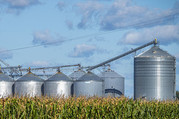
The Farm Service Agency’s (FSA) Farm Storage Facility Loan (FSFL) program provides low-interest financing to help you build or upgrade storage facilities and to purchase portable (new or used) structures, equipment and storage and handling trucks.
Eligible commodities include corn, grain sorghum, rice, soybeans, oats, peanuts, wheat, barley, minor oilseeds harvested as whole grain, pulse crops (lentils, chickpeas and dry peas), hay, honey, renewable biomass, fruits, nuts and vegetables for cold storage facilities, floriculture, hops, maple sap, rye, milk, cheese, butter, yogurt, meat and poultry (unprocessed), eggs, and aquaculture (excluding systems that maintain live animals through uptake and discharge of water). Qualified facilities include grain bins, hay barns and cold storage facilities for eligible commodities.
Loans exceeding $100,000 require additional security.
You do not need to demonstrate the lack of commercial credit availability to apply. The loans are designed to assist a diverse range of farming operations, including small and mid-sized businesses, new farmers, operations supplying local food and farmers markets, non-traditional farm products, and underserved producers.
For more information, contact your county FSA office.
December FSA FSFL Interest Rates:
Farm Storage Facility Loan 3 year term: 0.75%
Farm Storage Facility Loan 5 year term: 1.125%
Farm Storage Facility Loan 7 year term: 1.5%
Farm Storage Facility Loan 10 year term: 1.625%
Farm Storage Facility Loan 12 year term: 1.625%
|
Farm Service Agency offices in 42 Nebraska counties currently are accepting Conservation Reserve Program (CRP) contract offers under the Kansas/Nebraska CRP Migratory Birds, Butterflies, and Pollinators State Acres For Wildlife Enhancement (SAFE) project. Sign-up began on Dec. 13, 2021, in counties in Nebraska and Kansas where this program is available.
The Migratory Bird SAFE project is designed to improve habitat by restoring playa wetlands for migrating and wintering waterfowl, shorebirds and water birds. Playas are shallow depressions that often fill with water after rainstorms, providing habitat for migratory birds and recharging the underlying aquifer.
The project is available in portions of 42 counties, including: Adams, Banner, Blaine, Buffalo, Butler, Chase, Cheyenne, Clay, Custer, Dawson, Deuel, Dundy, Fillmore, Franklin, Frontier, Furnas, Garden, Gosper, Hall, Hamilton, Harlan, Hayes, Hitchcock, Jefferson, Kearney, Keith, Kimball, Lancaster, Lincoln, Logan, Loup, Morrill, Nuckolls, Perkins, Phelps, Polk, Saline, Seward, Thayer, Valley, Webster and York.
This project uses a competitive bid process. Landowners submit an offer to enroll their playa acres into the program for an amount they are willing to accept as an annual payment. Contracts are for periods of 10-15 years. The minimum enrollment per offer is two acres, and the maximum enrollment per offer is 160 acres. Offers can be submitted on a continuous basis, but will be reviewed periodically, ranked, and contracts offered. Producers interested in having their contract offers reviewed and ranked in the first round should submit their applications by Feb. 18, 2022.
Producers who are interested in learning more about this SAFE project are encouraged to contact their county FSA office or visit www.fsa.usda.gov/ne.
The University of Nebraska-Lincoln’s Center for Agricultural Profitability has scheduled a series of land management workshops to address the financial resiliency necessary for agriculture operations to sustain risk while remaining profitable.
Nebraska Extension educators will present “Building Farm and Ranch Resiliency in the Age of Financial Uncertainty” at 19 locations across the state between December and February. The workshops will cover cash rental rates, land values, leasing strategies, landlord-tenant communication, and farm and ranch succession planning. A presentation on USDA Farm Service Agency farm loans programs will be included as a part of the workshops.
Each meeting is free to attend and expected to last approximately three hours. Virtual options will be announced for some locations. Registration is required with the local county Extension office by one day prior to each workshop. More information is available on the Center for Agricultural Profitability’s website, https://cap.unl.edu/.
The workshop schedule, with registration phone numbers (all times local), are:
-
Beatrice: Dec. 21, 9 a.m.-noon (Gage County Extension Office, 1115 W. Scott St.), 402-223-1384
-
Kimball: Jan. 10, 2:30-4:30 p.m. (Kimball County Fairgrounds, High School St. & 6th St.), 308-235-3122
-
Sidney: Jan. 11, 9 a.m.-noon (Security First Bank, 1205 Jackson St.), 308-254-4455
-
Alliance: Jan. 11, 1-4 p.m. (Alliance City Library, 1750 Sweetwater Ave., #101), 308-762-5616
-
Scottsbluff: Jan. 12, 9 a.m.-noon (Panhandle Research, Extension and Education Center, 4502 Ave. I), 308-632-1230
-
Burwell: Jan. 18, 9 a.m.-noon (Senior Citizens Center, 411 Grand Ave.), 308-346-4200
-
O’Neill: Jan. 18, 1-4 p.m. (Holt County Extension Office), 402-336-2760
-
Ashland: Jan. 31, 1-4 p.m. (Round the Bend, 30801 E. Park Highway), 402-267-2205
-
Broken Bow: Feb. 1, 1-4 p.m. (Custer County Fairgrounds, 4-H Building, 44100 Memorial Drive), 308-872-6831
-
Kearney: Feb. 2, 9 a.m.-noon (Buffalo County Extension Office, 1400 E. 34th St.), 308-236-1235
-
McCook: Feb. 2, 1-4 p.m. (Red Willow County Fairgrounds, 4-H Building, W. 5th St.), 308-268-3105
-
Grant: Feb. 3, 9 a.m.-noon (Perkins County Extension Office, 6025 Road 329), 308-352-4340
-
Fullerton: Feb. 7, 1-4 p.m. (Nance County Fairgrounds, 406 N. Ida), 308-536-2691
-
Geneva: Feb. 8, 9 a.m.-noon (Fillmore County Fairgrounds, Ag Hall), 402-759-3712.
|
The U.S. Department of Agriculture’s Natural Resources Conservation Service (NRCS) is pleased to announce Stacy Riley as the Acting Nebraska State Conservationist. Riley comes to Nebraska from Oklahoma where she serves as the Assistant State Conservationist for Programs and has over 26 years of experience with NRCS.
Craig Derickson had served as the Nebraska State Conservationist for NRCS for 10 years. He retired on Dec. 31, 2020, after 35 years of federal service.
Upon Derickson’s retirement, three NRCS employees from across the agency have served as Acting State Conservationists for NRCS Nebraska, including Jeff VanderWilt, Britt Weiser, and John Wilson. Riley plans to serve as the Acting Nebraska State Conservationist until the vacancy is permanently filled.
Riley began her Natural Resources Conservation Service (NRCS) career in the summer of 1992 in Walters, OK, as a student trainee. Upon graduation from Oklahoma State University, she started as a Soil Conservationist in Ada, OK. She has since served in several positions with NRCS across Oklahoma.
For more information about the Natural Resources Conservation Service and the programs and services it provides, visit www.ne.nrcs.usda.gov.
|
December 24, 2021 – USDA Service Centers closed for federal holiday
December 31, 2021 – USDA Service Centers closed for federal holiday
January 3, 2022 – FSA acreage certification deadline for honey
January 7, 2022 – FSA application deadline for Organic and Transitional Education and Certification Program (OTECP)
January 31, 2022 – FSA deadline for applications for 2021 Livestock Forage Disaster Program assistance for eligible producers in eligible counties
February 18, 2022 – FSA deadline for applications to the Dairy Margin Coverage Program for 2022 production
February 18, 2022 – FSA deadline for first ranking period for applications to the CRP Migratory Birds, Butterflies and Pollinators State Acres for Wildlife Enhancement project; eligible in 42 Nebraska counties
February 25, 2022 - FSA deadline for applications to the Spot Market Hog Pandemic Program (SMHPP)
***Please note the above NAP calendar references may not be inclusive for all NAP-covered crops; NAP participants should contact their County FSA Office to confirm important program deadlines.
|