|
|
Brule-Buffalo Service Center Updates - November 26, 2021
|
|
|
|
Farm Service Agency | Natural Resources Conservation Service | Risk Management Agency
|

Calendar of Events/Programs:
December 6, 2021 – Deadline to return County Committee election ballots.
December 24, 2021 - Office Closed in observance of Christmas Day
December 31, 2021 – Office Closed in observance of New Year’s Day
January 31, 2022 - LFP & ELAP Application Deadline
March 15, 2022 – 2022 ARC/PLC Signup Deadline
Contact our office if you have had any changes to your farming/ranching operation. If you have sold land, purchased land, picked up a new lease or lost acreage, please contact this office so we may get your records updated prior to program signup.
Get the latest FSA news by signing up for text alerts - Text SDBrule and/or SDBuffalo to FSANOW (372-669) to subscribe for text message alerts from Buffalo and Brule County.
|
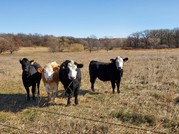
Producers in Brule and Buffalo Counties are eligible to apply for 2021 Livestock Forage Disaster Program (LFP) benefits on small grain, native pasture, and improved pasture intended for grazing. Please contact the office to apply NOW!
LFP provides compensation if you suffer grazing losses for covered livestock due to drought on privately owned or cash leased land.
You must complete a CCC-853 and the required supporting documentation no later than January 31, 2022, for 2021 losses.
Collect your grazing livestock numbers and your grazing leases as supporting documentation. If you have a verbal lease, we have a special CCC-855 form for you to have your landlord sign. For additional information about LFP, including eligible livestock and fire criteria, contact your local County USDA Service Center or visit fsa.usda.gov .
|
In response to the severe drought conditions in the West and Great Plains, the U.S. Department of Agriculture (USDA) announced today its plans to help cover the cost of transporting feed for livestock that rely on grazing. USDA is updating the Emergency Assistance for Livestock, Honeybees and Farm-Raised Fish Program (ELAP) to immediately cover feed transportation costs for drought impacted ranchers. USDA’s Farm Service Agency (FSA) will provide more details and tools to help ranchers get ready to apply at their local USDA Service Center later this month at fsa.usda.gov/elap.
ELAP provides financial assistance to eligible producers of livestock, honeybees, and farm-raised fish for losses due to disease, certain adverse weather events or loss conditions as determined by the Secretary of Agriculture.
ELAP already covers the cost of hauling water during drought, and this change will expand the program beginning in 2021 to cover feed transportation costs where grazing and hay resources have been depleted. This includes places where:
- Drought intensity is D2 for eight consecutive weeks as indicated by the S. Drought Monitor;
- Drought intensity is D3 or greater; or
- USDA has determined a shortage of local or regional feed availability.
Cost share assistance will also be made available to cover eligible cost of treating hay or feed to prevent the spread of invasive pests like fire ants.
Under the revised policy for feed transportation cost assistance, eligible ranchers will be reimbursed 60% of feed transportation costs above what would have been incurred in a normal year. Producers qualifying as underserved (socially disadvantaged, limited resource, beginning or military veteran) will be reimbursed for 90% of the feed transportation cost. above what would have been incurred in a normal year.
A national cost formula, as established by USDA, will be used to determine reimbursement costs which will not include the first 25 miles and distances exceeding 1,000 transportation miles. The calculation will also exclude the normal cost to transport hay or feed if the producer normally purchases some feed. For 2021, the initial cost formula of $6.60 per mile will be used (before the percentage is applied), but may be adjusted on a state or regional basis.
To be eligible for ELAP assistance, livestock must be intended for grazing and producers must have incurred feed transportation costs on or after Jan. 1, 2021. Although producers will self-certify losses and expenses to FSA, producers are encouraged to maintain good records and retain receipts and related documentation in the event these documents are requested for review by the local FSA County Committee. The deadline to file an application for payment for the 2021 program year is Jan. 31, 2022.
USDA offers a comprehensive portfolio of disaster assistance programs. On farmers.gov, the Disaster Assistance Discovery Tool, Disaster Assistance-at-a-Glance fact sheet, and Farm Loan Discovery Tool can help producers and landowners determine all program or loan options available for disaster recovery assistance.
More information on this expansion to ELAP is forthcoming. In the meantime, more information is available at fsa.usda.gov/elap or by contacting a local USDA Service Center.
|

An online tool is now available to help ranchers document and estimate payments to cover feed transportation costs caused by drought, which are now covered by the Emergency Assistance for Livestock, Honeybees and Farm-raised Fish Program (ELAP). The U.S. Department of Agriculture (USDA) updated the program this year to include feed transportation costs as well as lowered the threshold for when assistance for water hauling expenses is available. USDA’s Farm Service Agency (FSA) will begin taking applications this fall.
The new ELAP Feed Transportation Producer Tool is a Microsoft Excel workbook that enables ranchers to input information specific to their operation to determine an estimated payment. Final payments may vary depending on eligibility.
To use the tool, ranchers will need:
- Number of truckloads for this year.
- Mileage per truckload this year.
- Share of feed cost this year (if splitting loads).
- Number of truckloads you normally haul.
- Normal mileage per truckload.
- Share of normal feed cost
The tool requires Microsoft Excel, and a tutorial video is available.
Updates to ELAP
ELAP provides financial assistance to eligible producers of livestock, honeybees and farm-raised fish for losses due to disease, certain adverse weather events or loss conditions as determined by the Secretary of Agriculture. ELAP now covers feed transportation costs where grazing and hay resources have been depleted. This includes places where:
Drought intensity is D2 for eight consecutive weeks as indicated by the U.S. Drought Monitor; or
Drought intensity is D3 or greater.
The tool calculates the estimated payment for feed transportation assistance, but it is not an application. Once FSA begins accepting applications later this fall for feed transportation assistance, ranchers should contact their FSA county office to apply. To simplify the application process, ranchers can print or email payment estimates generated by this tool for submission to FSA. The deadline to apply for ELAP, including feed transportation costs, for 2021 is Jan. 31, 2022.
ELAP already covers above normal costs for hauling water to livestock in areas where drought intensity is D3 or greater on the drought monitor. FSA is also updating ELAP to also cover water hauling in areas experiencing D2 for eight consecutive weeks, lowering the threshold for this assistance to be available. Program benefits are retroactive for 2021.
Payment Calculations
USDA will reimburse eligible ranchers 60% of feed transportation costs above what would have been incurred in a normal year. Producers qualifying as underserved (socially disadvantaged, limited resource, beginning or military veteran) will be reimbursed for 90% of the feed transportation cost above what would have been incurred in a normal year.
USDA uses a national cost formula to determine reimbursement costs that will not include the first 25 miles and distances exceeding 1,000 transportation miles. The calculation will also exclude the normal cost to transport hay or feed if the producer normally purchases some feed. For 2021, the initial cost formula of $6.60 per mile will be used (before the percentage is applied).
Eligibility
To be eligible for ELAP assistance, livestock must be intended for grazing and producers must have incurred feed transportation costs on or after Jan. 1, 2021. Although producers will self-certify losses and expenses to FSA, producers are encouraged to maintain good records and retain receipts and related documentation in the event these documents are requested for review by the local FSA County Committee.
More Drought Recovery Information
USDA has taken additional steps to assist drought-impacted producers, including:
USDA offers a comprehensive portfolio of disaster assistance programs. On farmers.gov, the Disaster Assistance Discovery Tool, Disaster Assistance-at-a-Glance fact sheet, and Farm Loan Discovery Tool can help producers and landowners determine all program or loan options available for disaster recovery assistance. For details, producers should contact their local USDA Service Center.
|
The Farm Loan team in Brule; Buffalo & Lyman Counties is already working on operating loans for spring 2022 and asks potential borrowers to submit their requests early so they can be timely processed. The farm loan team can help determine which loan programs are best for applicants.
FSA offers a wide range of low-interest loans that can meet the financial needs of any farm operation for just about any purpose. The traditional farm operating and farm ownership loans can help large and small farm operations take advantage of early purchasing discounts for spring inputs as well expenses throughout the year.
Microloans are a simplified loan program that will provide up to $50,000 for both Farm Ownership and Operating Microloans to eligible applicants. These loans, targeted for smaller and non-traditional operations, can be used for operating expenses, starting a new operation, purchasing equipment, and other needs associated with a farming operation. Loans to beginning farmers and members of underserved groups are a priority.
Other types of loans available include:
Marketing Assistance Loans allow producers to use eligible commodities as loan collateral and obtain a 9-month loan while the crop is in storage. These loans provide cash flow to the producer and allow them to market the crop when prices may be more advantageous.
Farm Storage Facility Loans can be used to build permanent structures used to store eligible commodities, for storage and handling trucks, or portable or permanent handling equipment. A variety of structures are eligible under this loan, including bunker silos, grain bins, hay storage structures, and refrigerated structures for vegetables and fruit. A producer may borrow up to $500,000 per loan.
|

Ryan Randall is nominated in LAA 1 in Brule County to serve as COC member for a 3-year term beginning January 1, 2022. Ryan, wife McKenzie and daughter Raya reside in LAA 1. The Randall's manage and operate a feedlot and a diversified crop operation. Ryan is currently an active COC member and is willing to serve if re-elected.
Barry Knippling is nominated in LAA 4 in Buffalo County to serve as COC member for a 3-year term beginning January 1, 2022. Barry and wife Sherri reside in LAA 4 and have 1 son (Trevor) and three daughters (Whitney, Vanzi and Kazney). The Knippling's manage and operate a diversified crop and livestock operation. Barry is currently an active COC member and is willing to serve if re-elected.
|
|
|
|
Brule-Buffalo County USDA Service Center
200 S Paul Gust Road Suite #110
Chamberlain, SD 57325-1021
Phone: 605-734-5413
Fax: 855-262-1937
|
County Executive Director Ext #2
James L Anderson
james.anderson2@usda.gov
|
District Conservationist Ext #3
Rachel Frei
rachel.frei@usda.gov
|
|
Program Technicians: Ext #2
Kristine Rademacher
Danielle Ellsworth
Megan Hickey
|
Farm Loan Manager: Ext #2
Jenna Ripp
jenna.ripp@usda.gov
|
County Committee:
Matt Sinke, Chair
Barry Knippling, Vice Chair
Ryan Randall
Barbara Westendorf
Blain Bairey
|
Farm Loan Analyst Ext #2
Alicia Shonrock
alicia.shonrock@usda.gov
Farm Loan Trainee: Ext #2
Rachel Blasher
rachel.reuer@usda.gov
|
|
Office Hours:
Monday-Friday 8:00-4:30 PM
Open over lunch
|
Office E-mails:
sdchamberl-fsa@usda.gov
sdchamberl-nrcs@usda.gov
|
|
|