In This Issue:
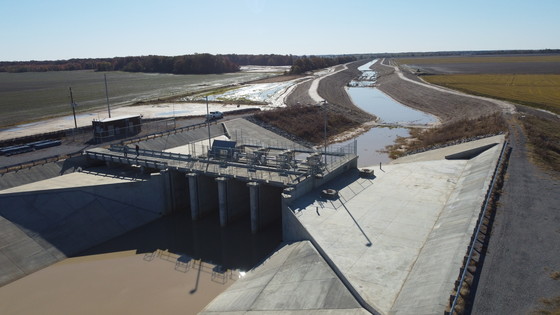
Back in May, the White River Irrigation District (WRID) began construction on the first series of canals for the Grand Prairie Irrigation Project. Construction of approximately two miles the first segment of canal is nearing completion and is a testament to the success of public – private partnerships. Upon completion, this first phase will deliver water from the White River to irrigate roughly 37,800 acres of cropland. (Above photo: Canal 1000 starts below the the regulating reservoir outlet structure in the foreground. NRCS and the WRID are constructing the canal.)
NRCS Arkansas has received $48 million in funds from the PL83-566 Watershed Program to be used with local funding available to construct several segments of canals and pipelines so the irrigation district can begin delivering water. A request for an additional $21.5 million will be made for FY 2022 in order to keep design and construction phases flowing.
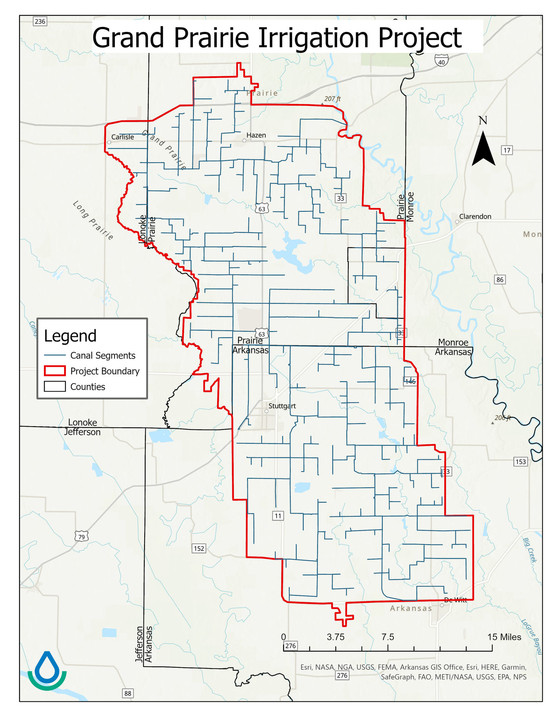
The water provided by this project for irrigation will significantly reduce the stress being placed on the aquifers by helping agricultural producers shift from groundwater to surface water for irrigation and provide continued irrigation on 245,000 acres of cropland. Overall, this project will greatly reduce the rate of groundwater withdrawal and allow farmers to continue to be productive, growing more rice than any other state, as well as other crops, all while reducing their pumping costs. (See map below for complete project area.)
Important Dates to Remember:
2021 Conservation Stewardship Program (CSP) Payments: Producers with active CSP contracts should receive a letter from their local field offices soon. The letter will instruct the producer to contact their local field offices and notify them of when they would like to receive their 2021 CSP payments. If the producer would like to receive their payment in calendar year 2021, then the payment will need to be approved by NRCS no later than December 15, 2021. Producers electing to receive payment in calendar year 2022 will need to have their payments approved by NRCS no later than February 26, 2022. If you have any questions or concerns pertaining to your CSP payment(s), please contact your local USDA Field Service Center.
I wish you and your family a very safe and Happy Thanksgiving Holiday Season.
Veterans Day is a United States federal holiday that honors all veterans who have served our country. Please take the time on Thursday, November 11th, 2021, to acknowledge and thank a Veteran(s). We appreciate all who have served and defended the freedom we experience daily.
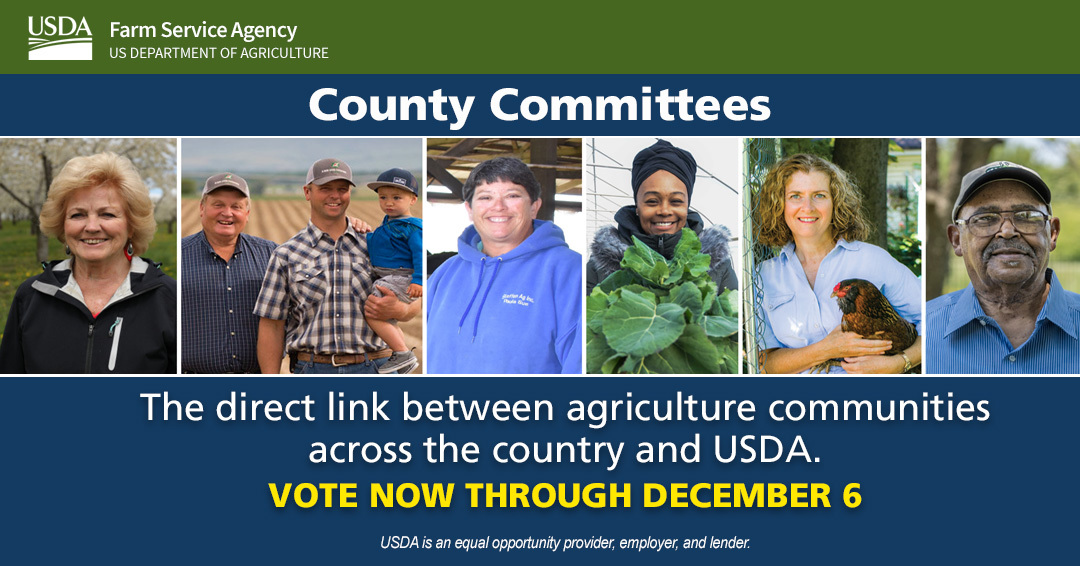
USDA will begin mailing ballots this week for the county and urban county committee elections to all eligible agricultural producers and private landowners across the country. Elections are occurring in certain Local Administrative Areas (LAA) for these committee members who make important decisions about how federal farm programs are administered locally. To be counted, producers and landowners must return ballots to their local FSA county office or be postmarked by Dec. 6, 2021.
USDA is in the process of issuing $1.8 billion in payments to agricultural producers who enrolled in the Agriculture Risk Coverage (ARC) and Price Loss Coverage (PLC) programs for the 2020 crop year. These payments provide critical support to help mitigate fluctuations in either revenue or prices for certain crops. These two safety-net programs help producers of certain crops build back better after facing the impacts of COVID-19 and other challenges.
USDA will provide pandemic assistance to cover certification and education expenses to agricultural producers who are certified organic or transitioning to organic. USDA will make $20 million available through the new Organic and Transitional Education and Certification Program (OTECP) as part of USDA’s broader Pandemic Assistance for Producers initiative, which provides new, broader and more equitable opportunities for farmers, ranchers and producers.
FSA County Offices are still available to customers. Please contact your local office to determine whether in-person or phone appointments are available. Our Staff is available to continue helping Producers with program signups, loan servicing and other important actions. Our Staff will also continue to work with our customers by phone, email and by using online tools whenever possible.
For more information, contact your local USDA service center or visit www.farmers.gov.
Please take advantage of these Opportunities. Until next time…
The U.S. Department of Agriculture (USDA) will invest more than $15.5 million this fiscal year to help agricultural producers improve water quality in Arkansas.The USDA’s Natural Resources Conservation Service (NRCS) is continuing two of its successful landscape-level water quality efforts, the Mississippi River Basin Healthy Watersheds Initiative (MRBI) and National Water Quality Initiative (NWQI).
“We have learned that when we partner with producers to deliver conservation practices to critical watersheds, we see a positive impact,” said NRCS State Conservationist in Arkansas Mike Sullivan. “Through these partnerships, we maximize the delivery of our conservation efforts which yields greater results to water quality and benefits the public, our natural resources and farmers’ bottom lines.”
Arkansas has 14 MRBI projects and three NWQI projects that will be receiving financial assistance dollars in fiscal year 2022. NRCS accepts program applications on a continuous basis but sets dates to batch and rank applications as funding allows. Farmers and landowners in Arkansas who submit applications to their local NRCS office by Dec, 17, 2021, will be considered for this round of funding. Applications received after Dec. 17, 2021, will be considered in later funding periods, subject to funding availability.
Arkansas’s project areas are:
MRBI
- Cache – Portions of Woodruff, Jackson and Cross counties
- Middle Cache – Portions of Jackson, Woodruff, Poinsett and Craighead counties
- Lower St. Francis – Portions Crittenden, Cross and St. Francis counties
- Upper Lower St. Francis – Portions of Clay and Green counties
- Cardron Creek Brewer Lake – Portions of Conway and Faulkner counties
- Candy Creek – Portions of Cross, St Francis, and Woordruff counties
- Canal 43 – Portions of Desha and Chicot counties
- Twin Creeks – Portions of Cross and Woodruff counties
- Izard Lower Strawberry – Portions of Izard and Sharp counties
- County Line Strawberry – Portions of Lawrence and Sharp counties
- Flat Hills – Portions of Poinsett and Cross counties
- Glade-Raft-White Oak Creek – Portions of White and Prairie counties
- Lee County – Portion of Lee county
- Lower White-Bayou Des Arc – Portion of Prairie county
NWQI
- Departee Creek – Portions of Independence, Jackson and White counties
- Greasy Creek-Strawberry River – Portion of Fulton County
- Brush Creek-Roberts Creek – Portions of Washington and Madison counties
NRCS has strengthened focus on watershed assessment and partner engagement in priority small watersheds in fiscal years 2020 and 2021. Partners are encouraged to work with Arkansas NRCS for new project area interests.
All applications will be evaluated for funding based on local, state and nationally developed criteria to optimize environmental benefits. Applications ranking highest in a funding category will be funded according to priority and is subject to availability of program funds.
For more information, visit http://www.ar.nrcs.usda.gov/ or contact the local your local USDA Service Center. All USDA Service Centers are open for business, including those that restrict in-person visits or require appointments. All Service Center visitors wishing to conduct business with NRCS or any other Service Center agency should call ahead and schedule an appointment.
The U.S. Department of Agriculture (USDA) is investing $11 million in five Wetland Reserve Enhancement Partnership (WREP) projects to bring together partners and landowners to voluntarily return critical wetland functions to agricultural landscapes. USDA’s Natural Resources Conservation Service (NRCS) is funding two new projects and providing additional funding to three existing ones that prioritize high-impact projects and provide assistance to historically underserved farmers and ranchers. Two of the existing projects are in Arkansas. These partnerships are part of USDA’s broader efforts to mitigate climate change by restoring wetlands while also prioritizing assistance to underserved communities.
“Wetlands protection and restoration is a key component of our strategy to address climate change, and partnerships are essential to this work,” NRCS Chief Terry Cosby said. “This year, we focused our investments on projects that support historically underserved landowners, who we know face significant barriers in accessing USDA assistance for conservation. Our partners provide a direct link to these communities, and these projects will expand conservation opportunities.”
The two ongoing Arkansas projects receiving additional funding are:
- The Tri-State partnership, led by the Nature Conservancy, which seeks to enroll an additional 1,500 acres of wetlands as part of a multi-year effort in the project area. A minimum of 750 acres (50%) will be specifically targeted for enrollment of historically underserved landowners. This project focuses on restoration of forested wetlands within priority portions of the Mississippi Alluvial Valley in Arkansas, Louisiana and Mississippi.
- The Lower Batture, led by the Mississippi River Trust, seeks to enroll 2,000 acres. A minimum of 250 acres (approximately 12.5%) will be specifically targeted for historically underserved landowner enrollment. This additional funding will expand the original project area along the lower Mississippi River to continue more sustainable land and water management in the river’s active floodplain and nearby flood-prone lands in Arkansas, Louisiana and Mississippi.
Farmers and landowners in the two Arkansas projects who submit applications to their local NRCS office by Dec. 10, 2021, will be considered for this round of funding. Applications received after Dec. 10, 2021, will be considered in later funding periods, subject to funding availability. NRCS accepts program applications on a continuous basis but sets dates to batch and rank applications as funding allows.
New projects include:
- The Georgia-Alabama Land Trust, which seeks to enroll approximately 4,000 acres, of which 42% will be specifically targeted for historically underserved landowners. This project area is in the Long County Wildlife Corridor Protection Area, much of which adjoins the Altamaha River and contains high-priority habitat. The project area includes significant impaired wetlands and numerous high-priority species.
- The Athens Land Trust, which seeks to enroll 120 acres; 100% is targeted at historically underserved landowners. The project prioritizes outreach areas in East Georgia with the goal of restoring and protecting wetlands needing biodiversity protection, improved water quality, increased flood buffer capacity, decreased erosion and enhanced carbon sequestration.
The other ongoing project is:
- The Lower Wabash River & White River Oxbow project in Indiana and Illinois, led by The Nature Conservancy, seeks to enroll 1,000 acres. This project aims to build on existing efforts of local partnerships between NRCS, The Nature Conservancy and the Conservation Law Center to enroll historically underserved landowners in the historic Lyle’s Station area, which was settled in the early 1800’s and is one of the last remaining Black American settlements in the state. The project focus is to reduce nutrient export from the Wabash River and to improve important habitat around priority oxbow lakes for monarch butterflies, migratory birds and large river fish species.
How WREP Works
WREP is part of the Wetland Reserve Easement (WRE) component of the Agricultural Conservation Easement Program (ACEP). WREP enables local conservation partners to provide their leadership and expertise to assist NRCS with acquiring and restoring private wetlands that have been previously altered for agricultural production, through targeting project areas and providing services to accomplish shared objectives in those areas.
Partners work with individual landowners to enroll in WRE which enable them to remove marginal agricultural land from production to return it to its historic state. WREP enables effective integration of wetland restoration on working agricultural landscapes, providing meaningful benefits to farmers and ranchers who enroll in the program and to communities.
Restoring wetland ecosystems help filter sediments and chemicals to improve water quality downstream, enhance wildlife and aquatic habitat, reduce impacts from flooding, recharge groundwater and offers recreational benefits. Wetlands may also serve as carbon sinks by sequestering and storing carbon from the atmosphere, an ecosystem function that supports climate change mitigation across private lands. More information about the WREP program is available on the WREP webpage.
Earlier this month, the USDA’s Natural Resources Conservation Service (NRCS) in Little Rock announced the winning proposal funded for 2021 Arkansas Conservation Innovation Grants (CIG).
“Conservation Innovation Grants invest in innovative, on-the-ground conservation technologies and approaches, with the eventual goal of wide-scale NRCS adoption to address water quality and quantity, air quality, energy conservation, and environmental markets, among other natural resource issues,” Mike Sullivan, Arkansas NRCS state conservationist, said. “We are excited to announce the approval of one Conservation Innovation Grant.”
The entity receiving the state-level grant is:
- Ecosystems Protective Services, LLC; “The Field Set-Aside Pilot Project”: The project will pilot three new practices that lead directly to a new incentive program. This new incentive program will encourage producers to set-aside fields and flood them, plant cover crops such as millet (provides quality foraging for waterfowl), and during the growing season or post-harvest of crops.
NRCS administers CIGs as part of the agency's Environmental Quality Incentives Program (EQIP). Grants are awarded to state and local governments, federally-recognized Indian tribes, non-governmental organizations and individuals.
Grant awardees must provide non-federal matching funds for at least 50 percent of the project cost. Of the non-federal matching funds, a minimum of 25 percent must be from cash contributions, the remaining 25 percent may come from in-kind contributions. For more on this grant program, visit USDA’s Conservation Innovation Grants webpage at https://www.nrcs.usda.gov/wps/portal/nrcs/main/national/programs/financial/cig/ or contact your local NRCS office.
Farm Service Agency (FSA) program payments are issued electronically into your bank account. In order to receive timely payments, you need to notify your FSA servicing office if you close your account or if your bank information is changed for any reason (such as your financial institution merging or being purchased). Payments can be delayed if FSA is not notified of changes to account and bank routing numbers.
For some programs, payments are not made until the following year. For example, payments for crop year 2019 through the Agriculture Risk Coverage and Price Loss Coverage program aren’t paid until 2020. If the bank account was closed due to the death of an individual or dissolution of an entity or partnership before the payment was issued, please notify your local FSA office as soon as possible to claim your payment.
The 2021 Farm Service Agency County Committee Elections began on Nov. 1, 2021, when ballots were mailed to eligible voters. The deadline to return ballots to local FSA offices, or to be postmarked, is Dec. 6, 2021.
County committee members are an important component of the operations of FSA and provide a link between the agricultural community and USDA. Farmers and ranchers elected to county committees help deliver FSA programs at the local level, applying their knowledge and judgment to make decisions on commodity price support programs; conservation programs; incentive indemnity and disaster programs for some commodities; emergency programs and eligibility. FSA committees operate within official regulations designed to carry out federal laws.
To be an eligible voter, farmers and ranchers must participate or cooperate in an FSA program. A person who is not of legal voting age but supervises and conducts the farming operations of an entire farm, may also be eligible to vote. A cooperating producer is someone who has provided information about their farming or ranching operation(s) but may not have applied or received FSA program benefits.
Eligible voters in local administrative area for elections are being held in, who do not receive a ballot can obtain one from their local USDA Service Center.
Newly elected committee members will take office Jan. 1, 2022.
More information on county committees, such as the new 2021 fact sheet, can be found on the FSA website at fsa.usda.gov/elections or at a local USDA Service Center.
The U.S. Department of Agriculture (USDA) announced a higher loan limit will be available for borrowers seeking a guaranteed farm loan starting Oct. 1, 2021, from $1.776 million to $1.825 million.
FSA farm loans offer access to funding for a wide range of producer needs, from securing land to financing the purchase of equipment. Guaranteed loans are financed and serviced by commercial lenders. FSA provides up to a 95% guarantee against possible financial loss of principal and interest. Guaranteed loans can be used for both farm ownership and operating purposes.
In fiscal year 2021, FSA saw continued strong demand for guaranteed loans. FSA obligated more than $3.4 billion in guaranteed farm ownership and operating loans. This includes nearly $1.2 billion for beginning farmers. The number of guaranteed borrowers has grown by 10% to more than 38,750 farmers and ranchers over the last decade. FSA expects the increasing demand for farm loans to continue into fiscal year 2022.
Disaster Set-Aside Extension
USDA has additional support available to producers given the recent outbreaks of the COVID-19 Delta variant and has extended the availability of COVID-19 Disaster Set-Aside (DSA) for installments due through Jan. 31, 2022. In addition, FSA will permit a second DSA for COVID-19 and a second DSA for natural disasters for those who had an initial COVID-19 DSA. Requests for a COVID-19 DSA or a second DSA must be received no later than May 1, 2022.
Last year, FSA broadened the use of the DSA. Normally used in the wake of natural disasters, the DSA can now allow farmers with USDA farm loans who are affected by COVID-19 and determined to be eligible, to have their next payment set aside. The set-aside payment’s due date is moved to the final maturity date of the loan or extended up to twelve months in the case of an annual operating loan. Any principal set-aside will continue to accrue interest until it is repaid. This will improve the borrower’s cashflow in the current production cycle.
More Information
Producers can explore available options on all FSA loan options at fsa.usda.gov or by contacting their local USDA Service Center. Service Center staff continue to work with agricultural producers via phone, email, and other digital tools. Because of the pandemic, some USDA Service Centers are open to limited visitors. Contact your Service Center to set up an in-person or phone appointment. Additionally, more information related to USDA’s response and relief for producers can be found at farmers.gov/coronavirus.
Many Farm Service Agency (FSA) programs require all program participants, either individuals or legal entities, to be “actively engaged in farming.” This means participants provide a significant contribution to the farming operation, whether it is capital, land, equipment, active personal labor and/or management. For entities, each partner, stockholder or member with an ownership interest, must contribute active personal labor and/or management to the operation on a regular basis that is identifiable and documentable as well as separate and distinct from contributions of any other member. Members of joint operations must have a share of the profits or losses from the farming operation commensurate with the member’s contributions to the operation and must make contributions to the farming operation that are at risk for a loss, with the level of risk being commensurate with the member’s claimed share on the farming operation.
Joint operations comprised of non-family members or partners, stockholders or persons with an ownership in the farming operation must meet additional payment eligibility provisions. Joint operations comprised of family members are exempt from these additional requirements. For 2016 and subsequent crop years, non-family joint operations can have one member that may use a significant contribution of active personal management exclusively to meet the requirements to be determined “actively engaged in farming.” The person or member will be defined as the farm manager for the purposes of administering these management provisions.
Non-family joint operations may request to add up to two additional managers for their farming operation based on the size and/or complexity of the operation. If additional farm managers are requested and approved, all members who contribute management are required to complete form CCC-902MR, Management Activity Record. The farm manager should use the form to record management activities including capital, labor and agronomics, which includes crop selection, planting decisions, acquisition of inputs, crop management and marketing decisions. One form should be used for each month and the farm manager should enter the number of hours of time spent for each activity under the date of the month the actions were completed. The farm manager must also document if each management activity was completed on the farm or remotely.
The records and supporting business documentation must be maintained and timely made available for review by the appropriate FSA reviewing authority, if requested.
If the farm manager fails to meet these requirements, their contribution of active personal management to the farming operation for payment eligibility purposes will be disregarded and their payment eligibility status will be re-determined for the applicable program year.
In some instances, additional persons or members of a non-family member joint operation who meet the definition of farm manager may also be allowed to use such a contribution of active personal management to meet the eligibility requirements. However, under no circumstances may the number of farm managers in a non-family joint operation exceed a total of three in any given crop and program year.
Bins are ideally designed to hold a level volume of grain. When bins are overfilled and grain is heaped up, airflow is hindered and the chance of spoilage increases.
If you take out marketing assistance loans and use the farm-stored grain as collateral, remember that you are responsible for maintaining the quality of the grain through the term of the loan.
If loan grain has been disposed of through feeding, selling or any other form of disposal without prior written authorization from the county office staff, it is considered unauthorized disposition. The financial penalties for unauthorized dispositions are severe and your name will be placed on a loan violation list for a two-year period. Always call before you haul any grain under loan.
Borrower training is available for all Farm Service Agency (FSA) customers. This training is required for all direct loan applicants, unless the applicant has a waiver issued by the agency.
Borrower training includes instruction in production and financial management. The purpose is to help the applicants develop and improve skills that are necessary to successfully operate a farm and build equity in the operation. It aims to help the producer become financially successful. Borrower training is provided, for a fee, by agency approved vendors. Contact your local FSA Farm Loan Manager for a list of approved vendors.
The USDA Arkansas Farm Service Agency (FSA) is committed to educating producers on available programs and loans. FSA representatives will be available at the following workshops and conferences. Producers interested in attending these conferences/workshops should follow the registration or RSVP instructions listed below.
Mar 15th-16th - Arkansas Women in Agriculture Conference Arkansas Women in Agriculture is hosting the 2022 ARWIA Conference on March 15-16, 2022. The conference will be held at the Airport Holiday Inn, 3201 Bankhead Drive, Little Rock, AR. Kimi Martin and Casie Person, both Farm Loan Specialist, will be the Exhibitors. For additional information and conference registration, please visit: http://arwomeninag.org/
|