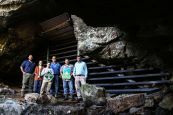
In September of 2021, The USDA Natural Resources Conservation Service (NRCS) assisted The Georgia-Alabama Land Trust and a group of other conservation partners with a cave gating project at the Weaver Cave complex near Weaver, Alabama in Calhoun County. The cave complex had 5 unrestricted access openings. Prior to the purchase of the land by the Georgia-Alabama Land Trust, the lack of access control allowed certain trespassers to party, vandalize, damage, and loot the cave complex by digging holes to search for Native American artifacts.
Through a collaborative conservation effort, all 5 access points now have steel gates installed to control human access to the complex, while allowing native wildlife to freely move in and out of the caves. Several entrances have locks installed so authorized persons can still have access to the complex. A portion of the funding for the cave gating project was provided via a financial assistance contract through NRCS’s Environmental Quality Incentives Program and the US Fish and Wildlife Service. The Alabama Department of Conservation and Natural Resources also provided technical guidance for the project.
Besides the possible presence of important Native American artifacts and unique geological features, the cave serves as a host for some unique residents. Three species of bats are known from the cave, two of which are federally endangered bat species that have been documented in the cave.
Over 12,000 gray bats call the Weaver Cave Complex home during the summer months, making it a major cave for the endangered species. Also, tricolored bats and big brown bats call the cave complex home. The Indiana bat Is another endangered bat species that has been found in the cave, but in much lower numbers and it’s not known if populations exist in the cave complex due to white- nose syndrome. White- nose syndrome is a fungal disease of bats that has killed over 6 million bats as it continues to spread across North America. This disease makes gating caves like the Weaver Cave Complex critical because it significantly reduces human and large animal disturbance of bat colonies, reducing the stress on the bats. The gating is designed for the bats to enter and exit the complex without impediment. The presence of bats was a critical reason for these partners coming together to gate the cave complex.
It is very important that we do what we can to protect and conserve bat populations. Bats provide a huge service to our nations food and fiber industries. According to USGS, if a monetary value was placed on their pest control capabilities (insect eating) it would be annually valued at over 3.7 billion dollars. Also, bats play a huge roll in crop pollinating and keeping forest ecosystems in balance. These are few of the many benefits that bats provide to the environment and agricultural economies.
There are many things one can do to conserve bat populations such as constructing bat boxes, adopting bat friendly agricultural practices, and doing ones best not to disturb bat populations. If you are interested in taking steps to protect and conserve bat populations, contact your local USDA-NRCS Field Office or log on the Bat Conservation International website.
|







