In the November 2021 Issue:
Some USDA Service Centers in Montana are open to limited visitors by appointment only. Contact your Service Center to schedule an appointment. You can find contact information at farmers.gov/service-locator. Farm Service Agency (FSA) and Natural Resources Conservation Service (NRCS) staff also continue to work with agricultural producers via phone, email, and other digital tools. Producers can learn more about how to leverage these digital offerings by visiting https://www.farmers.gov/mydocs.
 USDA in Montana reminds agricultural producers of important Farm Service Agency (FSA) program dates. Contact your local service center to apply and with any questions. Visit online at farmers.gov and fsa.usda.gov/mt. (Click here for printable deadline poster.)
Nov. 1: Last day of 2021 Conservation Reserve Program (CRP) Summer/Fall Non-Emergency Grazing Period (prior approval required)
Nov. 1: Deadline for Organic Certification Cost Share Program (OCCSP) Applications for eligible certification expenses paid between Oct. 1, 2020 to Sept. 30, 2021.
Early November: 2021 County Committee Election Ballots to be Mailed to Voters
Nov. 15: 2022 Acreage Reporting Deadline for Apiculture, Fall Wheat (Hard Red Winter), and all other Fall-Seeded Small Grains. Please note that this is the final date that FSA can accept late-filed 2021 reports for these crops.
Dec. 6: Voted FSA County Committee Election Ballots due to FSA
Dec. 31: 2022 NAP Coverage Application Closing Date for Honey
Jan. 1: Newly elected COC Members/Alternates take Oath of Office
Jan. 3: 2022 Acreage Reporting Deadline for Honey covered under NAP (or 30 days after placement of colonies). Please note that this is the final date that FSA can accept late-filed 2021 reports for these crops.
Jan. 17: 2022 Acreage Reporting Deadline Established Stand Alfalfa Seed, Fall Alfalfa Seed and Cherries. Please note that this is the final date that FSA can accept late-filed 2021 reports for these crops.
Jan. 31: 2021 Emergency Assistance for Livestock, Honeybees and Farm-Raised Fish Program (ELAP) Application for Payment Deadline for timely filed 2021 ELAP notices of losses
Jan. 31: Deadline for the 2021 Livestock Forage Disaster Program (LFP) Application and all supporting documentation
Jan. 31: Final availability date for Marketing Assistance Loans and Loan Deficiency Payments (LDPs) for prior year harvested peanuts, wool, mohair and LDP only for unshorn pelts
March 1: Deadline for the 2021 Livestock Indemnity Program Application for Payment and all supporting documentation for timely filed 2021 LIP notices of livestock losses.
March 15: Last day of 2022 Agriculture Risk Coverage (ARC) and Price Loss Coverage (PLC) Election and Enrollment Period
March 15: 2022 Noninsured Crop Disaster Assistance Program (NAP) Coverage Application Closing Date for all Spring Crops except Spring-Seeded Canola, Rye, Speltz, Triticale, Wheat and Mixed Forage
March 31: Final availability date for Loans and LDPs for prior year harvested Wheat, Barley, Canola, Crambe, Flaxseed, Honey, Oats, Rapeseed, and Sesame Seed
November 15 Reporting Deadline
Agricultural producers in Montana who have not yet completed their crop acreage reports after planting should make an appointment with their Farm Service Agency (FSA) office before the applicable deadline.
An acreage report documents a crop grown on a farm or ranch and its intended uses. Filing an accurate and timely acreage report for all crops and land uses, including failed acreage and prevented planted acreage, can prevent the loss of benefits.
How to File a Report
The following 2022 acreage reporting dates are applicable in Montana:
-
Nov. 15, 2021: Apiculture, Fall Wheat (Hard Red Winter), and all other Fall-Seeded Small Grains
-
Jan. 3, 2022: Honey covered under NAP (or 30 days after placement of colonies)
-
Jan. 17, 2022: Established Stand Alfalfa Seed, Fall Alfalfa Seed and Cherries
-
July 15, 2022: Spring Seeded Alfalfa Seed, Forage Seeding, CRP, Perennial Forage not covered under NAP, and all other crops not required to be reported by a previous reporting date
Service Center staff continue to work with agricultural producers via phone, email, and other digital tools. Because of the pandemic, some USDA Service Centers are open to limited visitors. Contact your Service Center to set up an in-person or phone appointment.
To file a crop acreage report, you will need to provide:
- Crop and crop type or variety.
- Intended use of the crop.
- Number of acres of the crop.
- Map with approximate boundaries for the crop.
- Planting date(s).
- Planting pattern, when applicable.
- Producer shares.
- Irrigation practice(s).
- Acreage prevented from planting, when applicable.
- Other information as required.
Acreage Reporting Details
The following exceptions apply to acreage reporting dates:
- If the crop has not been planted by the acreage reporting date, then the acreage must be reported no later than 15 calendar days after planting is completed.
- If a producer acquires additional acreage after the acreage reporting date, then the acreage must be reported no later than 30 calendar days after purchase or acquiring the lease. Appropriate documentation must be provided to the county office.
Producers should also report crop acreage they intended to plant, but due to natural disaster, were unable to plant. Prevented planting acreage must be reported on form CCC-576, Notice of Loss, no later than 15 calendar days after the final planting date as established by FSA and USDA’s Risk Management Agency.
Noninsured Crop Disaster Assistance Program (NAP) policy holders should note that the acreage reporting date for NAP-covered crops is the earlier of the dates listed above or 15 calendar days before grazing or harvesting of the crop begins.
More Information
For questions, please contact your local FSA office. To locate your local FSA office visit farmers.gov/service-center-locator.
Farmers Can Now Make Elections, Enroll in Agriculture Risk Coverage and Price Loss Coverage Programs
The U.S. Department of Agriculture (USDA) is in the process of issuing $1.8 billion in payments to agricultural producers who enrolled in the Agriculture Risk Coverage (ARC) and Price Loss Coverage (PLC) programs for the 2020 crop year. These payments provide critical support to help mitigate fluctuations in either revenue or prices for certain crops. These two USDA safety-net programs help producers of certain crops build back better after facing the impacts of COVID-19 and other challenges.
In addition, USDA’s Farm Service Agency (FSA) is encouraging producers to contact their local USDA Service Centers to make or change elections and to enroll for 2022 ARC or PLC, providing future protections against market fluctuations. The election and enrollment period opened on Oct. 18, 2021 and runs through March 15, 2022.
2020 Payments and Contracts
ARC and PLC payments for a given crop year are paid out the following fall to allow actual county yields and the Market Year Average prices to be finalized. This month, FSA processed payments to producers enrolled in 2020 ARC-County (ARC-CO), ARC-Individual (ARC-IC) and PLC for covered commodities that triggered for the crop year.
For ARC-CO, view the 2020 ARC-CO Benchmark Yields and Revenues online database for payment rates applicable to their county and each covered commodity.
For PLC, payments have triggered for barley, canola, chickpeas (large and small), dry peas, flaxseed, lentils, peanuts, seed cotton and wheat. More information on rice payments will be announced later this fall and in early 2022.
For ARC-IC, producers should contact their local FSA office for additional information pertaining to 2020 payment information, which relies on producer-specific yields for the crop and farm to determine benchmark yields and actual year yields when calculating revenues.
By the Numbers
More than 1.7 million contracts were signed in 2019. In 2020, producers signed nearly 1.8 million ARC or PLC contracts, and 251 million out of 273 million base acres were enrolled in the programs. In 2021, signed contracts surpassed 1.8 million.
Since the ARC and PLC were authorized by the 2014 Farm Bill and reauthorized by the 2018 Farm Bill, these safety-net programs have paid out more than $32.5 billion to producers of covered commodities.
2022 Elections and Enrollment
Producers can elect coverage and enroll in ARC-CO or PLC, which are both crop-by-crop, or ARC-IC, which is for the entire farm. Although election changes for 2022 are optional, producers must enroll through a signed contract each year. Also, if a producer has a multi-year contract on the farm and makes an election change for 2022, it will be necessary to sign a new contract.
If an election is not submitted by the deadline of March 15, 2022, the election remains the same as the 2021 election for crops on the farm. Farm owners cannot enroll in either program unless they have a share interest in the farm.
Covered commodities include barley, canola, large and small chickpeas, corn, crambe, flaxseed, grain sorghum, lentils, mustard seed, oats, peanuts, dry peas, rapeseed, long grain rice, medium and short grain rice, safflower seed, seed cotton, sesame, soybeans, sunflower seed, and wheat.
Web-Based Decision Tools
In partnership with USDA, the University of Illinois and Texas A&M University offer web-based decision tools to assist producers in making informed, educated decisions using crop data specific to their respective farming operations. Tools include:
- Gardner-farmdoc Payment Calculator, a tool available through the University of Illinois allows producers to estimate payments for farms and counties for ARC-CO and PLC.
-
ARC and PLC Decision Tool, a tool available through Texas A&M tallows producers to estimate payments and yield updates and expected payments for 2022.
Crop Insurance Considerations
ARC and PLC are part of a broader safety net provided by USDA, which also includes crop insurance and marketing assistance loans.
Producers are reminded that ARC and PLC elections and enrollments can impact eligibility for some crop insurance products.
Producers on farms with a PLC election have the option of purchasing Supplemental Coverage Option (SCO) through their Approved Insurance Provider; however, producers on farms where ARC is the election are ineligible for SCO on their planted acres for that crop on that farm.
Unlike SCO, the Enhanced Coverage Option (ECO) is unaffected by an ARC election. Producers may add ECO regardless of the farm program election.
Upland cotton farmers who choose to enroll seed cotton base acres in ARC or PLC are ineligible for the stacked income protection plan (STAX) on their planted cotton acres for that farm.
More Information
For more information on ARC and PLC, visit the ARC and PLC webpage or contact your local USDA Service Center.
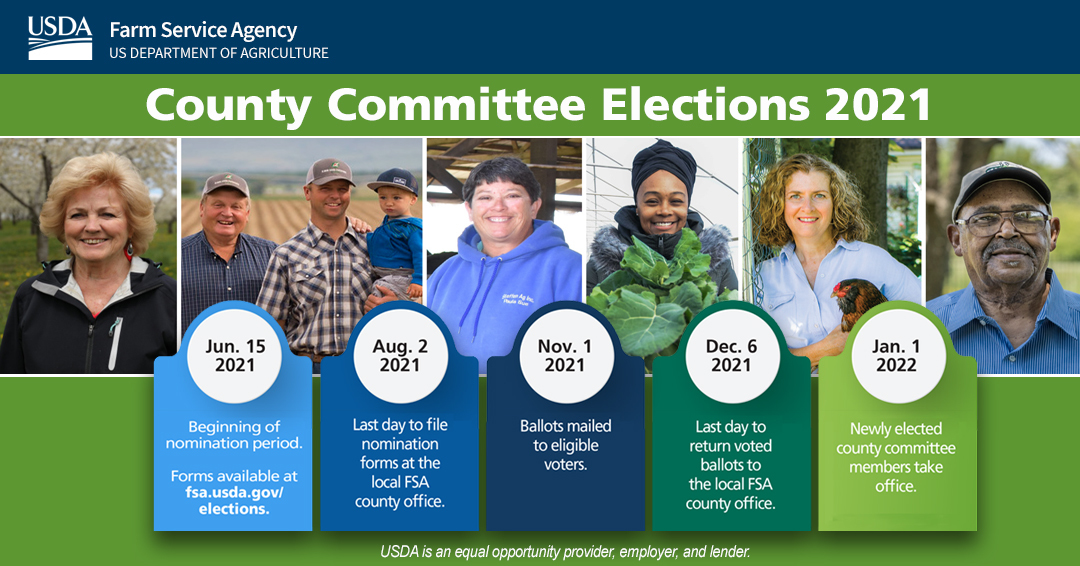 The 2021 Farm Service Agency County Committee Elections began on Nov. 1, 2021, when ballots are mailed to eligible voters. The deadline to return ballots to local FSA offices, or to be postmarked, is Dec. 6, 2021.
County committee members are an important component of the operations of FSA and provide a link between the agricultural community and USDA. Farmers and ranchers elected to county committees help deliver FSA programs at the local level, applying their knowledge and judgment to make decisions on commodity price support programs; conservation programs; incentive indemnity and disaster programs for some commodities; emergency programs and eligibility. FSA committees operate within official regulations designed to carry out federal laws.
To be an eligible voter, farmers and ranchers must participate or cooperate in an FSA program. A person who is not of legal voting age but supervises and conducts the farming operations of an entire farm, may also be eligible to vote. A cooperating producer is someone who has provided information about their farming or ranching operation(s) but may not have applied or received FSA program benefits.
Eligible voters in local administrative areas up for election who do not receive a ballot can obtain one from their local USDA Service Center.
Newly elected committee members will take office Jan. 1, 2022.
More information on county committees, such as the new 2021 fact sheet, can be found on the FSA website at fsa.usda.gov/elections or at a local USDA Service Center.
January 31 Application Deadline
Livestock producers in all 56 Montana counties are eligible to apply for 2021 Livestock Forage Disaster Program (LFP) benefits on small grain, native pasture, improved pasture, annual ryegrass, and forage sorghum.
LFP provides compensation if you suffer grazing losses for covered livestock due to drought on privately owned or leased land or fire on federally managed land.
County committees can only accept LFP applications after notification is received by the National Office of qualifying drought or if a federal agency prohibits producers from grazing normal permitted livestock on federally managed lands due to qualifying fire.
All 56 Montana counties have triggered the 2021 LFP drought criteria: Beaverhead, Big Horn, Blaine, Broadwater, Carbon, Carter, Cascade, Chouteau, Custer, Daniels, Dawson, Deer Lodge, Fallon, Fergus, Flathead, Gallatin, Garfield, Glacier, Golden Valley, Granite, Hill, Jefferson, Judith Basin, Lake, Lewis and Clark, Liberty, Lincoln, Madison, McCone, Meagher, Mineral, Missoula, Musselshell, Park, Petroleum, Phillips, Pondera, Powder River, Powell, Prairie, Ravalli, Richland, Roosevelt, Rosebud, Sanders, Sheridan, Silver Bow, Stillwater, Sweet Grass, Teton, Toole, Treasure, Valley, Wheatland, Wibaux and Yellowstone. Producers must complete a CCC-853 and the required supporting documentation no later than January 31, 2022, for 2021 losses.
For additional information about LFP, including eligible livestock and fire criteria, contact the local USDA Service Center and/or visit www.farmers.gov and/or fsa.usda.gov/mt.
From September 2021 through July 2022, the Montana Association of Conservation Districts, Montana Watershed Coordination Council and partners are reaching out across the state to ask: What more might be done to better support farmers and ranchers in managing soils in Montana?
The purpose is to increase the pace and scale at which land stewards implement voluntary practices and systems to maintain and improve soil health, and thereby the long term economic and ecological vitality of agriculture in Montana. In August of 2022 a report will be shared on what was learned along with any recommendations that seem to emerge. All responses will be kept confidential and anonymous.
Learn how to participate.
The USDA Natural Resources Conservation Service (NRCS) in Montana is announcing fiscal year 2022 assistance opportunities for agricultural producers and private landowners for the Agricultural Conservation Easement Program (ACEP) – Wetland Reserve Easements. While NRCS accepts applications for Wetland Reserve Easements year-round, producers and landowners should apply by the Dec. 3, 2021, ranking date to be considered for this year’s funding.
Ranking dates for all programs and states are available at nrcs.usda.gov/staterankingdates. Applications received after ranking dates will be automatically deferred to the next funding period.
Learn more.
The U.S. Department of Agriculture (USDA) is committed to partnering with agriculture, forestry and rural communities to develop climate solutions that strengthen rural America. The Department has outlined and requested public comments on a new climate partnership initiative designed to create new revenue streams for producers via market opportunities for commodities produced using climate-smart practices.
Guided by science, USDA will support a set of pilot projects that provide incentives to implement climate-smart conservation practices on working lands and to quantify and monitor the carbon and greenhouse gas benefits associated with those practices. The Department published a Request for Information (RFI) seeking public comment and input on design of the new initiative. Stakeholders interested in providing comments may do so on or before 11:59 p.m. EST on November 1, 2021, via the Federal Register, Docket ID: USDA-2021-0010.
Learn More
The 8th National Grazing Lands Conference promotes grazing land sustainability by bringing together hundreds of land managers from across the nation for education and technological advancements. Attendees will have the opportunity to gain the latest information in scientific and applied research, and practical, workable applications for building partnerships. The conference will focus on management methods that are successful in bridging agricultural needs with environmental and social benefits.
The conference takes place Dec. 6-9, 2021, in Myrtle Beach, South Carolina. Register now.
Contact Farm Service Agency for Feed Transportation & Water Hauling Assistance
An online tool is now available to help ranchers document and estimate payments to cover feed transportation costs caused by drought, which are now covered by the Emergency Assistance for Livestock, Honeybees and Farm-raised Fish Program (ELAP). The U.S. Department of Agriculture (USDA) updated the program this year to include feed transportation costs as well as lowered the threshold for when assistance for water hauling expenses is available. USDA’s Farm Service Agency (FSA) will begin taking applications this fall.
The new ELAP Feed Transportation Producer Tool is a Microsoft Excel workbook that enables ranchers to input information specific to their operation to determine an estimated payment. Final payments may vary depending on eligibility.
To use the tool, ranchers will need:
- Number of truckloads for this year.
- Mileage per truckload this year.
- Share of feed cost this year (if splitting loads).
- Number of truckloads you normally haul.
- Normal mileage per truckload.
- Share of normal feed cost
The tool requires Microsoft Excel, and a tutorial video is available at fsa.usda.gov/elap.
Updates to ELAP
ELAP provides financial assistance to eligible producers of livestock, honeybees and farm-raised fish for losses due to disease, certain adverse weather events or loss conditions as determined by the Secretary of Agriculture. ELAP now covers feed transportation costs where grazing and hay resources have been depleted. This includes places where:
- Drought intensity is D2 for eight consecutive weeks as indicated by the U.S. Drought Monitor; or
- Drought intensity is D3 or greater.
The tool calculates the estimated payment for feed transportation assistance, but it is not an application. Once FSA begins accepting applications later this fall for feed transportation assistance, ranchers should contact their FSA county office to apply. To simplify the application process, ranchers can print or email payment estimates generated by this tool for submission to FSA. The deadline to apply for ELAP, including feed transportation costs, for 2021 is Jan. 31, 2022.
ELAP already covers above normal costs for hauling water to livestock in areas where drought intensity is D3 or greater on the drought monitor. FSA is also updating ELAP to also cover water hauling in areas experiencing D2 for eight consecutive weeks, lowering the threshold for this assistance to be available. Program benefits are retroactive for 2021.
Payment Calculations
USDA will reimburse eligible ranchers 60% of feed transportation costs above what would have been incurred in a normal year. Producers qualifying as underserved (socially disadvantaged, limited resource, beginning or military veteran) will be reimbursed for 90% of the feed transportation cost above what would have been incurred in a normal year.
USDA uses a national cost formula to determine reimbursement costs that will not include the first 25 miles and distances exceeding 1,000 transportation miles. The calculation will also exclude the normal cost to transport hay or feed if the producer normally purchases some feed. For 2021, the initial cost formula of $6.60 per mile will be used (before the percentage is applied).
Eligibility
To be eligible for ELAP assistance, livestock must be intended for grazing and producers must have incurred feed transportation costs on or after Jan. 1, 2021. Although producers will self-certify losses and expenses to FSA, producers are encouraged to maintain good records and retain receipts and related documentation in the event these documents are requested for review by the local FSA County Committee.
More Drought Recovery Information
USDA has taken additional steps to assist drought-impacted producers, including:
USDA offers a comprehensive portfolio of disaster assistance programs. On farmers.gov, the Disaster Assistance Discovery Tool, Disaster Assistance-at-a-Glance fact sheet, and Farm Loan Discovery Tool can help producers and landowners determine all program or loan options available for disaster recovery assistance. For details, producers should contact their local USDA Service Center.
USDA has a new insurance option for agricultural producers with small farms who sell locally. The Micro Farm policy simplifies record keeping and covers post-production costs like washing and value-added products. It is offered through Whole-Farm Revenue Protection and is available to producers who have a farm operation that earns an average allowable revenue of $100,000 or less, or for carryover insureds, an average allowable revenue of $125,000 or less. Read More
USDA Extends Disaster Set-Aside for Direct Loans Until 2022
The U.S. Department of Agriculture (USDA) announced a higher loan limit will be available for borrowers seeking a guaranteed farm loan starting Oct. 1, 2021, from $1.776 million to $1.825 million.
FSA farm loans offer access to funding for a wide range of producer needs, from securing land to financing the purchase of equipment. Guaranteed loans are financed and serviced by commercial lenders. FSA provides up to a 95% guarantee against possible financial loss of principal and interest. Guaranteed loans can be used for both farm ownership and operating purposes.
In fiscal year 2021, FSA saw continued strong demand for guaranteed loans. FSA obligated more than $3.4 billion in guaranteed farm ownership and operating loans. This includes nearly $1.2 billion for beginning farmers. The number of guaranteed borrowers has grown by 10% to more than 38,750 farmers and ranchers over the last decade. FSA expects the increasing demand for farm loans to continue into fiscal year 2022.
Disaster Set-Aside Extension
USDA has additional support available to producers given the recent outbreaks of the COVID-19 Delta variant and has extended the availability of COVID-19 Disaster Set-Aside (DSA) for installments due through Jan. 31, 2022. In addition, FSA will permit a second DSA for COVID-19 and a second DSA for natural disasters for those who had an initial COVID-19 DSA. Requests for a COVID-19 DSA or a second DSA must be received no later than May 1, 2022.
Last year, FSA broadened the use of the DSA. Normally used in the wake of natural disasters, the DSA can now allow farmers with USDA farm loans who are affected by COVID-19 and determined to be eligible, to have their next payment set aside. The set-aside payment’s due date is moved to the final maturity date of the loan or extended up to twelve months in the case of an annual operating loan. Any principal set-aside will continue to accrue interest until it is repaid. This will improve the borrower’s cashflow in the current production cycle.
More Information
Producers can explore available options on all FSA loan options at fsa.usda.gov or by contacting their local USDA Service Center. Service Center staff continue to work with agricultural producers via phone, email, and other digital tools. Because of the pandemic, some USDA Service Centers are open to limited visitors. Contact your Service Center to set up an in-person or phone appointment. Additionally, more information related to USDA’s response and relief for producers can be found at farmers.gov/coronavirus.
The U.S. Department of Agriculture (USDA) announced a Request for Applications (RFA) for the new Pandemic Response and Safety (PRS) Grant program and encourages eligible entities to apply now for funds. Applications must be submitted electronically through the grant portal at https://usda-prs.grantsolutions.gov/usda by 11:59 p.m. Eastern Time on Monday, November 22, 2021. Approximately $650 million in funding is available for the PRS grants, which are funded by the Pandemic Assistance provided in the Consolidated Appropriations Act of 2021.
The PRS Grant program will assist small businesses in certain commodity areas, including specialty crop producers, shellfish farming, finfish farming, aquaculture, and apiculture; specialty crop, meat, and other processors; distributors; and farmers markets. Small businesses and nonprofits in these industries can apply for a grant to cover COVID-related expenses such as workplace safety measures (e.g., personal protective equipment (PPE), retrofitting facilities for worker and consumer safety, shifting to online sales platforms, transportation, worker housing, and medical costs. The minimum funding request is $1,500 and the maximum funding request is $20,000.
The RFA and the PRS Grant Portal provide more details about eligibility for the grant. Eligible entities are required to obtain a free DUNS Number from Dun & Bradstreet (D&B) BEFORE applying for this program. USDA has created a custom PRS DUNS number portal at https://support.dnb.com/PandemicResponse.
Application resources including Frequently Asked Questions (FAQs), tip sheets in English and Spanish on applying for a DUNS Number, videos on “How to Apply” and more are available on the PRS Grant Portal.
For more information, you can also reach out to the PRS help desk, Monday-Friday, 9 a.m.-9 p.m. ET at (301) 238-5550 or usda.ams.prs@grantsolutions.gov.
Check your eligibility, obtain a DUNS number, and learn more about the application process at the PRS Grant Portal.
It is important to promptly report any changes in your farming operation to FSA. These changes can include, but are not limited to, changes in your address, phone, or email, name changes, changes to entity membership or shares, formation or dissolution of any entity (such as a trust, partnership, LLC, LLP or corporation) that owns or operates land or owns other farming assets used in your operation, sale or purchase of land, adding or dropping leases, and any changes to financing or equipment. Participants in FSA and NRCS programs are required to timely report changes in their farming operation to their local FSA office in writing and update their CCC-902 Farm Operating Plan with necessary changes, as applicable. Failure to timely notify your local FSA office may result in ineligibility for program benefits, or delays in issuance of program payments. If you have any updates or corrections to your records, please call your local FSA office to update your records.
It’s important for agricultural producers to report losses immediately as all disaster programs are dependent on the timely reporting of the loss. A notice of loss can be filed with USDA Farm Service Agency via phone, email, fax or scheduled office visit.
-
ELAP – Emergency Assistance for Livestock, Honeybees and Farm-Raised Fish Program: Starting in 2020, producers will have 15 days from when the loss is first apparent, to file a honeybee notice of loss instead of 30 days,. This change provides consistency between ELAP and the Noninsured Crop Disaster Assistance Program, which also has a 15-day notice of loss period for honey. For other covered livestock losses, including livestock feed, grazing and farm-raised fish losses, the notice of loss deadline for ELAP will remain 30 days from when the loss is first apparent to the producer.
-
LIP - Livestock Indemnity Program: Submit Notice of Loss within 30 calendar days of when the loss is first apparent. Producers should document the adverse weather conditions and date(s) of weather events.
-
TAP - Tree Assistance Program: Final Date to Submit an Application and Supporting Documentation within 90 calendar days of: the disaster event or the date when the loss is apparent to the producer.
-
NAP – Noninsured Crop Disaster Assistance Program: Submit Notice of Loss within 15 calendar days of the earlier of a natural disaster occurrence, the final planting date if planting is prevented by a natural disaster, the date that damage to the crop or loss of production becomes apparent; or the normal harvest date. Note: A producer’s signature is required on form CCC-576 when a Notice of Loss is submitted.
Change to Policy on Filing a Notice of Loss for Grazed Forage Producers with NAP Coverage:
For the 2021 and subsequent crop years, NAP forage producers with the intended use of grazing who elect to use independent assessments or other approved alternative loss percentage methods to establish their loss are no longer required to file a CCC-576 Notice of Loss with FSA. However, a CCC-576 Application for Payment form must be submitted to FSA no later than 60 calendar days after the coverage period ends.
Producers that elect to have the grazing loss determined using similar mechanically harvested units still must timely file a CCC-576 Notice of Loss within 15 days of the disaster event or damage to the crop first becomes apparent or within 15 days of harvest.
The USDA Farm Service Agency’s Direct Farm Ownership loans are a resource to help farmers and ranchers become owner-operators of family farms, improve and expand current operations, increase agricultural productivity, and assist with land tenure to save farmland for future generations.
Depending on the applicant’s needs, there are three types of Direct Farm Ownership Loans: regular, down payment and joint financing. FSA also offers a Direct Farm Ownership Microloan option for smaller financial needs up to $50,000.
Joint financing allows FSA to provide more farmers and ranchers with access to capital. FSA lends up to 50 percent of the total amount financed. A commercial lender, a State program or the seller of the property being purchased, provides the balance of loan funds, with or without an FSA guarantee. The maximum loan amount for a Joint Financing loan is $600,000 and the repayment period for the loan is up to 40 years.
To be eligible, the operation must be an eligible farm enterprise. Farm Ownership loan funds cannot be used to finance nonfarm enterprises and all applicants must be able to meet general eligibility requirements. Loan applicants are also required to have participated in the business operations of a farm or ranch for at least three years out of the 10 years prior to the date the application is submitted. The applicant must show documentation that their participation in the business operation of the farm or ranch was not solely as a laborer.
For more information about FSA Loan programs, contact your local FSA office or visit www.fsa.usda.gov. To find your local FSA office, visit http://offices.usda.gov.
Farm Service Agency Farm Loan programs require that applicants have a satisfactory credit history. A credit report is requested for all FSA direct farm loan applicants. These reports are reviewed to verify outstanding debts, if bills are paid timely and to determine the impact on cash flow.
Information found on a customer’s credit report is strictly confidential and is used only as an aid in conducting FSA business.
Our farm loan staff will discuss options with you if you have an unfavorable credit report and will provide a copy of your report. If you dispute the accuracy of the information on the credit report, it is up to you to contact the issuing credit report company to resolve any errors or inaccuracies.
There are multiple ways to remedy an unfavorable credit score.
- Make sure to pay bills on time. Setting up automatic payments or automated reminders can be an effective way to remember payment due dates.
- Pay down existing debt.
- Keep your credit card balances low.
- Avoid suddenly opening or closing existing credit accounts.
FSA’s farm loan staff will guide you through the process, which may require you to reapply for a loan after improving or correcting your credit report.
For more information on FSA farm loan programs, visit www.fsa.usda.gov.
FSA’s Emergency Loan Program is available for agricultural producers in counties designated as primary or contiguous natural disaster areas. See map below of current Disaster Designations in Montana. Contact your local FSA office for specific designations in your area and time frames to apply. Eligible producers have eight months from the date of the disaster designation to apply for low-interest emergency loans to 1.) restore or replace essential property; 2.) pay all or part of production costs associated with the disaster year; 3.) pay essential family living expenses; or 4.) refinance certain debts, excluding real estate. Producers interested in applying for an emergency loan, or other FLP loans, should contact their local FSA office to set up an appointment with the Farm Loan Program staff serving your area.
FSA makes loans to youth to establish and operate agricultural income-producing projects in connection with 4-H clubs, FFA and other agricultural groups. Projects must be planned and operated with the help of the organization advisor, produce sufficient income to repay the loan and provide the youth with practical business and educational experience. The maximum loan amount is $5000.
Youth Loan Eligibility Requirements:
- Be a citizen of the United States (which includes Puerto Rico, the Virgin Islands, Guam, American Samoa, the Commonwealth of the Northern Mariana Islands) or a legal resident alien
- Be 10 years to 20 years of age
- Comply with FSA’s general eligibility requirements
- Be unable to get a loan from other sources
- Conduct a modest income-producing project in a supervised program of work as outlined above
- Demonstrate capability of planning, managing and operating the project under guidance and assistance from a project advisor. The project supervisor must recommend the youth loan applicant, along with providing adequate supervision.
Stop by the county office for help preparing and processing the application forms. Youth Loan Factsheet
Montana State University Extension and an associated statewide advisory council have developed an online clearinghouse of resources for a wide range of topics related to stress and mental health. The clearinghouse was created specifically for ag producers and their families, but it contains a wealth of information for anyone interested in learning more about causes of stress, stress prevention and management, and overall mental health. To access the site, please click on this link: https://msuextension.org/wellness/stress-management/mt_farm_stress_clearing_house/
|