In the October 2021 Issue:
Some USDA Service Centers in Montana are open to limited visitors by appointment only. Contact your Service Center to schedule an appointment. You can find contact information at farmers.gov/service-locator. Farm Service Agency (FSA) and Natural Resources Conservation Service (NRCS) staff also continue to work with agricultural producers via phone, email, and other digital tools. Producers can learn more about how to leverage these digital offerings by visiting https://www.farmers.gov/mydocs.
 USDA in Montana reminds agricultural producers of important Farm Service Agency (FSA) program dates. Contact your local service center to apply and with any questions. Visit online at farmers.gov and fsa.usda.gov/mt. (Click here for printable deadline poster.)
Oct. 12: Deadline to apply for or modify applications for Coronavirus Food Assistance Program 2 (CFAP2) Signup. Visit farmers.gov/cfap for details on all eligible commodities and additional program resources. Producers have multiple options to apply for CFAP 2, including through an online application portal and by working directly with the FSA office. Customers seeking one-on-one support with the CFAP 2 application process can call 877-508-8364 to speak directly with a USDA employee ready to offer assistance.
Oct. 12: Last day of Pandemic Livestock Indemnity Program (PLIP) Signup (extended)
Oct. 15: Application deadline for the Pandemic Assistance for Timber Harvesters and Haulers program (PATHH) - see article in this newsletter for additional details.
Nov. 1: Last day of 2021 Conservation Reserve Program (CRP) Summer/Fall Non-Emergency Grazing Period (prior approval required)
Nov. 1: Deadline for Organic Certification Cost Share Program (OCCSP) Applications for eligible certification expenses paid between Oct. 1, 2020 to Sept. 30, 2021.
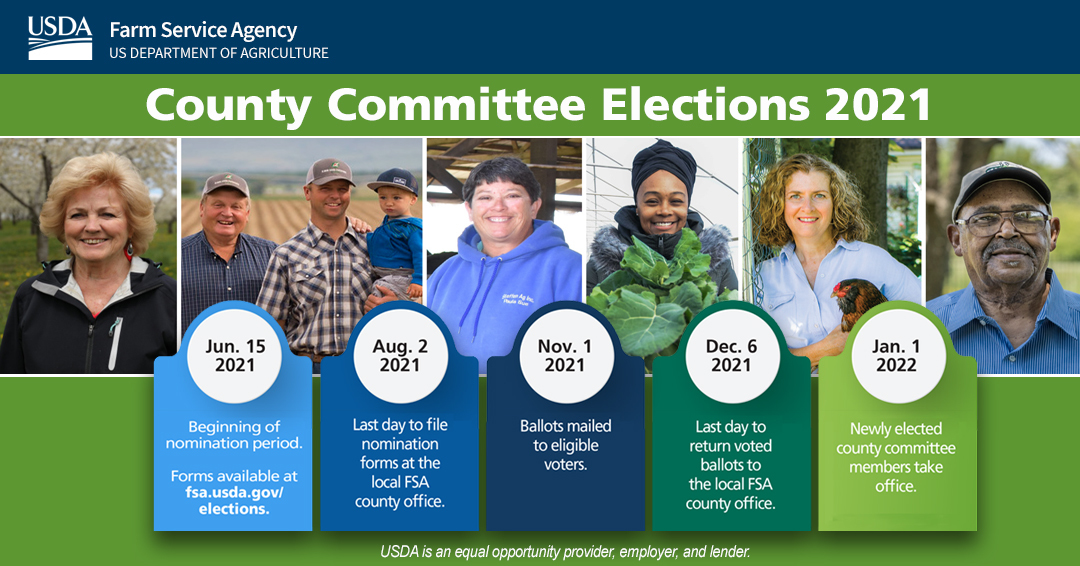
Early November: 2021 County Committee Election Ballots to be Mailed to Voters
Nov. 15: 2022 Acreage Reporting Deadline for Apiculture, Fall Wheat (Hard Red Winter), and all other Fall-Seeded Small Grains. Please note that this is the final date that FSA can accept late-filed 2021 reports for these crops.
Dec. 6: Voted FSA County Committee Election Ballots due to FSA
Dec. 31: 2022 NAP Coverage Application Closing Date for Honey
Jan. 1: Newly elected COC Members/Alternates take Oath of Office
Jan. 3: 2022 Acreage Reporting Deadline for Honey covered under NAP (or 30 days after placement of colonies). Please note that this is the final date that FSA can accept late-filed 2021 reports for these crops.
Jan. 17: 2022 Acreage Reporting Deadline Established Stand Alfalfa Seed, Fall Alfalfa Seed and Cherries. Please note that this is the final date that FSA can accept late-filed 2021 reports for these crops.
Jan. 30: 2021 Emergency Assistance for Livestock, Honeybees and Farm-Raised Fish Program (ELAP) Application for Payment Deadline for timely filed 2021 ELAP notices of losses
Jan. 31: Deadline for the 2021 Livestock Forage Disaster Program (LFP) Application and all supporting documentation
Jan. 31: Final availability date for Marketing Assistance Loans and Loan Deficiency Payments (LDPs) for prior year harvested peanuts, wool, mohair and LDP only for unshorn pelts
March 1: Deadline for the 2021 Livestock Indemnity Program Application for Payment and all supporting documentation for timely filed 2021 LIP notices of livestock losses.
January 31 Application Deadline
Livestock producers in all 56 Montana counties are eligible to apply for 2021 Livestock Forage Disaster Program (LFP) benefits on small grain, native pasture, improved pasture, annual ryegrass, and forage sorghum.
LFP provides compensation if you suffer grazing losses for covered livestock due to drought on privately owned or leased land or fire on federally managed land.
County committees can only accept LFP applications after notification is received by the National Office of qualifying drought or if a federal agency prohibits producers from grazing normal permitted livestock on federally managed lands due to qualifying fire.
All 56 Montana counties have triggered the 2021 LFP drought criteria: Beaverhead, Big Horn, Blaine, Broadwater, Carbon, Carter, Cascade, Chouteau, Custer, Daniels, Dawson, Deer Lodge, Fallon, Fergus, Flathead, Gallatin, Garfield, Glacier, Golden Valley, Granite, Hill, Jefferson, Judith Basin, Lake, Lewis and Clark, Liberty, Lincoln, Madison, McCone, Meagher, Mineral, Missoula, Musselshell, Park, Petroleum, Phillips, Pondera, Powder River, Powell, Prairie, Ravalli, Richland, Roosevelt, Rosebud, Sanders, Sheridan, Silver Bow, Stillwater, Sweet Grass, Teton, Toole, Treasure, Valley, Wheatland, Wibaux and Yellowstone. Producers must complete a CCC-853 and the required supporting documentation no later than January 31, 2022, for 2021 losses.
For additional information about LFP, including eligible livestock and fire criteria, contact the local USDA Service Center and/or visit www.farmers.gov and/or fsa.usda.gov/mt.
CFAP and PLIP Signup Closes Oct. 12
PATHH Signup Closes Oct. 15
The U.S. Department of Agriculture offers financial assistance for a broad set of customers – from farmers and ranchers to timber harvesters and haulers – through our Pandemic Assistance for Producers initiative. Signup deadlines for three critical programs are quickly approaching:
To those who haven’t yet applied: There’s still time, and we’re here to help. If you’re not sure which program(s) best fit your operation, Farm Service Agency Administrator Zach Ducheneaux shares three questions to consider.
Learn More
The USDA Natural Resources Conservation Service (NRCS) in Montana has set an October 29, 2021, application cutoff for agricultural operators to be considered for the next conservation program funding cycle. NRCS accepts applications year-round, this application batching period applies to the current funding cycle and applies to the Environmental Quality Incentives Program (EQIP), Conservation Stewardship Program-Classic (CSP), and the Regional Conservation Partnership Program (RCPP).
Agricultural producers in Montana who have not yet completed their crop acreage reports after planting should make an appointment with their Farm Service Agency (FSA) office before the applicable deadline.
An acreage report documents a crop grown on a farm or ranch and its intended uses. Filing an accurate and timely acreage report for all crops and land uses, including failed acreage and prevented planted acreage, can prevent the loss of benefits.
How to File a Report
The following 2022 acreage reporting dates are applicable in Montana:
-
Nov. 15, 2021: Apiculture, Fall Wheat (Hard Red Winter), and all other Fall-Seeded Small Grains
-
Jan. 3, 2022: Honey covered under NAP (or 30 days after placement of colonies)
-
Jan. 17, 2022: Established Stand Alfalfa Seed, Fall Alfalfa Seed and Cherries
-
July 15, 2022: Spring Seeded Alfalfa Seed, Forage Seeding, CRP, Perennial Forage not covered under NAP, and all other crops not required to be reported by a previous reporting date
Service Center staff continue to work with agricultural producers via phone, email, and other digital tools. Because of the pandemic, some USDA Service Centers are open to limited visitors. Contact your Service Center to set up an in-person or phone appointment.
To file a crop acreage report, you will need to provide:
- Crop and crop type or variety.
- Intended use of the crop.
- Number of acres of the crop.
- Map with approximate boundaries for the crop.
- Planting date(s).
- Planting pattern, when applicable.
- Producer shares.
- Irrigation practice(s).
- Acreage prevented from planting, when applicable.
- Other information as required.
Acreage Reporting Details
The following exceptions apply to acreage reporting dates:
- If the crop has not been planted by the acreage reporting date, then the acreage must be reported no later than 15 calendar days after planting is completed.
- If a producer acquires additional acreage after the acreage reporting date, then the acreage must be reported no later than 30 calendar days after purchase or acquiring the lease. Appropriate documentation must be provided to the county office.
Producers should also report crop acreage they intended to plant, but due to natural disaster, were unable to plant. Prevented planting acreage must be reported on form CCC-576, Notice of Loss, no later than 15 calendar days after the final planting date as established by FSA and USDA’s Risk Management Agency.
Noninsured Crop Disaster Assistance Program (NAP) policy holders should note that the acreage reporting date for NAP-covered crops is the earlier of the dates listed above or 15 calendar days before grazing or harvesting of the crop begins.
More Information
For questions, please contact your local FSA office. To locate your local FSA office visit farmers.gov/service-center-locator.
The USDA Farm Service Agency (FSA) made several policy updates for acreage reporting for cover crops, revising intended use, late-filed provisions, grazing allotments as well as updated the definitions of “idle” and “fallow.”
Reporting Cover Crops:
Cover crop types can be chosen from the following four categories:
- Cereals and other grasses
- Legumes
- Brassicas and other broadleaves
- Mixtures
If the cover crop is harvested for any use other than forage or grazing and is not terminated according to policy guidelines, then that crop will no longer be considered a cover crop and the acreage report must be revised to reflect the actual crop.
Permitted Revision of Intended use After Acreage Reporting Date:
New operators or owners who pick up a farm after the acreage reporting deadline has passed and the crop has already been reported on the farm, have 30 calendar days from the date when the new operator or owner acquired the lease on land, control of the land or ownership and new producer crop share interest in the previously reported crop acreage. Under this policy, appropriate documentation must be provided to the County Committee’s satisfaction to determine that a legitimate operator or ownership and producer crop share interest change occurred to permit the revision.
Acreage Reports:
In order to maintain program eligibility and benefits, you must timely file acreage reports. Failure to file an acreage report by the crop acreage reporting deadline may result in ineligibility for future program benefits. FSA will not accept acreage reports provided more than a year after the acreage reporting deadline.
Reporting Grazing Allotments:
FSA offices can now accept acreage reports for grazing allotments. You will use form “FSA-578” to report grazing allotments as animal unit months (AUMs) using the “Reporting Unit” field. Your local FSA office will need the grazing period start and end date and the percent of public land.
Definitions of Terms
FSA defines “idle” as cropland or a balance of cropland within a Common Land Unit (CLU) (field/subfield) which is not planted or considered not planted and does not meet the definition of fallow or skip row.
Fallow is considered unplanted cropland acres which are part of a crop/fallow rotation where cultivated land that is normally planted is purposely kept out of production during a regular growing season.
For more information, contact your local USDA Service Center and visit fsa.usda.gov.
USDA has a new insurance option for agricultural producers with small farms who sell locally. The Micro Farm policy simplifies record keeping and covers post-production costs like washing and value-added products. It is offered through Whole-Farm Revenue Protection and is available to producers who have a farm operation that earns an average allowable revenue of $100,000 or less, or for carryover insureds, an average allowable revenue of $125,000 or less. Read More
Four Organizations Identified to Assist Producers in Montana
The U.S. Department of Agriculture (USDA) announced an investment of $4.7 million to establish partnerships with organizations to provide outreach and technical assistance to historically underserved farmers and ranchers. The partnerships will support participation in Farm Service Agency (FSA) programs, including those that are part of USDA’s Pandemic Assistance for Producers initiative.
Fifty-six project proposals, covering all states and territories, are being finalized to assist historically underserved farmers and ranchers in accessing FSA programs. Programs include outreach for pandemic assistance programs, including the signup re-opening of the Coronavirus Food Assistance Program 2 (CFAP 2). These proposals will also assist in outreach for FSA’s farm programs, conservation programs, farm loans, county committee elections, disaster programs, the Heirs’ Property Relending Program, heirs’ property succession planning and the Agricultural Marketing Service’s Pandemic Response and Safety Grant program.
The four organizations and projects impacting Montana include:
-
Piikani Lodge Health Institute providing support on CFAP2, ECP, OCCS, ELAP, LFP, ARC-PLC on the Blackfeet Nation.
-
Intertribal Agriculture Council, Inc. providing support on CFAP2, Farm Enrollment, pandemic relief funding programs, and completing 2047s in their nationwide network.
-
Farmer’s Legal Action Group Inc. providing support on CFAP2 nationwide.
-
National Young Farmers Coalition, Inc., providing support on CFAP2 nationwide.
Read about all 56 funded projects and organizations on FSA’s cooperative agreements webpage.
Dawson County - October 18th Application Deadline
Hill County - October 21st Application Deadline
The Dawson and Hill County Farm Service Agency (FSA) offices in Glendive and Havre are hiring a full time, permanent Program Technician (PT).
Duties include general office activities supporting FSA programs administered at the field level. Successful applicants must be reliable, have a professional attitude and enjoy working with the public.
If you are interested or know of someone who might be interested, please share this information with them.
Here are the direct links to the positions with information on how to apply:
Applications must be completed through USAJOBs no later than close of business of the vacancy deadline.
USDA is an equal opportunity provider, employer, and lender.
USDA Extends Disaster Set-Aside for Direct Loans Until 2022
The U.S. Department of Agriculture (USDA) announced a higher loan limit will be available for borrowers seeking a guaranteed farm loan starting Oct. 1, 2021, from $1.776 million to $1.825 million.
FSA farm loans offer access to funding for a wide range of producer needs, from securing land to financing the purchase of equipment. Guaranteed loans are financed and serviced by commercial lenders. FSA provides up to a 95% guarantee against possible financial loss of principal and interest. Guaranteed loans can be used for both farm ownership and operating purposes.
In fiscal year 2021, FSA saw continued strong demand for guaranteed loans. FSA obligated more than $3.4 billion in guaranteed farm ownership and operating loans. This includes nearly $1.2 billion for beginning farmers. The number of guaranteed borrowers has grown by 10% to more than 38,750 farmers and ranchers over the last decade. FSA expects the increasing demand for farm loans to continue into fiscal year 2022.
Disaster Set-Aside Extension
USDA has additional support available to producers given the recent outbreaks of the COVID-19 Delta variant and has extended the availability of COVID-19 Disaster Set-Aside (DSA) for installments due through Jan. 31, 2022. In addition, FSA will permit a second DSA for COVID-19 and a second DSA for natural disasters for those who had an initial COVID-19 DSA. Requests for a COVID-19 DSA or a second DSA must be received no later than May 1, 2022.
Last year, FSA broadened the use of the DSA. Normally used in the wake of natural disasters, the DSA can now allow farmers with USDA farm loans who are affected by COVID-19 and determined to be eligible, to have their next payment set aside. The set-aside payment’s due date is moved to the final maturity date of the loan or extended up to twelve months in the case of an annual operating loan. Any principal set-aside will continue to accrue interest until it is repaid. This will improve the borrower’s cashflow in the current production cycle.
More Information
Producers can explore available options on all FSA loan options at fsa.usda.gov or by contacting their local USDA Service Center. Service Center staff continue to work with agricultural producers via phone, email, and other digital tools. Because of the pandemic, some USDA Service Centers are open to limited visitors. Contact your Service Center to set up an in-person or phone appointment. Additionally, more information related to USDA’s response and relief for producers can be found at farmers.gov/coronavirus.
The U.S. Department of Agriculture (USDA) announced a Request for Applications (RFA) for the new Pandemic Response and Safety (PRS) Grant program and encourages eligible entities to apply now for funds. Applications must be submitted electronically through the grant portal at https://usda-prs.grantsolutions.gov/usda by 11:59 p.m. Eastern Time on Monday, November 22, 2021. Approximately $650 million in funding is available for the PRS grants, which are funded by the Pandemic Assistance provided in the Consolidated Appropriations Act of 2021.
The PRS Grant program will assist small businesses in certain commodity areas, including specialty crop producers, shellfish farming, finfish farming, aquaculture, and apiculture; specialty crop, meat, and other processors; distributors; and farmers markets. Small businesses and nonprofits in these industries can apply for a grant to cover COVID-related expenses such as workplace safety measures (e.g., personal protective equipment (PPE), retrofitting facilities for worker and consumer safety, shifting to online sales platforms, transportation, worker housing, and medical costs. The minimum funding request is $1,500 and the maximum funding request is $20,000.
The RFA and the PRS Grant Portal provide more details about eligibility for the grant. Eligible entities are required to obtain a free DUNS Number from Dun & Bradstreet (D&B) BEFORE applying for this program. USDA has created a custom PRS DUNS number portal at https://support.dnb.com/PandemicResponse.
Application resources including Frequently Asked Questions (FAQs), tip sheets in English and Spanish on applying for a DUNS Number, videos on “How to Apply” and more are available on the PRS Grant Portal.
For more information, you can also reach out to the PRS help desk, Monday-Friday, 9 a.m.-9 p.m. ET at (301) 238-5550 or usda.ams.prs@grantsolutions.gov.
Check your eligibility, obtain a DUNS number, and learn more about the application process at the PRS Grant Portal.
The U.S. Department of Agriculture (USDA) is investing up to $50 million in cooperative agreements to support historically underserved farmers and ranchers with climate-smart agriculture and forestry. The Racial Justice and Equity Conservation Cooperative Agreements are available to entities for two-year projects that expand the delivery of conservation assistance to farmers who are beginning, limited resource, socially disadvantaged and veteran farmers.
Department of State (DOS) and U.S. Agency for International Development (USAID) announce a public meeting and to request public comment on the U.S. Government Global Water Strategy 2017-2022, including its achievements, challenges, implementation, results, and priorities. Comments from the public will inform the development of the revised U.S. Global Water Strategy and Agency-specific plans in 2022. The public meeting will take place virtually on November 17, 2021 at 2:00 pm EDT and is free and open to the public. Please register here by November 3, 2021 at 5:00 pm EDT. Please find more information and instructions in the Federal Register here.
DOS and USAID also invite written comments from the public on successes and challenges
within implementation, monitoring, and reporting on the Global Water Strategy. They are especially interested in comments on steps to strengthen the implementation of the Strategy and on opportunities to accelerate progress of its Strategic Objectives. Please submit written comments by October 29, 2021 at 5:00 pm EDT to waterteam@usaid.gov as a Word or PDF attachment and include: “Comments U.S. Global Water Strategy,” in the subject line.
For any questions, please contact Lillian Woods Shawver, Director, International Programs Division at lillian.woods@usda.gov.
Update to the Emergency Assistance for Livestock, Honeybees and Farm-Raised Fish Program
In response to the severe drought conditions in the West and Great Plains, the U.S. Department of Agriculture (USDA) announced its plans to help cover the cost of transporting feed for livestock that rely on grazing. USDA is updating the Emergency Assistance for Livestock, Honeybees and Farm-Raised Fish Program (ELAP) to immediately cover feed transportation costs for drought impacted ranchers. USDA’s Farm Service Agency (FSA) will provide more details and tools to help ranchers get ready to apply at their local USDA Service Center later this month at fsa.usda.gov/elap.
ELAP provides financial assistance to eligible producers of livestock, honeybees, and farm-raised fish for losses due to disease, certain adverse weather events or loss conditions as determined by the Secretary of Agriculture.
ELAP already covers the cost of hauling water during drought, and this change will expand the program beginning in 2021 to cover feed transportation costs where grazing and hay resources have been depleted. This includes places where:
- Drought intensity is D2 for eight consecutive weeks as indicated by the U.S. Drought Monitor;
- Drought intensity is D3 or greater; or
- USDA has determined a shortage of local or regional feed availability.
Cost share assistance will also be made available to cover eligible cost of treating hay or feed to prevent the spread of invasive pests like fire ants.
Under the revised policy for feed transportation cost assistance, eligible ranchers will be reimbursed 60% of feed transportation costs above what would have been incurred in a normal year. Producers qualifying as underserved (socially disadvantaged, limited resource, beginning or military veteran) will be reimbursed for 90% of the feed transportation cost. above what would have been incurred in a normal year.
A national cost formula, as established by USDA, will be used to determine reimbursement costs which will not include the first 25 miles and distances exceeding 1,000 transportation miles. The calculation will also exclude the normal cost to transport hay or feed if the producer normally purchases some feed. For 2021, the initial cost formula of $6.60 per mile will be used (before the percentage is applied), but may be adjusted on a state or regional basis.
To be eligible for ELAP assistance, livestock must be intended for grazing and producers must have incurred feed transportation costs on or after Jan. 1, 2021. Although producers will self-certify losses and expenses to FSA, producers are encouraged to maintain good records and retain receipts and related documentation in the event these documents are requested for review by the local FSA County Committee. The deadline to file an application for payment for the 2021 program year is Jan. 31, 2022.
USDA offers a comprehensive portfolio of disaster assistance programs. On farmers.gov, the Disaster Assistance Discovery Tool, Disaster Assistance-at-a-Glance fact sheet, and Farm Loan Discovery Tool can help producers and landowners determine all program or loan options available for disaster recovery assistance.
More information on this expansion to ELAP is forthcoming. In the meantime, more information is available at fsa.usda.gov/elap or by contacting a local USDA Service Center.
It is important to promptly report any changes in your farming operation to FSA. These changes can include, but are not limited to, changes in your address, phone, or email, name changes, changes to entity membership or shares, formation or dissolution of any entity (such as a trust, partnership, LLC, LLP or corporation) that owns or operates land or owns other farming assets used in your operation, sale or purchase of land, adding or dropping leases, and any changes to financing or equipment. Participants in FSA and NRCS programs are required to timely report changes in their farming operation to their local FSA office in writing and update their CCC-902 Farm Operating Plan with necessary changes, as applicable. Failure to timely notify your local FSA office may result in ineligibility for program benefits, or delays in issuance of program payments. If you have any updates or corrections to your records, please call your local FSA office to update your records.
It’s important for agricultural producers to report losses immediately as all disaster programs are dependent on the timely reporting of the loss. A notice of loss can be filed with USDA Farm Service Agency via phone, email, fax or scheduled office visit.
-
ELAP – Emergency Assistance for Livestock, Honeybees and Farm-Raised Fish Program: Starting in 2020, producers will have 15 days from when the loss is first apparent, to file a honeybee notice of loss instead of 30 days,. This change provides consistency between ELAP and the Noninsured Crop Disaster Assistance Program, which also has a 15-day notice of loss period for honey. For other covered livestock losses, including livestock feed, grazing and farm-raised fish losses, the notice of loss deadline for ELAP will remain 30 days from when the loss is first apparent to the producer.
-
LIP - Livestock Indemnity Program: Submit Notice of Loss within 30 calendar days of when the loss is first apparent. Producers should document the adverse weather conditions and date(s) of weather events.
-
TAP - Tree Assistance Program: Final Date to Submit an Application and Supporting Documentation within 90 calendar days of: the disaster event or the date when the loss is apparent to the producer.
-
NAP – Noninsured Crop Disaster Assistance Program: Submit Notice of Loss within 15 calendar days of the earlier of a natural disaster occurrence, the final planting date if planting is prevented by a natural disaster, the date that damage to the crop or loss of production becomes apparent; or the normal harvest date. Note: A producer’s signature is required on form CCC-576 when a Notice of Loss is submitted.
Change to Policy on Filing a Notice of Loss for Grazed Forage Producers with NAP Coverage:
For the 2021 and subsequent crop years, NAP forage producers with the intended use of grazing who elect to use independent assessments or other approved alternative loss percentage methods to establish their loss are no longer required to file a CCC-576 Notice of Loss with FSA. However, a CCC-576 Application for Payment form must be submitted to FSA no later than 60 calendar days after the coverage period ends.
Producers that elect to have the grazing loss determined using similar mechanically harvested units still must timely file a CCC-576 Notice of Loss within 15 days of the disaster event or damage to the crop first becomes apparent or within 15 days of harvest.
Application Deadline: Oct. 15, 2021
PATHH Webinar Presentation | PATHH Webinar Recording
The U.S. Department of Agriculture (USDA) is providing up to $200 million to provide relief to timber harvesting and timber hauling businesses that have experienced losses due to COVID-19 as part of USDA’s Pandemic Assistance for Producers initiative. Loggers and truckers can apply for assistance through USDA’s Farm Service Agency (FSA) July 22 through Oct. 15, 2021. The Pandemic Assistance for Timber Harvesters and Haulers program (PATHH) is administered by FSA in partnership with the U.S. Forest Service.
The Consolidated Appropriations Act, 2021, authorized this critical assistance for the timber industry. Timber harvesting and hauling businesses that have experienced a gross revenue loss of at least 10% during the period of Jan. 1 and Dec. 1, 2020, compared to the period of Jan. 1 and Dec. 1, 2019, are encouraged to apply.
Program Details
To be eligible for payments, individuals or legal entities must be a timber harvesting or timber hauling business where 50% or more of its gross revenue is derived from one or more of the following:
- Cutting timber.
- Transporting timber.
- Processing of wood on-site on the forest land (chipping, grinding, converting to biochar, cutting to smaller lengths, etc.).
Payments will be based on the applicant’s gross revenue received from Jan. 1, 2019, through Dec. 1, 2019, minus gross revenue received from Jan. 1, 2020, through Dec. 1, 2020, multiplied by 80%. FSA will issue an initial payment equal to the lesser of the calculated payment amount or $2,000 as applications are approved. A second payment will be made after the signup period has ended based upon remaining PATHH funds.
The maximum amount that a person or legal entity may receive directly is $125,000.
Applying for Assistance
Loggers and truckers can apply for PATHH beginning on July 22 by completing form FSA-1118, Pandemic Assistance for Timber Harvesters and Haulers Program application, and certifying to their gross revenue for 2019 and 2020 on the application. Additional documentation may be required. Visit farmers.gov/pathh for more information on how to apply.
Applications can be submitted to the FSA office at any USDA Service Center nationwide by mail, fax, hand delivery, or via electronic means. To find a local FSA office, loggers and truckers can visit farmers.gov/service-locator. They can also call 877-508-8364 to speak directly with a USDA employee ready to offer assistance.
|
Access your land information in real time
Producers with farmers.gov accounts can now access farm records and maps online, the latest self-service feature added to the U.S. Department of Agriculture (USDA) website.
You can quickly and easily access your land information in real time by desktop computer, tablet or phone. Capabilities include:
- View, print and export detailed farm records such as cropland, base acres, yields, CRP acres, land ownership details, and much more;
- View, print and export farm/tract maps that can be provided to lenders, chemical or fertilizer providers, and FSA for reporting acreage and crop insurance agents; and
- Export common land unit (field) boundaries as ESRI shapefiles.
The ability to access these records on demand without a visit to the service center saves you time and money.
Farmers.gov now includes the most popular functionalities from FSAFarm+, the FSA portal for producers, while providing enhanced functionality and an improved user experience. A new enhancement expands the scope of accessibility to include farmers and ranchers who are members of an entity, as well as people with a power of attorney form (FSA-211) on file with FSA.
Managing USDA Business Online
Using farmers.gov, producers, entities and those acting on their behalf can also:
- View, upload, download, and e-sign conservation documents.
- Request financial assistance, including submitting a program application.
- View and submit conservation requests.
- View technical references and submit questions.
- Access information on current and past conservation practices, plans and contracts.
- Report practice completion and request practice certification.
- View farm loan and interest information (producers only).
Future plans include adding the ability to import and view other shapefiles, such as precision agriculture planting boundaries.
To access your information, you’ll will need a USDA eAuth account to login to farmers.gov. After obtaining an eAuth account, producers should visit farmers.gov and sign into the site’s authenticated portal via the Sign In/Sign Up link at the top right of the website. Google Chrome, Mozilla Firefox or Microsoft Edge are the recommended browsers to access the feature.
In addition to the self-service features available by logging into farmers.gov, the website also has ample information on USDA programs, including pandemic assistance, farm loans, disaster assistance, conservation programs and crop insurance. Recently, USDA updated the navigation and organization of the site as well as added some new webpages, including “Get Involved,” “Common Forms,” and “Translations.” Learn more about these changes.
|
FSA’s Emergency Loan Program is available for agricultural producers in counties designated as primary or contiguous natural disaster areas. See map below of current Disaster Designations in Montana. Contact your local FSA office for specific designations in your area and time frames to apply. Eligible producers have eight months from the date of the disaster designation to apply for low-interest emergency loans to 1.) restore or replace essential property; 2.) pay all or part of production costs associated with the disaster year; 3.) pay essential family living expenses; or 4.) refinance certain debts, excluding real estate. Producers interested in applying for an emergency loan, or other FLP loans, should contact their local FSA office to set up an appointment with the Farm Loan Program staff serving your area.
The Farm Service Agency (FSA) has several loan programs to help you start or continue an agriculture production. Farm ownership and operating loans are available.
While all qualified producers are eligible to apply for these loan programs, FSA has provided priority funding for members of targeted underserved applicants.
A targeted underserved applicant is one of a group whose members have been subjected to racial, ethnic or gender prejudice because of his or her identity as members of the group without regard to his or her individual qualities.
For purposes of this program, targeted underserved groups are women, African Americans, American Indians, Alaskan Natives, Hispanics, Asian Americans and Pacific Islanders.
FSA loans are only available to applicants who meet all the eligibility requirements and are unable to obtain the needed credit elsewhere.
Montana State University Extension and an associated statewide advisory council have developed an online clearinghouse of resources for a wide range of topics related to stress and mental health. The clearinghouse was created specifically for ag producers and their families, but it contains a wealth of information for anyone interested in learning more about causes of stress, stress prevention and management, and overall mental health. To access the site, please click on this link: https://msuextension.org/wellness/stress-management/mt_farm_stress_clearing_house/
|