We are pleased to announce the launch of our partner newsletter —News and Views, Partners in Conservation edition. The newsletter will be biannual and emailed in April and October. It will also be published on our website.
The purpose is to spotlight organizations with whom NRCS has collaborated, and in addition, provide conservation assistance to our shared customers.
West Virginia benefits the most when federal, state, and nonprofit groups work together to put conservation on the ground. As partners in conservation, these groups bring expertise and diversity to deliver the best customer service to our landowners.
Each edition will highlight selected NRCS partners— who they are, what services they provide, web resources, success stories, program opportunities, agreements, and updates. The newsletter will be distributed to our partners, employees, stakeholders, and shared customers via GovDelivery. I encourage you to share with your conservation affiliates and subscribe using the subscriber services located in the footer.
I invite you to submit your stories and updates to our NRCS-WV Public Affairs Specialist and newsletter editor, Becky Haddix. The deadline for submissions will be 14 days prior to the publish date for each issue.
It is my pleasure to highlight a few of our partner achievements in our first edition.

Respectfully,
Jon Bourdon
NRCS-WV State Conservationist
|
West Virginia Department of Agriculture
Submitted by: Joseph Hatton, WVDA Deputy Commissioner
The USDA’s Natural Resource Conservation Service (NRCS) and the West Virginia Department of Agriculture (WVDA) have worked tirelessly over the last five years to assist producers and enhance agricultural production in West Virginia. Through this partnership, WVDA and NRCS teams have provided numerous trainings, educational opportunities, and countless hours of technical assistance to support producers and connect them with needed resources across the state.
|
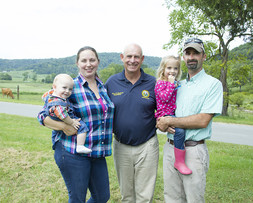
Our ongoing work has shined a light on West Virginia producers by recognizing agriculture as a viable solution to improving our environment through conservation practices, as well as generating additional income especially in post-coal communities. The WVDA, in partnership with NRCS, provides highly skilled subject matter to experts around the state who continue to be instrumental in coordinating access to resources for these practices. These efforts have proven effective for identifying emerging markets and other downstream opportunities for the West Virginia farmer.
Our staff work jointly to develop valuable resources for agriculture producers: educational classes, aggregation websites, business planning and training, for example. This team of experts frequently coordinate and co-host with NRCS to provide resources for managing high tunnel systems and produce production systems.
(Pictured above: WV’s Commissioner of Agriculture, Kent Leonhardt, with the owners and operators of Little Brown Cow Dairy in Monroe County. The farm is a recipient of the West Virginia Conservation Farm of the Year Award . The judging panel consists of officials from various state and federal agency partners including WVDA and NRCS).
|
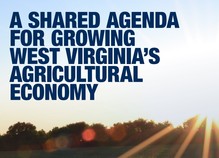
In 2019, the WVDA and its partners published the first state strategic plan for West Virginia Agriculture, “A Shared Agenda for Growing West Virginia’s Agricultural Economy.” This publication addresses West Virginia Agriculture’s coordinated effort by connecting producers to market opportunities, working to create needed infrastructure to grow West Virginia’s agricultural economy, and developing the next generation of agricultural industry leaders. The WVDA/NRCS partnership has provided a platform for significant progress over the last five years, and we look forward to continuing these efforts.
|
Trout Unlimited
Submitted by: Dustin Wichterman, Mid Atlantic Cold Water Habitat Program Associate Director
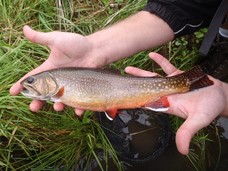
Trout Unlimited (TU) is a private, non-profit conservation organization dedicated to bringing together diverse interests to care for and recover rivers and streams so our children can experience the joy of wild and native trout and salmon. TU works at the watershed scale with private and public landowners in West Virginia to restore valuable cold water trout fisheries and their watersheds.
TU’s partnership with the NRCS puts vast amounts of quality conservation on the ground by making conservation an easy choice for landowners through turn-key conservation services. Together, we take our projects from start to finish by aiding with with things like funding, outreach, conservation planning, natural stream channel design, permitting, project implementation, and monitoring.
|
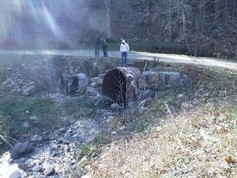
Before Photo: Undersized Culvert Crossing identified to be removed and replaced.
|
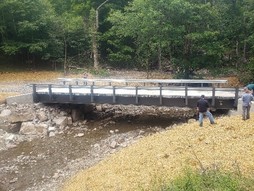
After Photo: Improved Road Stream Crossing installed in 2020.
|
As a native West Virginian who deeply values the state's natural resources and heritage, as well as the efforts and livelihoods of our producers and people, this work brings me great satisfaction. Together, TU and the NRCS, directly invest in the integrity of all the above. This work not only delivers meaningful watershed scale restoration but supports an economy that keeps local West Virginians working. It also supports a recreational economy by improving our state's wild and native trout fisheries. In my nine plus years at TU, I’ve personally watched and documented the revival of entire native brook trout streams and documented four-fold increases in the number of fish on project sites. We are seeing fish populations rebound and produce trophy sized native brook trout where none existed before. Our hearts and souls are invested in this work, and together we are restoring a healthier and more productive home for future generations.
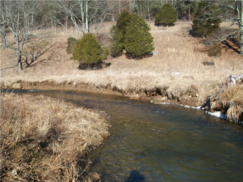
Before Photo: Shows eroding stream bank and limited riparian buffer in pre-project conditions. In 2015, there were no brook trout present within this reach as captured by two years of fisheries samples.
|
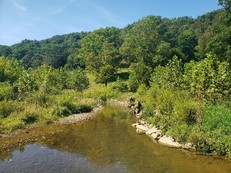
After Photo: This photo from 2020 shows the same location as above with recovering riparian buffer, stabilized stream bank, and a pool habitat for brook trout. TU has now documented three age classes of brook trout here as well as natural reproduction.
|
Together TU, the NRCS, and an array of other state and federal agency partners have installed over 100 miles of agricultural exclusion fencing, dozens of alternative water sources, stabilized 8+ miles of eroding stream banks, improved in-stream pool and run habitat for brook trout and other native fish on over 30 miles, improved road stream crossings at three locations with another four slated for the coming year, and planted trees on over 1000 acres. This work has benefitted around 200 producers and more than 100 miles of trout waters in West Virginia.
Specific Conservation Practices:
- Riparian Restoration
- In-stream Habitat Restoration
- Stream Bank Stabilization
- Agricultural Exclusion and Division Fencing
- Alternative Off-stream Water Sources
- Fish-Friendly Armored Ford Crossings
- Improved Road/Stream Crossings
Direct Benefits:
- Improved road stream crossings, like bridges and open bottomed culverts, to provide perennial fish passage and access to properties during high water events
- Improved fencing for rotational grazing and riparian exclusion, along with consistent and clean off stream watering sources
- Improved soil health
- Improved watershed function
- Improved water quality through the reduction of sediment, nutrients, and thermal inputs
- Improved management for agricultural operations to the benefit of the producers, their livestock, and native fish
- Significant increases in native brook trout and overall fish abundance and size on project lands
- Long term funding investment in our natural resources and people
Ongoing TU/NRCS Projects Include:
- Focused Conservation Approach Projects in Dillons and Edwards Run, the Cacapon River, the North Fork of the South Branch of the Potomac River, and the South Branch of the Potomac River Watersheds
- Regional Conservation Partnership Program-West Virginia Aquatic Passage: Working Farms Project focused on improving road stream crossings on private lands and the Cherry River Watershed Assessment
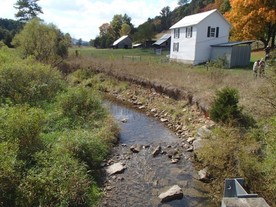
Before Photo: Photo shows eroding stream bank in 2015. At this time were no brook trout present within this reach, as captured by two years of fisheries samples.
|
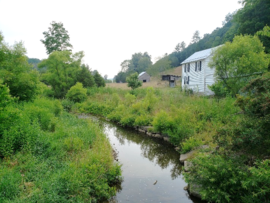
After Photo: In 2021 the photo shows stabilized stream bank and riparian buffer recovering. TU has now documented three age classes of brook trout here, as well as natural reproduction.
|
West Virginia Conservation Agency and NRCS Hold Fall Pasture Workshop
Submitted by: Tim Canfield, NRCS Eastern Panhandle District Conservationist
In conjunction with the West Virginia Conservation Agency (WVCA) and the NRCS, the Eastern Panhandle Conservation District (EPCD) sponsored a pasture workshop in Jefferson County on September 18, 2021. Rawlings Farm, in Jefferson County, kindly hosted the event. The farm consists of 52 acres of pasture and 15 acres of hay. An additional 75 acres are rented for annual forages, pasture, and hay production. The farm supports 40 Angus cross cow calf pairs and 40 Boer and Boer-Kiko cross goats.
Three key topics were highlighted during this workshop including Soil Health and Sustainability, Forage and Weed Management, and Soil Sampling and Results Interpretation. In-field stations for each topic were used for demonstration and accompanied by a professional speaker.
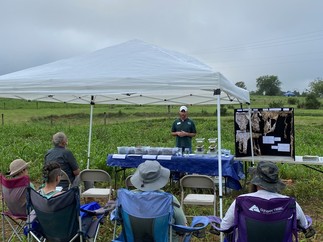
Soil Health and Sustainability
Lee Haggerty, the current North Area Grassland Specialist for the NRCS (pictured on left), discussed the importance of soil health and sustainability as it relates to pasture health and productivity. He provided two demonstrations, a slake test and a rainfall simulation, to illustrate the importance of a healthy soil in a pasture setting.
|
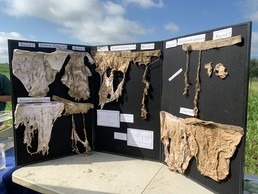
Also, in two six-week intervals, cotton underwear was buried on the farm in different locations to highlight microbial activity within the soil. In well managed areas only the waistband was remaining indicating a healthy soil as seen on the display board, (pictured on right).
|
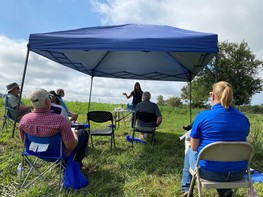
Forage and Weed Management
Amanda Grev, University of Maryland Extension Specialist for Forages and Weed Management (pictured on left), covered a variety of topics including forage and weed identification, balancing forage resources with livestock demands, and general pasture management techniques. To start, she engaged each participant individually to understand their operation and adjusted her presentation accordingly. She focused on the importance of rotational grazing and demonstrated proper grazing height management. Also, she highlighted the use of summer annuals and winter stockpiling of forages to extend both the summer and fall grazing periods.
|
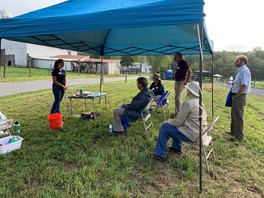
Soil Sampling and Results Interpretation Emily Morrow, West Virginia University Extension Agent for Jefferson County (pictured on right), discussed the importance of soil testing in pasture and hay operations to ensure optimal fertility for forage production goals. She demonstrated the proper depth for taking soil samples and provided guidance on number of samples needed per field for a representative result. Using a current soil test result, Emily described each section of the result and how to interpret WVU’s recommendation. She furthered her discussion by using individual field results to develop a nutrient management plan for the entire farm.
|
Cacapon & Lost Rivers Watershed Initiative
Submitted by: Alana Hartman, WV Deptartment of Environmental Protection (WVDEP)
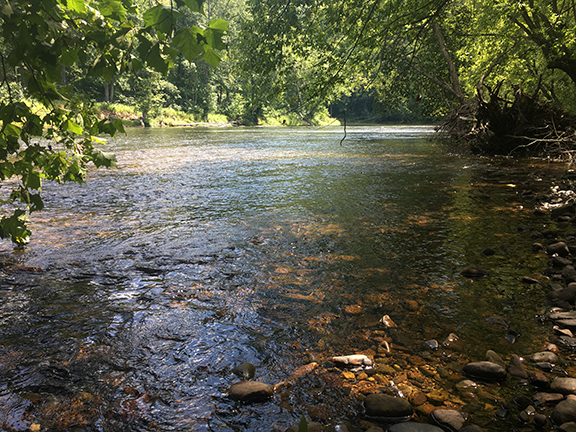
A dedicated source of funding has been directed to environmental practices in the Cacapon & Lost Rivers watershed, thanks to a successful effort by the USDA Natural Resources Conservation Service (NRCS) and local stakeholders. The project is known as a Focused Conservation Approach (FCA), which means that a portion of NRCS Environmental Quality Incentives Program (EQIP) funding, about $600,000 over 3 years, will be directed to this specific watershed. NRCS will work alongside partners including Trout Unlimited (TU) to implement best management practices which will promote stream shading, livestock exclusion, and in-stream habitat for aquatic species. Nutrients and sediment will be reduced through the implementation of streambank stabilization practices, hardened fish-friendly stream crossings, and alternative water sources for livestock. Upland grazing practices will also be used to improve pasture management, promote water filtration, and reduce overland flow and temperature spikes during rain events. Any animal or poultry waste concerns identified during planning efforts could be addressed using other EQIP funding sources. Many other sensitive aquatic and riparian species will likely benefit from these efforts, such as the Wood Turtle (Glyptemys insculpta).
Project goals include a minimum of 10 acres of riparian buffers, 1 mile of streambank stabilization measures, restoration of 2 miles of in-stream habitat, 4 miles of livestock exclusion fencing, and 100 acres of improved grazing management. The field office will accepted applications for this project in FY2021, will implement projects in 2022, and continue to accept and fund applicants through 2024. As the FCA proposal states, “this project will help strengthen work currently underway within the watershed and allow NRCS to work alongside partners in a way that delivers a more comprehensive conservation product for all.”
Landowner interest continues to grow as outreach and conservation efforts are being made by a host of partners including the WVDEP, WV Department of Agriculture, WV Division of Natural Resources, WV Division of Forestry, U.S. Forest Service, Farm Service Agency, WV Conservation Agency, Cacapon and Lost Rivers Land Trust, and TU. These partners have been cooperatively working within the watershed for decades to improve water quality resource concerns. To date, partners have restored over a dozen miles of in stream habitat, over a mile of eroding stream banks, hundreds of acres of riparian habitat, and promoted rotational grazing practices on over 20 farms. However, there is more work to be done as water quality issues continue to have negative impacts.
For more information or to have your property considered for this funding, please contact NRCS at (304) 822-3020 (Hampshire County) or (304) 530-2825 (Hardy County).
|
West Virginia Association of Conservation Districts
An agreement between the NRCS and the West Virginia Association of Conservation Districts (WVACD) has led to the creation of an executive director position. The intent of this position is to enhance communication networks between NRCS, WVCA, FSA, local branches of governments, and other respective partners.
“The point of contact and method of communication are key strategies for the districts to have an executive director,” said NRCS State Conservationist, Jon Bourdon. “This position will enable all 14 districts to engage more on the local, state and national level to strengthen their programs.”
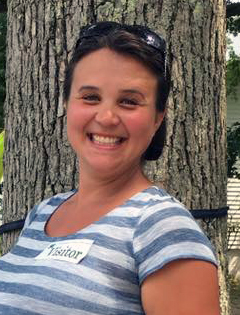
A recent interview with Heather Duncan provided her an opportunity to introduce herself and discuss the roles, mission, and responsibilities of her new position. Congratulations Heather!
|
Tell us a little about yourself? I live in Shepherdstown with my husband Michael and three daughters, Lilly, Carley, and Abby. We raise hay, grain, and cattle and are based on my parent’s family farm. I attended Wilson College and majored in Equine Management and ultimately decided to stay local and pursue life near home.
Tell us about this position and what does it mean to you? The executive director (ED) position is brand new to West Virginia. Our surrounding states have very strong state associations, and it shows in their ability to receive and disperse funding and conduct trainings for their conservation districts. I am very honored to be the first in West Virginia to hold this title and to help build WVACD into a strong organization that can better support each of the 14 conservation districts. Since I have been around WVACD, I am familiar with how various programs work and I am excited to be able to take my experiences from the “sidelines.”
Tell us a little about your work history with the conservation districts? Prior to accepting this new position, I spent nine years at the Eastern Panhandle Conservation District (EPCD) as the education and outreach specialist. So, while new to WVACD as an employee, I have been around the WVACD for some time.
It was very bittersweet leaving EPCD because I truly loved what I did there by teaching youth and adults about conservation, stewardship, and environmental education and literacy. I hope to find ways for other conservation districts to have strong education and outreach programs and I am most excited to continue to work with the many colleagues and friends that I have made through the years. West Virginia is special because we are a small, inter-twined state and I love how everyone across local, state, and national agencies are able to work together on projects for the betterment of our natural resources and conservation.
What are some of the NRCS/WVACD partner projects and why is this partnership beneficial to putting conservation on the ground? Mine for one! The ED position would not be possible without NRCS. The NRCS and Conservation Districts have a long history together and I am excited for us to work closer together than ever before. My first goal is to encourage all 14 districts to renew the MOAs between WVACD and NRCS and I am looking forward to helping conduct training events scheduled for supervisors. By having this wealth of information to take back to the local districts, I think supervisors will better know the vast amounts of resources they have to offer their producers and landowners.
We know that conservation starts at the local level and what better way than CDs and the NRCS working together to get conservation on the ground and in a way that is actually feasible.
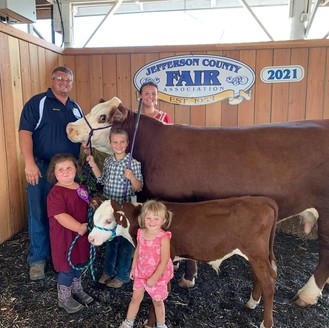
Heather with her husband Michael and three daughters, Lilly, Carley, and Abby at the Jefferson County Fair.
Shepherd University Small Agriculture Program
Submitted by : Peter Vila, Shepherd University Professor, Environmental Studies
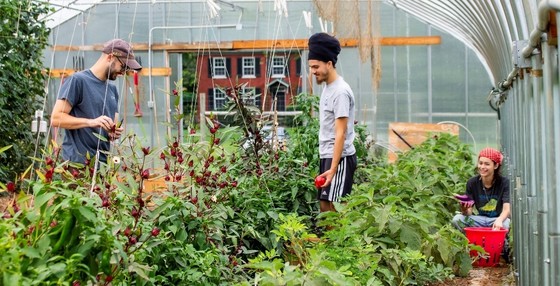
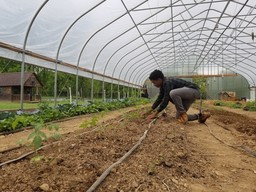
High Tunnel production with Shepherd University students.
The NRCS awarded a five year grant to Shepherd University that provided Shepherd a significant impetus to start its agricultural and Veterans to Agriculture programs on the 158 acre farm situated about 1.5 miles from the main campus. The Department of Environmental Studies partnered with the College of Business to design three agricultural programs centered on small-scale agriculture production and agriculture business management.
We have one four year program in Environmental Studies: Sustainable Food Production; and two Regents Bachelor of Arts programs: Emphasis in Sustainable Food Production and Emphasis in Agricultural Entrepreneurship. In addition, we have developed two one year certificates: Sustainable Food Production and Agricultural Entrepreneurship, both certified by the Department of Veteran Affairs.
NRCS funds were vital for our program and allowed us to establish the basic infrastructure needed for demonstrations of agricultural production techniques. The Shepherd Farm is essential for the development of different types of small-scale agricultural production; it is where practice, and the real-life experience needed to manage or launch a sustainable agriculture enterprise, occurs.
An important component for our success has been the overwhelming community participation. For example, all electrical labor after initial hookup to the main power line was donated by students from the James Rumsey electrician class. Labor to repair the existing well on the farm with new polypipe, electrical wire, and other plumbing fittings was donated by the installer with students assisting the well-digger. The focus of the grant was establishing a high tunnel and field production demonstration site and a 30ft x 100ft high tunnel was built in an approximately 1.6 acre area enclosed with a deer fence. Once established, this enclosed area allowed us to start an orchard from donated apple trees. The plan is for these trees to be trellised. In addition, we planted about 20 peach, nectarine and pear trees donated from the USDA Fruit Research Center. Pawpaw trees will be planted this Fall.
|
A private WISH (Women Investing in Shepherd) grant also made possible the installation of a grid-tied solar photovoltaic panels demonstrating one type of sustainable energy production. WISH funds and a private donor also allowed for renovation of a small block building. This building incorporates our internet infrastructure, and with the addition of sitting chairs and sofas, is a gathering and meeting area for students.
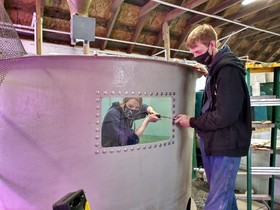
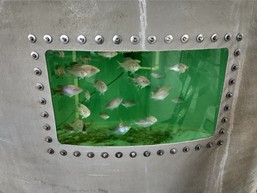
We also have established a small apiary under the direction of a certified bee keeper. The Ranson VFW donated a hive and equipment and the WISH grant provided funds for supplies such as extraction equipment, veils, and smokers to be used by students. In addition we also have an observation hive used in outreach activities for schools. In a collaboration with the VFW Charles Town, and a veteran assistance grant from the Home Depot Foundation, we established an area with ten raised beds that allows for wheelchair access and for smaller contained production areas. We are particularly excited in establishing an aquaponics laboratory in a renovated dairy parlor. This 20ft x 100ft structure houses two 1,200 gallon tanks for fish and different methods for growing plants.
|
Covid severely curtailed hours for our farm coordinator and no students were allowed on the farm. During that time, and, continuing now, agricultural production was donated to a non-profit, Shepherdstown Shares, that distributes food to those in need. This arrangement is continuing as we strongly believe in the social impact and responsibility local small-scale agriculture can have in our community. With eased restrictions this Fall, we are excited to start up with students and a new farm coordinator who is establishing innovative production techniques. At the present time we are planning for an Open House on October 30 to showcase our progress and future projects.
We are fortunate to be able to tap into the expertise provided by NRCS personnel and are indebted to their assistance. As a result of this collaboration we have made substantial gains in establishing infrastructure and were able to leverage other funding avenues to establish other agricultural production methods. Shepherd University has the strong desire and commitment for excellence in education. We provide the required training necessary for successful employment in agriculture or for establishing agricultural business enterprises. Please visit us at https://www.shepherd.edu/sustainable-agriculture.
|
Published Materials
-
NRCS WV-related peer reviewed research was recently published online. These articles utilize empirical data from West Virginia to model the likelihood of farmer participation in the Conservation Technical Assistance (CTA) Program, conduct spatial analyses of high and low participation, and explore natural resource management through a community development theoretical lens. Manuscripts are linked below. However, if you do not have a subscription to these journals, please feel free to contact Matt Oliver at matthew.oliver@usda.gov for a complimentary copy.
- Journal of Soil and Water Conservation
Oliver, M.D., and K.A. Gazal. 2021. Modeling likelihood of farmer participation in the USDA NRCS Conservation Technical Assistance program in West Virginia. Journal of Soil and Water Conservation 76(3):233-245. https://doi.org/10.2489/jswc.2021.00001.
Oliver, M.D., and M.P. Strager. 2021. A spatial analysis of high and low farmer participation in the USDA NRCS Conservation Technical Assistance Program in West Virginia. Journal of Soil and Water Conservation 76(2):130-141. https://doi.org/10.2489/jswc.2021.00005.
- Community Development Journal
Oliver, M.D., and M. Stout. 2021. Examining natural resource management through a community development theoretical lens. Community Development. https://doi.org/10.1080/15575330.2021.1946575.
- Richard Mine partner project local media coverage, Monongalia County.
Interview with Northeast Natural Energy CEO, Mike John on WV MetroNews/Outdoors Today Hunting and Fishing Show
Dominion Post Article
Recorded Events
Upcoming Events
-
Chestnut Festival — October 10, Rowlesburg
-
WV Walk in the Woods Workshop — Pendleton County, October 11
-
2021 West Virginia Women in Agriculture Conference to be Hosted Virtually — November 8-10
- WVACD October Quarterly Meeting Update: Virtual – October 18 and 19
-
2021 Hemp Acreage and Production Survey — This October, USDA’s National Agricultural Statistics Service (NASS), will mail out its first Hemp Acreage and Production Survey. The survey collects information on the acreage, yield, production, price, and value of hemp in the United States. To educate producers, other hemp industry stakeholders, and the general public, NASS is asking that you share information about the survey with your networks.
- West Virginia will be hosting the 2022 Southern Association of State Departments of Agriculture (SASDA) Annual Meeting next June.
Announcements
-
Nicole Viars, Assistant State Conservationist – Management and Strategy, has accepted a new position as management analyst with the NRCS Outreach and Partnerships Division. She begins her new position October 12, 2021. A Farewell from Nicole: "Sixteen years ago, I moved back to my home state of West Virginia to become the district conservationist in the Northern Panhandle. Since that time, I have had many opportunities to work with and get to know our West Virginia partners. Many I think of as family. While I am sad to be leaving NRCS-WV, I am excited to continue working with NRCS on the national level as we develop new initiatives and partnerships while delivering the message of conservation." Congratulations Nicole! You will be missed!
-
The U.S. Fish and Wildlife Service published a proposed rule to remove the tubercled-blossom pearly mussel from the endangered species list. The public comment period will close on Monday, November 29, 2021. You may view the proposed rule on the Federal Register at http://www.gpo.gov/fdsys/browse/collection.action?collectionCode=FR. If you have any questions or would like additional information, please reach out the U.S. Fish and Wildlife Service office at fw5_wvfo@fws.gov.
-
The U.S. Fish and Wildlife Service has completed an initial review on the petition to list the American bumble bee under the Endangered Species Act (ESA) and has determined that the petition contains substantial information and that listing may be warranted. The notice for the above findings is available here at regulations.gov under docket number FWS–R3–ES–2021–0063. If you have any questions or would like additional information, please contact Matt Hinderliter, Regional Listing Coordinator, at matthew_hinderliter@fws.gov.
**Reminder- Please email updates/ announcements to Becky Haddix by March 18, 2022 to be included in the next issue.
Environmental Defense Fund
USDA Farm Service Agency
WV Association of Conservation Districts
WV Department of Agriculture
WV Poultry Association
USDA Rural Development
US Environmental Protection Agency
WV Department of Health and Human Resources
WV National Guard
WV Rivers Coalition
WV Rural Water Association
WV University
WVU Potomac State UniversityWVU Potomac State University
WV Agricultural Land Protection Authority
WV Land Trust
US Fish and Wildlife Service
WVU Wildlife & Fisheries Resources
WV Division of Forestry
WVU Extension
USDA Forest Service
WV Association of RC&D Councils
WV Farm Bureau
WV Farmland Protection
WV Conservation Agency
American Bird Conservancy
The National Wild Turkey Federation
The Nature Conservancy
Trout Unlimited
WV Division of Natural Resources
WV Dept. of Environmental Protection
WV State University
Risk Management Agency
Send your submissions to rebecca.haddix@usda.gov
***The due date for the next edition is March 18, 2022***
|