As the fiscal year is winding down, our field staff has been hard at work finishing up the Conservation Stewardship Program (CSP) and focusing on the Conservation Reserve Program (CRP) in several counties as well, while providing technical assistance as needed. Now that we start to enter into the last quarter of the year, it is wise to start to think about getting those program payments in this calendar year or next. Please visit with your local office if you are going to want your program payment in this calendar year. The cutoff date will be announced soon to field offices to allow time for the staff to process the payments.
Beginning farmer meetings will be happening across the state with the cooperation of OSU Extension Service and other state and local entities. Please share with neighbors and friends as you hear or plan to participate in these events. Racial Justice and Equity Conservation Cooperative Agreements are available to entities for two year projects that expand the delivery of conservation assistance to farmers who are beginning, limited resource, socially disadvantaged, and veteran farmers. This opportunity is for non-profits, tribes, universities, and individuals. In this newsletter, you will see a great video showing how Farmers are helping other Farmers.
NRCS participated in a tour near Elk City at Upper Elk Creek 23D watershed site where information was shared with partners and congressional leaders about the importance of the watershed program in Oklahoma. As the rains have devastated other parts of the country, it is important to remember how these watersheds work and provide the economic and safety to our communities.
Gary O'Neill, State Conservationist
|
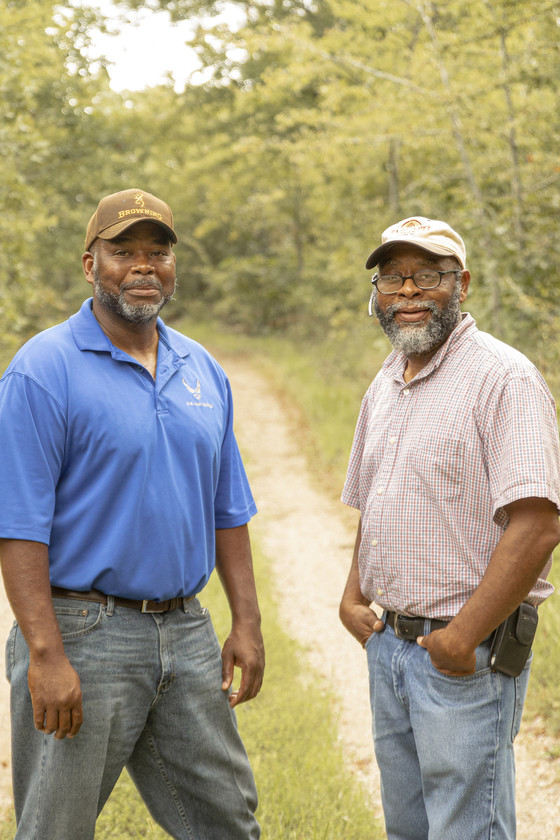 Phillip Mitchell and Phil Campbell pictured at Phillip's farm.
Phillip Mitchell speaks about how helpful his mentor, Phil Campbell, has been in the start of his farming operation. Watch the new video here.
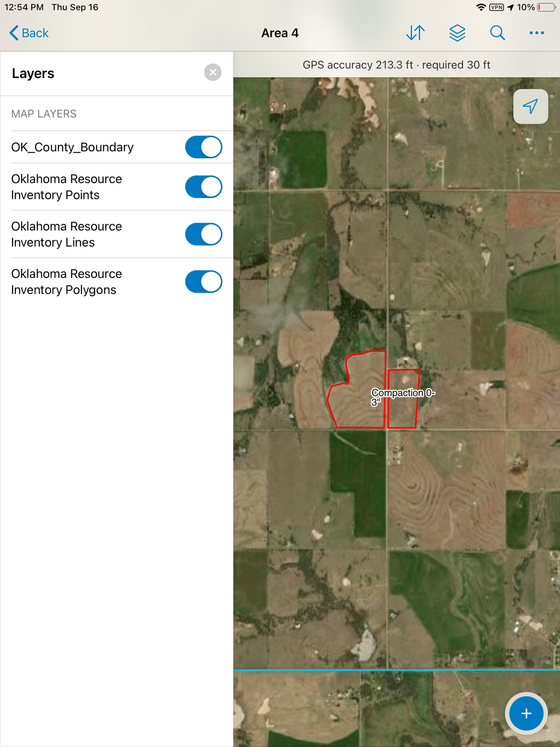
This past spring and summer, a team of ten Oklahoma NRCS employees began testing new field data collection devices. The data collection consisted of using an iPhone or iPad along with a Bluetooth enabled GPS receiver.
The data was collected using two ESRI based software applications, Collector and Survey123. The Collector application allows users to collect GPS point, line, and polygon information. The Survey123 application lets users collect geospatially referenced data along with questionnaire information into created survey forms. The survey forms are task and subject specific. The surveys created for Oklahoma at this point cover subjects like soil and range health and pasture condition score.
All the data collected are then synchronized and saved on the NRCS’ cloud-based geospatial platform, The NRCS GeoPortal. This data can then be accessed in ArcMap, ArcGIS Pro, and/or Conservation Desktop for resource inventory and conservation planning activities.
Oklahoma NRCS hopes to deploy more of these data collection devices in the future, as well as create more surveys to aid field offices with conservation planning activities.
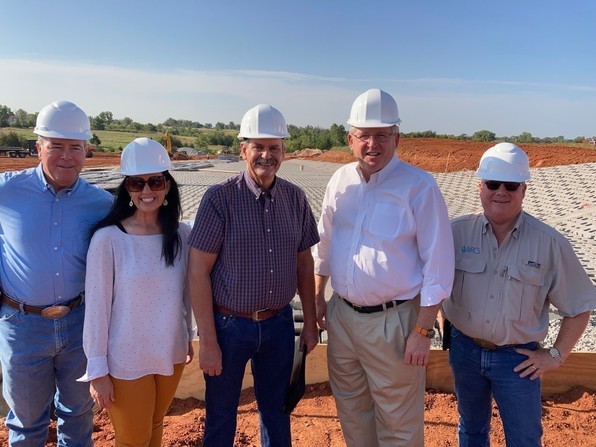 State Representative Todd Russ, from left, Oklahoma Secretary of Agriculture Blayne Arthur, Oklahoma Conservation Commission Executive Director Trey Lam, U.S. Congressman Frank Lucas, and USDA Natural Resources Conservation Service Oklahoma State Conservation Engineer Chris Stoner on September 7 at a tour of the Upper Elk Creek Site 23D flood control dam rehabilitation on the east edge of Elk City.
New life is being given to this flood control dam and the tour was a way to showcase those efforts along with the watershed project sponsor, North Fork of Red River Conservation District. Originally constructed in 1976 at a cost of $102,401 and classified as a significant hazard dam, this is now a high hazard dam. An increase in risk of loss of life and property damage due to a potential overtopping breach of the dam during an extreme flood event is the reason site 23D is undergoing this rehabilitation.
Although Site 23D is functioning as originally planned and providing downstream flood damage prevention, this rehabilitation means that in the future, Site 23D will reduce the potential of a dam breach and subsequent potential damage to downstream properties and infrastructure and will reduce the risk of loss of life. Additionally, the rehabilitation of site 23D allows for the service life of the dam to be extended for at least a century.
To read the entire article, click here.
To be announced:
- Assistant State Conservationist (M&S) – GS-0301–13
- Stillwater - State Office
- Resource Conservationist – GS-0457-9/11
- Wewoka
- Altus
- Lawton
- Atoka
- Office Assistant – GS-0303-6
- McAlester or Claremore Technical Service Office
- Resource Specialist – GS-0457-12
- Woodward Technical Service Office
Pathways to be announced:
- Recent Graduate – Agriculture Economist - GS-0110 – 5/7/9
- Stillwater - State Office
- Student Intern – Rangeland Management
- Student Intern – Soil Conservationist
- Student Intern – Soil Scientist
- Claremore Technical Service Office
The best way to stay updated on job postings is to check USA Jobs often and sign up for notifications for job announcements.
All jobs with NRCS are listed on USA Jobs.
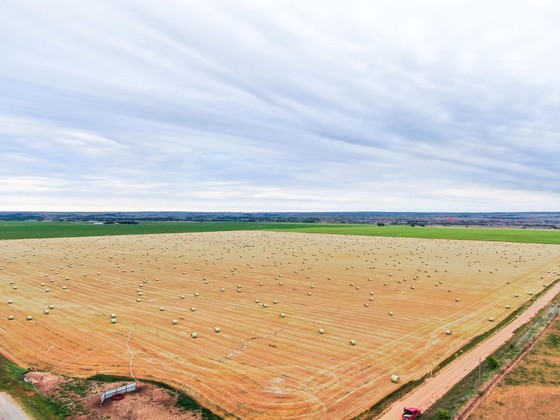 Photo by Macee Hammack. To enter a photo in this month's contest, email the full resolution photo to NRCSinfo-OK@usda.gov by October 15.
The U.S. Department of Agriculture (USDA) is providing additional time for livestock and poultry producers to apply for the Pandemic Livestock Indemnity Program (PLIP). Producers who suffered losses during the pandemic due to insufficient access to processing may now apply for assistance for those losses and the cost of depopulation and disposal of the animals through Oct. 12, 2021, rather than the original deadline of Sept. 17, 2021. PLIP is part of USDA’s Pandemic Assistance for Producers initiative.
PLIP provides payments to producers for losses of livestock or poultry depopulated from March 1, 2020 through Dec. 26, 2020, due to insufficient processing access as a result of the pandemic. Payments are based on 80% of the fair market value of the livestock and poultry and for the cost of depopulation and disposal of the animal. Eligible livestock and poultry include swine, chickens and turkeys.
PLIP Program Details
PLIP payments are calculated by multiplying the number of head of eligible livestock or poultry by the payment rate per head, and then subtracting the amount of any payments the eligible livestock or poultry owner has received for disposal of the livestock or poultry under the Natural Resources Conservation Service (NRCS) Environmental Quality Incentives Program (EQIP) or a state program. The payments will also be reduced by any Coronavirus Food Assistance Program (CFAP 1 and 2) payments paid on the same inventory of swine that were depopulated.
Eligible livestock and poultry producers can apply for PLIP through the Oct. 12, 2021 deadline by completing the FSA-620, Pandemic Livestock Indemnity Program application, and submitting it to any Farm Service Agency county office. Additional documentation may be required. Visit farmers.gov/plip more information on how to apply.
Additional Pandemic Assistance
Other programs within the Pandemic Assistance for Producer initiative with upcoming deadlines include:
To learn more about USDA’s commitment to delivery of financial assistance to farmers, ranchers and agricultural producers and businesses who have been impacted by COVID-19 market disruptions, visit farmers.gov/pandemic-assistance.
The U.S. Department of Agriculture’s Agricultural Marketing Service (AMS) announced it will soon publish Requests for Applications (RFAs) for the Pandemic Response and Safety (PRS) Grants program to support agricultural stakeholders who haven’t yet received substantial federal financial assistance in responding to the COVID-19 crisis. This grant program will provide assistance to small businesses in certain commodity areas, including small scale specialty crop producers, food processors, manufacturers, distributors and farmers markets.
A grant forecast is now available to help potential applicants determine their eligibility and to prepare to apply for funding. Eligible entities should visit the PRS grant portal at usda-prs.grantsolutions.gov for complete information on the program, including how to obtain a free of charge DUNS Number from Dun & Bradstreet (D&B) BEFORE applying for this program. On September 23, USDA will issue another announcement indicating that entities may submit their applications through the grant portal; entities will need their DUNS number to submit an application.
Visit usda-prs.grantsolutions.gov or the AMS website to learn more.
The U.S. Department of Agriculture (USDA) has accepted offers for more than 2.5 million acres from agricultural producers and private landowners for enrollment through this year’s Grassland Conservation Reserve Program (CRP) Signup. This is double last year’s enrollment and brings the total acres enrolled across all CRP signups in 2021 to more than 5.3 million acres, surpassing USDA’s 4-million-acre goal. Producers and landowners submitted offers for nearly 4 million acres in Grassland CRP, the highest in the signup’s history.
Oklahoma producers enrolled 235,428 acres through this year’s Grassland CRP signup. Through Grassland CRP, producers and landowners can conserve grasslands, rangelands, and pastures, while retaining the right to conduct common grazing practices, such as haying, mowing, or harvesting seed from the enrolled land, pursuant to approved conservation plans designed to promote thoughtful use while creating and maintaining vital habitat.
Updates to Grassland CRP
FSA rolled out a number of updates to its CRP signups earlier this year. This included setting a minimum payment rate for Grassland CRP as well as establishing new national priority zones.
Producers enrolled 1.1 million acres in the two priority zones, which include the Greater Yellowstone Elk Migratory Corridor, which is focused on wildlife and includes counties in Idaho, Montana, and Wyoming, and the Historical Dust Bowl Region, which still is at great risk of high wind erosion and includes counties in Colorado, Oklahoma, Kansas, and Texas. The two national priority areas adjoin or include habitat ranges of the lesser prairie-chicken and sage grouse, both of which are part of larger USDA wildlife habitat initiatives. The new Grassland enrollment acres include 1.4 million acres within the range of these two species.
Download the “What’s New” fact sheet to learn more about CRP updates.
CRP and Climate Change Mitigation
Additionally, lands enrolled in CRP – including grasslands – play an important role in addressing climate change. For example, this enrollment of more than 2.5 million acres of grazing land into Grassland CRP will mitigate an additional estimated 22,000 metric tons of CO2 equivalent.
By the Numbers
In addition to the more than 2.5 million acres enrolled in Grassland CRP, almost 1.9 million acres in offers were accepted through the General CRP Signup and 902,000 acres were accepted so far through the Continuous Signup. Additional enrollment information on the General and Continuous signups is available in the Aug. 23, 2021 news release.
The 2018 Farm Bill established a nationwide acreage limit for CRP, with the total number of acres that may be enrolled capped at 25 million acres in fiscal year (FY) 2021 and growing to 27 million by FY 2023. Currently, 20.6 million acres are enrolled. With more than 5.3 million acres accepted for enrollment, the USDA will start 2022 off with about 22.9 million acres, leaving room for further enrollment and program expansion up to the FY 2022 cap of 25.5 million.
More Information
For more information on Grassland CRP or any other CRP program, contact your local FSA county office or visit fsa.usda.gov/crp. To locate your local FSA office, visit farmers.gov/service-locator.
In response to the severe drought conditions in the West and Great Plains, the U.S. Department of Agriculture (USDA) announced today its plans to help cover the cost of transporting feed for livestock that rely on grazing. USDA is updating the Emergency Assistance for Livestock, Honeybees and Farm-Raised Fish Program (ELAP) to immediately cover feed transportation costs for drought impacted ranchers. USDA’s Farm Service Agency (FSA) will provide more details and tools to help ranchers get ready to apply at their local USDA Service Center later this month at fsa.usda.gov/elap.
ELAP provides financial assistance to eligible producers of livestock, honeybees, and farm-raised fish for losses due to disease, certain adverse weather events or loss conditions as determined by the Secretary of Agriculture.
ELAP already covers the cost of hauling water during drought, and this change will expand the program beginning in 2021 to cover feed transportation costs where grazing and hay resources have been depleted. This includes places where:
- Drought intensity is D2 for eight consecutive weeks as indicated by the U.S. Drought Monitor;
- Drought intensity is D3 or greater; or
- USDA has determined a shortage of local or regional feed availability.
Cost share assistance will also be made available to cover eligible cost of treating hay or feed to prevent the spread of invasive pests like fire ants.
Under the revised policy for feed transportation cost assistance, eligible ranchers will be reimbursed 60% of feed transportation costs above what would have been incurred in a normal year. Producers qualifying as underserved (socially disadvantaged, limited resource, beginning or military veteran) will be reimbursed for 90% of the feed transportation cost. above what would have been incurred in a normal year.
A national cost formula, as established by USDA, will be used to determine reimbursement costs which will not include the first 25 miles and distances exceeding 1,000 transportation miles. The calculation will also exclude the normal cost to transport hay or feed if the producer normally purchases some feed. For 2021, the initial cost formula of $6.60 per mile will be used (before the percentage is applied), but may be adjusted on a state or regional basis.
To be eligible for ELAP assistance, livestock must be intended for grazing and producers must have incurred feed transportation costs on or after Jan. 1, 2021. Although producers will self-certify losses and expenses to FSA, producers are encouraged to maintain good records and retain receipts and related documentation in the event these documents are requested for review by the local FSA County Committee. The deadline to file an application for payment for the 2021 program year is Jan. 31, 2022.
USDA offers a comprehensive portfolio of disaster assistance programs. On farmers.gov, the Disaster Assistance Discovery Tool, Disaster Assistance-at-a-Glance fact sheet, and Farm Loan Discovery Tool can help producers and landowners determine all program or loan options available for disaster recovery assistance.
More information on this expansion to ELAP is forthcoming. In the meantime, more information is available at fsa.usda.gov/elap or by contacting a local USDA Service Center.
- September 24
- September 30
|