In the September 2021 Newsletter:
USDA Service Centers in Montana are open to limited visitors by appointment only. Contact your Service Center to schedule an appointment. You can find contact information at farmers.gov/service-locator. Farm Service Agency (FSA) and Natural Resources Conservation Service (NRCS) staff also continue to work with agricultural producers via phone, email, and other digital tools. Producers can learn more about how to leverage these digital offerings by visiting https://www.farmers.gov/mydocs.
USDA in Montana reminds agricultural producers of upcoming Farm Service Agency dates and deadlines. Contact your local service center to apply and with any questions. Visit online at farmers.gov and fsa.usda.gov/mt. (Click here for printable deadline poster.)
Sept. 17: Last day of Pandemic Livestock Indemnity Program (PLIP) Signup
Sept. 30: 2022 Noninsured Crop Disaster Assistance Program (NAP) Application for Coverage Deadline for Annual Fall-Seeded Crops, Perennial Forage and Grazing, Mixed Forage Crops (including spring seeded annual types of mixed forage), Rye, Speltz, Triticale, Wheat and Garlic
Oct. 12: Deadline to apply for or modify applications for Coronavirus Food Assistance Program 2 (CFAP2) Signup. Visit farmers.gov/cfap for details on all eligible commodities and additional program resources. Producers have multiple options to apply for CFAP 2, including through an online application portal and by working directly with the FSA office. Customers seeking one-on-one support with the CFAP 2 application process can call 877-508-8364 to speak directly with a USDA employee ready to offer assistance.
Oct. 15: Application deadline for the Pandemic Assistance for Timber Harvesters and Haulers program (PATHH)
Nov. 1: Last day of 2021 Conservation Reserve Program (CRP) Summer/Fall Non-Emergency Grazing Period (prior approval required)
Nov. 1: Deadline for Organic Certification Cost Share Program (OCCSP) Applications for eligible certification expenses paid between Oct. 1, 2020 to Sept. 30, 2021.
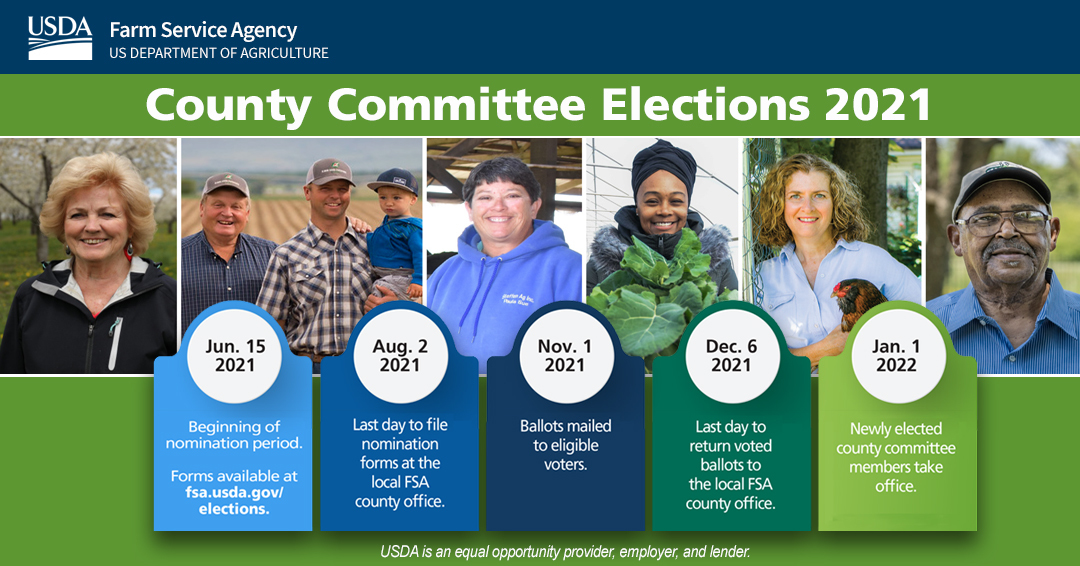
Early November: 2021 County Committee Election Ballots to be Mailed to Voters
Nov. 15: 2022 Acreage Reporting Deadline for Apiculture, Fall Wheat (Hard Red Winter), and all other Fall-Seeded Small Grains. Please note that this is the final date that FSA can accept late-filed 2021 reports for these crops.
Dec. 6: Voted FSA County Committee Election Ballots due to FSA
Dec. 31: 2022 NAP Coverage Application Closing Date for Honey
Jan. 1: Newly elected COC Members/Alternates take Oath of Office
Jan. 3: 2022 Acreage Reporting Deadline for Honey covered under NAP (or 30 days after placement of colonies). Please note that this is the final date that FSA can accept late-filed 2021 reports for these crops.
Jan. 17: 2022 Acreage Reporting Deadline Established Stand Alfalfa Seed, Fall Alfalfa Seed and Cherries. Please note that this is the final date that FSA can accept late-filed 2021 reports for these crops.
Jan. 30: 2021 Emergency Assistance for Livestock, Honeybees and Farm-Raised Fish Program (ELAP) Application for Payment Deadline for timely filed 2021 ELAP notices of losses
Jan. 31: Deadline for the 2021 Livestock Forage Disaster Program (LFP) Application and all supporting documentation
Jan. 31: Final availability date for Marketing Assistance Loans and Loan Deficiency Payments (LDPs) for prior year harvested peanuts, wool, mohair and LDP only for unshorn pelts
March 1: Deadline for the 2021 Livestock Indemnity Program Application for Payment and all supporting documentation for timely filed 2021 LIP notices of livestock losses.
The Farm Service Agency’s Noninsured Crop Disaster Assistance Program (NAP) helps you manage risk through coverage for both crop losses and crop planting that was prevented due to natural disasters. The eligible or “noninsured” crops include agricultural commodities not covered by federal crop insurance.
You must be enrolled in the program and have purchased coverage for the eligible crop in the crop year in which the loss incurred to receive program benefits following a qualifying natural disaster.
Upcoming Montana 2022 Crop Year Coverage Closing Dates:
-
Sept. 30: Annual Fall-Seeded Crops, Perennial Forage and Grazing, Mixed Forage Crops (including spring seeded annual types of mixed forage), Rye, Speltz, Triticale, Wheat and Garlic
-
Dec. 31: Honey
-
March 15, 2022: all Spring Crops except Spring-Seeded Canola, Rye, Speltz, Triticale, Wheat and Mixed Forage
NAP Buy-Up Coverage Option
NAP offers higher levels of coverage, from 50 to 65 percent of expected production in 5 percent increments, at 100 percent of the average market price.
Producers of organics and crops marketed directly to consumers also may exercise the “buy-up” option to obtain NAP coverage of 100 percent of the average market price at the coverage levels of between 50 and 65 percent of expected production.
NAP basic coverage is available at 55 percent of the average market price for crop losses that exceed 50 percent of expected production.
Buy-up coverage is not available for crops intended for grazing.
NAP Service Fees
For all coverage levels, the NAP service fee is the lesser of $325 per crop or $825 per producer per county, not to exceed a total of $1,950 for a producer with farming interests in multiple counties.
NAP Enhancements for Qualified Military Veterans
Qualified veteran farmers or ranchers are eligible for a service fee waiver and premium reduction, if the NAP applicant meets certain eligibility criteria.
Beginning, limited resource and targeted underserved farmers or ranchers, including females and entities with 50 percent female ownership, remain eligible for a waiver of NAP service fees and premium reduction when they file form CCC-860, “Socially Disadvantaged, Limited Resource and Beginning Farmer or Rancher Certification.”
For NAP application, eligibility and related program information, contact your local USDA Service Center and/or visit fsa.usda.gov/nap.
FSA program payments are issued electronically into your bank account. In order to make timely payments, you need to notify your FSA servicing office if you close your account or if your bank information is changed for whatever reason (such as your financial institution merging or being purchased). Payments can be delayed if FSA is not notified of changes to account and bank routing numbers.
For some programs, payments are not made until the following year. If the bank account was closed due to the death of an individual or dissolution of an entity or partnership before the payment was issued, please notify your local FSA office as soon as possible to claim your payment.
USDA surpasses goal with more than 5.3 million acres enrolled through CRP signups in 2021
The U.S. Department of Agriculture (USDA) has accepted offers for more than 2.5 million acres from agricultural producers and private landowners for enrollment through this year’s Grassland Conservation Reserve Program (CRP) Signup. This is double last year’s enrollment and brings the total acres enrolled across all CRP signups in 2021 to more than 5.3 million acres, surpassing USDA’s 4-million-acre goal. Producers and landowners submitted offers for nearly 4 million acres in Grassland CRP, the highest in the signup’s history.
Montana producers enrolled 129,622 acres through this year’s Grassland CRP signup. Through Grassland CRP, producers and landowners can conserve grasslands, rangelands, and pastures, while retaining the right to conduct common grazing practices, such as haying, mowing, or harvesting seed from the enrolled land, pursuant to approved conservation plans designed to promote thoughtful use while creating and maintaining vital habitat.
Updates to Grassland CRP
FSA rolled out a number of updates to its CRP signups earlier this year. This included setting a minimum payment rate for Grassland CRP as well as establishing new national priority zones.
Producers enrolled 1.1 million acres in the two priority zones, which include the Greater Yellowstone Elk Migratory Corridor, which is focused on wildlife and includes counties in Idaho, Montana, and Wyoming, and the Historical Dust Bowl Region, which still is at great risk of high wind erosion and includes counties in Colorado, Oklahoma, Kansas, and Texas. The two national priority areas adjoin or include habitat ranges of the lesser prairie-chicken and sage grouse, both of which are part of larger USDA wildlife habitat initiatives. The new Grassland enrollment acres include 1.4 million acres within the range of these two species.
Download the “What’s New” fact sheet to learn more about CRP updates.
CRP and Climate Change Mitigation
Additionally, lands enrolled in CRP – including grasslands – play an important role in addressing climate change. For example, this enrollment of more than 2.5 million acres of grazing land into Grassland CRP will mitigate an additional estimated 22,000 metric tons of CO2 equivalent.
By the Numbers
Top states for producers submitting offers included Colorado, South Dakota, Nebraska, Montana, and New Mexico.
In addition to the more than 2.5 million acres enrolled in Grassland CRP, almost 1.9 million acres in offers were accepted through the General CRP Signup and 902,000 acres were accepted so far through the Continuous Signup. Additional enrollment information on the General and Continuous signups is available in the Aug. 23, 2021 news release.
The 2018 Farm Bill established a nationwide acreage limit for CRP, with the total number of acres that may be enrolled capped at 25 million acres in fiscal year (FY) 2021 and growing to 27 million by FY 2023. Currently, 20.6 million acres are enrolled. With more than 5.3 million acres accepted for enrollment, the USDA will start 2022 off with about 22.9 million acres, leaving room for further enrollment and program expansion up to the FY 2022 cap of 25.5 million.
More Information
For more information on Grassland CRP or any other CRP program, contact your local FSA county office or visit fsa.usda.gov/crp. To locate your local FSA office, visit farmers.gov/service-locator.
Update to the Emergency Assistance for Livestock, Honeybees and Farm-Raised Fish Program
In response to the severe drought conditions in the West and Great Plains, the U.S. Department of Agriculture (USDA) announced its plans to help cover the cost of transporting feed for livestock that rely on grazing. USDA is updating the Emergency Assistance for Livestock, Honeybees and Farm-Raised Fish Program (ELAP) to immediately cover feed transportation costs for drought impacted ranchers. USDA’s Farm Service Agency (FSA) will provide more details and tools to help ranchers get ready to apply at their local USDA Service Center later this month at fsa.usda.gov/elap.
ELAP provides financial assistance to eligible producers of livestock, honeybees, and farm-raised fish for losses due to disease, certain adverse weather events or loss conditions as determined by the Secretary of Agriculture.
ELAP already covers the cost of hauling water during drought, and this change will expand the program beginning in 2021 to cover feed transportation costs where grazing and hay resources have been depleted. This includes places where:
- Drought intensity is D2 for eight consecutive weeks as indicated by the U.S. Drought Monitor;
- Drought intensity is D3 or greater; or
- USDA has determined a shortage of local or regional feed availability.
Cost share assistance will also be made available to cover eligible cost of treating hay or feed to prevent the spread of invasive pests like fire ants.
Under the revised policy for feed transportation cost assistance, eligible ranchers will be reimbursed 60% of feed transportation costs above what would have been incurred in a normal year. Producers qualifying as underserved (socially disadvantaged, limited resource, beginning or military veteran) will be reimbursed for 90% of the feed transportation cost. above what would have been incurred in a normal year.
A national cost formula, as established by USDA, will be used to determine reimbursement costs which will not include the first 25 miles and distances exceeding 1,000 transportation miles. The calculation will also exclude the normal cost to transport hay or feed if the producer normally purchases some feed. For 2021, the initial cost formula of $6.60 per mile will be used (before the percentage is applied), but may be adjusted on a state or regional basis.
To be eligible for ELAP assistance, livestock must be intended for grazing and producers must have incurred feed transportation costs on or after Jan. 1, 2021. Although producers will self-certify losses and expenses to FSA, producers are encouraged to maintain good records and retain receipts and related documentation in the event these documents are requested for review by the local FSA County Committee. The deadline to file an application for payment for the 2021 program year is Jan. 31, 2022.
USDA offers a comprehensive portfolio of disaster assistance programs. On farmers.gov, the Disaster Assistance Discovery Tool, Disaster Assistance-at-a-Glance fact sheet, and Farm Loan Discovery Tool can help producers and landowners determine all program or loan options available for disaster recovery assistance.
More information on this expansion to ELAP is forthcoming. In the meantime, more information is available at fsa.usda.gov/elap or by contacting a local USDA Service Center.
Agricultural producers now will have until December 1 to make coverage decisions and complete reporting activities for the Pasture, Rangeland, and Forage Pilot Insurance Program (PRF) and Apiculture Pilot Insurance Program (API). The U.S. Department of Agriculture’s (USDA) Risk Management Agency (RMA) is making this change and other updates to these two policies based on feedback from stakeholders.
PRF and API are both Rainfall Index crop insurance policies designed to aid agricultural producers in case of a lack of precipitation that affects available forage for livestock and honeybees. The plans consider a decline in rainfall by comparing it with the historical average precipitation for the same area during the same period of time. PRF is designed to help protect a producer’s livestock operation from the risks of forage loss. In 2020, producers insured almost 160 million acres and nearly 32,000 policies to protect $2.9 billion in liabilities. API provides a safety net for beekeepers’ primary income sources of honey, pollen collection, wax, and breeding stock. In 2020, producers covered about 1.8 million colonies under 3,300 policies to protect $250 million in liabilities.
RMA is revising the dates for the sales closing, acreage/colony reporting, cancellation, and termination of the PRF and API insurance programs from November 15 to December 1. For PRF, RMA is also increasing reporting flexibility by allowing the USDA’s Farm Service Agency (FSA) acreage report (form FSA-578) to be used in conjunction with other documents to verify insurable interest.
Other changes to the plans include:
Other Livestock Insurance Options
Livestock Risk Protection (LRP), which is available for Feeder Cattle, Fed Cattle, and Swine producers. It provides protection against declining market prices. Recent changes to LRP have resulted in substantial increases in program participation and livestock producers are encouraged to explore these risk management tools. More information on LRP and other livestock programs can be found on RMA’s livestock webpage.
To learn more about crop insurance and the modern farm safety net at rma.usda.gov.
Organic and aquaculture producers can soon benefit from updates to the U.S. Department of Agriculture’s (USDA) Whole-Farm Revenue Protection (WFRP) plan. USDA’s Risk Management Agency (RMA) is revising the plan of insurance to make it more flexible and accessible to producers beginning in crop year 2022.
Changes to WFRP include:
- Increasing expansion limits for organic producers to the higher of $500,000 or 35 percent. Previously, small and medium size organic operations were held to the same 35 percent limit to expansion as conventional practice producers.
- Increasing the limit of insurance for aquaculture producers to $8.5 million. Previously aquaculture producers were held to a $2 million cap on expected revenue, this change allows more aquaculture producers to participate in the program.
- Allowing a producer to report acreage as certified organic, or as acreage in transition to organic, when the producer has requested an organic certification by the acreage reporting date. This allows organic producers more flexibility when reporting certified acreage.
- Providing flexibility to report a partial yield history for producers lacking records by inserting zero yields for missing years. Previously, missing a year of records would cause the commodity’s expected value to be zero, meaning past revenue from the commodity would contribute nothing to the insurance guarantee.
WFRP provides a risk management safety net for all commodities on the farm under one insurance policy and is available in all counties nationwide. Producers purchased more than 2,000 policies to protect $2.26 billion in liabilities in 2020.
This insurance plan is tailored for any farm with up to $8.5 million in insured revenue, including farms with specialty or organic commodities (both crops and livestock), or those marketing to local, regional, farm-identity preserved, specialty, or direct markets.
Insurance for Specialty Crop and Organic Producers
The number of agricultural producers who purchase crop insurance for their specialty and organic crops continues to climb, which USDA attributes to its work with producers and agricultural groups in recent years to create new crop insurance options. Learn more in our August 26, 2021 news release.
More Information
RMA staff are working with crop insurance companies and other customers to support crop insurance coverage for producers. Farmers with crop insurance questions or needs should contact their insurance agents about conducting business remotely (by telephone or email). More information can be found at: farmers.gov/coronavirus.
Crop insurance is sold and delivered solely through private crop insurance agents. A list of crop insurance agents is available at all USDA Service Centers and online at the RMA Agent Locator. Learn more about crop insurance and the modern farm safety net at rma.usda.gov.
It is important to promptly report any changes in your farming operation to FSA. These changes can include, but are not limited to, changes in your address, phone, or email, name changes, changes to entity membership or shares, formation or dissolution of any entity (such as a trust, partnership, LLC, LLP or corporation) that owns or operates land or owns other farming assets used in your operation, sale or purchase of land, adding or dropping leases, and any changes to financing or equipment. Participants in FSA and NRCS programs are required to timely report changes in their farming operation to their local FSA office in writing and update their CCC-902 Farm Operating Plan with necessary changes, as applicable. Failure to timely notify your local FSA office may result in ineligibility for program benefits, or delays in issuance of program payments. If you have any updates or corrections to your records, please call your local FSA office to update your records.
Potential applicants interested in learning more about the following full-time permanent positions with the USDA Farm Service Agency in Montana and/or applying for these positions at usajobs.gov should click on the vacancy links below:
Two (2) Farm Loan Assistant/Specialist Positions
Location to be determined upon selection (Cut Bank, Glacier County, Montana or Great Falls, Cascade County, Montana.
Open period: 09/07/2021 to 09/20/2021
https://www.usajobs.gov/GetJob/ViewDetails/613300900
County Office Program Technician in Yellowstone County (Billings)
Open period: 9/3/21 - 9/17/21
https://www.usajobs.gov/GetJob/ViewDetails/613077800
County Office Program Technician in Valley County (Glasgow)
Open period: 9/3/21 - 9/17/21
https://www.usajobs.gov/GetJob/ViewDetails/613078000
County Program Technician in Judith Basin County (Stanford)
Open period: 9/3/21 -9/17/21
https://www.usajobs.gov/GetJob/ViewDetails/613078400
County Office Program Technician (PT) in Gallatin County (Bozeman)
Open period: 9/3/21 - 9/17/21
https://www.usajobs.gov/GetJob/ViewDetails/613203000
Two (2) County Office Program Technicians in Carter County (Ekalaka) or Fallon County (Baker)
Selectees can be located in either Carter County (Ekalaka) -or- Fallon County (Baker).
Open period: 9/3/21 - 9/17/21
https://www.usajobs.gov/GetJob/ViewDetails/613182900
It’s important for agricultural producers to report losses immediately as all disaster programs are dependent on the timely reporting of the loss. A notice of loss can be filed with USDA Farm Service Agency via phone, email, fax or scheduled office visit.
-
ELAP – Emergency Assistance for Livestock, Honeybees and Farm-Raised Fish Program: Starting in 2020, producers will have 15 days from when the loss is first apparent, to file a honeybee notice of loss instead of 30 days,. This change provides consistency between ELAP and the Noninsured Crop Disaster Assistance Program, which also has a 15-day notice of loss period for honey. For other covered livestock losses, including livestock feed, grazing and farm-raised fish losses, the notice of loss deadline for ELAP will remain 30 days from when the loss is first apparent to the producer.
-
LIP - Livestock Indemnity Program: Submit Notice of Loss within 30 calendar days of when the loss is first apparent. Producers should document the adverse weather conditions and date(s) of weather events.
-
TAP - Tree Assistance Program: Final Date to Submit an Application and Supporting Documentation within 90 calendar days of: the disaster event or the date when the loss is apparent to the producer.
-
NAP – Noninsured Crop Disaster Assistance Program: Submit Notice of Loss within 15 calendar days of the earlier of a natural disaster occurrence, the final planting date if planting is prevented by a natural disaster, the date that damage to the crop or loss of production becomes apparent; or the normal harvest date. Note: A producer’s signature is required on form CCC-576 when a Notice of Loss is submitted.
Change to Policy on Filing a Notice of Loss for Grazed Forage Producers with NAP Coverage:
For the 2021 and subsequent crop years, NAP forage producers with the intended use of grazing who elect to use independent assessments or other approved alternative loss percentage methods to establish their loss are no longer required to file a CCC-576 Notice of Loss with FSA. However, a CCC-576 Application for Payment form must be submitted to FSA no later than 60 calendar days after the coverage period ends.
Producers that elect to have the grazing loss determined using similar mechanically harvested units still must timely file a CCC-576 Notice of Loss within 15 days of the disaster event or damage to the crop first becomes apparent or within 15 days of harvest.
53 MT Counties Triggered; U.S. Drought Monitor Updated Weekly
Livestock producers in 53 Montana counties are eligible to apply for 2021 Livestock Forage Disaster Program (LFP) benefits on small grain, native pasture, improved pasture, annual ryegrass, and forage sorghum.
LFP provides compensation if you suffer grazing losses for covered livestock due to drought on privately owned or leased land or fire on federally managed land.
County committees can only accept LFP applications after notification is received by the National Office of qualifying drought or if a federal agency prohibits producers from grazing normal permitted livestock on federally managed lands due to qualifying fire.
The following 53 Montana counties have triggered the 2021 LFP drought criteria: Beaverhead, Big Horn, Blaine, Broadwater, Carbon, Carter, Cascade, Chouteau, Custer, Daniels, Dawson, Deer Lodge, Fallon, Fergus, Flathead, Gallatin, Garfield, Glacier, Golden Valley, Granite, Hill, Jefferson, Judith Basin, Lewis and Clark, Liberty, Lincoln, Madison, McCone, Meagher, Mineral, Missoula, Musselshell, Park, Petroleum, Phillips, Powder River, Powell, Prairie, Ravalli, Richland, Roosevelt, Rosebud, Sanders, Sheridan, Silver Bow, Stillwater, Sweet Grass, Toole, Treasure, Valley, Wheatland, Wibaux and Yellowstone. Producers must complete a CCC-853 and the required supporting documentation no later than January 31, 2022, for 2021 losses.
For additional information about LFP, including eligible livestock and fire criteria, contact the local USDA Service Center and/or visit www.farmers.gov and/or fsa.usda.gov/mt.
USDA Sets October 12 Deadline for CFAP 2
The U.S. Department of Agriculture (USDA) is updating the Coronavirus Food Assistance Program 2 (CFAP 2) for contract producers of eligible livestock and poultry and producers of specialty crops and other sales-based commodities. CFAP 2, which assists producers who faced market disruptions in 2020 due to COVID-19, is part of USDA’s broader Pandemic Assistance for Producers initiative. Additionally, USDA’s Farm Service Agency (FSA) has set an Oct. 12 deadline for all eligible producers to apply for or modify applications for CFAP 2.
Assistance for Contract Producers
The Consolidated Appropriations Act, 2021, provides up to $1 billion for payments to contract producers of eligible livestock and poultry for revenue losses from Jan. 1, 2020, through Dec. 27, 2020. Contract producers of broilers, pullets, layers, chicken eggs, turkeys, hogs and pigs, ducks, geese, pheasants and quail may be eligible for assistance. This update includes eligible breeding stock and eggs of all eligible poultry types produced under contract.
Payments for contract producers were to be based on a comparison of eligible revenue for the periods of Jan. 1, 2019, through Dec. 27, 2019, and Jan. 1, 2020, through Dec. 27, 2020. Today’s changes mean contract producers can now elect to use eligible revenue from the period of Jan. 1, 2018, through Dec. 27, 2018, instead of that date range in 2019 if it is more representative. This change is intended to provide flexibility and make the program more equitable for contract producers who had reduced revenue in 2019 compared to a normal production year. The difference in revenue is then multiplied by 80% to determine a final payment. Payments to contract producers may be factored if total calculated payments exceed the available funding and will be made after the application period closes.
Additional flexibilities have been added to account for increases to operation size in 2020 and situations where a contract producer did not have a full period of revenue from Jan. 1 to Dec. 27 for either 2018 or 2019. Assistance is also available to new contract producers who began their farming operation in 2020.
Updates for Sales-Based Commodities
USDA is amending the CFAP 2 payment calculation for sales-based commodities, which are primarily comprised of by specialty crops, to allow producers to substitute 2018 sales for 2019 sales. Previously, payments for producers of sales-based commodities were based only on 2019 sales, with 2019 used as an approximation of the amount the producer would have expected to market in 2020. Giving producers the option to substitute 2018 sales for this approximation, including 2018 crop insurance indemnities and 2018 crop year Noninsured Disaster Assistance Program (NAP) and Wildfire and Hurricane Indemnity Program Plus (WHIP+) payments, provides additional flexibility to producers of sales-based commodities who had reduced sales in 2019.
Grass seed has also been added as an eligible sales commodity for CFAP 2. A complete list of all eligible sales-based commodities can be found at farmers.gov/cfap2/commodities. Producers of sales-based commodities can modify existing applications
Applying for Assistance
Newly eligible producers who need to submit a CFAP 2 application or producers who need to modify an existing one can do so by contacting their local FSA office. Producers can find their local FSA office by visiting farmers.gov/service-locator. Producers can also obtain one-on-one support with applications by calling 877-508-8364. All new and modified CFAP 2 applications are due by the Oct. 12 deadline.
Application Deadline: Oct. 15, 2021
PATHH Webinar Presentation | PATHH Webinar Recording
The U.S. Department of Agriculture (USDA) is providing up to $200 million to provide relief to timber harvesting and timber hauling businesses that have experienced losses due to COVID-19 as part of USDA’s Pandemic Assistance for Producers initiative. Loggers and truckers can apply for assistance through USDA’s Farm Service Agency (FSA) July 22 through Oct. 15, 2021. The Pandemic Assistance for Timber Harvesters and Haulers program (PATHH) is administered by FSA in partnership with the U.S. Forest Service.
The Consolidated Appropriations Act, 2021, authorized this critical assistance for the timber industry. Timber harvesting and hauling businesses that have experienced a gross revenue loss of at least 10% during the period of Jan. 1 and Dec. 1, 2020, compared to the period of Jan. 1 and Dec. 1, 2019, are encouraged to apply.
Program Details
To be eligible for payments, individuals or legal entities must be a timber harvesting or timber hauling business where 50% or more of its gross revenue is derived from one or more of the following:
- Cutting timber.
- Transporting timber.
- Processing of wood on-site on the forest land (chipping, grinding, converting to biochar, cutting to smaller lengths, etc.).
Payments will be based on the applicant’s gross revenue received from Jan. 1, 2019, through Dec. 1, 2019, minus gross revenue received from Jan. 1, 2020, through Dec. 1, 2020, multiplied by 80%. FSA will issue an initial payment equal to the lesser of the calculated payment amount or $2,000 as applications are approved. A second payment will be made after the signup period has ended based upon remaining PATHH funds.
The maximum amount that a person or legal entity may receive directly is $125,000.
Applying for Assistance
Loggers and truckers can apply for PATHH beginning on July 22 by completing form FSA-1118, Pandemic Assistance for Timber Harvesters and Haulers Program application, and certifying to their gross revenue for 2019 and 2020 on the application. Additional documentation may be required. Visit farmers.gov/pathh for more information on how to apply.
Applications can be submitted to the FSA office at any USDA Service Center nationwide by mail, fax, hand delivery, or via electronic means. To find a local FSA office, loggers and truckers can visit farmers.gov/service-locator. They can also call 877-508-8364 to speak directly with a USDA employee ready to offer assistance.
September 17 Deadline
Livestock and poultry producers who suffered losses during the pandemic due to insufficient access to processing can apply for assistance for those losses and the cost of depopulation and disposal of the animals. The U.S. Department of Agriculture (USDA) Secretary Vilsack announced the Pandemic Livestock Indemnity Program (PLIP) in [recorded] remarks at the National Pork Industry Conference in Wisconsin Dells, WI. The announcement is part of USDA’s Pandemic Assistance for Producers initiative. Livestock and poultry producers can apply for assistance through USDA’s Farm Service Agency (FSA) July 20 through Sept. 17, 2021.
The Consolidated Appropriations Act, 2021, authorized payments to producers for losses of livestock or poultry depopulated from March 1, 2020 through December 26, 2020, due to insufficient processing access as a result of the pandemic. PLIP payments will be based on 80% of the fair market value of the livestock and poultry and for the cost of depopulation and disposal of the animal. Eligible livestock and poultry include swine, chickens and turkeys.
PLIP Program Details
Eligible livestock must have been depopulated from March 1, 2020, through December 26, 2020, due to insufficient processing access as a result of the pandemic. Livestock must have been physically located in the U.S. or a territory of the U.S. at the time of depopulation.
Eligible livestock owners include persons or legal entities who, as of the day the eligible livestock was depopulated, had legal ownership of the livestock. Packers, live poultry dealers and contract growers are not eligible for PLIP.
PLIP payments compensate participants for 80% of both the loss of the eligible livestock or poultry and for the cost of depopulation and disposal based on a single payment rate per head. PLIP payments will be calculated by multiplying the number of head of eligible livestock or poultry by the payment rate per head, and then subtracting the amount of any payments the eligible livestock or poultry owner has received for disposal of the livestock or poultry under the Natural Resources Conservation Service (NRCS) Environmental Quality Incentives Program (EQIP) or a state program. The payments will also be reduced by any Coronavirus Food Assistance Program (CFAP 1 and 2) payments paid on the same inventory of swine that were depopulated.
There is no per person or legal entity payment limitation on PLIP payments. To be eligible for payments, a person or legal entity must have an average adjusted gross income (AGI) of less than $900,000 for tax years 2016, 2017 and 2018.
Applying for Assistance
Eligible livestock and poultry producers can apply for PLIP starting July 20, 2021, by completing the FSA-620, Pandemic Livestock Indemnity Program application, and submitting it to any FSA county office. Additional documentation may be required. Visit farmers.gov/plip for a copy of the Notice of Funding Availability and more information on how to apply.
Applications can be submitted to the FSA office at any USDA Service Center nationwide by mail, fax, hand delivery or via electronic means. To find your local FSA office, visit farmers.gov/service-locator. Livestock and poultry producers can also call 877-508-8364 to speak directly with a USDA employee ready to offer assistance.
Hidden Hollow Hideaway Cattle & Guest Ranch is the 2021 recipient of the Montana Leopold Conservation Award®. Given in honor of renowned conservationist Aldo Leopold, the prestigious award recognizes farmers, ranchers and forestland owners who inspire others with their dedication to land, water and wildlife habitat management on private, working land. Kelly Flynn’s land ethic was passed down from relatives who carved a living from the land since the 1860s. He recalled his aging parents pulling weeds on hot days. With those values etched in his mind, he spent a life caring for livestock, wildlife, and 6,000 acres of meadows, creeks and forests. (Read More)
The U.S. Department of Agriculture (USDA) recently announced its Risk Management Agency (RMA) will authorize Approved Insurance Providers (AIPs) to extend deadlines for premium and administrative fee payments, defer and waive the resulting interest accrual and allow other flexibilities to help farmers and ranchers through widespread drought conditions in many parts of the nation.
Producers now have additional time to pay premium and administrative fees, and interest will be waived for 60 days or the termination date on the policy, whichever comes first. RMA also authorized AIPs to waive interest for an additional 60 days for Written Payment Agreements due between August 1 and September 30, 2021.
These new crop insurance flexibilities are part of USDA’s broader response to help producers impacted by drought. On July 13, 2021, RMA authorized emergency procedures to help streamline and accelerate the adjustment of losses and issuance of indemnity payments to crop insurance policyholders in impacted areas. Additionally, RMA updated policy on July 6, 2021, to allow producers with crop insurance to hay, graze or chop cover crops at any time and still receive 100% of the prevented planting payment. This policy change supports use of cover crops, which can help producers build resilience to drought.
Additional Drought Assistance
Farm Service Agency (FSA) and Natural Resources Conservation Service (NRCS) also offer a broad suite of programs available to producers to help recover losses from drought. Disaster assistance programs and loans are available to help producers offset losses and get financing to help with recovery. Producers should visit farmers.gov, where they can use the Disaster Assistance Discovery Tool or Disaster-at-a-Glance fact sheet to learn more about program or loan options.
More Information
RMA staff are working with AIPs and other customers by phone, mail and electronically to support crop insurance coverage for producers. Farmers with crop insurance questions or needs should contact their insurance agents about conducting business remotely (by telephone or email). More information can be found at farmers.gov/coronavirus.
Crop insurance is sold and delivered solely through private crop insurance agents. A list of crop insurance agents is available at all USDA Service Centers and online at the RMA Agent Locator. Learn more about crop insurance and the modern farm safety net at rma.usda.gov.
Farm Storage Facility Loans (FSFL) provide low-interest financing so producers can build or upgrade facilities to store commodities. Some storage and handling trucks are eligible for the FSFL. These include:
-
Cold Storage Trucks: A van or truck designed to carry perishable freight at specific temperatures. Cold storage trucks can be ice-cooled or equipped with any variety of mechanical refrigeration systems.
-
Flatbed Trucks: Truck with an open body in the form of a platform with no side walls for easy loading and unloading. These trucks can be categorized into different sizes which range from light, medium, or heavy duty, compact or full-size, or short and expandable beds.
-
Grain Trucks: A piece of farm equipment specially made to accommodate grain products and are traditionally truck chassis units with a mounted grain “dump” body where grain commodities are transported from a field to either a grain elevator or a storage bin.
-
Storage Trucks with a Chassis Unit: Commonly referred to as a box truck, box van or straight truck, is a truck with a cargo body mounted on the same chassis with the engine and cab.
-
Semi-Trucks or Truck Tractors: Any vehicle configuration consisting of a power-unit designed in combination to draw or pull a semi-trailer or farm machinery.
To be eligible for FSFL, the storage and handling truck must be less than 15 years old and have a maximum of four axles with a gross weight rating of 60,000 pounds or less. Pick-up trucks, semi-trucks, dump trucks, and simple insulated and ventilated vans are ineligible for FSFL.
FSFL for storage and handling trucks must be $100,000 or less. FSFL-financed storage and handling trucks must be used for the purpose for which they were acquired for the entire FSFL term.
Eligible commodities include grains, oilseeds, pulse crops, hay, honey, renewable biomass commodities, fruits and vegetables, floriculture, hops, maple sap, milk, cheese, yogurt, butter, eggs, meat/poultry (unprocessed), rye and aquaculture.
For more information or to apply for a FSFL, contact your local FSA Service Center.
FSA makes loans to youth to establish and operate agricultural income-producing projects in connection with 4-H clubs, FFA and other agricultural groups. Projects must be planned and operated with the help of the organization advisor, produce sufficient income to repay the loan and provide the youth with practical business and educational experience. The maximum loan amount is $5000.
Youth Loan Eligibility Requirements:
- Be a citizen of the United States (which includes Puerto Rico, the Virgin Islands, Guam, American Samoa, the Commonwealth of the Northern Mariana Islands) or a legal resident alien
- Be 10 years to 20 years of age
- Comply with FSA’s general eligibility requirements
- Be unable to get a loan from other sources
- Conduct a modest income-producing project in a supervised program of work as outlined above
- Demonstrate capability of planning, managing and operating the project under guidance and assistance from a project advisor. The project supervisor must recommend the youth loan applicant, along with providing adequate supervision.
Stop by the county office for help preparing and processing the application forms. Youth Loan Factsheet
Guaranteed Conservation Loans are available for applicants to install a conservation practice. These funds may be used for any conservation activities included in a conservation plan or Forest Stewardship Management plan. A copy of the conservation plan is required to complete the application. These loans are not limited to just family farmers. In some cases, applicants can operate non-eligible enterprises. Loan funds are issued by a participating commercial lender and guaranteed up to 80 percent by FSA or up to 90 percent for beginning and historically underserved producers.
FSA’s Emergency Loan Program is available for agricultural producers in counties designated as primary or contiguous natural disaster areas. See map below of current Disaster Designations in Montana. Contact your local FSA office for specific designations in your area and time frames to apply. Eligible producers have eight months from the date of the disaster designation to apply for low-interest emergency loans to 1.) restore or replace essential property; 2.) pay all or part of production costs associated with the disaster year; 3.) pay essential family living expenses; or 4.) refinance certain debts, excluding real estate. Producers interested in applying for an emergency loan, or other FLP loans, should contact their local FSA office to set up an appointment with the Farm Loan Program staff serving your area.
USDA’s Farm Service Agency (FSA) announced that organic producers and handlers can apply for USDA funds to assist with the cost of receiving and maintaining organic certification through the Organic Certification Cost Share Program (OCCSP). Applications for eligible certification expenses paid between Oct. 1, 2020, and Sept. 30, 2021, are due Nov. 1, 2021.
OCCSP provides cost-share assistance to producers and handlers of agricultural products for the costs of obtaining or maintaining organic certification under the USDA’s National Organic Program. Eligible producers include any certified producers or handlers who have paid organic certification fees to a USDA-accredited certifying agent. Producers can be reimbursed for expenses including application fees, inspection costs, fees related to equivalency agreement and arrangement requirements, travel expenses for inspectors, user fees, sales assessments and postage.
For 2021, OCCSP will reimburse 50 percent of a certified operation’s allowable certification costs, up to a maximum of $500 for each of the following categories or “scopes:”
- crops
- wild crops
- livestock
- processing/handling
- State organic program fees.
Organic farmers and ranchers may apply through an FSA county office or a participating state agency.
More Information
To learn more about organic certification cost share, please visit the OCCSP webpage, visit usda.gov/organic, or contact your local USDA Service Center.
Montana State University Extension and an associated statewide advisory council have developed an online clearinghouse of resources for a wide range of topics related to stress and mental health. The clearinghouse was created specifically for ag producers and their families, but it contains a wealth of information for anyone interested in learning more about causes of stress, stress prevention and management, and overall mental health. To access the site, please click on this link: https://msuextension.org/wellness/stress-management/mt_farm_stress_clearing_house/
|