In the August 2021 Newsletter:
USDA Service Centers in Montana are open to limited visitors by appointment only. Contact your Service Center to schedule an appointment. You can find contact information at farmers.gov/service-locator. Farm Service Agency (FSA) and Natural Resources Conservation Service (NRCS) staff also continue to work with agricultural producers via phone, email, and other digital tools. Producers can learn more about how to leverage these digital offerings by visiting https://www.farmers.gov/mydocs.
The U.S. Department of Agriculture (USDA) recently announced its Risk Management Agency (RMA) will authorize Approved Insurance Providers (AIPs) to extend deadlines for premium and administrative fee payments, defer and waive the resulting interest accrual and allow other flexibilities to help farmers and ranchers through widespread drought conditions in many parts of the nation.
Producers now have additional time to pay premium and administrative fees, and interest will be waived for 60 days or the termination date on the policy, whichever comes first. RMA also authorized AIPs to waive interest for an additional 60 days for Written Payment Agreements due between August 1 and September 30, 2021.
These new crop insurance flexibilities are part of USDA’s broader response to help producers impacted by drought. On July 13, 2021, RMA authorized emergency procedures to help streamline and accelerate the adjustment of losses and issuance of indemnity payments to crop insurance policyholders in impacted areas. Additionally, RMA updated policy on July 6, 2021, to allow producers with crop insurance to hay, graze or chop cover crops at any time and still receive 100% of the prevented planting payment. This policy change supports use of cover crops, which can help producers build resilience to drought.
Additional Drought Assistance
Farm Service Agency (FSA) and Natural Resources Conservation Service (NRCS) also offer a broad suite of programs available to producers to help recover losses from drought. Disaster assistance programs and loans are available to help producers offset losses and get financing to help with recovery. Producers should visit farmers.gov, where they can use the Disaster Assistance Discovery Tool or Disaster-at-a-Glance fact sheet to learn more about program or loan options.
More Information
RMA staff are working with AIPs and other customers by phone, mail and electronically to support crop insurance coverage for producers. Farmers with crop insurance questions or needs should contact their insurance agents about conducting business remotely (by telephone or email). More information can be found at farmers.gov/coronavirus.
Crop insurance is sold and delivered solely through private crop insurance agents. A list of crop insurance agents is available at all USDA Service Centers and online at the RMA Agent Locator. Learn more about crop insurance and the modern farm safety net at rma.usda.gov.
USDA’s Farm Service Agency (FSA) offers disaster assistance and low-interest loan programs to assist you in your recovery efforts following drought. Available programs and loans include:
Noninsured Crop Disaster Assistance Program (NAP) - provides financial assistance to producers of non-insurable crops when low yields, loss of inventory, or prevented planting occur due to natural disasters including qualifying drought (includes native grass for grazing). NAP Application for Coverage must have been obtained by the Sales Closing date to be eligible for this program.
Livestock Forage Disaster Program (LFP) – provides compensation to eligible livestock producers who suffered grazing losses for covered livestock due to drought on privately owned or cash leased land. (See Montana 2021 LFP Map)
Livestock Indemnity Program (LIP) - offers payments to eligible producers for livestock death losses in excess of normal mortality due to adverse weather. Drought is not an eligible adverse weather event, except when associated with anthrax, a condition that occurs because of drought and directly results in the death of eligible livestock.
Tree Assistance Program (TAP) – provides assistance to eligible orchardists and nursery tree growers for qualifying tree, shrub and vine losses due to natural disasters including excessive wind and qualifying drought.
Emergency Assistance for Livestock, Honeybees, and Farm-Raised Fish Program (ELAP) - provides emergency relief for losses due to feed or water shortages, disease, adverse weather, or other conditions, which are not adequately addressed by other disaster programs.
Emergency Loan Program – available to producers with agriculture operations located in a county under a primary or contiguous Secretarial Disaster designation. These low interest loans help producers recover from production and physical losses. (See 2021 Montana Disaster Designations)
Emergency Conservation Program (ECP) - provides emergency funding for farmers and ranchers to rehabilitate land severely damaged by natural disasters and to implement emergency water conservation measures in periods of severe drought. (See 2021 ECP in Montana; signup deadlines vary by county)
To establish or retain FSA program eligibility, you must report prevented planting and failed acres (crops and grasses). Prevented planting acreage must be reported on form FSA-576, Notice of Loss, no later than 15 calendar days after the final planting date as established by FSA and Risk Management Agency (RMA).
For more information on these programs, contact your USDA Service Center and visit fsa.usda.gov/disaster.

USDA in Montana reminds agricultural producers of upcoming Farm Service Agency dates and deadlines. Contact your local service center to apply and with any questions. (Click here for printable deadline poster.)
CFAP2 Deadline TBA: Coronavirus Food Assistance Program 2 (CFAP2) Signup Reopened April 5. Visit farmers.gov/cfap for details on all eligible commodities, producer eligibility, payment limitations and structure and additional program resources. Producers have multiple options to apply for CFAP 2, including through an online application portal and by working directly with the FSA office. Customers seeking one-on-one support with the CFAP 2 application process can call 877-508-8364 to speak directly with a USDA employee ready to offer assistance.
July 16: First day of Conservation Reserve Program (CRP) Summer/Fall Non-emergency & Emergency Haying and Grazing Periods (prior approval required)
Aug. 6: Last day of CRP Continuous and CLEAR30 Signup 55
Aug. 15: Last day to cut CRP Emergency Hay
Aug. 20: Last day of CRP Grasslands Signup
Sept. 1: 2022 Noninsured Crop Disaster Assistance Program (NAP) Coverage Application Closing Date for all Canola (Winter and Spring Seeded) and Value-Loss Crops such as Nursery, Christmas Trees, Grass Sod, Ginseng, Aquaculture, Floriculture, Root Stock Sets and Mushrooms
Sept. 17: Last day of Pandemic Livestock Indemnity Program (PLIP) Signup
Sept. 30: 2022 NAP Application for Coverage Deadline for Annual Fall-Seeded Crops, Perennial Forage and Grazing, Mixed Forage Crops (including spring seeded annual types of mixed forage), Rye, Speltz, Triticale, Wheat and Garlic
Nov. 1: Last day of 2021 CRP Summer/Fall Non-Emergency Grazing Period (prior approval required)
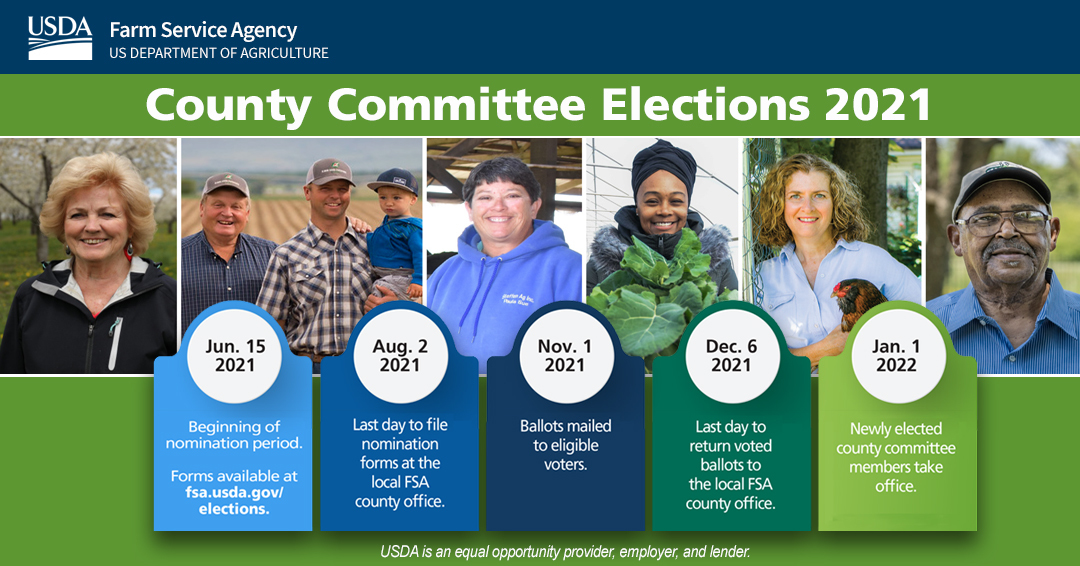
Early November: 2021 County Committee Election Ballots to be Mailed to Voters
Nov. 15: 2022 Acreage Reporting Deadline for Apiculture, Fall Wheat (Hard Red Winter), and all other Fall-Seeded Small Grains. Please note that this is the final date that FSA can accept late-filed 2021 reports for these crops.
Dec. 6: Voted FSA County Committee Election Ballots due to FSA
Dec. 31: 2022 NAP Application for Coverage Deadline for Honey
|
It’s important for agricultural producers to report losses immediately as all disaster programs are dependent on the timely reporting of the loss. A notice of loss can be filed with USDA Farm Service Agency via phone, email, fax or scheduled office visit.
-
ELAP – Emergency Assistance for Livestock, Honeybees and Farm-Raised Fish Program: Starting in 2020, producers will have 15 days from when the loss is first apparent, to file a honeybee notice of loss instead of 30 days,. This change provides consistency between ELAP and the Noninsured Crop Disaster Assistance Program, which also has a 15-day notice of loss period for honey. For other covered livestock losses, including livestock feed, grazing and farm-raised fish losses, the notice of loss deadline for ELAP will remain 30 days from when the loss is first apparent to the producer.
-
LIP - Livestock Indemnity Program: Submit Notice of Loss within 30 calendar days of when the loss is first apparent. Producers should document the adverse weather conditions and date(s) of weather events.
-
TAP - Tree Assistance Program: Final Date to Submit an Application and Supporting Documentation within 90 calendar days of: the disaster event or the date when the loss is apparent to the producer.
-
NAP – Noninsured Crop Disaster Assistance Program: Submit Notice of Loss within 15 calendar days of the earlier of a natural disaster occurrence, the final planting date if planting is prevented by a natural disaster, the date that damage to the crop or loss of production becomes apparent; or the normal harvest date. Note: A producer’s signature is required on form CCC-576 when a Notice of Loss is submitted.
Change to Policy on Filing a Notice of Loss for Grazed Forage Producers with NAP Coverage:
For the 2021 and subsequent crop years, NAP forage producers with the intended use of grazing who elect to use independent assessments or other approved alternative loss percentage methods to establish their loss are no longer required to file a CCC-576 Notice of Loss with FSA. However, a CCC-576 Application for Payment form must be submitted to FSA no later than 60 calendar days after the coverage period ends.
Producers that elect to have the grazing loss determined using similar mechanically harvested units still must timely file a CCC-576 Notice of Loss within 15 days of the disaster event or damage to the crop first becomes apparent or within 15 days of harvest.
Three More MT Counties Triggered; U.S. Drought Monitor Updated Weekly
Livestock producers in 47 Montana counties are eligible to apply for 2021 Livestock Forage Disaster Program (LFP) benefits on small grain, native pasture, improved pasture, annual ryegrass, and forage sorghum.
LFP provides compensation if you suffer grazing losses for covered livestock due to drought on privately owned or leased land or fire on federally managed land.
County committees can only accept LFP applications after notification is received by the National Office of qualifying drought or if a federal agency prohibits producers from grazing normal permitted livestock on federally managed lands due to qualifying fire.
The following 47 Montana counties have triggered the 2021 LFP drought criteria, as of July 29, 2021, Beaverhead, Big Horn, Blaine, Broadwater, Carbon, Carter, Cascade, Custer, Daniels, Dawson, Deer Lodge, Fallon, Fergus, Flathead, Gallatin, Garfield, Golden Valley, Hill, Jefferson, Judith Basin, Lewis and Clark, Liberty, Lincoln, Madison, Meagher, Mineral, McCone, Musselshell, Park, Petroleum, Phillips, Powder River, Prairie, Ravalli, Richland, Roosevelt, Rosebud, Sanders, Sheridan, Silver Bow, Stillwater, Sweet Grass, Treasure, Valley, Wheatland, Wibaux and Yellowstone. Producers must complete a CCC-853 and the required supporting documentation no later than January 31, 2022, for 2021 losses.
For additional information about LFP, including eligible livestock and fire criteria, contact the local USDA Service Center and/or visit www.farmers.gov and/or fsa.usda.gov/mt.
If you’ve incurred additional operating costs for transporting water to livestock due to an eligible drought, assistance may be available to you through the Emergency Assistance for Livestock, Honeybees and Farm-Raised Fish Program (ELAP).
An eligible drought means that part or all of your county is designated D3 (extreme drought) or higher as indicated by the U.S. Drought Monitor.
Eligible livestock must be adult or non-adult dairy cattle, beef cattle, buffalo and beefalo, as well as alpacas, deer, elk, emus, equine, goats, llamas, reindeer, or sheep. Additionally, the livestock must have been owned 60 calendar days prior to the beginning of the drought and be physically located in the county designated as a disaster area due to drought. Adequate livestock watering systems or facilities must have existed before the drought occurred and producers are only eligible if they do not normally transport water to the livestock.
Livestock that were or would have been in a feedlot are not eligible for transporting water. ELAP covers the additional cost of transporting water and does not cover the cost of the water itself.
You must file a notice of loss on form CCC-851 the earlier of 30 calendar days of when the loss is apparent to you or by Jan. 31, 2022. Additionally, the deadline to submit an application for payment for 2020 ELAP assistance is Jan. 31, 2022.
You’ll have to provide documentation to FSA that shows the method used to transport the water, the number of gallons of water transported and the number of eligible livestock to which water was transported.
To make an appointment to sign up for ELAP and to learn more about eligibility, application and documentation requirements, contact your local USDA Service Center or visit fsa.usda.gov.
USDA will accept applications for CRP Grasslands from July 12 to August 20.
USDA’s Farm Service Agency (FSA) will accept applications for CRP Grasslands from July 12 to August 20. This year, USDA updated the signup option to provide greater incentives for producers and increase its conservation benefits, including reducing the impacts of climate change.
The signup is competitive and will provide for annual rental payments for land devoted to conservation purposes.
Grasslands Signup
CRP Grasslands helps landowners and operators protect grassland, including rangeland, and pastureland and certain other lands, while maintaining the areas as grazing lands. Protecting grasslands contributes positively to the economy of many regions, provides biodiversity of plant and animal populations, and improves environmental quality.
FSA has updated the Grasslands Signup to establish a minimum rental rate of $15 per acre, as well as new National Grassland Priority Zones.
How to Sign Up
To enroll in the CRP Grasslands signup, they should contact USDA by the August 20 deadline. While USDA offices may have limited visitors because of the pandemic, Service Center staff continue to work with agricultural producers via phone, email, and other digital tools. To work with FSA, producers and landowners should contact their local USDA Service Center. Contact information can be found at farmers.gov/service-locator.
More Information on CRP
Signed into law in 1985, CRP is one of the largest voluntary private-lands conservation programs in the United States. It was originally intended to primarily control soil erosion and potentially stabilize commodity prices by taking marginal lands out of production. The program has evolved over the years, providing many conservation and economic benefits. The program marked its 35-year anniversary this past December.
CRP Grasslands Working Lands Fact Sheet
CRP Grasslands Signup 203 Ranking Factors Fact Sheet
Eligible Counties Updated Weekly
USDA Farm Service Agency announced changes for emergency haying and grazing use of acres enrolled in the Conservation Reserve Program last year. This included changes outlined in the 2018 Farm Bill that streamlines the authorization process for farmers and ranchers.
Drought conditions are tough for our livestock producers, but emergency haying and grazing use of Conservation Reserve Program acres provides temporary relief to these producers. Thanks to a streamlined authorization process, Montana producers will be able to more quickly obtain emergency use approval to begin emergency haying or grazing of CRP acres.
Program Changes
Previously emergency haying and grazing requests originated with FSA at the county level and required state and national level approval. Now approval will be based on drought severity as determined by the U.S. Drought Monitor.
To date, 56 counties in Montana have triggered eligibility for emergency haying and grazing on CRP acres. A list by state and map of eligible counties are updated weekly and available on FSA’s website.
Producers located in a county that is designated as severe drought (D2) or greater on March 1st are eligible for emergency haying and grazing on all eligible acres. Counties that trigger for Livestock Forage Disaster Program (LFP) payments based on the U.S. Drought Monitor may hay only certain practices on less than 50% of eligible contract acres. Producers should contact their local FSA county office for eligible CRP practices.
Producers who don’t meet the drought monitor qualifications but have a 40% loss of forage production may also be eligible for emergency haying and grazing outside of the primary nesting season.
CRP Emergency Haying and Grazing Provisions
Before haying or grazing eligible acres, producers must submit a request for CRP emergency haying or grazing to FSA and obtain a modified conservation plan from the Natural Resources Conservation Service.
Emergency grazing is authorized for up to 90 days and emergency haying is authorized for up to 60 days outside of the primary nesting season which is May 15-July 15. Under the emergency grazing provisions, producers can use the CRP acreage for their own livestock or may grant another livestock producer use of the CRP acreage. The eligible CRP acreage is limited to acres located within the approved county.
For emergency haying, producers are limited to one cutting and are permitted to sell the hay. Participants must remove all hay from CRP acreage within 15 days after baling and remove all livestock from CRP acreage no later than 1 day after the end of the emergency grazing period. There will be no CRP annual rental payment reduction for emergency haying and grazing authorizations.
More Information
For more information on CRP emergency haying and grazing visit fsa.usda.gov/crp or contact your FSA county office. To locate your FSA office, visit farmers.gov/service-locator. For more disaster recovery assistance programs, visit farmers.gov/recover.
CRP Haying & Grazing Fact Sheet
FSA Will Begin Accepting Applications July 22, 2021
The U.S. Department of Agriculture (USDA) is providing up to $200 million to provide relief to timber harvesting and timber hauling businesses that have experienced losses due to COVID-19 as part of USDA’s Pandemic Assistance for Producers initiative. Loggers and truckers can apply for assistance through USDA’s Farm Service Agency (FSA) July 22 through Oct. 15, 2021. The Pandemic Assistance for Timber Harvesters and Haulers program (PATHH) is administered by FSA in partnership with the U.S. Forest Service.
The Consolidated Appropriations Act, 2021, authorized this critical assistance for the timber industry. Timber harvesting and hauling businesses that have experienced a gross revenue loss of at least 10% during the period of Jan. 1 and Dec. 1, 2020, compared to the period of Jan. 1 and Dec. 1, 2019, are encouraged to apply.
Program Details
To be eligible for payments, individuals or legal entities must be a timber harvesting or timber hauling business where 50% or more of its gross revenue is derived from one or more of the following:
- Cutting timber.
- Transporting timber.
- Processing of wood on-site on the forest land (chipping, grinding, converting to biochar, cutting to smaller lengths, etc.).
Payments will be based on the applicant’s gross revenue received from Jan. 1, 2019, through Dec. 1, 2019, minus gross revenue received from Jan. 1, 2020, through Dec. 1, 2020, multiplied by 80%. FSA will issue an initial payment equal to the lesser of the calculated payment amount or $2,000 as applications are approved. A second payment will be made after the signup period has ended based upon remaining PATHH funds.
The maximum amount that a person or legal entity may receive directly is $125,000.
Applying for Assistance
Loggers and truckers can apply for PATHH beginning on July 22 by completing form FSA-1118, Pandemic Assistance for Timber Harvesters and Haulers Program application, and certifying to their gross revenue for 2019 and 2020 on the application. Additional documentation may be required. Visit farmers.gov/pathh for more information on how to apply.
Applications can be submitted to the FSA office at any USDA Service Center nationwide by mail, fax, hand delivery, or via electronic means. To find a local FSA office, loggers and truckers can visit farmers.gov/service-locator. They can also call 877-508-8364 to speak directly with a USDA employee ready to offer assistance.
FSA Began Taking Applications for Indemnity Program July 20
Livestock and poultry producers who suffered losses during the pandemic due to insufficient access to processing can apply for assistance for those losses and the cost of depopulation and disposal of the animals. The U.S. Department of Agriculture (USDA) Secretary Vilsack announced the Pandemic Livestock Indemnity Program (PLIP) in [recorded] remarks at the National Pork Industry Conference in Wisconsin Dells, WI. The announcement is part of USDA’s Pandemic Assistance for Producers initiative. Livestock and poultry producers can apply for assistance through USDA’s Farm Service Agency (FSA) July 20 through Sept. 17, 2021.
The Consolidated Appropriations Act, 2021, authorized payments to producers for losses of livestock or poultry depopulated from March 1, 2020 through December 26, 2020, due to insufficient processing access as a result of the pandemic. PLIP payments will be based on 80% of the fair market value of the livestock and poultry and for the cost of depopulation and disposal of the animal. Eligible livestock and poultry include swine, chickens and turkeys.
PLIP Program Details
Eligible livestock must have been depopulated from March 1, 2020, through December 26, 2020, due to insufficient processing access as a result of the pandemic. Livestock must have been physically located in the U.S. or a territory of the U.S. at the time of depopulation.
Eligible livestock owners include persons or legal entities who, as of the day the eligible livestock was depopulated, had legal ownership of the livestock. Packers, live poultry dealers and contract growers are not eligible for PLIP.
PLIP payments compensate participants for 80% of both the loss of the eligible livestock or poultry and for the cost of depopulation and disposal based on a single payment rate per head. PLIP payments will be calculated by multiplying the number of head of eligible livestock or poultry by the payment rate per head, and then subtracting the amount of any payments the eligible livestock or poultry owner has received for disposal of the livestock or poultry under the Natural Resources Conservation Service (NRCS) Environmental Quality Incentives Program (EQIP) or a state program. The payments will also be reduced by any Coronavirus Food Assistance Program (CFAP 1 and 2) payments paid on the same inventory of swine that were depopulated.
There is no per person or legal entity payment limitation on PLIP payments. To be eligible for payments, a person or legal entity must have an average adjusted gross income (AGI) of less than $900,000 for tax years 2016, 2017 and 2018.
Applying for Assistance
Eligible livestock and poultry producers can apply for PLIP starting July 20, 2021, by completing the FSA-620, Pandemic Livestock Indemnity Program application, and submitting it to any FSA county office. Additional documentation may be required. Visit farmers.gov/plip for a copy of the Notice of Funding Availability and more information on how to apply.
Applications can be submitted to the FSA office at any USDA Service Center nationwide by mail, fax, hand delivery or via electronic means. To find your local FSA office, visit farmers.gov/service-locator. Livestock and poultry producers can also call 877-508-8364 to speak directly with a USDA employee ready to offer assistance.
The Farm Service Agency (FSA) administers two programs that have specific safety net benefits for producers of honeybees and honey. The Noninsured Crop Disaster Assistance Program (NAP) and the Emergency Assistance for Livestock, Honeybees and Farm-Raised Fish Program (ELAP) assist producers when disasters impact honey production or damage or destroy colonies, hives or honeybee feed.
NAP is designed to reduce financial losses when natural disasters result in lower yields or crop losses, including honey. NAP coverage is equivalent to catastrophic insurance, meaning it covers up to 50 percent of a producer’s normal yield (must have at least a 50 percent loss) at 55 percent of the average market price. The 2018 Farm Bill reinstates higher levels of coverage, from 50 to 65 percent of expected production in 5 percent increments, at 100 percent of the average market price. Producers of organics and crops marketed directly to consumers also may exercise the “buy-up” option to obtain NAP coverage of 100 percent of the average market price at the coverage levels of between 50 and 65 percent of expected production.
The NAP service fee is the lesser of $325 per crop or $825 per producer per administrative county, not to exceed a total of $1,950 for a producer with farming interests in multiple counties.
You must apply for NAP coverage by Dec. 31 prior to the year for which you’re seeking coverage.
ELAP covers colony losses, honeybee hive losses (the physical structure) and honeybee feed losses in instances where the colony, hive or feed has been destroyed by a natural disaster or, in the case of colony losses, because of Colony Collapse Disorder. Colony losses must be in excess of normal mortality.
Both the NAP and ELAP programs require you to report the number of colonies you have in production to FSA by Jan. 2, 2022. You must notify FSA within 30 calendar days of changes in the total number of colonies or when honeybees are moved to another county.
For both programs, you must notify FSA within 15 calendar days of when a loss occurs or from when the loss is apparent.
To learn more about programs for honey and honeybee producers, contact your FSA service center or visit fsa.usda.gov.
U.S. Department of Agriculture (USDA) is providing $67 million in competitive loans through the new Heirs’ Property Relending Program (HPRP), which aims to help agricultural producers and landowners resolve heirs’ land ownership and succession issues. Intermediary lenders -- cooperatives, credit unions, and nonprofit organizations – can apply for loans up to $5 million at 1% interest once the Farm Service Agency (FSA) opens the two-month signup window in late August.
After FSA selects lenders, heirs can apply directly to those lenders for loans and assistance. Heirs’ property issues have long been a barrier for many producers and landowners to access USDA programs and services, and this relending program provides access to capital to help producers find a resolution to these issues.
The Heirs’ Property Relending Program is another example of how USDA is working to rebuild trust with America’s farmers and ranchers. HPRP is a loan and will need to be repaid as directed by the 2018 Farm Bill.
The program’s benefits go far beyond its participants. It will also keep farmland in farming, protect family farm legacies and support economic viability.
Eligible Lenders
To be eligible, intermediary lenders must be certified as a community development financial institution and have experience and capability in making and servicing agricultural and commercial loans that are similar in nature.
If applications exceed the amount of available funds, those applicants with at least 10 years or more of experience with socially disadvantaged farmers that are located in states that have adopted a statute consisting of enactment or adoption of the Uniform Partition of Heirs Property Act (UPHPA) will receive first preference. A list of these states is available at farmers.gov/heirs/relending. A secondary preference tier is established for those that have applications from ultimate recipients already in process, or that have a history of successfully relending previous HPRP funds. When multiple applicants are in the same tier, or there are no applicants in tier 1 or 2, applications will be funded in order of the date the application was received.
Selected intermediary lenders will determine the rates, terms, and payment structure for loans to heirs. Interest rates will be the lowest rate sufficient for intermediaries to cover cost of operating and sustaining the loan.
Additional information for lenders, including how to apply for funding, can be found in the HPRP final rule (PDF, 387 KB). A webinar will be held Tuesday, August 3, 2021 regarding applying for funding. Interested re-lenders should register through the
Relending to Heirs
Heirs may use the loans to resolve title issues by financing the purchase or consolidation of property interests and financing costs associated with a succession plan. This may also include costs and fees associated with buying out fractional interests of other heirs in jointly-owned property to clear the title, as well as closing costs, appraisals, title searches, surveys, preparing documents, mediation, and legal services.
Heirs may not use loans for any land improvement, development purpose, acquisition or repair of buildings, acquisition of personal property, payment of operating costs, payment of finders’ fees, or similar costs.
Intermediary lenders will make loans to heirs who:
- Are individuals or legal entities with authority to incur the debt and to resolve ownership and succession of a farm owned by multiple owners;
- Are a family member or heir-at-law related by blood or marriage to the previous owner of the property;
- Agree to complete a succession plan.
More information on how heirs can borrow from lenders under HPRP will be available in the coming months.
More Information
Heirs’ property is a legal term that refers to family land inherited without a will or legal documentation of ownership. It has historically been challenging for heirs to benefit from USDA programs because of the belief that they cannot get a farm number without proof of ownership or control of land. However, FSA provides alternative options that allow an heir to obtain a farm number. In states that have adopted the UPHPA, producers may provide specific documents to receive a farm number. To learn more about heirs property, HPRP, or UPHPA, visit farmers.gov/heirs/relending.
Guaranteed Conservation Loans are available for applicants to install a conservation practice. These funds may be used for any conservation activities included in a conservation plan or Forest Stewardship Management plan. A copy of the conservation plan is required to complete the application. These loans are not limited to just family farmers. In some cases, applicants can operate non-eligible enterprises. Loan funds are issued by a participating commercial lender and guaranteed up to 80 percent by FSA or up to 90 percent for beginning and historically underserved producers.
FSA’s Emergency Loan Program is available for agricultural producers in counties designated as primary or contiguous natural disaster areas. See map below of current Disaster Designations in Montana. Contact your local FSA office for specific designations in your area and time frames to apply. Eligible producers have eight months from the date of the disaster designation to apply for low-interest emergency loans to 1.) restore or replace essential property; 2.) pay all or part of production costs associated with the disaster year; 3.) pay essential family living expenses; or 4.) refinance certain debts, excluding real estate. Producers interested in applying for an emergency loan, or other FLP loans, should contact their local FSA office to set up an appointment with the Farm Loan Program staff serving your area.
FSA and RMA jointly support the prevention of fraud, waste and abuse of the Federal Crop Insurance Program. FSA has been, and will continue to, assist RMA and insurance providers by monitoring crop conditions throughout the growing season. FSA will continue to refer all suspected cases of fraud, waste and abuse directly to RMA. Producers can report suspected cases to the county office staff, the RMA office or the Office of the Inspector General.
Montana State University Extension and an associated statewide advisory council have developed an online clearinghouse of resources for a wide range of topics related to stress and mental health. The clearinghouse was created specifically for ag producers and their families, but it contains a wealth of information for anyone interested in learning more about causes of stress, stress prevention and management, and overall mental health. To access the site, please click on this link: https://msuextension.org/wellness/stress-management/mt_farm_stress_clearing_house/
|