By: Shelby Parker-Gonzales county NRCS
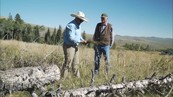
Land management can have a significant effect on how the land responds to rain, or the lack thereof. The trip a raindrop takes from the cloud to the soil can be highly impacted by grazing management. Raindrops that fall on unprotected soil cause tiny explosions, dislodging microscopic soil particles in every direction. This dislodging of soil matter is the beginning step to erosion.
Rain that falls on hard, bare ground will likely run off before it infiltrates. In this case, the land is no better off after a rain than it was before; because no water has infiltrated into the soil profile where it can be used to grow grass and other forage species. With no roots to hold it together, fertile topsoil will be washed away, further degrading the potential for that land to be productive. Raindrops can be intercepted by vegetative matter, in the rancher’s case, primarily grass. The more forage matter, or grass, that is present on the ground, the more likely the raindrop will be intercepted and slow its’ impact with the soil. This will protect the soil below from disruption. The slower the raindrop, the higher the likelihood it will be absorbed into the ground, where it can be used for greater forage production.
High stocking rates, or number of cattle on a given area of land for a given period, can lead to a decrease in forage productivity and increase in bare ground without providing adequate rest and recovery. This bare ground will be subject to erosion and will not aid in capturing rain that falls on your land. Grasses slow rainfall impact above ground and their roots create channels for rain to infiltrate into the soil.
Dead plant material will become part of the soil profile, known as organic material. The higher the proportion of organic material in the soil, the more water it can hold. While it may seem like a waste to leave plant material un-grazed, it is helping your grass production in the long run. Good rangeland management cannot be bought in a 50-pound bag or a lick tub. If your property is experiencing bare ground and low drought resiliency, strongly consider reducing cattle numbers and look at a good rotational grazing program to help your property become more productive. Healthier rangelands produce healthier cows, which wean heavier calves. While lower cattle numbers will reduce gross income from a reduced calf crop, your feed bill will also likely be reduced. If you feel like your property is constantly undergoing repeated small droughts, it could be a result of degraded soil. Help your soil help you by reducing cattle numbers. Your soil will thank you, your cattle will thank you, and your wallet will thank you.
|
The USDA Natural Resources Conservation Service (NRCS) is currently hiring several different field positions across Texas. Positions include soil conservationists, rangeland management specialists, soil scientists, and engineers.
Direct hire positions open in Texas can be found on USAJobs . Applications will be accepted until August 4, 2021. For more information, contact Tony Townsend at 254-742-9935 or tony.townsend@usda.gov.
The USDA NRCS works in close partnership with farmers, ranchers, forest managers, non-governmental organizations, local and state governments, and other federal agencies to create and maintain healthy and productive working landscapes.
As part of USDA’s new Farm Production and Conservation (FPAC) Mission Area, NRCS has 3,000 locations and covers every county in the United States. NRCS employees help stewards of agricultural lands and non-industrial private forest lands plan and implement proven conservation systems through technical and financial assistance designed to enhance productivity, improve soil and water health, and restore wetlands and wildlife habitat.
USDA’s Farm Service Agency (FSA) will broaden the use of the Disaster Set-Aside (DSA) loan provision, normally used in the wake of natural disasters, to allow farmers with USDA farm loans who are affected by COVID-19, and are determined eligible, to have their next payment set aside. In some cases, FSA may also set aside a second payment for farmers who have already had one payment set aside because of a prior designated disaster.
FSA direct loan borrowers will receive a letter with the details of the expanded Disaster Set-Aside authorities, which includes the possible set-aside of annual operating loans, as well as explanations of the additional loan servicing options that are available. To discuss or request a loan payment Set-Aside, borrowers should call or email the farm loan staff at their local FSA county office.
The set-aside payment’s due date is moved to the final maturity date of the loan or extended up to twelve months in the case of an annual operating loan. Any principal set-aside will continue to accrue interest until it is repaid. This aims to improve the borrower’s cashflow in the current production cycle.
FSA previously announced it was relaxing the loan-making process and adding flexibilities for servicing direct and guaranteed loans to provide credit to producers in need. Direct loan applicants and borrowers are encouraged to contact their local FSA county office to discuss loan making and servicing flexibilities and other needs or concerns. Customers participating in FSA’s guaranteed loan programs are encouraged to contact their lender. Information on these flexibilities, and office contact information, can be found on farmers.gov/coronavirus.
FSA will be accepting most forms and applications by facsimile or electronic signature. Some services are also available online to customers with an eAuth account, which provides access to the farmers.gov portal where producers can view USDA farm loan information and certain program applications and payments. Customers can track payments, report completed practices, request conservation assistance and electronically sign documents. Customers who do not already have an eAuth account can enroll at farmers.gov/sign-in.
|