In This Issue:
Kevin Bohon, Acting State Executive Director of Virginia, would like to inform producers of two new pandemic assistance programs that were recently announced: The Pandemic Livestock Indemnity Program (PLIP) and Pandemic Assistance for Timber Harvesters and Haulers (PATHH) Program.
PLIP provides assistance for losses of livestock and poultry depopulated from March 1, 2020, through December 26, 2020, due to insufficient processing access during the COVID-19 pandemic, and for the cost of depopulation and disposal. County Offices will accept PLIP applications (FSA-620) July 20, 2021, through September 17, 2021, from persons or legal entities that depopulated livestock or poultry from March 1, 2020, through December 26, 2020.
PATHH provides assistance for timber harvesting and timber hauling businesses impacted by the effects of COVID-19 during a portion of calendar year 2020. FSA is implementing PATHH as authorized by the Consolidated Appropriations Act, 2021 (Pub. L. 116-260). County Offices will accept 2020 PATHH applications (FSA-1118) July 22, 2021, through October 15, 2021.
County Office Operations: All FSA service Centers are currently operating at up to 75% office staffing capacity and may accept visitors by appointment only. To make an appointment, contact your local service center. FSA offers alternative methods for conducting business with the local FSA offices in addition to our traditional methods of post mail and drop boxes. Alternative methods include telephonic and virtual appointments; FSA also accepts signatures on applications and many other required documents through FAX, e-mail, OneSpan, and BOX. To learn more about alternative methods of conducting business with FSA and Service center status, visit Farmers.gov.
Chattel Security Inspections: The end of the Fiscal Year is approaching for FSA, which means Agency officials will be making routine farm visits to inspect our borrowers’ chattel security—meaning crops, machinery/equipment, and livestock. Be on the lookout for requests to schedule farm visits. If you are contacted, please try to consolidate the security location(s) as able so the inspections can be completed as efficiently as possible. Your cooperation is appreciated!
Office Closures Sep 6 All Offices Closed for Labor Day Holiday
One phrase I’ve caught myself using over and over this summer is “It’s great to see you!”
As I joined most of the Virginia NRCS team in making a gradual return to the field and to in-person meetings and events, I’ve had many welcome reminders of just how valuable these face-to-face contacts can be. I’ve always found personal interactions to be important in developing the trust-based relationships that are essential to the successful completion of our numerous mission and outreach activities. As a relative newcomer to Virginia, I’ve also taken advantage of invaluable opportunities to learn about our state’s diverse agricultural enterprises through farm visits and meetings with district staff and conservation partners. I am certainly very appreciative of those invitations.
I’ve now gotten a closer look at some of these enterprises and innovative approaches that range from precision agriculture on cropland, to new ideas for sustaining and increasing our oyster populations under water. We recently welcomed USDA leadership to the state for two small but significant events highlighting opportunities available for Virginia producers through the American Jobs Plan. Dr. Jewel Bronaugh made her first official appearance as deputy secretary to discuss debt relief at VSU and Secretary Tom Vilsack stopped in Amelia County to highlight rural broadband. I also thoroughly enjoyed expanding our “circle of friends” at VSU’s Field Day at Randolph Farm on July 30.
I can’t conclude without thanking Virginia FSA staff for being uniformly helpful and cooperative as both our agencies move toward a return to normal operations with an emphasis on teamwork. While the COVID pandemic has not gone away and we need to stay safe, it’s been wonderful to see everyone coming back together again.
Be sure to check out our article below on how conservation supports organic production in the commonwealth.
Dr. Edwin Martinez Martinez, State Conservationist
Hurricane season is underway, and it lasts until November 30. The National Oceanic and Atmospheric Administration (NOAA) predicts that the 2021 hurricane season will be above normal in the Atlantic and produce 13 to 20 named storms with six to 10 hurricanes and three to five major hurricanes. The eastern Pacific hurricane season will produce 12 to 18 named storms, with five to 10 hurricanes and two to five major hurricanes.
USDA is here to help you prepare for and recover from hurricane events.
Take precautions to prepare and protect your family and operation.
-
Develop an Emergency Plan - Ensure your household and employees know your hurricane plan, including meeting points, emergency contact lists, and alternate evacuation routes in case infrastructure is damaged.
-
Remove Debris and Secure Large Objects - Clean out culverts, ditches, and other drainage areas, especially before and during peak hurricane season to reduce water damage. Most injuries to animals, people, or structures during a hurricane are caused by flying objects. To lessen the risk, minimize the presence of equipment, supplies, and debris that may become airborne during high winds or encountered in floodwaters.
-
Secure Important Records and Documents - Pre- and post-hurricane documentation is extremely important for insurance compensation and recovery assistance. You’ll want to have thorough records of damages and losses sustained on your farm as well as documentation of your cleanup and recovery efforts.
It is critical to document inventory of farm buildings, vehicles, equipment, and livestock before a disaster occurs. Take photos, videos, or make written lists with descriptions. Keep copies of this inventory in multiple places: computer, off-site in a safe location, and on a cloud-based server where information is transmitted and saved weekly.
-
Know Your Insurance Options - Regularly review your insurance policies with your agent to be sure you have adequate coverage, including flood insurance, for your facilities, vehicles, farm buildings, crops and livestock. Note, there are limitations on how soon insurance coverage will take effect. Generally, insurance policies will not cover damage if the policy was not in place before a disaster.
For counties within or adjacent to the area of sustained hurricane-force winds, the Risk Management Agency’s (RMA) Hurricane Insurance Protection – Wind Index (HIP-WI) covers a portion of your underlying crop insurance policy’s deductible. HIP-WI covers 70 crops and is available in counties near the Gulf of Mexico, the Atlantic, and Hawaii.
-
Gather Supplies - Have drinking water, canned food, a generator, batteries, a flashlight, and fuel available in case you lose power. For widespread outages, credit and debit cards may not work, so have cash handy.
-
Access Real-time Emergency Information - Download the FEMA app for free on the App Store and Google Play for safety tips on what to do before, during, and after disasters.
Learn more about how USDA can help you recover.
Are drought conditions affecting your agricultural operation? The U.S. Drought Monitor (USDM) is a resource producers can use to help determine how to best respond and react to a drought as it develops or lingers.
The USDM is an online, weekly map showing the location, extent, and severity of drought across the United States. It categorizes the entire country as being in one of six levels of drought. The map is released on Thursdays and depicts conditions for the week.
The USDM provides producers with the latest information about drought conditions where they live, enabling producers to best respond and react to a drought as it develops or lingers. In some cases, the USDM may help a producer make specific decisions about their operation, such as reducing the stocking rate because forage is not growing. For others, it may provide a convenient big-picture snapshot of broader environmental conditions.
The USDM incorporates varying data – rain, snow, temperature, streamflow, reservoir levels, soil moisture, and more – as well as first-hand information submitted from on-the-ground sources such as photos, descriptions, and experiences. The levels of drought are connected to the frequency of occurrence across several different drought indicators. What makes the USDM unique is that it is not a strictly numeric product. The mapmakers rely on their judgment and a nationwide network of 450-plus experts to interpret conditions for each region. They synthesize their discussion and analysis into a single depiction of drought for the entire country.
USDA uses the Drought Monitor to determine a producer’s eligibility for certain drought assistance programs, like the Livestock Forage Disaster Program and Emergency Haying or Grazing on Conservation Reserve Program acres.
Additionally, the Farm Service Agency uses the Drought Monitor to trigger and “fast track” Secretarial Disaster Designations which then provides producers impacted by drought access to emergency loans that can assist with credit needs.
Learn more about the U.S. Drought Monitor.
Farmers and ranchers working with USDA’s Farm Service Agency or Natural Resources Conservation Service can now sign and share documents online in just a few clicks. By using Box or OneSpan, producers can digitally complete business transactions without leaving their homes or agricultural operations. Both services are free, secure, and available for multiple FSA and NRCS programs.
Box is a secure, cloud-based site where FSA or NRCS documents can be managed and shared. Producers who choose to use Box can create a username and password to access their secure Box account, where documents can be downloaded, printed, manually signed, scanned, uploaded, and shared digitally with Service Center staff. This service is available to any FSA or NRCS customer with access to a mobile device or computer with printer connectivity.
OneSpan is a secure eSignature solution for FSA and NRCS customers. Like Box, no software downloads or eAuthentication is required for OneSpan. Instead, producers interested in eSignature through OneSpan can confirm their identity through two-factor authentication using a verification code sent to their mobile device or a personalized question and answer. Once identity is confirmed, documents can be reviewed and e-signed through OneSpan via the producer’s personal email address. Signed documents immediately become available to the appropriate Service Center staff.
Box and OneSpan are both optional services for customers interested in improved efficiency in signing and sharing documents with USDA, and they do not replace existing systems using eAuthentication for digital signature. Instead, these tools provide additional digital options for producers to use when conducting business with FSA or NRCS.
USDA Service Center staff are available to help producers get started with Box and OneSpan through a few simple steps. Please visit farmers.gov/service-locator to find your local office and let Service Center staff know you’re interested in signing and sharing documents through these new features. In most cases, one quick phone call will be all that is needed to initiate the process.
Visit farmers.gov/mydocs to learn more about Box and OneSpan, steps for getting started, and additional resources for conducting business with USDA online.
To learn more about program flexibilities and Service Center status during the coronavirus pandemic, visit farmers.gov/coronavirus.
The U.S. Department of Agriculture (USDA) is providing up to $200 million to provide relief to timber harvesting and timber hauling businesses that have experienced losses due to COVID-19 as part of USDA’s Pandemic Assistance for Producers initiative. Loggers and truckers can apply for assistance through USDA’s Farm Service Agency (FSA) July 22 through Oct. 15, 2021. The Pandemic Assistance for Timber Harvesters and Haulers program (PATHH) is administered by FSA in partnership with the U.S. Forest Service.
The Consolidated Appropriations Act, 2021, authorized this critical assistance for the timber industry. Timber harvesting and hauling businesses that have experienced a gross revenue loss of at least 10% during the period of Jan. 1 and Dec. 1, 2020, compared to the period of Jan. 1 and Dec. 1, 2019, are encouraged to apply.
Program Details
To be eligible for payments, individuals or legal entities must be a timber harvesting or timber hauling business where 50% or more of its gross revenue is derived from one or more of the following:
- Cutting timber.
- Transporting timber.
- Processing of wood on-site on the forest land (chipping, grinding, converting to biochar, cutting to smaller lengths, etc.).
Payments will be based on the applicant’s gross revenue received from Jan. 1, 2019, through Dec. 1, 2019, minus gross revenue received from Jan. 1, 2020, through Dec. 1, 2020, multiplied by 80%. FSA will issue an initial payment equal to the lesser of the calculated payment amount or $2,000 as applications are approved. A second payment will be made after the signup period has ended based upon remaining PATHH funds.
The maximum amount that a person or legal entity may receive directly is $125,000.
Applying for Assistance
Loggers and truckers can apply for PATHH beginning on July 22 by completing form FSA-1118, Pandemic Assistance for Timber Harvesters and Haulers Program application, and certifying to their gross revenue for 2019 and 2020 on the application. Additional documentation may be required. Visit farmers.gov/pathh for more information on how to apply.
Applications can be submitted to the FSA office at any USDA Service Center nationwide by mail, fax, hand delivery, or via electronic means. To find a local FSA office, loggers and truckers can visit farmers.gov/service-locator. They can also call 877-508-8364 to speak directly with a USDA employee ready to offer assistance.
Livestock and poultry producers who suffered losses during the pandemic due to insufficient access to processing can apply for assistance for those losses and the cost of depopulation and disposal of the animals. The U.S. Department of Agriculture (USDA) Secretary Vilsack announced the Pandemic Livestock Indemnity Program (PLIP) in [recorded] remarks at the National Pork Industry Conference in Wisconsin Dells, WI. The announcement is part of USDA’s Pandemic Assistance for Producers initiative. Livestock and poultry producers can apply for assistance through USDA’s Farm Service Agency (FSA) July 20 through Sept. 17, 2021.
The Consolidated Appropriations Act, 2021, authorized payments to producers for losses of livestock or poultry depopulated from March 1, 2020 through December 26, 2020, due to insufficient processing access as a result of the pandemic. PLIP payments will be based on 80% of the fair market value of the livestock and poultry and for the cost of depopulation and disposal of the animal. Eligible livestock and poultry include swine, chickens and turkeys.
PLIP Program Details
Eligible livestock must have been depopulated from March 1, 2020, through December 26, 2020, due to insufficient processing access as a result of the pandemic. Livestock must have been physically located in the U.S. or a territory of the U.S. at the time of depopulation.
Eligible livestock owners include persons or legal entities who, as of the day the eligible livestock was depopulated, had legal ownership of the livestock. Packers, live poultry dealers and contract growers are not eligible for PLIP.
PLIP payments compensate participants for 80% of both the loss of the eligible livestock or poultry and for the cost of depopulation and disposal based on a single payment rate per head. PLIP payments will be calculated by multiplying the number of head of eligible livestock or poultry by the payment rate per head, and then subtracting the amount of any payments the eligible livestock or poultry owner has received for disposal of the livestock or poultry under the Natural Resources Conservation Service (NRCS) Environmental Quality Incentives Program (EQIP) or a state program. The payments will also be reduced by any Coronavirus Food Assistance Program (CFAP 1 and 2) payments paid on the same inventory of swine that were depopulated.
There is no per person or legal entity payment limitation on PLIP payments. To be eligible for payments, a person or legal entity must have an average adjusted gross income (AGI) of less than $900,000 for tax years 2016, 2017 and 2018.
Applying for Assistance
Eligible livestock and poultry producers can apply for PLIP starting July 20, 2021, by completing the FSA-620, Pandemic Livestock Indemnity Program application, and submitting it to any FSA county office. Additional documentation may be required. Visit farmers.gov/plip for a copy of the Notice of Funding Availability and more information on how to apply.
Applications can be submitted to the FSA office at any USDA Service Center nationwide by mail, fax, hand delivery or via electronic means. To find your local FSA office, visit farmers.gov/service-locator. Livestock and poultry producers can also call 877-508-8364 to speak directly with a USDA employee ready to offer assistance.
The Noninsured Crop Disaster Assistance Program (NAP) provides financial assistance to you for crops that aren’t eligible for crop insurance to protect against lower yields or crops unable to be planted due to natural disasters including freeze, hail, excessive moisture, excessive wind or hurricanes, flood, excessive heat and qualifying drought (includes native grass for grazing), among others.
In order to participate, you must obtain NAP coverage for the crop year by the applicable deadline using form CCC-471 “Application for Coverage” and pay the service fee. Application closing dates vary by crop. Producers are also required to submit an acceptable crop acreage report. Additionally, NAP participants must provide:
- The quantity of all harvested production of the crop in which the producer held an interest during the crop year
- The disposition of the harvested crop, such as whether it is marketable, unmarketable, salvaged or used differently than intended
- Acceptable crop production records (when requested by FSA)
Producers who fail to report acreage and production information for NAP-covered crops could see reduced or zero NAP assistance. These reports are used to calculate the approved yield.
If your NAP-covered crops are affected by a natural disaster, notify your FSA office by completing Part B of form CCC-576 “Notice of Loss and Application for Payment.” This must be completed within 15 calendar days of the occurrence of the disaster or when losses become apparent or 15 days of the final harvest date. For hand-harvested crops and certain perishable crops, you must notify FSA within 72 hours of when a loss becomes apparent.
To receive benefits, you must also complete Parts D, E, F and G of the CCC-576 “Notice of Loss and Application for Payment” within 60 days of the last day of coverage for the crop year for any NAP covered crops. The CCC-576 requires acceptable appraisal information. Producers must provide evidence of production and note whether the crop was marketable, unmarketable, salvaged or used differently than intended.
Eligible crops must be commercially produced agricultural commodities for which crop insurance is not available, including perennial grass forage and grazing crops, fruits, vegetables, mushrooms, floriculture, ornamental nursery, aquaculture, turf grass, ginseng, honey, syrup, bioenergy, and industrial crops.
For more information on NAP, visit fsa.usda.gov/nap.
In response to catastrophic aquaculture losses due to major winter storms that hit states along the U.S. Gulf Coast including Virginia in February, the U.S. Department of Agriculture’s (USDA) Farm Service Agency (FSA) today announced a policy change that makes food fish and other aquatic species eligible for the Emergency Assistance for Livestock, Honey Bees and Farm-raised Fish Program (ELAP). Previously, only farm-raised game and bait fish were eligible for death loss ELAP benefits. Beginning June 1, eligible aquaculture producers can request ELAP assistance for 2021 losses. This policy change is for the 2021 and subsequent program years.
ELAP provides financial assistance to eligible producers of livestock, honeybees and farm-raised fish for losses due to disease, certain adverse weather events or loss conditions, including blizzards and wildfires, as determined by the Secretary.
To be eligible, losses must have occurred on or after Jan. 1, 2021. For farm-raised fish and other aquatic species death losses only that occurred prior to June 1, 2021, FSA is waiving the requirement to file a notice of loss within 30 calendar days of when the loss is apparent. An aquaculture producer will still need to be able to provide contemporaneous records upon request to document the eligible loss event and demonstrate the beginning and ending inventory. The deadline to file an application for payment for the 2021 program year is Jan. 31, 2022.
Producers must provide acreage reports for the surface acres of water where their aquatic species are raised. Acreage reports for 2021 must be filed by Sept. 30, 2022.
More Information
USDA offers a comprehensive portfolio of disaster assistance programs. On farmers.gov, the Disaster Assistance Discovery Tool, Disaster-at-a-Glance fact sheet, and Farm Loan Discovery Tool can help producers and landowners determine all program or loan options available for disaster recovery assistance. For assistance with a crop insurance claim, producers and landowners should contact their crop insurance agent. For FSA and NRCS programs, they should contact their local USDA Service Center.
Using the correct signature when doing business with FSA can save time and prevent a delay in program benefits.
The following are FSA signature guidelines:
- A married woman must sign her given name: Mrs. Mary Doe, not Mrs. John Doe
- For a minor, FSA requires the minor's signature and one from the minor’s parent
Note, by signing a document with a minor, the parent is liable for actions of the minor and may be liable for refunds, liquidated damages, etc.
When signing on one’s behalf the signature must agree with the name typed or printed on the form or be a variation that does not cause the name and signature to be in disagreement. Example - John W. Smith is on the form. The signature may be John W. Smith or J.W. Smith or J. Smith. Or Mary J. Smith may be signed as Mrs. Mary Joe Smith, M.J. Smith, Mary Smith, etc.
FAXED signatures will be accepted for certain forms and other documents provided the acceptable program forms are approved for FAXED signatures. Producers are responsible for the successful transmission and receipt of FAXED information.
Examples of documents not approved for FAXED signatures include:
- Promissory note
- Assignment of payment
- Joint payment authorization
- Acknowledgement of commodity certificate purchase
Spouses may sign documents on behalf of each other for FSA and CCC programs in which either has an interest, unless written notification denying a spouse this authority has been provided to the county office.
Spouses cannot sign on behalf of each other as an authorized signatory for partnerships, joint ventures, corporations or other similar entities. Likewise, a spouse cannot sign a document on behalf of the other in order to affirm the eligibility of oneself.
Any member of a general partnership can sign on behalf of the general partnership and bind all members unless the Articles of Partnership are more restrictive. Spouses may sign on behalf of each other’s individual interest in a partnership, unless notification denying a spouse that authority is provided to the county office. Acceptable signatures for general partnerships, joint ventures, corporations, estates, and trusts must consist of an indicator “by” or “for” the individual’s name, individual’s name and capacity, or individual’s name, capacity, and name of entity.
For additional clarification on proper signatures contact your local FSA office.
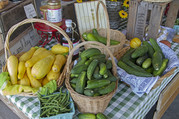
Consumer demand is high for products that carry the organic seal and the industry is growing every year. Organic farms support a more than a $50 billion industry in the United States by employing practices that foster the cycling of resources, promote ecological balance and foster biodiversity. These operators limit applications of synthetic fertilizers and pesticides and do not use sewage sludge, irradiation or genetic engineering.
USDA’s National Organic Program sets the standards for organic production and handling, and NRCS provides financial and technical assistance via the Environmental Quality Incentives Program and Conservation Stewardship Program to assist these operations and those wanting to transition to organic production. NRCS can help you develop conservation and conservation activity plans (also known as transition to organic plans), which may include establishing buffers, improving soil quality, reducing soil erosion and pests and improving irrigation efficiency.
When certified organic and transitioning organic producers use conservation practices on their operations, the benefits extend beyond producing quality fruits, vegetables and meat on their farms or ranches. These practices can also lead to cleaner water and air, healthier soil and habitat for birds, bees and other pollinators.
Contact your local USDA Service Center for more information on financial and technical assistance available for organic production. Visit farmers.gov to find the NRCS office nearest you.
|
FSA guaranteed loans allow lenders to provide agricultural credit to farmers who do not meet the lender's normal underwriting criteria. Farmers and ranchers apply for a guaranteed loan through a lender, and the lender arranges for the guarantee. FSA can guarantee up to 95 percent of the loss of principal and interest on a loan. Guaranteed loans can be used for both farm ownership and operating purposes.
Guaranteed farm ownership loans can be used to purchase farmland, construct or repair buildings, develop farmland to promote soil and water conservation or to refinance debt.
Guaranteed operating loans can be used to purchase livestock, farm equipment, feed, seed, fuel, farm chemicals, insurance and other operating expenses.
FSA can guarantee farm ownership and operating loans up to $1,776,000. Repayment terms vary depending on the type of loan, collateral and the producer's ability to repay the loan. Operating loans are normally repaid within seven years and farm ownership loans are not to exceed 40 years.
For more information on guaranteed loans, contact your County USDA Service Center or visit fsa.usda.gov.
The Farm Service Agency (FSA) assists beginning farmers to finance agricultural enterprises. Under these designated farm loan programs, FSA can provide financing to eligible applicants through either direct or guaranteed loans. FSA defines a beginning farmer as a person who:
- Has operated a farm for not more than 10 years
- Will materially and substantially participate in the operation of the farm
- Agrees to participate in a loan assessment, borrower training and financial management program sponsored by FSA
- Does not own a farm in excess of 30 percent of the county’s average size farm.
For more information contact, contact your County USDA Service Center or visit fsa.usda.gov.
Farm loan borrowers who have pledged chattel as security for their Farm Service Agency (FSA) direct or guaranteed loans are responsible for maintaining loan collateral. Borrowers must obtain prior consent or approval from FSA or the guaranteed lender for any transaction that affects chattel security. These transactions include, but are not limited to:
- Equipment
- Livestock
- Crops
Failure to meet or follow the requirements in the loan agreement, promissory note, and other security instruments could lead to nonmonetary default which could jeopardize your current and future loans.
|
90-Day Treasury Bill
|
0.125%
|
|
Farm Operating Loans — Direct
|
1.75%
|
|
Farm Ownership Loans — Direct
|
3.25%
|
|
Farm Ownership Loans — Direct Down Payment, Beginning Farmer or Rancher
|
1.50%
|
|
Emergency Loans
|
2.75%
|
|
Farm Storage Facility Loans
(7 years)
|
1.125%
|
|
Commodity Loans 1996-Present
|
1.125%
|
|
9/15
|
Acreage Reporting Deadline for Beans, planted 7/15-9/5
|
|
9/30
|
2022 NAP Coverage Sales Closing Date for value loss crops and small grains
|
|
10/12
|
2021 DMC Registration Begins
|
|