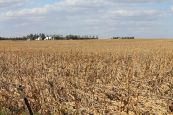
Severe weather events create significant challenges and often result in catastrophic loss for agricultural producers. Despite every attempt to mitigate risk, your operation may suffer losses. USDA offers several programs to help with recovery.
Risk Management
For producers who have risk protection through Federal Crop Insurance or the Noninsured Crop Disaster Assistance Program (NAP), we want to remind you to report crop damage to your crop insurance agent or the local Farm Service Agency (FSA) office.
If you have crop insurance, contact your agency within 72 hours of discovering damage and be sure to follow up in writing within 15 days. If you have NAP coverage, file a Notice of Loss (also called Form CCC-576) within 15 days of loss becoming apparent, except for hand-harvested crops, which should be reported within 72 hours.
Disaster Assistance
USDA also offers disaster assistance programs, which is especially important to livestock, fruit and vegetable, specialty and perennial crop producers who have fewer risk management options.
First, the Livestock Indemnity Program (LIP) and Emergency Assistance for Livestock, Honeybee and Farm-raised Fish Program (ELAP) reimburses producers for a portion of the value of livestock, poultry and other animals that died as a result of a qualifying natural disaster event or for loss of grazing acres, feed and forage. And, the Livestock Forage Disaster Program (LFP) provides assistance to producers of grazed forage crop acres that have suffered crop loss due to a qualifying drought. Livestock producers suffering the impacts of drought can also request Emergency Haying and Grazing on Conservation Reserve Program (CRP) acres.
Next, the Tree Assistance Program (TAP) provides cost share assistance to rehabilitate and replant tree, vines or shrubs loss experienced by orchards and nurseries. This complements NAP or crop insurance coverage, which cover the crop but not the plants or trees in all cases.
For LIP and ELAP, you will need to file a Notice of Loss for livestock and grazing or feed losses within 30 days and honeybee losses within 15 days. For TAP, you will need to file a program application within 90 days.
Documentation
It’s critical to keep accurate records to document all losses following this devastating cold weather event. Livestock producers are advised to document beginning livestock numbers by taking time and date-stamped video or pictures prior to after the loss.
Other common documentation options include:
- Purchase records
- Production records
- Vaccination records
- Bank or other loan documents
- Third-party certification
Other Programs
The Emergency Conservation Program and Emergency Forest Restoration Program can assist landowners and forest stewards with financial and technical assistance to restore damaged farmland or forests.
Additionally, FSA offers a variety of loans available including emergency loans that are triggered by disaster declarations and operating loans that can assist producers with credit needs. You can use these loans to replace essential property, purchase inputs like livestock, equipment, feed and seed, or refinance farm-related debts, and other needs.
Meanwhile, USDA’s Natural Resources Conservation Service (NRCS) provides financial resources through its Environmental Quality Incentives Program to help with immediate needs and long-term support to help recover from natural disasters and conserve water resources. Assistance may also be available for emergency animal mortality disposal from natural disasters and other causes.
Additional Resources
Additional details – including payment calculations – can be found on our NAP, ELAP, LIP, and TAP fact sheets. On farmers.gov, the Disaster Assistance Discovery Tool, Disaster-at-a-Glance fact sheet, and Farm Loan Discovery Tool can help you determine program or loan options.
While we never want to have to implement disaster programs, we are here to help. To file a Notice of Loss or to ask questions about available programs, contact your local USDA Service Center. All USDA Service Centers are open for business, including those that restrict in-person visits or require appointments because of the pandemic.
|

Are you a military veteran interested in farming?
USDA offers resources to help you:
-
Fund Your Operation: USDA’s Farm Service Agency offers a variety of funding opportunities to help agricultural producers finance their businesses. Certain funds are targeted for veterans and beginning farmers and ranchers.
-
Conserve Natural Resources: USDA’s Natural Resources Conservation Service offers conservation programs and expert one-on-one technical assistance to strengthen agricultural operations now and into the future. Veterans may be eligible for a cost share of up to 90 percent and advance payments of up to 50 percent to cover certain conservation practices.
-
Manage Risks: USDA is here to help you prepare for and recover from the unexpected. Veterans who are beginning farmers may be eligible for reduced premiums, application fee waivers, increased insurance coverage, and other incentives for multiple USDA programs that support risk management.
USDA wants to ensure that veterans transitioning to agriculture have the resources needed to succeed. While USDA offices are currently closed to visitors because of the pandemic, Service Center staff continue to work with agricultural producers via phone, email, and other digital tools. To conduct business, please contact your local USDA Service Center. Additionally, more information related to USDA’s response and relief for producers can be found at farmers.gov/coronavirus. If you’re a new farmer, you can also reach out the Kentucky Beginning Farmer and Rancher Coordinator, Angella Watson, (ph) 859-224-7685.
|
USDA recently launched a new website for producers to find information on heirs’ property.
Heirs’ property is family owned land that is jointly owned by descendants of a deceased person whose estate did not clear probate. The descendants, or heirs, have the right to use the property, but they do not have a clear or marketable title to the property since the estate issues remain unresolved.
The 2018 Farm Bill authorized alternative documentation for heirs’ property operators to establish a farm number. A farm number is required to be eligible for many different USDA programs, including lending, disaster relief programs, and participation in county committees.
For more information visit farmers.gov/manage/HeirsPropertyLandowners.
Additional USDA Programs and Services
USDA offers a variety of farm loan, risk management, disaster assistance, and conservation programs to support farmers, including heirs’ property landowners once they have a farm number.
USDA also has several special provisions and resources for heirs’ property landowners, including:
- Targeted funding through farm loans
- Crop insurance benefits
- Conservation program benefits
Producers who elected Individual Agriculture Risk Coverage (ARC-IC) are required to report yields annually to FSA. The final date to report production from the prior crop year for farms enrolled in ARC-IC is July 15. The ARC Program is an income support program that provides payments when actual crop revenue declines below a specified guarantee level.
ARC-IC program payments are issued when the actual individual crop revenue for all covered commodities planted on the ARC-IC farm is less than the ARC-IC guarantee for those covered commodities. ARC-IC uses producer’s certified yields, rather than county level yields. ARC-IC payments are dependent upon the planting of covered commodities on the farm. A producer’s ARC-IC farm is defined as the sum of the producer’s interest in all ARC-IC enrolled farms in the state. Producers with all farms enrolled in County Agriculture Risk Coverage and Price Loss Coverage are not required to report production from the prior crop year.
For more information contact your local USDA Service Center or visit fsa.usda.gov.
Agricultural producers in Kentucky who have not yet completed their crop acreage reports after planting should make an appointment with their U.S. Department of Agriculture (USDA) Farm Service Agency (FSA) office by July 15th for most crops.
“Many USDA programs require producers to file an accurate crop acreage report by July 15th for most crops,” said Debbie Wakefield, Acting State Executive Director in Kentucky. “Our FSA staff can assist producers in completing acreage reports, including providing maps.”
An acreage report documents a crop grown on a farm or ranch and its intended uses. Filing an accurate and timely acreage report for all crops and land uses, including failed acreage and prevented planted acreage, can prevent the loss of benefits.
How to File a Report
Contact your local FSA office for a list of acreage reporting deadlines by crop.
Service Center staff continue to work with agricultural producers via phone, email and other digital tools. Because of the pandemic, some USDA Service Centers are open to limited visitors. Contact your Service Center to set up an in-person or phone appointment.
To file a crop acreage report, you will need to provide:
- Crop and crop type or variety.
- Intended use of the crop.
- Number of acres of the crop.
- Map with approximate boundaries for the crop.
- Planting date(s).
- Planting pattern, when applicable.
- Producer shares.
- Irrigation practice(s).
- Acreage prevented from planting, when applicable.
- Other information as required.
Acreage Reporting Details
The following exceptions apply to acreage reporting dates:
- If the crop has not been planted by the acreage reporting date, then the acreage must be reported no later than 15 calendar days after planting is completed.
- If a producer acquires additional acreage after the acreage reporting date, then the acreage must be reported no later than 30 calendar days after purchase or acquiring the lease. Appropriate documentation must be provided to the county office.
Producers should also report crop acreage they intended to plant, but due to natural disaster, were unable to plant. Prevented planting acreage must be reported on form CCC-576, Notice of Loss, no later than 15 calendar days after the final planting date as established by FSA and USDA’s Risk Management Agency.
Noninsured Crop Disaster Assistance Program (NAP) policy holders should note that the acreage reporting date for NAP-covered crops is the earlier of the dates listed above or 15 calendar days before grazing or harvesting of the crop begins.
More than $1 billion in payments will be released over the next several weeks starting June 15 for agricultural producers with approved applications for the Quality Loss Adjustment (QLA) Program and for producers who have already received payments through the Wildfire and Hurricane Indemnity Program Plus (WHIP+). These U.S. Department of Agriculture (USDA) programs provide disaster assistance to producers who suffered losses to 2018 and 2019 natural disasters.
Producers weathered some significant natural disasters in 2018 and 2019, and USDA’s Farm Service Agency (FSA) provided support for crop value and production losses through QLA and crop quantity losses through WHIP+.
QLA Payments
QLA provides assistance to crop and forage producers who suffered a quality loss due to qualifying natural disasters occurring in 2018 or 2019. FSA will begin issuing payments to producers on June 15. FSA accepted applications from Jan. 6 to April 9, 2021. Based on these QLA applications, producers will receive 100% of the calculated assistance under QLA.
For each crop year, 2018, 2019 and 2020, the maximum amount that a person or legal entity may receive, directly or indirectly, is $125,000. Payments made to a joint operation (including a general partnership or joint venture) will not exceed $125,000, multiplied by the number of persons and legal entities that comprise the ownership of the joint operation. A person or legal entity is ineligible for QLA payment if the person’s or legal entity’s average Adjusted Gross Income exceeds $900,000, unless at least 75% is derived from farming, ranching or forestry-related activities.
Second WHIP+ Payments WHIP+ provides payments to producers to offset production losses due to hurricanes, wildfires, and other qualifying natural disasters that occurred in 2018 and 2019. WHIP+ covered losses of crops, trees, bushes and vines that occurred as a result of those disaster events.
Producers who applied for and have received their first WHIP+ payment can expect to receive the second payment beginning in mid-June for eligible crop losses. Due to budget constraints, producers received an initial WHIP+ payment for 2019 crop losses equal to 50% of the calculated payment. This second payment will be equal to 40% of the calculated payment for a total 90% WHIP+ program payment. This second round of WHIP+ payments are expected to exceed $700 million. A third round of payments may be issued if sufficient funds become available. Producers with 2018 crop losses have already been compensated at 100%.
Future Insurance Coverage Requirements
All producers receiving QLA Program and WHIP+ payments are required to purchase federal crop insurance or Noninsured Crop Disaster Assistance Program (NAP) coverage for the next two available crop years at the 60% coverage level or higher. If eligible, QLA participants may meet the insurance purchase requirement by purchasing Whole-Farm Revenue Protection coverage offered through USDA’s Risk Management Agency.
More Information
USDA offers a comprehensive portfolio of disaster assistance programs. On farmers.gov, the Disaster Assistance Discovery Tool, Disaster-at-a-Glance fact sheet, and Farm Loan Discovery Tool can help producers and landowners determine all program or loan options available for disaster recovery assistance. For assistance with a crop insurance claim, producers and landowners should contact their crop insurance agent. For FSA and NRCS programs, they should contact their local USDA Service Center.
Farm Service Agency (FSA) is committed to providing our farm loan borrowers the tools necessary to be successful. FSA staff will provide guidance and counsel from the loan application process through the borrower’s graduation to commercial credit. While it is FSA’s commitment to advise borrowers as they identify goals and evaluate progress, it is crucial for borrowers to communicate with their farm loan staff when changes occur. It is the borrower’s responsibility to alert FSA to any of the following:
- Any proposed or significant changes in the farming operation
- Any significant changes to family income or expenses
- The development of problem situations
- Any losses or proposed significant changes in security
If a farm loan borrower can’t make payments to suppliers, other creditors, or FSA on time, contact your farm loan staff immediately to discuss loan servicing options.
For more information on FSA farm loan programs, contact your contact your local USDA Service Center or visit fsa.usda.gov.

Farmers and ranchers can use the Farm Loan Discovery Tool on farmgers.gov to find information on USDA farm loans that may best fit their operations.
USDA’s Farm Service Agency (FSA) offers a variety of loan options to help farmers finance their operations. From buying land to financing the purchase of equipment, FSA loans can help.
USDA conducted field research in eight states, gathering input from farmers and FSA farm loan staff to better understand their needs and challenges.
How the Tool Works
Farmers who are looking for financing options to operate a farm or buy land can answer a few simple questions about what they are looking to fund and how much money they need to borrow. After submitting their answers, farmers will receive information on farm loans that best fit their specific needs. The loan application and additional resources also will be provided.
Farmers can download application quick guides that outline what to expect from preparing an application to receiving a loan decision. There are four guides that cover loans to individuals, entities, and youth, as well as information on microloans. The guides include general eligibility requirements and a list of required forms and documentation for each type of loan. These guides can help farmers prepare before their first USDA service center visit with a loan officer.
Farmers can access the Farm Loan Discovery Tool by visiting farmers.gov/fund and clicking the “Start” button. Follow the prompts and answer five simple questions to receive loan information that is applicable to your agricultural operation. The tool is built to run on any modern browser like Chrome, Edge, Firefox, or the Safari browser, and is fully functional on mobile devices. It does not work in Internet Explorer.
About Farmers.gov
In 2018, USDA unveiled farmers.gov, a dynamic, mobile-friendly public website combined with an authenticated portal where farmers will be able to apply for programs, process transactions, and manage accounts.
The Farm Loan Discovery Tool is one of many resources on farmers.gov to help connect farmers to information that can help their operations. Earlier this year, USDA launched the My Financial Information feature, which enables farmers to view their loan information, history, payments, and alerts by logging into the website.
USDA is building farmers.gov for farmers, by farmers. In addition to the interactive farm loan features, the site also offers a Disaster Assistance Discovery Tool. Farmers can visit farmers.gov/recover/disaster-assistance-tool#step-1 to find disaster assistance programs that can help their operation recover from natural disasters.
For more information, contact your contact your local USDA Service Center or visit farmers.gov.
|
| Farm Loan Programs |
| 90-Day Treasury Bill |
0.125% |
| Farm Operating Loans - Direct |
1.875% |
| Farm Ownership Loans - Direct |
3.250% |
| Limited Resource Loans |
5.000% |
| Farm Ownership Loans - Direct FO Down Payment |
1.500% |
| Emergency Loans |
2.875% |
Farm Programs
Farm Storage Facility Loans
|
| 3 Year |
0.375% |
| 5 Year |
0.750% |
| 7 Year |
1.250% |
| 10 Year |
1.500% |
| 12 Year |
1.750% |
| 15 Year |
1.875% |
| Commodity Loans |
1.125% |
| CCC Borrowing Rate |
0.125% |
|