NRCS staff is busy working with producers on wrapping up the final EQIP contracts for FY21. Oklahoma will end up obligating more than 800 contracts for almost $22 million. These contracts will result in critical conservation practices being installed throughout Oklahoma that will address natural resource concerns. Producers that did not signup for EQIP in FY21 or did not get funded can work with local NRCS staff to get signed up for the FY22 program year.
Staff are also working with producers on the Conservation Stewardship Program (CSP) applications. NRCS received over 600 applications for the CSP Classic program. Staff are reviewing these applications in the field and completing an assessment and ranking for the producers to make final decisions regarding potential contracts. Whether you are looking to improve grazing conditions, increase crop resiliency, or develop wildlife habitat, we can custom design a CSP plan to help you meet those goals. CSP is designed to help farmers take their conservation activities to the next level.
As we move into the hot summer months, many Oklahoma livestock producers need to be aware of any ever changing drought conditions. Severe drought conditions can have a significant impact on livestock grazing and how we manage our livestock. Having a grazing plan can provide ranchers with critical recommendations to help manage livestock during drought conditions while still emphasizing grass conditions. Grazing management can sometimes feel like a difficult chore especially when you are trying to make decisions in the face of many variables including rainfall, changing temperatures, market conditions and all other things which can impact a grazing operation.
Grazing plans can provide a contingency based on unexpected conditions which might include culling cows or selling calves early or a multitude of other things that may change your operation due to drought. Ultimately having a plan written down with action dates helps to take the guess work out of the hard decisions that need to be made when growing conditions are not ideal. NRCS can assist ranchers with a site specific grazing plan.
Gary O'Neill, State Conservationist
|
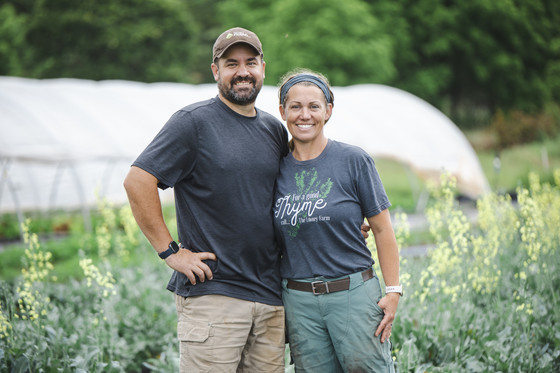 Carrie and Joe Chlebanowski, owners of The Looney Farm.
A high tunnel system is an enclosed polyethylene, polycarbonate, plastic, or fabric covered structure that is used to cover and protect crops from sun, wind, excessive rainfall, or cold, to extend the growing season in an environmentally safe manner.
This practice applies to land capable of producing crops. A high tunnel system applies where sun or wind intensity may damage crops, or where an extension of the growing season is needed due to climatic conditions.
To learn more about the conservation practice, watch the new video here.
Outstanding Conservation District Director Award—this award recognizes a conservation district director(s) who has established themselves as a conservation leader within their community, in the spirit, if not the style of the first directors who volunteered to bear responsibility for the conservation of natural resources.
Karl Jett promotes conservation and local partnerships at the local level with outreach meetings for producers to discuss local needs such as Prescribed Burning and Brush Management for wildfire suppression in local communities, Range Planting for native grass establishment and erosion control, and Prescribed Grazing with implementing water management practices to improve grazing distribution of his pastures.
He is highly active and involved with local conservation district board meetings and helps develop the long range plan, 5 yr plan, etc... Karl also has, on his own personal time and expense, helped to maintain conservation district drills and equipment needed by our producers throughout the year. The Beaver County District shed suffered significant damage in a wildfire. During the wildfire, he and a neighbor removed the NRCS UTV and ATV's out of the shed to safety, saving thousands of NRCS dollars in equipment. He also played a critical role in spearheading the formation of the Beaver County Youth Board and has been assisting and attending their meetings as an advisor since its inception.
Karl, as an Area 1 Commissioner, has worked tirelessly side by side with legislators and appointees to promote conservation for Oklahoma. He not only speaks with others about conservation, Karl lives it in his daily operation. In 2020, he implemented numerous conservation practices such as patch burning, min-till & no-till, cover crops, prescribed grazing and a suite of water related conservation practices tied to grazing distribution.
Karl utilizes USDA programs to enhance and further his conservation footprint on his farm near Slapout, OK. He also uses many conservation practices on his own because he knows it is the right way to manage his operation.
He is a fourth generation farmer and said, "Hopefully, some of the work I do today will help guarantee a brighter future for my grandchildren and great grandchildren."
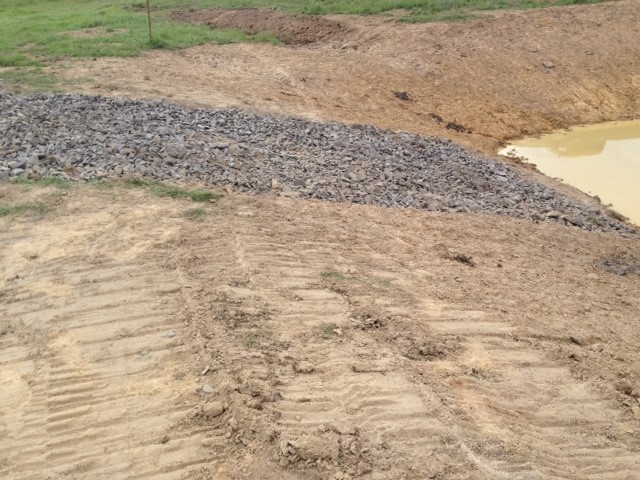 Watering Ramp into a Pond (Fencing to be installed to control access).
The Watering Facility (Conservation Practice Standard (CPS) 614) is the most visible part of a Livestock Water System. The system could also include a Livestock Pipeline (CPS 516) that connects the water source which could be a Water Well (CPS 642) or a Pond (CPS 378) requiring a Pumping Plant (CPS 533). Protection of the soil around the watering facility with some form of Heavy Use Area Protection (CPS 561) is also critical. Each component is dependent on the other and must be designed and sized accordingly.
Various types and sizes of Watering Facilities may be used to meet the needs of an individual livestock producer. The CPS 614 even provides criteria for ramps into existing ponds. Some research has indicated that fresh clean water from a watering facility may be sufficient to draw animals away from streams and ponds to improve water quality. However, another method of improving water quality is to fence off the stream or pond and provide alternative water. A Watering Ramp into an existing pond that is fenced can provide such access.
For more information about your livestock water systems options, click here.
The best way to stay updated on job postings is to check USA Jobs often and sign up for notifications for job announcements.
All jobs with NRCS are listed on USA Jobs.
 Photo entered by Saska Koch. To enter a photo in this month's contest, email the full resolution photo to NRCSinfo-OK@usda.gov by August 15.
Agricultural producers in Oklahoma who have not yet completed their crop acreage reports after planting should make an appointment with their Farm Service Agency (FSA) office before the applicable deadline.
An acreage report documents a crop grown on a farm or ranch and its intended uses. Filing an accurate and timely acreage report for all crops and land uses, including failed acreage and prevented planted acreage, can prevent the loss of benefits.
The following acreage reporting dates are applicable in Oklahoma:
July 15, 2021 | Spring and summer planted crops including perennial forage, CRP, and cover crops.
July 31, 2021 | Hemp
Acreage reporting dates vary by crop and by county. Contact your local FSA office for a list of acreage reporting deadlines by crop.
Service Center staff continue to work with agricultural producers via phone, email, and other digital tools. Because of the pandemic, some USDA Service Centers are open to limited visitors. Contact your Service Center to set up an in-person or phone appointment.
To read more on acreage reporting, click here.
The U.S. Department of Agriculture (USDA) has set a July 23, 2021, deadline for agricultural producers and landowners to apply for the Conservation Reserve Program (CRP) General signup 56. Additionally, USDA’s Farm Service Agency (FSA) will accept applications for CRP Grasslands from July 12 to August 20. This year, USDA updated both signup options to provide greater incentives for producers and increase its conservation benefits, including reducing the impacts of climate change.
Through CRP, producers and landowners establish long-term, resource-conserving plant species, such as approved grasses or trees, to control soil erosion, improve water quality, and enhance wildlife habitat on cropland. Lands enrolled in CRP also play a key role in mitigating impacts from climate change, and FSA has added a new Climate-Smart Practice Incentive for practices that sequester carbon and reduce greenhouse gas emissions.
To read more on on CRP, click here.
All producers receiving Quality Loss Adjustment (QLA) Program and Wildfire and Hurricane Indemnity Program Plus (WHIP+) payments are required to purchase federal crop insurance or Noninsured Crop Disaster Assistance Program (NAP) coverage for the next two available crop years (2022 and 2023) at the 60% coverage level or higher. If eligible, QLA participants may meet the insurance purchase requirement by purchasing Whole-Farm Revenue Protection coverage offered through USDA’s Risk Management Agency.
- July 10
- July 15
- July 23-24
- August 5-6
- August 6
- August 12
- August 14
|