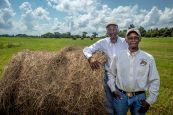
The U.S. Department of Agriculture Farm Service Agency (FSA) published the first notice of funding availability (NOFA) (PDF, 242 KB) announcing loan payments for eligible borrowers with qualifying direct farm loans under the American Rescue Plan Act Section 1005. The official NOFA will be published in the Federal Register early this week and USDA expects payments to begin in early June and continue on a rolling basis. A subsequent notice addressing guaranteed loan balances and direct loans that no longer have collateral and have been previously referred to the Department of Treasury for debt collection for offset, will be published within 120 days.
Section 1005 of the American Rescue Plan Act of 2021 (ARPA) provides funding and authorization for USDA FSA to pay up to 120 percent of direct and guaranteed loan outstanding balances as of January 1, 2021, for socially disadvantaged farmers and ranchers as defined in Section 2501(a) of the Food, Agriculture Conservation, and Trade Act of 1990 (7 U.S.C. 2279(a)). Section 2501(a) defines a socially disadvantaged farmer or rancher as a farmer or rancher who is a member of a socially disadvantaged group, which is further defined as a group whose members have been subjected to racial or ethnic prejudice because of their identity as members of a group without regard to their individual qualities. Qualifying loans as part of today’s announcement are certain direct loans under the Farm Loan Programs (FLP) and Farm Storage Facility Loan Program (FSFL).
For much of the history of the USDA, socially disadvantaged farmers and ranchers have faced discrimination—sometimes overt and sometimes through deeply embedded rules and policies—that have prevented them from achieving as much as their counterparts who do not face these documented acts of discrimination. Over the past 30 years, several major civil rights lawsuits have compensated farmers for specific acts of discrimination—including Pigford I and Pigford II, Keepseagle, and the Garcia cases. However, those settlements and other related actions did not address the systemic and cumulative impacts of discrimination over a number of decades that the American Rescue Plan now begins to address.
Sections 1005 and 1006 of ARPA provide USDA with new tools to address longstanding inequities for socially disadvantaged borrowers. Section 1006 of ARPA provides additional funding to begin long-term racial equity work within USDA, including to address heirs property claims and to stand up an Equity Commission to identify barriers to access USDA programming.
To learn more about the loan payments to socially disadvantaged farmers and ranchers, visit www.farmers.gov/americanrescueplan.
USDA touches the lives of all Americans each day in so many positive ways. In the Biden-Harris Administration, USDA is transforming America’s food system with a greater focus on more resilient local and regional food production, fairer markets for all producers, ensuring access to safe, healthy and nutritious food in all communities, building new markets and streams of income for farmers and producers using climate smart food and forestry practices, making historic investments in infrastructure and clean energy capabilities in rural America, and committing to equity across the Department by removing systemic barriers and building a workforce more representative of America. To learn more, visit www.usda.gov.
|
The U.S. Department of Agriculture (USDA) Farm Service Agency (FSA) announced an initiative to quantify the climate benefits of Conservation Reserve Program (CRP) contracts. This multi-year effort will enable USDA to better target CRP toward climate outcomes and improve existing models and conservation planning tools while supporting USDA’s goal of putting American agriculture and forestry at the center of climate-smart solutions to address climate change.
CRP Monitoring, Assessment and Evaluation Projects
FSA has historically worked with partners to identify Monitoring, Assessment and Evaluation (MAE) projects to quantify CRP environmental benefits to water quality and quantity, wildlife and rural economies. The agency will now invest $10 million through this program to measure and monitor the soil carbon sequestration and other climate and environmental benefits of conservation practices over the life of CRP contracts.
This effort will allow USDA to better target climate outcomes through CRP while gaining critical data to calibrate, validate and further improve quantification methods within existing models and tools. One model of focus is the Daily Century Model, or DayCent, which simulates the movement of carbon and nitrogen through agricultural systems and informs the National Greenhouse Gas Inventory. Data will also be used to strengthen the COMET-Farm and COMET-Planner tools, which enable producers to evaluate potential carbon sequestration and greenhouse gas emission reductions based on specific management scenarios.
Request for Proposals
USDA is seeking proposals for projects to survey, sample and measure the climate benefits of land enrolled in the following CRP practice types over time:
- Predominately Perennial grass with legumes and shrubs, depending on the practice
- Tree
- Wetland, including both mineral and organic soils and both floodplain and non-floodplain wetlands
A project can cover one or more of the above practice types and should be for a three- to five-year term, with the potential for renewal. Projects should be a minimum of $1 million and not exceed $9 million.
Applications are welcome from all types of organizations, including public, private and nonprofit institutions. Project proposals can be from a single entity or from a group of partners who coordinate efforts. Applications from or in partnership with Historically Black Colleges & Universities (HBCU), Tribal Colleges & Universities (TCU) and Hispanic-Serving Institutions (HSI) or organizations will be considered as part of the selection process.
The deadline for proposals is July 2, 2021. Visit the request for proposals for more information on requirements, project deliverables, evaluation criteria and how to submit your proposal. Visit FSA’s Monitoring, Assessment and Evaluation page for additional information on CRP MAEs.
Conservation Reserve Program
CRP is one of the world’s largest voluntary conservation programs with an established track record of preserving topsoil, sequestering carbon, reducing nitrogen runoff and providing healthy habitat for wildlife.
In exchange for a yearly rental payment, agricultural producers enrolled in the program agree to remove environmentally sensitive land from production and plant species that will improve environmental health and quality. Land is enrolled in CRP for 10 to 15 years, with the option of re-enrollment. FSA offers multiple CRP signups, including the general signup and continuous signup – both currently open – as well as CRP Grasslands and pilot programs focused on soil health and clean water.
In April, USDA announced updates to CRP including higher payment rates, new incentives for environmental practices and a more targeted focus on the program’s role in climate change mitigation. This included a new Climate-Smart Practice Incentive for CRP general and continuous signups that aims to increase carbon sequestration and reduce greenhouse gas emissions. Climate-Smart CRP practices include establishment of trees and permanent grasses, development of wildlife habitat and wetland restoration. Download our “What’s New” fact sheet to learn more about program updates.
Under the Biden-Harris Administration, USDA is engaged in a whole-of-government effort to combat the climate crisis and conserve and protect our nation’s lands, biodiversity and natural resources including our soil, air and water. Through conservation practices and partnerships, USDA aims to enhance economic growth and create new streams of income for farmers, ranchers, producers and private foresters. Successfully meeting these challenges will require USDA and our agencies to pursue a coordinated approach alongside USDA stakeholders, including State, local and Tribal governments.
USDA touches the lives of all Americans each day in so many positive ways. In the Biden-Harris Administration, USDA is transforming America’s food system with a greater focus on more resilient local and regional food production, fairer markets for all producers, ensuring access to healthy and nutritious food in all communities, building new markets and streams of income for farmers and producers using climate smart food and forestry practices, making historic investments in infrastructure and clean energy capabilities in rural America, and committing to equity across the Department by removing systemic barriers and building a workforce more representative of America. To learn more, visit www.usda.gov.
|