Newsletter from USDA Service Center in Park County

View as a webpage / Share

US Department of Agriculture

Park County USDA Bulletin   -  May 2021

Conservation Compliance on Highly Erodible Land and Wetlands

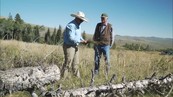
Image of Brush Management depicting two people in a field

Highly erodible land (HEL) and wetland conservation (WC) provisions aim to reduce soil loss on erosion-prone lands and to protect wetlands for the multiple benefits they provide. HEL and WC provisions apply to all land that is considered highly erodible or a wetland, and that is owned or farmed by persons voluntarily participating in USDA programs.

To comply with HEL and WC provisions, agricultural producers and affiliated persons must fill out and sign form AD-1026 certifying they will not:

  • Plant or produce an agricultural commodity on highly erodible land without following an NRCS-approved conservation plan or system;
  • Plant or produce an agricultural commodity on a converted wetland; or
  • Convert a wetland that makes the production of an agricultural commodity possible. In addition, producers planning to conduct activities that may affect their HEL or WC compliance; for example land clearing, conducting drainage activities, land leveling, filling, dredging, or excavation, including the clearing of woody vegetation; must notify FSA by filing form AD-1026. FSA will notify NRCS, and they will then provide highly erodible land or wetland technical evaluations and issue determinations if needed.

It is extremely important that producers comply with the HEL and WC provisions to continue receiving USDA Program benefits.

Please contact your local USDA Service Center for more information.


ELAP Covers Losses from Additional Cost of Transporting Water to Livestock

Cattle Grazing

If you’ve incurred additional operating costs for transporting water to livestock due to an eligible drought, assistance may be available to you through the Emergency Assistance for Livestock, Honeybees and Farm-Raised Fish Program (ELAP).

An eligible drought means that part or all of your county is designated D3 (extreme drought) or higher as indicated by the U.S. Drought Monitor.

Eligible livestock must be adult or non-adult dairy cattle, beef cattle, buffalo and beefalo, as well as alpacas, deer, elk, emus, equine, goats, llamas, reindeer, or sheep. Additionally, the livestock must have been owned 60 calendar days prior to the beginning of the drought and be physically located in the county designated as a disaster area due to drought. Adequate livestock watering systems or facilities must have existed before the drought occurred and producers are only eligible if they do not normally transport water to the livestock.

Livestock that were or would have been in a feedlot are not eligible for transporting water. ELAP covers the additional cost of transporting water and does not cover the cost of the water itself.

You must file a notice of loss on form CCC-851 the earlier of 30 calendar days of when the loss is apparent to you or by Jan. 31, 2022.  Additionally, the deadline to submit an application for payment for 2020 ELAP assistance is Jan. 31, 2022.

You’ll have to provide documentation to FSA that shows the method used to transport the water, the number of gallons of water transported and the number of eligible livestock to which water was transported.

To make an appointment to sign up for ELAP and to learn more about eligibility, application and documentation requirements, contact your Park County USDA Service Center at 307-754-9411 Ext. 2 or visit fsa.usda.gov.


Borrower Training for Farm Loan Customers

Service Center

Borrower training is available for all Farm Service Agency (FSA) customers. This training is required for all direct loan applicants, unless the applicant has a waiver issued by the agency. 

Borrower training includes instruction in production and financial management. The purpose is to help the applicants develop and improve skills that are necessary to successfully operate a farm and build equity in the operation. It aims to help the producer become financially successful. Borrower training is provided, for a fee, by agency approved vendors. Contact your local FSA Farm Loan Manager for a list of approved vendors.  


Park County USDA Service Center

1017 Highway 14A
Powell, WY 82435

Phone: 307-754-9411
Fax: 855-415-3438


County Executive Director

Darla Rhodes 307-754-9411
darla.rhodes@usda.gov

District Conservationist

Rory Karhu 307-754-9411
rory.karhu@usda.gov

Farm Loan Manager

Thomas Schambow 307-754-9411
thomas.schambow@usda.gov


Program Technicians
Tanya Butz
Marcia Shuler


County Committee
Emily Karst - Chairperson
Tim Acord - Vice-Chairperson
Lynn George - Regular Member

Next County Committee Meeting: TBD