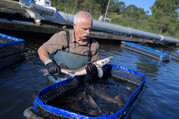
In response to catastrophic aquaculture losses due to major winter storms that hit states along the U.S. Gulf Coast in February, the U.S. Department of Agriculture’s (USDA) Farm Service Agency (FSA) today announced a policy change that makes food fish and other aquatic species eligible for the Emergency Assistance for Livestock, Honey Bees and Farm-raised Fish Program (ELAP). Previously, only farm-raised game and bait fish were eligible for death loss ELAP benefits. Beginning June 1, eligible aquaculture producers can request ELAP assistance for 2021 losses. This policy change is for the 2021 and subsequent program years.
ELAP provides financial assistance to eligible producers of livestock, honeybees and farm-raised fish for losses due to disease, certain adverse weather events or loss conditions, including blizzards and wildfires, as determined by the Secretary.
To be eligible, losses must have occurred on or after Jan. 1, 2021. For farm-raised fish and other aquatic species death losses only that occurred prior to June 1, 2021, FSA is waiving the requirement to file a notice of loss within 30 calendar days of when the loss is apparent. An aquaculture producer will still need to be able to provide contemporaneous records upon request to document the eligible loss event and demonstrate the beginning and ending inventory. The deadline to file an application for payment for the 2021 program year is Jan. 31, 2022.
Producers must provide acreage reports for the surface acres of water where their aquatic species are raised. Acreage reports for 2021 must be filed by Sept. 30, 2022.
More Information
USDA offers a comprehensive portfolio of disaster assistance programs. On farmers.gov, the Disaster Assistance Discovery Tool, Disaster-at-a-Glance fact sheet, and Farm Loan Discovery Tool can help producers and landowners determine all program or loan options available for disaster recovery assistance. For assistance with a crop insurance claim, producers and landowners should contact their crop insurance agent. For FSA and NRCS programs, they should contact their local USDA Service Center.
|
Farmers and ranchers working with USDA’s Farm Service Agency or Natural Resources Conservation Service can now sign and share documents online in just a few clicks. By using Box or OneSpan, producers can digitally complete business transactions without leaving their homes or agricultural operations. Both services are free, secure, and available for multiple FSA and NRCS programs.
Box is a secure, cloud-based site where FSA or NRCS documents can be managed and shared. Producers who choose to use Box can create a username and password to access their secure Box account, where documents can be downloaded, printed, manually signed, scanned, uploaded, and shared digitally with Service Center staff. This service is available to any FSA or NRCS customer with access to a mobile device or computer with printer connectivity.
OneSpan is a secure eSignature solution for FSA and NRCS customers. Like Box, no software downloads or eAuthentication is required for OneSpan. Instead, producers interested in eSignature through OneSpan can confirm their identity through two-factor authentication using a verification code sent to their mobile device or a personalized question and answer. Once identity is confirmed, documents can be reviewed and e-signed through OneSpan via the producer’s personal email address. Signed documents immediately become available to the appropriate Service Center staff.
Box and OneSpan are both optional services for customers interested in improved efficiency in signing and sharing documents with USDA, and they do not replace existing systems using eAuthentication for digital signature. Instead, these tools provide additional digital options for producers to use when conducting business with FSA or NRCS.
USDA Service Center staff are available to help producers get started with Box and OneSpan through a few simple steps. Please visit farmers.gov/service-locator to find your local office and let Service Center staff know you’re interested in signing and sharing documents through these new features. In most cases, one quick phone call will be all that is needed to initiate the process.
Visit farmers.gov/mydocs to learn more about Box and OneSpan, steps for getting started, and additional resources for conducting business with USDA online.
To learn more about program flexibilities and Service Center status during the coronavirus pandemic, visit farmers.gov/coronavirus.
USDA will open enrollment in the Conservation Reserve Program (CRP) with higher payment rates, new incentives, and a more targeted focus on the program’s role in climate change mitigation. Additionally, USDA is announcing investments in partnerships to increase climate-smart agriculture, including $330 million in 85 Regional Conservation Partnership Program (RCPP) projects and $25 million for On-Farm Conservation Innovation Trials.
Conservation Reserve Program
USDA’s goal is to enroll up to 4 million new acres in CRP by raising rental payment rates and expanding the number of incentivized environmental practices allowed under the program. CRP is one of the world’s largest voluntary conservation programs with a long track record of preserving topsoil, sequestering carbon, and reducing nitrogen runoff, as well providing healthy habitat for wildlife.
CRP is a powerful tool when it comes to climate mitigation, and acres currently enrolled in the program mitigate more than 12 million metric tons of carbon dioxide equivalent (CO2e). If USDA reaches its goal of enrolling an additional 4 million acres into the program, it will mitigate an additional 3 million metric tons of CO2 equivalent and prevent 90 million pounds of nitrogen and 33 million tons of sediment from running into our waterways each year.
New Climate-Smart Practice Incentive
To target the program on climate change mitigation, FSA is introducing a new Climate-Smart Practice Incentive for CRP general and continuous signups that aims to increase carbon sequestration and reduce greenhouse gas emissions. Climate-Smart CRP practices include establishment of trees and permanent grasses, development of wildlife habitat, and wetland restoration. The Climate-Smart Practice Incentive is annual, and the amount is based on the benefits of each practice type.
Higher Rental Rates and New Incentives
In 2021, CRP is capped at 25 million acres, and currently 20.8 million acres are enrolled. Furthermore, the cap will gradually increase to 27 million acres by 2023. To help increase producer interest and enrollment, FSA is:
-
Adjusting soil rental rates.This enables additional flexibility for rate adjustments, including a possible increase in rates where appropriate.
-
Increasing payments for Practice Incentives from 20% to 50%.This incentive for continuous CRP practices is based on the cost of establishment and is in addition to cost share payments.
-
Increasing payments for water quality practices.Rates are increasing from 10% to 20% for certain water quality benefiting practices available through the CRP continuous signup, such as grassed waterways, riparian buffers, and filter strips.
-
Establishing a CRP Grassland minimum rental rate.This benefits more than 1,300 counties with rates currently below the minimum.
To learn more about updates to CRP, download our “What’s New with CRP” fact sheet.
USDA recognizes that socially disadvantaged farmers and ranchers have faced systemic discrimination with cumulative effects that have, among other consequences, led to a substantial loss in the number of socially disadvantaged producers, reduced the amount of farmland they control, and contributed to a cycle of debt that was exacerbated during the COVID-19 pandemic. During the pandemic, socially disadvantaged communities saw a disproportionate amount of COVID-19 infection rates, loss of property, hospitalizations, death, and economic hurt.
To address these systemic challenges, the American Rescue Plan Act of 2021 provides historic debt relief to socially disadvantaged producers including Black/African American, American Indian or Alaskan native, Hispanic or Latino, and Asian American or Pacific Islander.
USDA is now reviewing and working to gather feedback to implement the Act, and more guidance will be forthcoming for socially disadvantaged borrowers with direct or guaranteed farm loans as well as Farm Storage Facility Loans. As information becomes available, it will be provided directly to socially disadvantaged borrowers and stakeholder groups representing socially disadvantaged producers, posted here on farmers.gov, and shared through our social media channels, email newsletters, and the media.
Who qualifies for this debt relief?
Any socially disadvantaged borrower with direct or guaranteed farm loans as well as Farm Storage Facility Loans qualifies. The American Rescue Plan Act uses the 2501 definition of socially disadvantaged, which includes Black/African American, American Indian or Alaskan native, Hispanic or Latino, and Asian American or Pacific Islander. Gender is not a criterion in and of itself, but of course women are included in these categories.
I qualify as socially disadvantaged under the American Rescue Plan definition, but I am not late on my payments. Do I still qualify?
Yes. Any socially disadvantaged borrower with direct or guaranteed farm loans as well as Farm Storage Facility Loans qualifies.
When will qualified borrowers begin to see a loan pay-off or other payment in response to the American Rescue Plan?
USDA is now reviewing and working to gather feedback to implement the Act, and more guidance will be forthcoming for socially disadvantaged borrowers with direct or guaranteed farm loans as well as Farm Storage Facility Loans. For borrowers in arrears, the moratorium established on January 26th to stop all debt collections, foreclosures and evictions for all borrowers, including socially disadvantaged producers, remains in effect.
Producers who have worked with USDA’s Farm Service Agency previously may have their ethnicity and race on file. A borrower, including those with guaranteed loans, can contact their local their local USDA Service Center to verify, update or submit a new ethnicity and race designation using the AD-2047. Find your nearest service center at farmers.gov/service-locator.
To learn more about USDA’s work to implement the American Rescue Plan Act of 2021, visit www.usda.gov/arp.
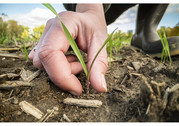
After a long winter and a challenging year, spring has finally come. As the world around us bursts into song and color, our farmers will begin to work the soil they’ve protected all winter and plant the seeds they will nurture for months to come. Later this year, the fruits of their labor will become the food that feeds our communities, the fiber that clothes our families, and the fuel that powers industries.
For many, 2020 was the first year they’d ever seen an empty shelf at the grocery store. And for the first time, many people realized how much they take farming and the people who make it possible for granted. Fewer and fewer Americans understand what our farmers do, who they are, and the hard work they put in. Let’s change that.
This planting season, let Farmers.gov showcase your work by participating in the #Plant2021 campaign. We’ll share your story on @FarmersGov on social media and a nationwide storymap. Here’s how:
Using your smartphone or digital camera, take photos of what’s happening on your operation during planting season. Videos may be too large to email as attachment, so you can email them to us via mail drop (iPhone), Google Photos (Android), or any other file sharing service. A few ideas:
- If you're comfortable, we’d love to see the people that make it happen set against the backdrop of your agricultural operation.
- Take a photo from inside the tractor cab so we can see what you see.
- Photos at sunrise or sunset are always beautiful!
- Behind-the-scenes photos showing us the amount of planning and preparation it takes to have a successful planting season are welcomed.
- Emerging (baby) crops.
Submit your photos/videos along with the following information to us at SM.FP.Social@usda.gov:
- Your name if you’re comfortable sharing.
- Location of the operation (city or county and state).
- Information about what’s in the photo/video and what’s being planting.
- Your thoughts about this year’s planting season. Is this year different from previous years? How do you feel about the season? What are you hopeful about?
- If your operation has a Facebook, Twitter, and/or Instagram account, please include it so that we can tag you.
Please note that by submitting your photo/video, you are granting USDA permission to use these materials for outreach and education purposes. Follow @FarmersGov on Facebook, Twitter, and Instagram, and we look forward to sharing your story!
|
|