
Emerald Ash Borer Program Report Update | April 10, 2020
USDA Animal and Plant Health Inspection Service sent this bulletin at 04/10/2020 03:56 PM EDTHaving trouble viewing this email? View it as a Web page. 
You are subscribed to Emerald Ash Borer Program Report for USDA Animal and Plant Health Inspection Service. This information has recently been updated, and is now available.
April 10, 2020
USDA’s Animal and Plant Health Inspection Service (APHIS) works with State, Federal, and other partners to detect and manage known emerald ash borer (EAB) infestations. The EAB program uses biological control and ongoing research to minimize the impact from an infestation and maintain ash as a viable part of the American landscape. This report provides the most current information on EAB program efforts.
Announcements
Growing Degree Maps
APHIS is distributing by email EAB growing degree day (GDD) maps once a week. The maps can be used to predict emergence and can help with the timing of placing traps and plans for releasing biocontrol agents. Starting next week, a peak activity GDD map will be included in the email, which can help with the timing of lure placements. If you would like to receive the maps too, please email Doug Bopp at Douglas.a.Bopp@usda.gov.
Kiln Certification Extensions
If your firewood kiln certification for EAB is due soon, the certification can be extended for up to 3 months due to COVID-19 situation. Please contact your State Plant Health Director.
Proposed Rule
In September 2018, APHIS published a proposal to remove the domestic quarantine regulations for emerald ash borer requesting comments from the public on the proposal. When the final rule is ready, it will be published in the Federal Register.
EAB in the United States
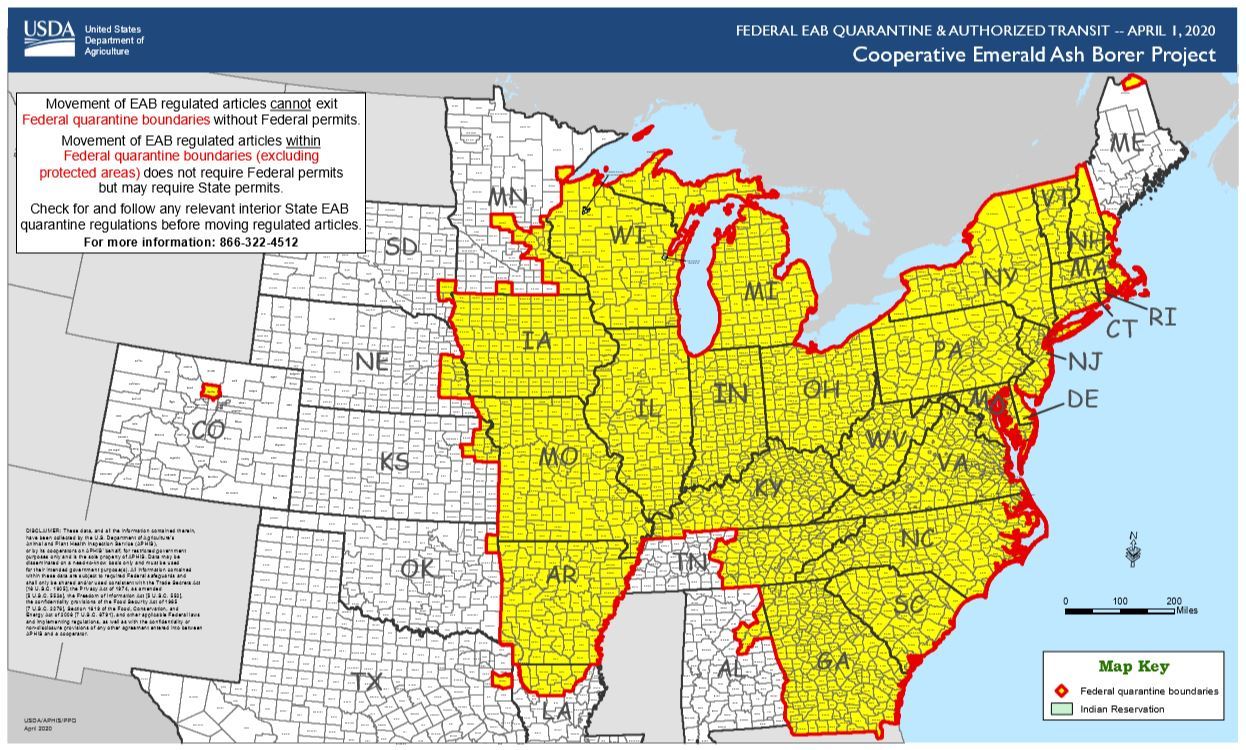
EAB is in 35 states and the District of Columbia: Alabama, Arkansas, Colorado, Connecticut, Delaware, Georgia, Illinois, Indiana, Iowa, Kansas, Kentucky, Louisiana, Maine, Maryland, Massachusetts, Michigan, Minnesota, Missouri, Nebraska, New Hampshire, New Jersey, New York, North Carolina, Ohio, Oklahoma, Pennsylvania, Rhode Island, South Carolina, South Dakota, Tennessee, Texas, Vermont, Virginia, West Virginia, and Wisconsin.
Biological Control
The EAB Biocontrol Rearing Facility will begin shipping wasps to biocontrol partners in early May to start the 2020 release season. If needed, the shipments can be stored in a cool place out of the sun for an additional day with little impact to the wasps. In addition to releasing wasps at selected release sites, biocontrol partners use the EAB Biological Control Release and Recovery Guidelines to determine if the wasps have reproduced and established. In 2019, wasps were released in 3 new states (ME, NE, & RI) and 74 new counties. In total, wasps have been released in 309 counties and in 29 states and the District of Columbia. To learn more, please visit APHIS’ EAB Program webpage.
Trapping
APHIS is providing traps and lures to states to conduct surveys and has already received requests from 21 states this year. Traps, lures, and accessories can be requested through your State Plant Regulatory Official or ordered through the APHIS’ Integrated Plant Health Information System (IPHIS). If you are an APHIS cooperator, please remember to submit your survey data weekly into IPHIS.
Latest Maps
Federal Quarantine Map as of April 1, 2020
Ash Range Map with Federal Quarantine as of April1, 2020
New County Detection Map as of April 1, 2020
Initial County EAB Detection Map as of April 1, 2020
Additional Resources
Informational Websites
EAB Website (Michigan State University)
Outreach Materials
Contacts
EAB National Policy Manager
Herb Bolton, 301-851-3594
Herbert.Bolton@usda.gov
EAB National Operations Manager
Russ Bulluck, 919-855-7182
Russ.Bulluck@usda.gov
If you think you’ve found EAB or signs of infestation, record the area where the specimen was found and take digital pictures of the insect and tree damage. Submit your report to your State Plant Health Director or email Report.EAB@usda.gov or call the EAB hotline at 1-866-322-4512. Thank you.
 |
Questions about APHIS programs and services? Contact Us |
| STAY CONNECTED: | ||||||||
 |
 |

|
 |
 |
 |
|||
SUBSCRIBER SERVICES:
Manage Preferences | Unsubscribe | Help