AMS Program Subaward Information Now Available
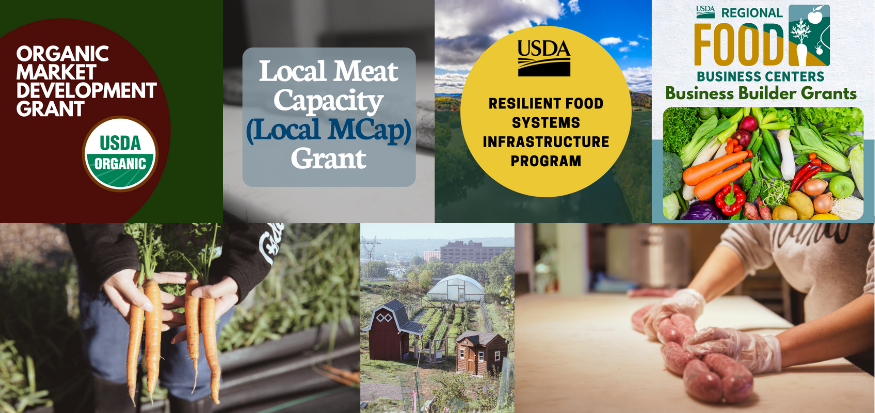 Many of AMS’s newer grant programs, such as the Local Meat Capacity, Resilient Food Systems Infrastructure, and Regional Food Business Centers provide subawards to projects throughout the country. The subaward information for these programs is now available in spreadsheet format on the websites below.
USDA’s Local and Regional Foods Division Webinar Series Continues

On Thursday, Jan. 16 at 1 p.m. ET, the Local and Regional Foods Division will hold the fourth webinar in the Local and Regional Foods Resources & Research Webinar Series (the R&R Webinars), a monthly series highlighting local and regional foods research projects, resources, partnerships and programs. The January webinar will highlight the courses developed through the Realizing the Promise of Urban Agriculture project.
USDA AMS, in partnership with the Cornell Small Farms Program and Rooted, has developed the Promise of Urban Agriculture courses to provide critical information for building or supporting successful commercial urban farms. The Promise of Urban Agriculture courses represent an innovative and holistic approach to support robust urban farming businesses and communities by addressing city planners, policymakers, and farmers alike. The courses, available on the Cornell Small Farms Program website, educate participants through unique video content and materials about topics including, Accessing Urban Land for Farming, Urban Farm Planning and Management, and Sources of Urban Farm Income.
Upcoming Webinars:
Past Webinars:
- Oct.17, 2024 - The first webinar in this series provided an update on the Regional Food Business Center Program, highlighted the program’s first-year impacts, and outlined ways for stakeholders to engage with their local centers.
- Nov. 21, 2024 – The second webinar built on frameworks from USDA’s Local and Regional Food Systems Resilience Playbook to explore strategies for supporting recovery and resilience of local and regional food systems in the face of natural and man-made disruptions.
- Dec. 19, 2024 – The third webinar featured the latest findings from the national Consumer Food Insights survey highlighting consumers’ post-COVID-19 food spending habits and key takeaways for food businesses, opportunities, and strategies drawn from survey findings.
Regional Food Business Centers Impact Reports Available
 |
|
| |
An interim report reflecting the first year of the Regional Food Business Center (RFBC) Program is now available. The report summarizes the semi-annual Performance Progress Reports submitted by the 12 centers. This report includes center activity highlights and key outcomes.
|
|
$119 Million in Business Builder Grants Available
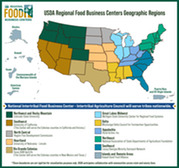
USDA announced it has invested a total of $119 million in Business Builder grants to support small and mid-sized farm and food businesses by funding projects that increase business viability, develop regional market opportunities, and expand value chain capacity. The Business Builder grants are being offered through USDA’s 12 Regional Food Business Centers (RFBC) and is a part of their work to support a more resilient, diverse, and competitive food system by providing localized assistance to access local and regional supply chains, including linking producers to wholesalers and distributors.
To date, the USDA has distributed $7.8 million in Business Builder grants, with $112 million slated for award by December 2027.
Grant Funding by Region (2024 and 2025)
-
Launched in 2024:
- Appalachia RFBC: $16.5 million
- Heartland RFBC: $11.2 million
- North Central RFBC: $3 million
- Northwest and Rocky Mountain RFBC: $6.8
- National Intertribal Food Business Center: $25 million
- Southwest RFBC: $4 million
-
Launching in 2025
- Delta RFBC: $9.9 million
- Great Lakes Midwest RFBC: $6.8 million
- Islands and Remote Areas RFBC: $8.1 million
- Northeast RFBC: $15.9 million
- Rio Grande Colonias RFBC: $6.6 million
- Southeast RFBC: $6.1 million
|
Additional Funding Resources
In addition to finding funding opportunities through USDA agency websites and newsletters, there are two main websites to assist organizations seeking federal funding: USAspending.gov and Grants.gov.

USAspending.gov is the official open data source of federal spending information, including information about federal awards such as contracts, grants, and loans. It can be used as a retrospective search tool.
|

Grants.gov is a prospective search tool for federal funding where users can search and apply for current grant opportunities.
|
Two current research projects funded by AMS are looking for survey responses! We encourage you to share these opportunities with your producer and/or technical assistance networks.
Virginia Tech and Illinois Tech launch Black, Hispanic, and Tribal Producer Wholesale Marketing and Technical Assistance Survey

If you are a farmer or rancher who identifies as Black, Hispanic, or Tribal, selling wholesale now or in the past, or plan to access wholesale markets, we would like to invite you to take this online survey. This project aims to understand the distinct technical assistance needs of Black, Hispanic, and Tribal producers when accessing and scaling into wholesale markets. The survey takes approximately 10 minutes to complete.
|
If you are an individual, organization, or institution providing technical assistance to Black, Hispanic and Tribal producers, and are willing to participate in an interview, please reach out to the project team.
The project is being conducted jointly by a team of researchers from Virginia Tech and the Illinois Institute of Technology. If you have any questions or complaints about this study, you can contact Pratyoosh Kashyap at pratyoosh@vt.edu or Weslynne Ashton at washton@iit.edu.
Agritourism Pre-Survey
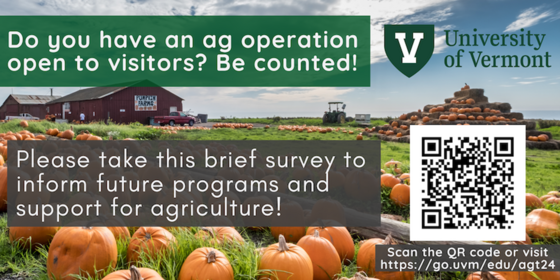 Be counted! If your farm, ranch, or agricultural business is open to visitors, please take five minutes to complete a short pre-survey from our colleagues at the University of Vermont.
The goal of this survey is to understand how many agricultural operations in the U.S. welcome visitors for direct sales and experiences, including pick-your-own, farm stands, tours, overnight farm stays, recreation, etc. This information will be used to inform future programs and support, as well as to inform the development of a more comprehensive survey to be released in 2025.
If you have questions about the survey, please contact Lisa.Chase@uvm.edu or 802-656-7532. If you have questions about your rights as a participant in a research project, please contact the Research Protections Office at the University of Vermont at 802-656-5040.
Each month, we highlight the work of Farmers Market and Local Food Promotion grant recipients.
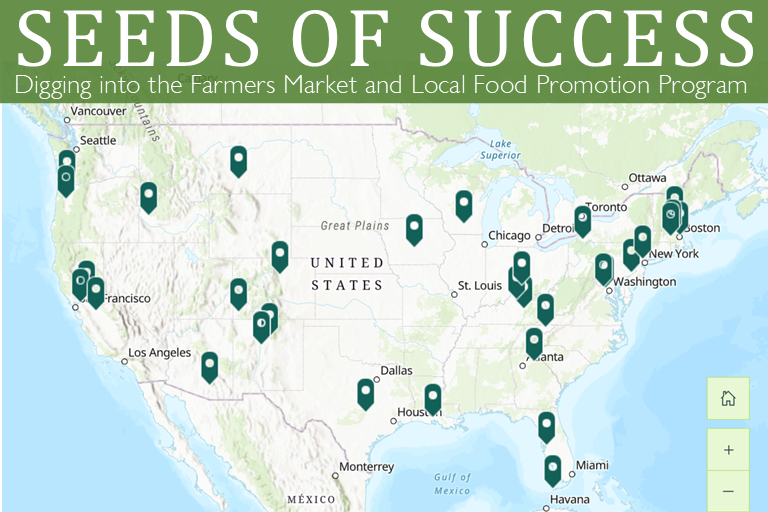
In 2024, more grant recipients were added to the Seeds of Success interactive map and platform! Learning how grant recipients are leveraging their grant funds may help prospective applicants or current grant recipients make connections and explore opportunities. These snapshots allow AMS to share impacts and showcase the variety of ways Farmers Market and Local Food Promotion grant funds are used to benefit local and regional food systems. Grant recipient highlights from 2024 include:
Food Safety Certification for Specialty Crops Program (FSCSC): USDA’s Farm Service Agency FSCSC program provides financial assistance for specialty crop operations that incur eligible on-farm food safety program expenses related to obtaining or renewing a food safety certification. FSA is accepting applications for calendar year 2024 through Jan. 31, 2025. The application period for calendar year 2025 will be Jan. 1, 2025 – Jan. 31, 2026.
February
Rural Business Development Grants:The grant promotes economic development and job creation projects. Applications will compete in two separate categories, business opportunity grants and business enterprise grants. Opportunity type grants are limited to up to 10 percent of the total Rural Business Development Grant annual funding. Enterprise type grants must be used on projects to benefit small and emerging businesses in rural areas as specified in the grant application.
Applications due Feb. 28.
|