New Resources from the Agricultural Utilization Research Institute
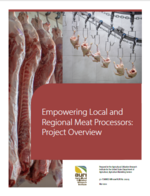
USDA’s Agricultural Marketing Service (AMS) is excited to announce new resources to support small and mid-sized meat processors. As part of a cooperative agreement with AMS, the Agricultural Utilization Research Institute (AURI) explored opportunities to strengthen the resiliency of the industry and promote the success of local and regional meat and poultry processors. Using the Upper Midwest as a learning laboratory, AURI worked with industry stakeholders to develop various materials relevant to small and mid-sized meat processors nationwide, including a resource database, funding sources guide, a series of short courses, and reports that examine industry needs, common financial barriers faced by processors, and byproduct and animal hide utilization. AURI has published a project report, along with tools and briefs.
|
Lessons Learned from Public Investment in Local Meat and Poultry Activities
USDA Proposes New Rule to Clarify Unfair Practices in the Livestock, Meat, and Poultry Industries

On June 25, USDA announced the Fair and Competitive Livestock and Poultry Markets Proposed Rule, which would tackle longstanding challenges around interpretations of unfairness and competitive injury for the livestock, meat, and poultry sectors. Specifically, the proposed rule provides clearer tests and frameworks around unfair practices that harm market participants individually and unfair practices that harm markets overall. If finalized, this proposed rule would better enable AMS to carry out its legal obligation to ensure fair and competitive national livestock, meat, and poultry markets and ensure livestock producers and poultry growers can secure the full value for their products and services. View the proposed rule at the link below. Comments must be submitted by August 27.
|
USDA Accepting Applications for Assistance to Offset Milk Loss Due to H5N1

As of July 1, USDA is accepting applications through its updated Emergency Assistance for Livestock, Honeybees, and Farm-raised Fish Program (ELAP) to provide financial assistance to eligible dairy producers who incur milk losses when cattle are removed from commercial milking in dairy herds due to a confirmed positive H5N1 test. The per cow milk loss payment will be determined based on an expected 21-day period of no milk production when a cow is removed from the milking herd, followed by seven days when the cow has returned to milking but produces 50% of the normal amount of production. The final date to file a notice of loss and application for payment for eligible losses is 30 days after the end of the prior calendar year, which is January 30. To apply, producers should contact the Farm Service Agency at their local USDA Service Center.
|
Each month, we highlight the work of Farmers Market and Local Food Promotion grant recipients.
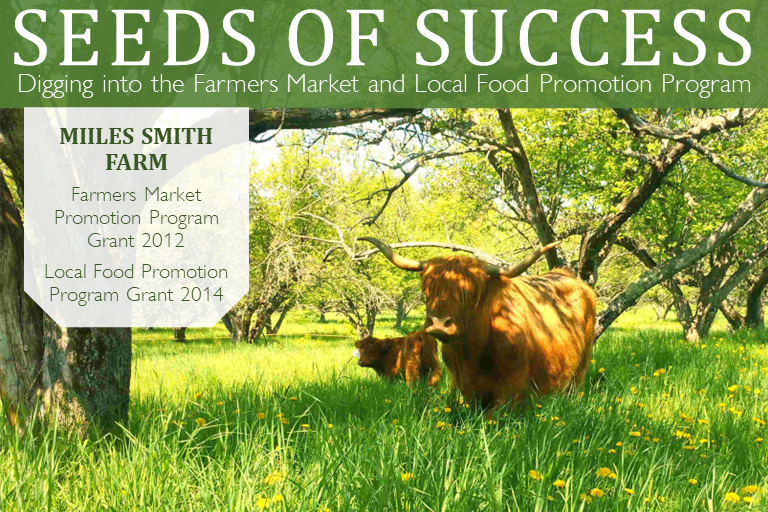 |
Miles Smith Farm is a 36-acre farm owned by Carole Soule and Bruce Dawson in Loudon, NH. The 36 acres combine part of a farm owned by Miles Smith in the 1850s and two neighboring farms. They raise Scottish Highlander and Angus cattle both on the home farm as well as on 300 acres leased across New Hampshire. Carole identified a gap in the local meat industry between local farms producing meat without a sales outlet and healthcare institutions which could benefit from serving their staff and visitors fresh, locally sourced meat. She applied for a Farmers Market Promotion Program (FMPP) grant in 2012 and a Local Food Promotion Program (LFPP) grant in 2014 to bridge the gap between meat producers and healthcare institutions in the New England region. As a result of this project, five health care institutions made the switch to local meat. Three of the institutions, in the fall of 2020, were still purchasing from Miles Smith Farm and the remaining two continued to buy local meat. Carole estimates that at least 15 local businesses have been economically impacted by this project through the supply chain she sources from.
September
Composting and Food Waste Reduction Cooperative Agreement: The goal of this cooperative agreement is to assist local and municipal governments with projects that develop and test strategies for planning and implementing municipal compost plans and food waste reduction plans. Projects that anticipate or demonstrate economic benefits; incorporate plans to make compost easily accessible to farmers, including community gardeners; integrate other food waste strategies, including food recovery efforts, and collaborate with multiple partners will be prioritized. Learn more with a previously recorded webinar or Frequently Asked Questions.
Application Deadline: September 4
Ongoing
USDA's Farm Service Agency is offering the Food Safety Certification for Specialty Crops Program (FSCSC) again. The FSCSC program provides financial assistance for specialty crop operations that incur eligible on-farm food safety program expenses related to obtaining or renewing a food safety certification. For calendar year 2024 this starts July 1st and goes through the end of the year. This will also be available for calendar year 2025.
|