This Winter issue has new updates from our Commodity Procurement Program (CPP). It includes the website location for the Qualified Bidders Lists, GS1 updates and food labeling requirements, recent staff changes within CPP, commodity specification changes, WBSCM’s new validation on pricing changes for offshore items, CPP's quarterly webinars, and a recent CPP outing to a two-acre urban farm in Washington, D.C. |
|
 |
CPP Website Update: Qualified Bidders Lists
Operations and Support Division
There have been some recent changes to the Commodity Procurement Program (CPP) website. The primary change being the location of the Qualified Bidders Lists (QBLs). The QBLs which were previously housed on the New Vendor webpage can now be found at the bottom of the Purchase Programs: Solicitations and Awards webpage.
NEW: GS1 Updates and Food Labeling Requirements
Angela Brochu and Jane Sayner, Nutrition and Specification Management Division
USDA needs your help!
Check your inbox for Catalog Item Confirmation (CIC) messages and respond immediately by uploading your product information on the Global Data Synchronization Network GS1 GDSN®.
USDA Vendors providing direct deliveries to schools are required to provide complete and accurate nutrition, allergen, and ingredient information into the GS1 GDSN® to support the USDA Foods Database. Your input helps schools with menu planning and helps alleviate direct state and school district vendor contact. For additional assistance with publishing your product information into GS1 GDSN® visit the GS1 GDSN® website.
GS1 Updates
Updates to the List of Required Products for GS1 GDSN® Reporting for USDA Foods vendors:
- Added new product material code: 111643- Cherries, Tart, Dried, Individual Portion.
- Removed two products: 100195- Tuna, Chunk Light, Canned (K), and 111100- Cereal, Oat Circles, Bowls.
 |
|
New Food Labeling Requirement
Sesame joined the list of major food allergens. As of Jan. 1, 2023, Sesame is required to be labeled as an allergen on packaged foods. The FDA notice can be found here. Please remember to update all allergens in GS1 GDSN®.
|
CPP Staffing Changes
Workforce Support Team
As a result of recent retirements and personnel moves within the Commodity Procurement Program (CPP), you might find yourself reaching out to a new contact.
CPP’s Associate Deputy Administrator Chris Purdy is now serving as the Acting Deputy Administrator for the Specialty Crops Program as of Jan. 29. In his absence, Mr. Purdy’s duties in CPP will be handled by Dave Tuckwiller, Elizabeth Lober, and Chad Burke.
Chad Burke (former Web-Based Supply Chain Management Division (WMD) Director) is now the Program Manager within our CPP Office of the Deputy Administrator and will be driving various projects forward for CPP, while still providing leadership for the WMD. In his absence, Michael Gunderson will be Acting WMD Director.
Hilary Cole has taken on the duties and responsibilities of Acting International Commodity Procurement Division (ICPD) Director. Additionally, ICPD Packaged Branch has a new Chief: David Cottrell.
LaShawne Brown will be Acting Proteins, Grains, and Oilseeds Division Director until March 17, when Greta Samuel (current Dairy, Grains, and Oilseeds Branch Chief) will take over.
For updated contact information and full details on these and other changes, be sure to check out our updated contact roster.
USDA Foods Commodity Specifications Updates and Changes
Nutrition and Specification Management Division
Below are some updates and changes that have been made to the USDA Foods Commodity Specifications as they pertain to Livestock and Poultry as well as Specialty Crops.
Livestock and Poultry:
Federal Purchase Program Specification for Bulk Pack Chicken and Chicken Legs: Updated to include a change in the chilled delivery time from five to seven days, the addition of the fiberboard container packaging requirement, removing Bulk Pack Small, Bulk Parts Thighs, and Bulk Parts Drumsticks, and indicating Bulk Pack Chicken Legs as Large with a 7.0 pounds or over WOG
Specialty Crops:
Commodity Specification for Canned Vegetables: Updated to include clarified crop year language and amendments to sodium requirements for the following items: green beans, green peas, sliced carrots, and mixed vegetables.
For additional information on commodity specifications, please visit the AMS Specifications & Requirements webpage: https://www.ams.usda.gov/selling-food/product-specs
New Validation on Pricing Changes for Offshore Items for Domestic Commodity Solicitations
Web-Based Supply Chain Management Division
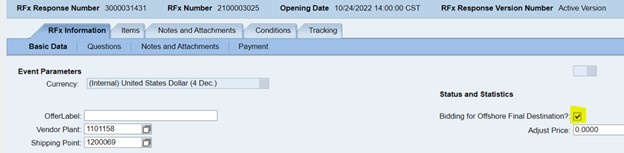 Previously, a price would inadvertently be entered for a final destination price on offshore items during the solicitation process, when the intent was to only enter a bid price to deliver product to the U.S. port location.
Now, Domestic Commodity solicitations include a new Bidding for Offshore Final Destination checkbox. This must be checked if a vendor is submitting an offer price for an offshore final destination. An error message will display when the checkbox is not selected. A vendor can verify their intentions and update their offer pricing, if needed.
New Vendor Outreach
Operations and Support Division
 The Commodity Procurement Program (CPP) has committed to address the administration’s emphasis on small businesses outreach and encourage collaboration as they continue to conduct and increase the nationwide outreach to small businesses. As a result, in collaboration with the various CPP teams, the Communications and Support Branch is hosting live, interactive quarterly webinars, to help increase new vendor outreach, engagement and share some best practices. They include lessons learned in becoming an approved USDA food vendor, tips about registering in the System for Award Management (SAM), a guided tour of the CPP websites, Apex Accelerators (formerly known as Procurement Technical Assistance Centers), as well as frequently asked questions.
Our next quarterly webinar is on Feb. 15, at 2:00 p.m. ET and it will go over the updated new vendor approval process. In December 2022, CPP addressed barriers facing potential vendors interested in becoming an approved USDA Foods vendor. The requirement to provide audited financial statements has long been a barrier due to the cost and time required for small and large businesses alike. In an effort to streamline the new vendor process and increase vendor participation, CPP removed the need for vendors to provide audited financial statements. Instead, to determine financial capability, CPP will obtain a Contractor Responsibility Assessment Report (CRA) from FedDataCheck.
After the vendor’s entire administrative paperwork package is received, the approving Contracting Officer will pull a CRA from FedDataCheck to determine contractor responsibility. Vendors must have a Unique Entity Identifier and be active in System for Award Management (SAM) to pull the CRA report, which is why it is essential for vendors to be successfully registered in SAM. For assistance in SAM, please contact the SAM HelpDesk: 1-866-606-8220. For questions regarding CRAs and FedDataCheck, please contact the Senior Contracting Officers: Felicitas Lofton, Felicitas.Lofton@usda.gov, 202-720-9199 and James Sprandel, James.Sprandel@usda.gov, 202-720-9191.
If you are interested in the watching one of our previous webinars, please go to our website. Additionally, there are currently many opportunities to purchase food commodities. You can find these opportunities on our website.
If you have questions or need additional assistance you can email us at Newvendor@usda.gov.
|