This Fall issue has updates from our Commodity Procurement Program (CPP). It includes information on the USDA Foods Database, new requirements from the International Commodity Procurement Division, market research, Livestock and Poultry specification changes, WBSCM e-invoicing updates, CPP's outreach efforts, and a request for comments on CPP's New Vendor Process on the Federal Register. |
|
 |
NEW: USDA Foods Database provides Nutrition, Allergen, and Ingredient Information for USDA Foods in Schools
Jane Sayner and Angela Brochu, Nutrition and Specification Management Division
The new USDA Foods Database is now available on the FNS website. Thank you to the vendors who supported GS1 Global Data Synchronization Network (GDSN) for USDA Foods for Child Nutrition Programs! States and school districts can confidently access nutrition, allergen, and ingredient information on the USDA Foods Database to help provide safe meals for students with food allergies or other special dietary needs.
Vendors, please continue to provide nutrition, allergen, and ingredient information into the GS1 GDSN to support the new USDA Foods Database. Your input assists schools with menu planning and preparation, as well as helps decrease direct state and school district vendor contact.
Expect significant updates over the next year to include additional product information from vendors. Access the USDA Foods Database for instructions on how to navigate the new tool. Questions about the USDA Foods Database can be sent to USDAFoods@usda.gov.
Still having issues publishing your product information into GS1 GDSN? Find out more on the GS1 GDSN website and contact the Nutrition and Specification Management Division at CPPNPDNutrition@usda.gov.
Implementing Changes to Mitigate Commodity Damage and Increase Traceability
International Commodity Procurement Division
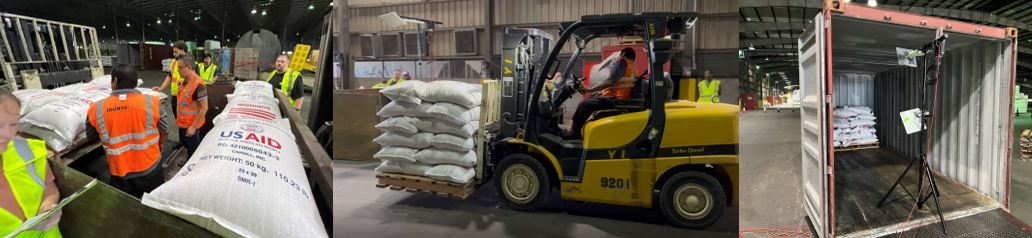 The International Commodity Procurement Division (ICPD) has implemented a series of requirement changes to mitigate commodity damage and increase traceability. One of the major causes of damage to bagged cargo happens when railcar doors are opened at the receiving terminal. To combat this, a new requirement was recently added to stipulate that all bagged commodities shipped by rail must now include cardboard protection inside both sliding railcar doors.
ICPD has been working in conjunction with the United States Agency for International Development and the Michigan Institute of Technology (MIT) on multiple aspects of commodity traceability. Subtle changes include the requirement that nearly all commodities, except for whole grains, include the best used by dates on all packaging. Additionally, the commodity suppliers’ name is required on all packaging and recently a new requirement was added to include the printing of the Purchase Order (PO) line item on all packaging. There is also a pilot project currently in progress whereby a quick response (QR) code is going to be added to a small shipment of vegetable oil. These codes will be scanned multiple times as the oil makes its way through the supply chain until it reaches its distribution point in Africa.
Incidentally, this is a dual-purpose pilot with oil as this shipment also contains a new prototype lid designed to increase functionality and the complete evacuation of the oil container. It is anticipated that some means of scannable printing technology will be required on all commodity packaging in the future. MIT personnel have also floated the idea of using radio frequency identification tags (RFID) and environmental sensors. However, that may be further down the road.
Market Research for USDA Foods Programs
Nutrition and Specification Management Division
 |
|
The Agricultural Marketing Service (AMS) is exploring the possibility of purchasing frozen strawberries (sliced and whole), frozen stir-fry vegetables, and olive oil in retail package sizes for USDA feeding programs. If you have the capacity and interesting in supplying these products to USDA, please contact Kayla Johnson at Kayla.Johnson@usda.gov. |
USDA Foods Commodity Specifications
Nutrition and Specification Management Division
Below are some updates and changes that have been made to the USDA Foods Commodity Specifications as it pertains to Livestock and Poultry.
Supplement 210 Beef Roast and Diced Beef and Supplement 303 Ham Products: Updated to include changes in certification of contract compliance, variable weights, and options for contractor checkloading.
Federal Purchase Program Specification for Diced Chicken: Updated to include a change in the date processed requirement from 60 days to 90 days, allow the use of antimicrobial agent(s) in the 12 percent added solution (optional), add contractor checkloading options, and add Exhibit 1 Certificate of Conformance.
Federal Purchase Program Specification for Cooked Whole Muscle Turkey Breast: Updated to add contractor checkloading options and add a reference to the Supplement for Turkey Products on certification requirement options.
For additional information on commodity specifications, please visit the AMS Specifications & Requirements webpage: https://www.ams.usda.gov/selling-food/product-specs
E-Invoicing Updates
Web-Based Supply Chain Management Division
In a recent release, the Web-Based Supply Chain Management (WBSCM) team implemented some new features relating to attachments on the eInvoicing screen. After following the portal path: Suppliers/Supplier Self Service/e-Invoices for Processing and searching for eInvoices that need to be submitted, the following updates have been made:
1. After selecting “Process Further” and selecting “Add Attachments” (Screenshot 1), the attachments screen now has a new pop-up window (Screenshot 2) which allows you to select your attachment type and upload the attachment(s). Previously a “Done” button needed to be selected to finalize the attachment process, is no longer required.
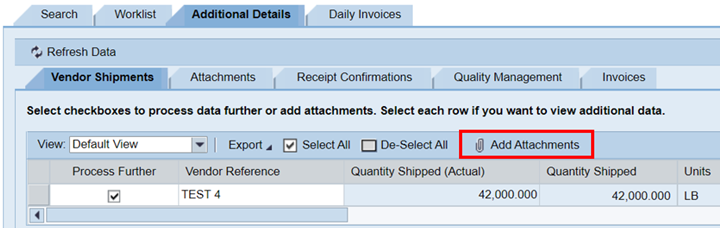 Screenshot 1: Click on the checkbox under the Process Further column then select Add Attachments highlighted in red.
New Vendor Outreach: Quarterly Webinars and Pilot Workshops
Operations and Support Division
 The Commodity Procurement Program (CPP) has committed to address the administration’s emphasis on small businesses outreach and encourage collaboration as they continue to conduct and increase the nationwide outreach to small businesses. As a result, in collaboration with the various CPP teams, the Communications and Support Branch is hosting live, interactive quarterly webinars, to help increase new vendor outreach, engagement and share some best practices. They include lessons learned in becoming an approved USDA food vendor, tips about registering in the System for Award Management (SAM), a guided tour of the CPP websites, Procurement Technical Assistance Centers, as well as frequently asked questions. If you are interested in the watching one of our previous webinars, please go to our website.
There are currently many opportunities to purchase food commodities. You can find these opportunities on our website. If you have questions or need additional assistance you can email us at Newvendor@usda.gov.
|