|
|
AmeriCorps Education Newsletter: Protecting Youth Mental Health
|
|
|
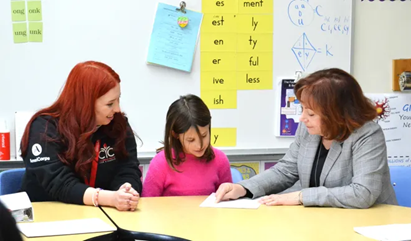
(Colorado Lt. Governor Diana Dianne Primavera joins an AmeriCorps member and student in January. AmeriCorps members serving as tutors at Reading Corps work with the same student for 20 minutes a day, five days a week to develop stronger reading skills. Read more.)
Since the COVID-19 pandemic started, thousands of AmeriCorps members and AmeriCorps Seniors volunteers across the nation have continued their service while adapting to meet challenges created or exacerbated by the pandemic. They provided support, community response, and recovery efforts to communities and continue to do so. Right now, we know that there is perhaps no greater need for young people than providing accessible and evidence-informed mental health support.
In 2021, the U.S. Surgeon General released the Surgeon General’s Advisory on Protecting Youth Mental Health, calling for a swift and comprehensive response to the youth mental health crisis. That advisory noted that one in three high school students and half of female students report persistent feelings of hopelessness. There has been a 62 percent increase in suicide rates in the last 15 years for youth between ages 10 and 24, and 160 million Americans live in communities lacking adequate mental health services.
Supporting Youth Mental Health
Whether you or your organization supports students through tutoring, expanded learning time, STEM programming, or other educational activities, it is critical that all those interacting with students and families protect the mental health of children and youth. Here are a few ways that you or your organizations can help.
- Create positive, safe, and affirming environments for young people.
- Educate the public about the importance of mental health. Work to reduce negative stereotypes, bias, and stigma around mental illness.
- Implement evidence-based programs that promote healthy development; support children, youth, and families; and increase their resilience.
- Learn how to recognize signs of changes in mental and physical health among students, including trauma and behavior changes. Take appropriate action when needed.
- Address the unique mental health needs of youth more at-risk of mental health challenges, such as racial and ethnic minorities, LGBTQI+ youth, foster youth, youth in the juvenile justice system, and youth with disabilities.
- Elevate the voices of children, young people, and their families.
- Ensure that programs rigorously evaluate mental health-related outcomes.
Here are additional tools and resources that may help you:
-
Surgeon General: Read the Surgeon General’s Advisory on Protecting Youth Mental Health. Share a one-page summary of the advisory with others in your community. Dive into answers to key questions, identify actions to take based on your role, and provide shareable resources.
-
Free to Learn Initiative: The Departments of Education and Health and Human Services are coordinating to help states and territories, school districts, tribal nations, and public health agencies prevent, address, and mitigate the effects of bullying, violence, and hate while also supporting school safety, school-based mental health, and positive school climates so that all students are free to learn. You can pledge to partner, view Free to Learn resources, and encourage your state to apply for a grant to provide more children with access to critical health care services, particularly for mental health, at school. Applications are due Sunday, March 24.
-
School Coordinators: Wraparound/integrated student supports site coordinators enable schools to build strong connections and systems with community health, mental health, and social service providers. Coordinators put school climate plans and multi-tiered systems of support in place. You can learn more about this role or request TA through the NPSS if you want support to implement, expand, or improve their presence in your community.
|
Engaging Corporations and Corporate Volunteers
Corporations and corporate volunteers have an important role to play in supporting P-12 students, but they often have difficulty finding the “right” fit. That’s why the NPSS Support Hub, in partnership with the READY SET coalition, and several supporting champions, launched new resources centered around engaging corporate volunteers in meaningful volunteer opportunities to support students in schools and out-of-school time programs.
NPSS Resources
-
Visit the New NPSS Interactive Map. The NPSS has a new resource showcasing NPSS-aligned programs around the country. The new interactive map highlights some of the organizations and efforts nationwide working in one or more of the five evidence-based student support roles.
-
Join the Engaging Older Adults in Student Success Learning Community. The NPSS Support Hub hosts a Learning Community dedicated to organizations engaging older Americans in student-support roles. Participation consists of attending quarterly meetings as well as subgroup meetings when available and connecting with other participants outside of scheduled calls. To join, please reach out to jenlopiccolo@jhu.edu.
-
Join or Support the NPSS Higher Education Coalition. This coalition is a national network of 50 colleges and universities that are working together, alongside their nonprofit organizations and school district partners, to place more college students in NPSS-aligned student support roles. If your organization currently partners with a college or university, we welcome them to join the coalition. This is a perfect time for institutions to get involved, and access supportive networks and resources. If your organization does not currently have higher ed partners but would like to support college students for NPSS roles or collaborate with colleges in other ways, the NPSS Support Hub can help facilitate connections. For more information or to request support, contact Mariko Yoshisato Cavey, Director of Higher Education Partnerships, at mcavey2@jhu.edu.
-
Request Technical Assistance at no cost. Receive support finding partners in your region, guidance on implementing, expanding, or improving programs, or general consultation if you are not sure where to start.
|
Biden-Harris Administration Announces Improving Student Achievement Agenda and Extends Liquidation Period for ARP Funds
In January, the administration announced its Improving Student Achievement Agenda for 2024, which is focused on three evidence-based strategies to accelerate academic performance for every child:
- increasing student attendance;
- providing high-dosage tutoring; and
- increasing summer learning and extended or afterschool learning time.
Check out the White House fact sheet and the Department of Education’s new guidance, which highlights the use of AmeriCorps to support these priorities.
The US Department of Education released a letter sent to state education agencies outlining the process for requesting American Rescue Plan Elementary and Secondary School Emergency Relief III funding extensions. The department is encouraging ARP ESSER III grantees to highlight investments in the three evidence-based strategies listed in its Improving Student Achievement Agenda. State agencies, school districts, and other subrecipients of this funding can request up to 14 months extension, on a case-by-case basis, for liquidation of funds. Funds must still be obligated by Monday, Sept. 30, but approval of the extension would shift the spending/liquidation deadline from January 2025 to March 2026. Under no circumstances may a state or subgrantee enter into new contracts relating to ESSER III funds after Monday, Sept. 30, 2024.
Public Service Loan Forgiveness
Check out this blog post to learn more about how AmeriCorps members and alumni can take advantage of Public Service Loan Forgiveness.
Free Summer Learning Training
The National Summer Learning Association is hosting a free, two-day, virtual “Summer Planning Bootcamp” on Wednesday, March 6 and Thursday, March 7 from 1-2 p.m. ET each day. The bootcamp will include national leaders and practitioner experts sharing best practices, strategies, and resources on hot topics such as summer policy and research, mental and physical health support, building creative partnerships, impactful academic support, engaging enrichment activity, recruiting students and staff, and much more.
National STEM Festival
The US Department of Education, in partnership with EXPLR, will co-present the first-ever National STEM Festival to celebrate student achievements in science, technology, engineering, and mathematics. From April 11 to 13, this festival in Washington, DC will showcase innovative student solutions to urgent global challenges.
Register For Partners for Rural Impact’s 2024 Summit

Partners for Rural Impact’s 2024 Rural Summit will be held in Lexington, KY from April 28 to May 1. The summit will bring together a broad range of cross-sector rural partners, including educators, higher education leaders, legislators, and nonprofit organization leaders, who create equitable opportunities for students and their communities to enter school ready to learn and successfully transition from high school to college and career.
|
|
Public Health AmeriCorps Grantee: Rocky Mountain Youth Corps
AmeriCorps members on the Public Health Crew at Rocky Mountain Youth Corps serve in high schools under the guidance of school counselors and provide mentoring and peer support to students in northern New Mexico. AmeriCorps members connect high school students with mental health resources, refer students for counseling, provide resources and referrals for substance misuse, and support students with other issues. Students in the mentorship program report an increase in awareness of mental health resources in the community and a willingness to access mental health programs. Additionally, members receive personal and professional development opportunities to allow them to continue to be leaders in the healthcare profession after their service.
Each month, the spotlight section will highlight examples of great work happening across the country. If you’d like to be featured, please email P12education@americorps.gov.
|
|
If this newsletter was shared with you, subscribe to future newsletters.
If you have feedback on the types of tools or resources that would be most helpful for you or your organization, please send comments via email to P12education@americorps.gov.
Disclaimer: Reference in this message to any non-US government organization, event, or product does not constitute an endorsement, recommendation, or favoring by AmeriCorps and is strictly for the information and convenience of the public.
|
|
|
|