|
|
CENTER FOR MEDICARE & MEDICAID SERVICES (CMS) Summer 2018
|
|
This Medicaid Enterprise Systems (MES) bi-monthly e-newsletter contains updates on the following:
To be added to the distribution list, click here.
|
|
|
|
Upcoming Events
Medicaid Enterprise Systems Conference 2018 | August 13-16, Portland, OR | Oregon Convention Center
|
|
|

Do we get the systems we get
because we buy them? Medicaid and CHIP programs need new capabilities and
new solutions in months, not years. Have the things we have done to date
actually helped to improve the outcomes from our information technology
projects? Can CMS be a more effective partner with states in implementing and
operating Medicaid and CHIP programs?
These are some of the questions
I asked myself in thinking about a return to government service. After four
years working in the private sector, I have returned to CMS to lead the Data
and Systems Group (DSG) within CMS’s Center for Medicaid and CHIP Services
(CMCS). In those years, I read and helped respond to dozens and dozens of
procurement requests from both federal government and states. I began to wonder
if we could perhaps get different (improved) outcomes from our information
technology projects if we simply bought different projects. In other words, how
many of the outcomes we get are the result of the things we write in
procurement requests? How might the projects change if we focus on
delivering working solutions in months, not years? How are our efforts
helping to make Medicaid and CHIP data more available to decision makers and
researchers?
As we usher in what I am calling
an “era of experimentation,” I look forward to working with all of you, who are
our partners in the systems and operations that support Medicaid and CHIP
across the country, as we try new things to improve the project outcomes,
develop new tools and data to help understand how well the systems are supporting
the programs, and look objectively and critically at the outcomes of the
experiments.
Policy makers – in CMS, in state
legislatures, and in the federal government – are making decisions that we, the
implementers, need to bring to life in months, not years. CMS approved one
state waiver recently that went into effect literally the next day. That says
something to those of us who work in technology and operations about how
responsive we need to be. Together, can we rise to the challenge? I think
the answer is, “Yes!” I look forward to working with all of you to make
that happen.
For those of you who don’t know
me, I now have a career in IT that spans more years than I really want to admit
lest it make me seem totally un-cool. As much as I love my work, my
favorite roles in life are as “auntie” to 14 nieces and nephews and as “mom” to
two cute dogs. If I was stranded on a desert island, the one food I would
want to have is pizza, but the kind that you find in Italy. I get my best
ideas when I am riding my bicycle.
Julie Boughn
Director, Data and Systems Group
CMS/Center for Medicaid &
CHIP Services
Julie.boughn@cms.hhs.gov
|

The Vermont Agency of Human Services (AHS) adopted a modular
approach to certifying the Medicaid Management Information System (MMIS) in
2016 and implemented the first module-‒Pharmacy
Benefits Management (PBM)‒-in
January 2015. The R3 Final Review was held onsite over three days in Waterbury,
VT in late November 2017. The official certification letter was received March
28, 2018.
The journey to certification began mid-2016 after the module
was operational and in the late stages of Design, Development, and Implementation (DDI). When CMS published the modular
approach in the April 2016 Director’s Letter, we immediately began steps to
explore modularity starting with PBM. The first action was to onboard a
Certification Lead, who drafted a strategy, a reusable process, and later
established a team to support the certification tasks. Achieving PBM
certification required the newly founded AHS Certification team to take a
retroactive view of the PBM DDI effort and develop an action plan to ensure
compliance. We worked closely with CMS to address questions, risks, issues, and
decisions that could impact the PBM certification and future modules.
The AHS Certification Strategy consisted of:
- Following the guidance of the MECT and MECL
- Building a Certification Team to work in parallel to the
DDI project
- Developing a reusable process for future modules
- Establishing and maintaining a certification schedule of
activities
- Conducting regular overviews/meetings to prepare the State
and contractor for reviews
- Planning time with CMS wisely
As a result, we walked away from the R3 review with 11 of only 21 action items completed over the three-day review. We completed the
remaining action items within 30 days of the Review.
For more information on our success story, please reach out to: MES@cms.hhs.gov?subject=MESNewsletter
and we will be sure to forward the
Pharmacy Certification Lessons Learned presented at the MMIS Cohort on
April 26, 2018.
For more information about the Medicaid Enterprise Certification Toolkit 2.2., please click here.
|
 |
|
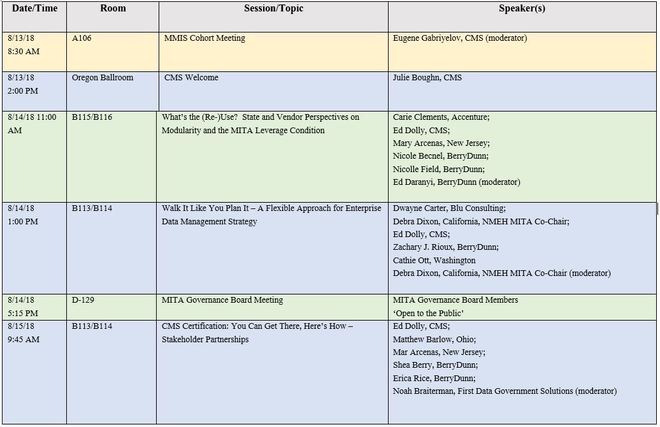
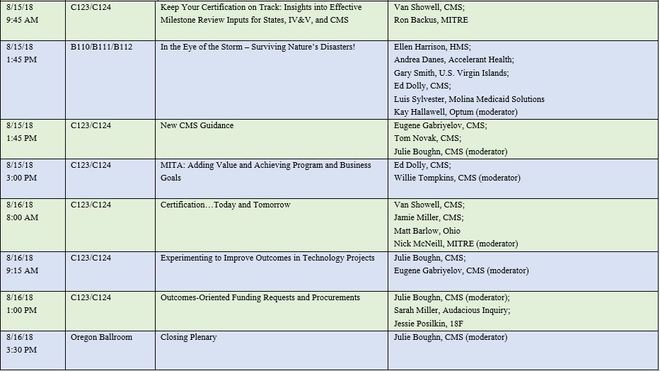
CMS will have a presence at the upcoming Medicaid Enterprise
Systems Conference (MESC) in
Portland, OR August 13-16. In addition to live meetings of the MMIS Cohort
and MITA Governance Board, CMS will hold state office hours and present
the latest updates on current initiatives. If you are able to attend, we look
forward to your participation and feedback.
Day at a Glance Agenda
The recently updated MESC
2018 Day at a Glance Agenda can be found here.
|
CMS Featured Sessions & Speakers
CMS released the Medicaid Eligibility and Enrollment Toolkit
(MEET) 1.1 and Medicaid Enterprise Certification Toolkit (MECT) 2.3 August 1 on
the MEET and MECT webpages.
The new toolkits include the following important changes.
Key changes in MEET
1.1:
- Enhanced guidance tabs for the
checklists
- Consolidation of a few
Eligibility and Enrollment checklist criteria
Key changes in MECT
2.3:
- Removal of the MITA Business
Area Module Checklist Set
- Mapping from MITA business
areas to each MMIS Module Checklist Set criterion
- New Pharmacy and Provider
Management checklists guidance tabs
- Enhanced guidance for five core
checklists
- New Program Integrity Checklist
Electronic Visit Verification criteria
Both updated toolkits include a milestone review guide and a
new CMS email address: MES@cms.hhs.gov.

State IT leaders—have you been joining the monthly MMIS Cohort
meetings? Here’s what’s been happening!
In April, we discussed how CMS is streamlining certification
checklist sets to use only the MMIS set moving forward. Vermont shared
lessons learned from their recent Pharmacy Benefits Management module
certification, including how they approached the R3 milestone review, what
went well, and recommendations for how other States can prepare for upcoming
certification reviews. Questions regarding Vermont’s lessons learned should
be sent to Kaitlin Epstein (Kaitlin.Epstein@vermont.gov), Tobi
Daniels (Tobi.Daniels@partner.vermont.gov), and
Nancy Hogue (Nancy.Hogue@vermont.gov).
In May, we discussed Project Partnership Understanding (PPU)
documents, including the purpose, process, and structure. Pennsylvania shared
their MMIS project timeline and we discussed how CMS uses this information to
align the Medicaid Enterprise Certification Life Cycle (MECL) and plan for
milestone reviews. Questions about Pennsylvania’s MMIS project should be sent
to Sam Moore (c-sammoore@pa.gov).
In June, Tennessee announced their Enterprise Data Warehouse
(EDW) / Decision Support Services (DSS) RFP feedback survey to gather
information about other states’ EDW/DSS module efforts, functionality, and lessons
learned. Montana introduced their Claims module procurement strategy, and we
discussed certification and the role of IV&V vendors. Delaware shared
their experience working with IV&V, the vendor’s role in milestone
reviews, and lessons learned. Questions about Tennessee’s survey should
be sent to Raichon Morand (raichon.morand@tn.gov).
Questions on Montana’s procurement strategy should be sent to Tim Peterson (TPeterson@mt.gov).
In July, Delaware continued the conversation about certification
and the role of IV&V, focusing on R3 certification readiness and how the
state and IV&V worked together to prepare for the final milestone review.
Montana provided additional information about the multi-state cooperative
procurement for a claims processing and management module including the
projected timeline, how it will work, what types of state involvement are
needed, and the overall benefits of participation. Questions regarding
Delaware’s experience with IV&V, milestone reviews, and lessons learned
should be sent to Al Boulogne (Alexander.Boulogne@state.de.us).
CMS invites State IT leadership to join the MMIS Cohort on the last
Wednesday of every month from 2-3 pm ET. As a reminder, participation
is limited to States; vendors should not attend Cohort meetings. Vendors
are welcome to subscribe to this newsletter to keep up to date. To be invited
to future MMIS Cohort meetings, please email Van Showell (van.showell@cms.hhs.gov).
What is the MMIS Cohort?
- A monthly discussion on key
topics, such as States' modular certification experiences and
preliminary precertification pilot results
- A chance for States to
share experiences and challenges
- A forum for States to
identify opportunities to collaborate with one another and/or with CMS
to find actionable solutions
- An opportunity to hear “sneak
peeks” and provide State feedback on upcoming CMS initiatives
The next MMIS Cohort meeting will be live at MESC on
Monday, 8/13 at 8:30AM PST, and will feature State-to-State networking and
opportunities to collaborate. If you can join or would like to share, please
complete this brief survey.
|
|
|
The Vendor Module Precertification Pilot results, currently being
evaluated by CMS, will provide indicators on whether Precertification could attract
new vendors and streamline State certification, as well as the level of effort
required to sustain a program. CMS is evaluating the Pilot and will make a
decision whether or how to move forward.
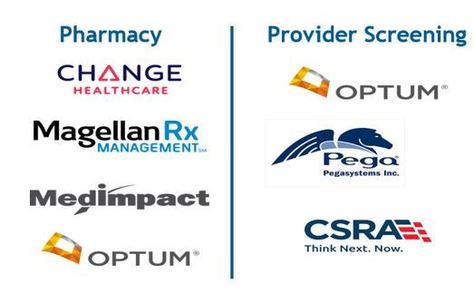
The Precertification Pilot was conducted from October 2017 through
March 2018. Six vendors submitted a
total of seven modules, either Pharmacy or Provider Screening or both, for
evaluation. Participants completed multiple rounds of documentation and
demonstration and provided valuable insights and feedback throughout the
process.
While participating vendors did not receive precertification
status for submitted modules, they each received a detailed module evaluation
report from CMS that can be shared with States considering their module. CMS
would like to acknowledge the following vendors for being active and engaged
participants:
|
|
|
|
|
|
|
(Q) I am a vendor not currently in the Medicaid space, but interested in learning more about opportunities for MMIS and/or E&E modular solutions. Whom can I contact for more information?
(A) CMS is looking for new innovators in the Medicaid IT space. Please direct MMIS inquiries to: MES@cms.hhs.gov?subject=MMIS and E&E inquiries to MES@cms.hhs.gov?subject=E&E.
(Q) We are procuring a COTS solution. This prevents us from providing some of the technical evidence requested in the checklists. Will this pose a problem?
(A) CMS encourages the use of COTS solutions where possible, and the milestone review process supports certification of COTS products. The review criteria are intended to be tailorable to support different solutions, including COTS. In this case, the technical criteria in the checklists that do not apply to COTS may be marked "Not Applicable" with an explanation as to why they do not apply.
|
|