|
|
CENTERS FOR MEDICARE & MEDICAID SERVICES (CMS) March / April 2018
|
|
This Medicaid Enterprise Systems (MES) bi-monthly e-newsletter contains updates on the following:
To be added to the distribution list, click here.
Upcoming News & Events
Medicaid Enterprise
Systems Conference (MESC) | August 13-16 | Portland, OR
|
|
|
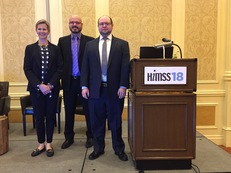
The Healthcare Information and Management Systems Society (HIMSS) conference
recently took place in Las Vegas from March 5-9. CMS provided insights on efforts to actively use and repurpose open source software, encourage
reuse, and collaborate with interagency partners to improve healthcare outcomes.
-
Open Source Provider Screening Module (PSM), A
State and Federal Priority:
The Provider Screening
Module project is a Federal and State partnership to pilot Open Source module
development, including piloting models for procuring, developing, and
maintaining shared modules. The goal is to produce a fully functional,
configurable module that vendors and States can freely incorporate into their
systems. To learn more, click here.
- Partnership and the Health Information Sharing
Maturity Model: HISMM provides a framework for a State to assess
current Health Information Exchange capabilities based on their
identified healthcare priorities. The goal of the maturity model is to help
States build a roadmap to improve capabilities to support programs that improve
patient experience and population health, while reducing per capita cost of
care.
|
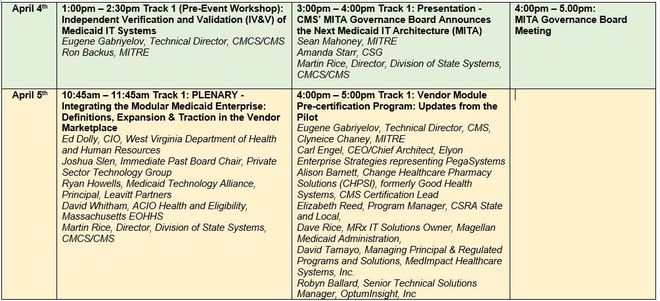
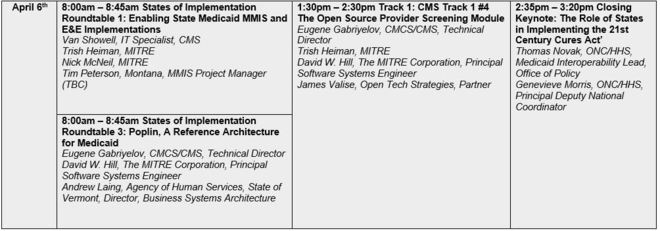
 The ninth annual HIT Connect Summit was held April 4-6 at the Hilton Hotel in Baltimore, Md. It was a well-attended success, with over 700 participants from the public and private sectors. The event provided a platform for thought leaders to connect, share ideas, and benchmark implementation strategies of State health IT systems. The agenda included keynotes, keynote panels, collaborative networking roundtables (Meet the Innovators and States of Implementation), the Connect Exhibition, and breakouts assigned to five separate tracks.
If you were unable to attend, please Register Here>> to access the complimentary archive video-stream (with synchronized PowerPoint) of ALL pre-conference workshops, keynotes, and track sessions.
CMS speakers presented at the sessions detailed below.
|
|
|
HISMM provides a common framework and incremental approach to improving Health Information Sharing (HIS)
capabilities.
With respect
to Medicaid IT, HISMM can support:
- State HIS and health information exchange planning
- Health information technology roadmap development
- Cross-state collaborations
- Key MITA objectives, including: adopting industry standards for data exchange; promoting efficient and effective data sharing to meet stakeholder needs; providing a beneficiary-centric focus; and promoting secure data exchange
HISMM consists
of 11 maturity dimensions each assessable at one of five levels and 30 HIS
capabilities relevant to Medicaid agencies, patients, and providers.
HISMM on zONE
The HIS Maturity
Model is now available on the CMS zONE website.
Interested State users can request access through the community tab on
zONE.
If you are
interested in learning more about the HISMM and performing an assessment, please contact Tom Novak at Thomas.Novak@hhs.gov.
|
|
|
|
|
Look for CMS draft updates to the MITA 3.0 Framework for public comments this summer.
Why should I care?
- States will be expected to complete a MITA 3.0 State Self-Assessment within 12 months of the MITA 3.0 updates
- Vendors can use the revised MITA framework to identify, build, and deliver capabilities necessary for state Medicaid agencies
What’s included?
How do I get information?
-
For further information related to the upcoming MITA
release, please click here or email us with questions.
**Special thanks to the MITA Governance Board and working groups for support
in completing draft updates to the MITA 3.0 Framework***
 To explore the precertification of Medicaid modules and its impact on
the modularity vision for the MMIS ecosystem, CMS initiated a precertification pilot
in October 2017. The pilot focused on two business areas--Pharmacy and
Provider Screening--and was open to all vendors. The precertification pilot is now complete.
CMS thanks the six participating vendors for their hard work and collaborative
approach in making the pilot a great learning experience. As indicated by the engaging vendor panel at
the recent 2018 HIT Connect Summit, the opportunity to collaborate with vendors
provided useful insights into the benefits, challenges, and impact of implementing
a precertification program.
|
CMS will be sending vendors a final report that summarizes the extent to which the modules met the precertification criteria, key observations about their modules, and recommending opportunities for further development.
More information about the pilot’s findings and next steps will
be shared at MESC 18. For more
information, please sign up for the precertification listserv at module_precert@mitre.org or click here.
|
State
IT leaders - were you able to attend the March MMIS Cohort meeting? On March
28, Ralph Lollar, Director, CMCS Division of Long Term Services and Supports, presented an overview of Section 12006 of the 21st Century CURES Act Provisions that requires States to implement an Electronic Visit Verification (EVV) system, which led to great interactive discussion. States must implement an EVV for Personal Care Services (PCS) by January 1, 2019 and for Home Health Care Services (HHCS) by January 1, 2023 to avoid a reduction in the Federal Medical Assistance Percentage. For additional information about the EVV requirement, suggestions for implementation, and current State practices, please see part 1 and part 2 of this EVV presentation.
Questions regarding the EVV requirement should be sent to Ralph.Lollar@cms.hhs.gov with EVV in the subject line.
In
case you missed it, CMS invites State IT leadership to join the MMIS Cohort on the last
Wednesday of every month from 2-3 pm ET. What is the MMIS Cohort?
- An interactive monthly discussion geared around key topics of interest, such as States' modular certification experiences and preliminary results of the precertification pilot
- A chance for States to share experiences and challenges and identify opportunities to collaborate with one another and/or with CMS toward actionable solutions
- An opportunity to hear “sneak peeks” and provide State feedback on upcoming CMS initiatives
At our 2018 kickoff, States received answers to their questions on the
precertification pilot as well as the Open Source Provider Screening Module.
To
be invited to the next MMIS Cohort meeting on April 25, please email Van Showell (van.showell@cms.hhs.gov).
|
|
 |
|
|
(Q) CMS has released 90/10 funding in order for States to improve their eligibility systems for Medicaid. Will that funding continue?
(A) Yes. Both the "90/10" funding for Medicaid eligibility (E&E) system design and development, and the enhanced 75 percent matching rate for maintenance and operations of such systems, will be available indefinitely as long as the systems meet applicable program requirements.
In previous guidance (PDF 104.38 KB), we have assured States that the 90/10 and 75/25 percent funding for eligibility systems will be available without regard to whether a state decides to expand its program to cover newly eligible low-income adults. We reiterate that system modernization will be supported and the enhanced matching funds will be available regardless of a State's decision on expansion. Additionally, we will continue exploring opportunities to provide States additional support for the administrative costs of eligibility changes.
|