New Census Bureau Statistics Show How Young Adults Today Compare With Previous Generations in Neighborhoods Nationwide
FOR IMMEDIATE RELEASE: THURSDAY, DEC. 4, 2014
New Census Bureau Statistics Show How Young Adults Today Compare With Previous Generations in Neighborhoods Nationwide
Interactive Map Uses New American Community Survey Five-Year Statistics
Young
adults today, often called the millennial generation, are more likely to be
foreign born and speak a language other than English at home, compared with
young adults in 1980, according to the U.S. Census Bureau’s latest statistics
from the American
Community Surveyreleased today.
“Many
of the differences between generations examined within these latest data
reflect long-term demographic and societal changes,” said Jonathan Vespa, a Census
Bureau demographer. “Three decades of decennial census statistics combined with
the latest American Community Survey statistics give us a unique view of how — and
where — our nation is changing. In this case, we can look at the changing
characteristics of young adults over the last few decades.”
Five
years of data collected between 2009 and 2013 provide statistics on more than
40 economic, housing and social topics, such as commuting, educational
attainment and home value. As the nation’s largest ongoing household survey,
the American Community Survey produces statistics at all levels of geography,
down to the block group level. Today,
for the first time users can access block group level statistics on the census.gov tool rather
than via a separate FTP site.
Highlighting
some of the topics available from the American Community Survey, the Census
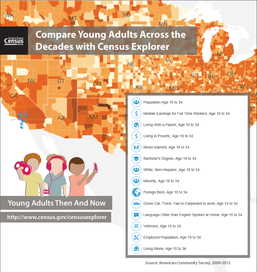
Bureau released “Young Adults: Then and Now,” a new edition of the interactive
mapping tool Census Explorer. The tool
illustrates characteristics of the young adult population (age 18-34) across
the decades using data from the 1980, 1990 and 2000 Censuses and the 2009-2013
American Community Survey. The American Community Survey, which is a part of
the decennial census, replaced the “long form” questionnaire soon after the
2000 Census.
Comparing Generations
The 73 million young adults currently 18
to 34 years old, often referred to as millennials, comprised the largest such population
in the last three decades. Nonetheless, their share of the population is
actually smaller today than in 1980, when the young adult population included
the baby boomers born between1946 and 1964. The baby boom is distinguished by a
dramatic increase in birth rates following World War II and comprises one of
the largest generations in U.S. history.
In 1980, 30 percent of the population was age
18 to 34, compared with 23 percent today.
The percentage of young adults today who are
foreign born has more than doubled since 1980 (15 percent versus 6
percent).
All states have higher proportions of
foreign-born young adults than 30 years ago.
The increase was larger in the
West and Northeast, where 21 percent and 18 percent, respectively, are
now foreign born, compared with 12 percent and 8 percent 30 years ago.
Only 9 percent of young adults in the
Midwest and 14 percent in the South are foreign born, up from 3 and 4 percent,
respectively, in 1980.
One in four young adults, or 17.9 million, speaks
a language other than English at home. That proportion is higher still in
New York, New Jersey, Texas, New Mexico and Nevada (where it is about one
in three) but is highest in California (where it is about one in two).
More
millennials are living in poverty today, and they have lower rates of
employment, compared with their counterparts in 1980:
One in five young adults lives in poverty (13.5
million people), up from one in seven (8.4 million people) in 1980.
Today, 65 percent of young adults are employed,
down from 69 percent in 1980.
Prior generations of young adults were more
likely to have ever served in the armed services: 9 percent were veterans
in 1980, compared with 2 percent today.
Millennials
are more educated than young
adults in 1980:
22 percent have a college degree, up from 16
percent in 1980. States with the largest share of young college graduates
are in the Northeast, including Massachusetts, New York and New Jersey.
Unlike
in prior generations, the majority of millennials have never been married,
reflecting continued delays in getting married:
Only about three in 10 young adults have ever
been married, down from six in 10 in 1980.
The state with the highest share of married
young adults is Utah (51 percent); the lowest is Rhode Island (25
percent).
Some
things have not changed:
Young adults continue to rely on a car to get
to work: about eight in 10 drive to work, which is largely unchanged
compared with 1980. Alabama has the highest share (95 percent); New York
has the lowest (53 percent).
Note
that the Census Bureau does not define generational terms beyond “baby boom generation.”
The term “millennial” is used here only to reference the 18-34 age range used
in Census Bureau statistics.
“Young Adults: Then and Now” in Census
Explorer
Young Adults:
Then and Now
looks at socioeconomic characteristics of 18- to 34-year-olds using the
2009-2013 American Community Survey and the 2000, 1990 and 1980 Censuses. The
interactive data tool has estimates for the national, state, metropolitan,
county and neighborhood (census tract) level.
Topics
include:
Demographic:
-Total
population
-Percent
non-Hispanic white alone
-Percent
minority (Note: “Minority” refers to people who reported their ethnicity and
race as a group other than non-Hispanic white alone)
Earnings:
-Year-round,
full-time median earnings
Poverty:
-Percent
living in poverty
Labor Force:
-Percent
employed
Foreign Born:
-Percent
foreign born
Education:
-Percent
with a bachelor’s degree or higher
Veterans:
-Percent
veterans
Language:
-Percent
language other than English spoken at home
Family:
-Percent
never married
-Percent
living in their parents’ home
-Percent
living alone
Commuting:
-Percent
of workers who drove or carpooled
About
the American Community Survey
The American Community Survey is the only
source of small area estimates for social and demographic characteristics. It
gives communities the current information they need to plan investments and
services. Retailers, homebuilders, police departments, and town and city
planners are among the many private- and public-sector decision makers who
count on these annual results. Visit the Stats in Action
page to see some examples.
These statistics would not be possible
without the participation of the randomly selected households in the survey.
Citation Guidance
Note to Correspondents: When sourcing the data in this
release, please use “American Community Survey: 2009-2013.”
-X-
Note:
Statistics from sample surveys are subject to sampling and nonsampling error.
All comparisons made in the reports have been tested and found to be
statistically significant at the 90 percent confidence level, unless otherwise
noted. Please consult the tables for specific margins of error. For more
information, go to <https://www.census.gov/acs/www/data_documentation/documentation_main/>.