|
Celebrating Mississippi's 206th Anniversary of Statehood
Mississippi became the 20th state on December 10, 1817. Explore Census Bureau data about Mississippi using 2020 Census data, geographic profiles from data.census.gov, and other interactive data tools.
|
|
Population and Demographics
Mississippi is the 31st largest state by area. Learn more about the geography and history of Mississippi.
Did you know:
- The top employed industry is educational services, health care, and social assistance.
- The percentage of people who moved to Mississippi from a different state in the last year was 2.4%.
- The average commute is 25.5 minutes, compared to the United States average of 26.4 minutes.
Learn more about the state's business and economy on data.census.gov.
2020 Census Data
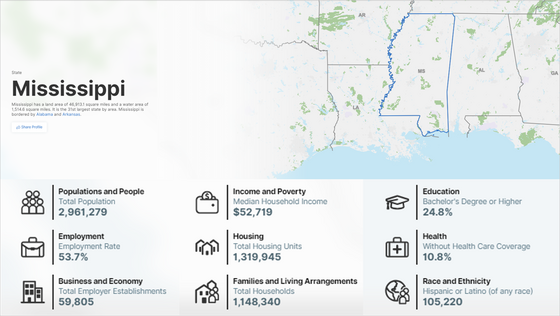
Mississippi's population was 2,961,279 in 2020, a 0.2% decrease from 2010.
The results of the 2020 Census show that:
-
683,680 or 23.1% of people in Mississippi were under age 18. That's a decrease of 9.5% from 2010 to 2020.
-
105,220 or 3.6% of people in Mississippi reported Hispanic or Latino origin. That's an increase of 29.1% from 2010 to 2020.
|
|
Fun Facts
🌳💮 Mississippi designated the Magnolia as both the state flower and the state tree.
🐬 The state water mammal is the Bottlenose Dolphin.
🌇 The largest city is Jackson.
🔎 Explore our State Facts for Students tool to learn more about Mississippi and test your knowledge of Census Bureau data with interactive games from Statistics in Schools.
Help us spread the word about Census Bureau data!
Share this on social media or forward it to a friend.
|
|
Featured Resources for State Data
Check out these interactive data tools that you can use to find data about your state.
|
|
About the Census Bureau
We serve as the nation’s leading provider of quality data about its people and economy. The Census Bureau is the federal government's largest statistical agency. As the world’s premier statistical agency, we are dedicated to making our nation a better place. Policy-makers, businesses, and the public use our data to make informed decisions.
|
|
|
|