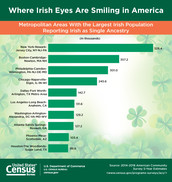
PROFILE AMERICA FACTS FOR FEATURES: CB20-FF.02
FEB. 24, 2020 (RESEND)
The U.S. Congress proclaimed March as Irish-American Heritage Month in 1991, and the president issues a proclamation commemorating the occasion each year.
Originally a religious holiday to honor St. Patrick, who introduced Christianity to Ireland in the fifth century, St. Patrick’s Day has evolved into a celebration of all things Irish. The world’s first St. Patrick’s Day parade occurred on March 17, 1762, in New York City, featuring Irish soldiers serving in the English military. This parade became an annual event, with President Truman attending in 1948.
The following facts are made possible by the invaluable responses to the U.S. Census Bureau’s surveys. We appreciate the public’s cooperation as we continuously measure America’s people, places and economy.
Did You Know?
32 million or 9.9%
The number and percentage of U.S. residents who claimed Irish ancestry in 2018.
Source: 2014-2018 American Community Survey
123,950
The number of foreign-born U.S. residents who reported Ireland as their birthplace in 2018.
Source: 2014-2018 American Community Survey
470,277
The number of people living in Cook County, IL, the county with the largest population of people who claimed Irish ancestry in 2018.
Source: 2014-2018 American Community Survey
20,590
The estimated number of U.S. residents who spoke Irish Gaelic in 2013.
Source: 2009-2013 American Community Survey
More Stats
For more information on the Irish population from the American Community Survey, see the selected population profile. Statistics include:
- Sex and age.
- Marital status.
- Educational attainment.
- Veteran status.
- Employment status.
- Occupation.
- Commuting.
- Housing.
- Income.
Related News Products
Past Facts for Features
Briefs
Graphics
Related Information
Graphic| JPG | PDF |
###
|