Where the Nation’s Foreign-Born Live Has Changed Over Time

Registered United States Census Bureau Logo

America Counts: Stories Behind the Numbers

Where the Nations Foreign Born Live Has Changed Over Time

The number of foreign-born residents in the United States has ebbed and flowed over the past 165 years. By 2016, 13.5 percent of the U.S. population was foreign-born, a level that rivaled historic highs.

But what has changed considerably over time is who the foreign-born are and where they have dispersed across the country, according to U.S. Census Bureau research.

Read More

The share of all foreign-born living in the United States was historically concentrated in the Northeast and Midwest regions. Until 1940, over 80 percent of all foreign-born in the United States resided in either of the two regions.

The foreign-born population eventually followed the rest of the U.S. population, expanding to the South and West. By 2016, more than two-thirds of the foreign-born resided in the South or West.
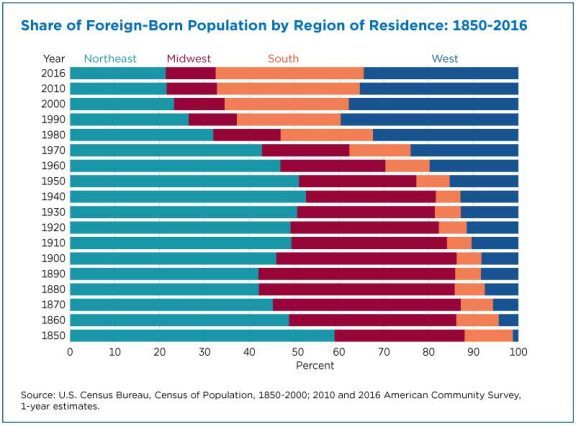
Share of Foreign Born Population by Region of Residence

Help us spread the word. Share this story on social media. Click on the images below to learn more about how America is changing.

Share This

Related: America Counts Stories

Race, ethnicity, and marriage in the United States

Race, Ethnicity, and Marriage in the United States: Marriage looks a lot different today in many ways than in years past. As our nation becomes more racially and ethnically diverse, so are married couples. 


Learn More


Ecological Classification of the Desert Southwest

Fast Growth in the Desert Southwest Continues: One of the most arid parts of the country has enjoyed population growth of more than 40% in three different decades since 1950.


Learn More

About America Counts

America Counts tells the stories behind the numbers in a new inviting way. It features stories on various topics such as families, housing, employment, business, education, the economy, emergency preparedness, and population. Contact our Public Information Office for media inquiries or interviews.