Profile America Facts for Features: Irish-American Heritage Month (March) and St. Patrick’s Day (March 17): 2016 RESEND
Irish-American Heritage Month (March) and St. Patrick’s Day (March 17): 2016 RESEND
PROFILE AMERICA FACTS FOR FEATURES: CB16-FF.04
MARCH 14, 2016
Congress proclaimed March as Irish-American Heritage
Month in 1991, and the President issues a proclamation commemorating the
occasion each year.
Originally a religious holiday to honor St. Patrick,
who introduced Christianity to Ireland in the fifth century, St. Patrick’s Day
has evolved into a celebration of all things Irish. The world’s first St.
Patrick’s Day parade occurred on March 17, 1762, in New York City, featuring
Irish soldiers serving in the English military. This parade became an annual
event, with President Truman attending in 1948.
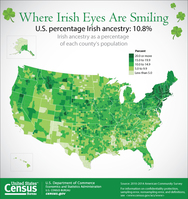
Percentage of Massachusetts residents who claimed Irish ancestry in 2014.
New Hampshire, at 20.9 percent, is the only other state in which more than 20
percent claimed Irish ancestry. (The rates for the two states were not
statistically different from each other.) California had 2.5 million people
claiming Irish ancestry, which was the highest of any state. Two other states —
New York and Pennsylvania — also had more than 2 million Irish-Americans. Source: 2014
American Community Survey, Table B04006 http://factfinder.census.gov/bkmk/table/1.0/en/ACS/14_1YR/B04006/0400000US06|0400000US25|0400000US33|0400000US36|0400000US42
Number of Irish-Americans living in Chicago, the location of one of the
nation’s most renowned St. Patrick’s Day traditions: dyeing the Chicago River
green. Chicago’s Irish-American population was second among cities only to New
York (363,045), home to the world’s oldest and largest St. Patrick’s Day parade.
Philadelphia was third at 176,568. Source: 2014 American Community Survey, Table B04006 http://factfinder.census.gov/faces/tableservices/jsf/pages/productview.xhtml?pid=ACS_14_1YR_B04006&prodType=table
Irish-Americans Today
35.6%
Percentage of
people of Irish ancestry, 25 or older, who had a bachelor’s degree or higher.
In addition, 93.7 percent of Irish-Americans in this age group had at least a
high school diploma. For the nation as a whole, the corresponding rates were 30.1
percent and 86.9 percent, respectively. Source: 2014
American Community Survey, Table S0201 http://factfinder.census.gov/faces/tableservices/jsf/pages/productview.xhtml?pid=ACS_14_1YR_S0201&prodType=table
Percentage
of employed civilian Irish-Americans 16 or older who worked in management, business, science and arts occupations. Additionally, 24.8 percent worked in sales and office occupations; 15.6 percent in service occupations; 9.5 percent in production, transportation and material
moving occupations; and 7.6 percent in natural resources, construction and maintenance
occupations. Source: 2014
American Community Survey, Table S0201 http://factfinder.census.gov/faces/tableservices/jsf/pages/productview.xhtml?pid=ACS_14_1YR_S0201&prodType=table
Population of South Bend, Ind., home to the Fighting
Irish of the University of Notre Dame. About 11.5 percent of South Bend’s
population claimed Irish ancestry in 2014. Source: 2014 Population
Estimates and 2014 American Community Survey, Table DP02 https://www.census.gov/popest/data/cities/totals/2014/SUB-EST2014-3.html
Population of New Rochelle, N.Y., and Moraga, Calif.,
home to the Gaels of Iona University and Saint Mary’s College of California,
respectively. About 8.5 percent of the New Rochelle population and 12.7 percent
of the Moraga population claimed Irish ancestry. Sources: 2014
Population Estimates and 2010-2014 American Community Survey (Table DP02) https://www.census.gov/popest/data/cities/totals/2014/SUB-EST2014-3.html
Number of places
(incorporated places and census designated places) or county subdivisions in the United
States that share the name of Ireland’s capital, Dublin. The most populous of these places in 2014 was Dublin,
Calif., at 54,695. Source: 2014 Population Estimates https://www.census.gov/popest/data/cities/totals/2014/SUB-EST2014-3.html
Other places thatmight conjure up images of the
old country include the township of Irishtown, Ill., several places or county subdivisions named Clover (in South
Carolina, Illinois, Minnesota, Pennsylvania, Virginia, West Virginia and Wisconsin) or one of the six places that are named Shamrock (in
Oklahoma, Texas [two], Minnesota, Missouri and Nebraska).Source:
2015 Census U.S. Gazetteer Fileshttp://www.census.gov/geo/maps-data/data/gazetteer.html
20,590
Estimated
number of U.S. residents who spoke Irish Gaelic. All except about 2,500 of them
also spoke English “very well.”Source:
Detailed Languages Spoken at Home and Ability to Speak English for the
Population 5 Years and Over: 2009-2013 https://www.census.gov/data/tables/2013/demo/2009-2013-lang-tables.html
Number
of synthetic dye and pigment manufacturing establishments around the U.S. in
2013. It is an annual tradition to dye the Chicago River green as part of the
Windy City’s St. Patrick’s Day celebration. The dye used very well could have
been produced by one of these establishments.Source: 2013 County Business Patterns http://factfinder.census.gov/bkmk/table/1.0/en/BP/2013/00A1//naics~32513|325130
The following is a list of observances typically
covered by the Census Bureau’s Facts for Features series:
African-American
History Month (February)
Super Bowl
Valentine's Day (Feb. 14)
Women's History Month (March)
Irish-American Heritage Month (March)/
St. Patrick's Day (March 17)
Earth Day (April 22)
Asian/Pacific American Heritage Month (May)
Older Americans Month (May)
Mother's Day
Hurricane Season Begins (June 1)
Father's Day
The
Fourth of July (July 4)
Anniversary of Americans With Disabilities Act (July 26)
Back to School (August)
Labor Day
Grandparents Day
Hispanic Heritage Month (Sept. 15-Oct. 15)
Unmarried and Single Americans Week
Halloween (Oct. 31)
American Indian/Alaska Native Heritage Month (November)
Veterans Day (Nov. 11)
Thanksgiving Day
The Holiday Season (December)
Editor’s note: The preceding data were collected from a variety of sources and may be
subject to sampling variability and other sources of error. Facts for Features
are customarily released about two months before an observance in order to
accommodate magazine production timelines.