Census Bureau News -- Facts for Features -- Black (African-American) History Month: February 2016 (resend)
Census Bureau News -- Facts for Features -- Black (African-American) History Month: February 2016
Black
(African-American) History Month:
February
2016
To commemorate and celebrate the contributions to our
nation made by people of African descent, American historian Carter G. Woodson
established Black History Week. The first celebration occurred on Feb. 12,
1926. For many years, the second week of February was set aside for this
celebration to coincide with the birthdays of abolitionist/editor Frederick
Douglass and Abraham Lincoln. In 1976, as part of the nation’s bicentennial,
the week was expanded into Black History Month. Each year, U.S. presidents proclaim
February as National African-American History Month.
Note:
The reference to the black population in this publication is to single-race
blacks (“black alone”) except in the first section on “Population.” In that
section the reference is to black alone or in combination with other races; a
reference to respondents who said they were one race (black) or more than one
race (black plus other races).
Population
45.7 million
The number of blacks, either
alone or in combination with one or more other races, on July 1, 2014, up 1.3 percent from July 1, 2013.
The projected black, either alone or in combination,population
of the United States (including those of more than one race) for July 1, 2060.
On that date, according to the projection, blacks would constitute 17.9 percent
of the nation’s total population.
The black population in New
York, which led all states as of July 1, 2014. Texas had the largest numeric
increase since 2013 (88,000). The District of Columbia had the highest
percentage of blacks (50.6 percent), followed by Mississippi (38.2 percent).
Cook
County, Ill. (Chicago) had the largest black population of any county in 2014
(1.3 million), and Harris, Texas (Houston) had the largest numeric increase in 2014(21,000).
Holmes, Miss., was the county with the highest percentage of blacks in the
nation (82.5 percent).
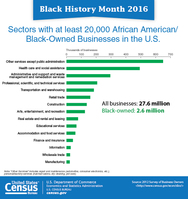
The number of African-American/black-owned firms
in “other services”— which includes repair and
maintenance (automotive, consumer electronics, etc.) and personal/laundry
services (hair/nail salons, dry cleaning, pet care) — the largest sector of
black-owned businesses. The “other
services” sector is followed by health care and social assistance (492,983
black-owned firms); administrative, support, waste management and remediation (294,977);
professional, scientific and technical support (206,942); and transportation
and warehousing (184,777).
The number of blacks who voted in the 2012
presidential election. In
comparison to the 2008 election, about 1.7 million additional black voters
reported going to the polls in 2012.
Percent of blacks who voted in the 2012 presidential
election, higher than the 64.1 percent of non-Hispanic whites who did so. This
marks the first time that blacks have voted at a higher rate than whites since
the Census Bureau started publishing statistics on voting by the eligible
citizen population in 1996.
Percentage of blacks that were
covered by health insurance during all or part of 2014. Nationally, 89.6
percent of all races were covered by health insurance.
Number of black
grandparents who lived with their own grandchildren younger than 18 in 2014. Of
this number, 44.0 percent were also responsible for their care.
28.6% The percentage
of civilian employed blacks 16 and over who worked in management, business,
science and arts occupations, while 36.9 percent of the total civilian employed
population worked in these occupations.
The following is
a list of observances typically covered by the Census Bureau’s Facts for
Features series:
African-American
History Month (February)
Super Bowl
Valentine's Day (Feb. 14)
Women's History Month (March)
Irish-American Heritage Month (March)/
St. Patrick's Day (March 17)
Earth Day (April 22)
Asian/Pacific American Heritage Month (May)
Older Americans Month (May)
Mother's Day
Hurricane Season Begins (June 1)
Father's Day
The
Fourth of July (July 4)
Anniversary of Americans With Disabilities Act (July 26)
Back to School (August)
Labor Day
Grandparents Day
Hispanic Heritage Month (Sept. 15-Oct. 15)
Unmarried and Single Americans Week
Halloween (Oct. 31)
American Indian/Alaska Native Heritage Month (November)
Veterans Day (Nov. 11)
Thanksgiving Day
The Holiday Season (December)
Editor’s note: The preceding data were collected from a variety of sources and may be
subject to sampling variability and other sources of error. Facts for Features
are customarily released about two months before an observance in order to
accommodate magazine production timelines.